
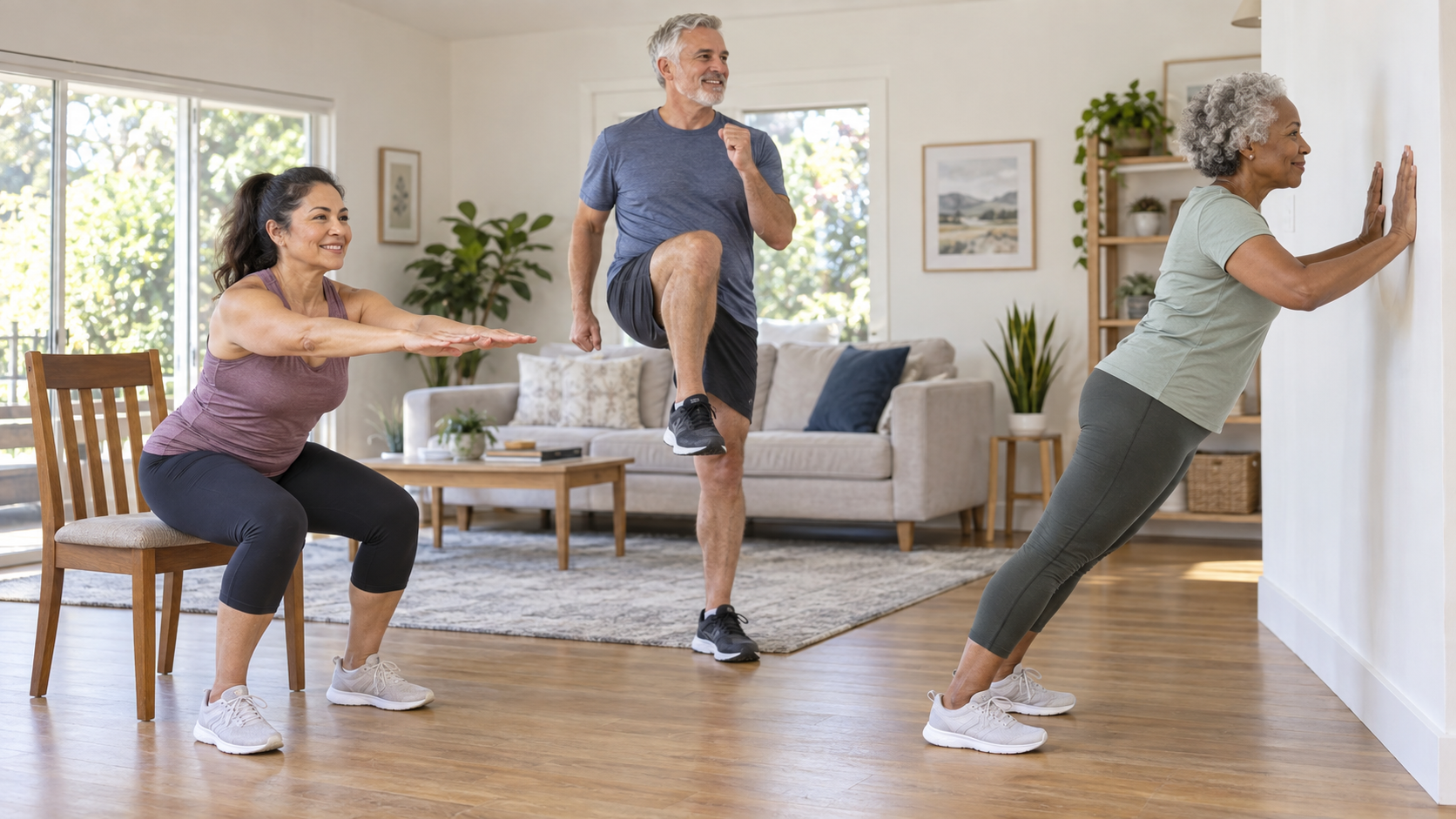
A bodyweight strength workout can fit into 10 or 15 minutes at home without dumbbells or a gym membership. The 10-minute version offers a short introduction to squats, pushing, hip movement, and core control. The 15-minute version gives you time for a second round. Choose movements that challenge your muscles while allowing controlled form, and gradually make the routine harder as your strength improves.
Key Takeaways
- Bodyweight exercises use your own body as resistance, so weights are not required to begin.
- The 10-minute workout includes a warm-up, seven short exercise intervals, and a cool-down.
- The 15-minute workout uses two rounds of five movements, with more time for warming up and cooling down.
- Adults are advised to strengthen all major muscle groups on at least two days each week.
- Good technique, suitable difficulty, and gradual progression matter more than moving quickly.
- A short home workout can help, but it may need additional exercises or resistance over time to train every muscle group fully.
Can 10 or 15 Minutes of Bodyweight Strength Training Help?
Yes. A short session can provide muscle-strengthening activity when the movements are challenging enough for your current ability. Bodyweight squats, push-up variations, and other resistance exercises can help build a consistent strength habit.
CDC recommends muscle-strengthening activity on at least two days each week. These activities should work the legs, hips, back, abdomen, chest, shoulders, and arms. In addition, adults should aim for the recommended amount of weekly aerobic activity, such as brisk walking.
However, 10 or 15 minutes is not a special threshold that guarantees results. The effect depends on the exercises, effort, total weekly training, recovery, and whether you increase the challenge as movements become easier.
Choose your version: use the 10-minute plan when time or energy is limited. Choose the 15-minute plan when you can complete a second controlled round without rushing.
The Five Core Bodyweight Movements
Learn these movements before starting the timed workout. A wall and a sturdy chair are optional supports; no exercise machine or weights are needed.
1. Squat or Chair Sit-to-Stand
Stand with your feet at a comfortable width. Bend your hips and knees as though sitting down, then push through your feet to stand. If you need a more predictable depth, use a sturdy chair and stand up from a seated position. Keep the movement controlled and use a comfortable range.
2. Wall or Floor Push-Up
Place your hands on a stable wall and step back. Bend your elbows to move your chest toward the wall, then press away. As you become stronger, a floor push-up from your knees or toes can increase the challenge.
3. Glute Bridge
Lie on your back with knees bent and feet on the floor. Tighten your buttock muscles, lift your hips to a comfortable height, and lower slowly. Avoid forcing your lower back into a large arch.
4. Prone W Raise
Lie face down with your arms bent into a W shape. Gently lift your hands and arms a small distance while drawing your shoulder blades toward each other. Keep your neck comfortable and avoid lifting your chest excessively.
This movement works muscles around the upper back and shoulders. However, it does not provide the same pulling resistance as a row or pull-up. Add a suitable pulling exercise later if equipment becomes available.
5. Dead Bug
Lie on your back with knees raised and arms pointing upward. Slowly lower one arm and the opposite leg as far as you can while keeping your trunk controlled. Return and switch sides. Shorten the movement if your lower back begins to arch or you cannot maintain control.
The 10-Minute Bodyweight Strength Workout
This version uses two minutes to warm up, seven one-minute exercise slots, and one minute to cool down. During each exercise slot, aim for approximately 40 seconds of controlled movement and use the remaining 20 seconds to rest or change positions. These intervals are a practical workout format, not a required training dose.
| Time | Activity | Focus |
|---|---|---|
| 0:00–2:00 | Easy marching, shoulder circles, and gentle squats | Warm-up |
| 2:00–3:00 | Squat or chair sit-to-stand | Legs and hips |
| 3:00–4:00 | Wall or floor push-up | Chest, shoulders, arms |
| 4:00–5:00 | Glute bridge | Hips |
| 5:00–6:00 | Prone W raise | Upper back and shoulders |
| 6:00–7:00 | Dead bug | Core control |
| 7:00–8:00 | Squat or controlled standing hip hinge | Lower body |
| 8:00–9:00 | Wall push-up or prone W raise | Upper body |
| 9:00–10:00 | Slow walking and relaxed breathing | Cool-down |
Move at a pace that allows good technique. If changing between floor and standing exercises takes longer, use additional transition time and complete fewer repetitions. The clock should guide the session, not force rushed movements.
The 15-Minute Bodyweight Strength Workout
The 15-minute version keeps the same five core movements but gives you two rounds. Start with two minutes of gentle movement. Next, complete the five-exercise circuit twice. Finish with three minutes of easy movement and recovery.
| Time | Activity |
|---|---|
| 0:00–2:00 | Warm up with marching, shoulder circles, and gentle hip movement |
| 2:00–7:00 | Round 1: squat, push-up, glute bridge, prone W raise, dead bug |
| 7:00–12:00 | Round 2: repeat the same five movements |
| 12:00–15:00 | Cool down with slow walking, comfortable mobility, and relaxed breathing |
Give each exercise one minute, allowing approximately 40 seconds for controlled repetitions and 20 seconds for rest or transition. If you need a longer break between rounds, take it. A slightly longer session with safe technique is preferable to rushing through the workout.
What changes in 15 minutes? You get another chance to practice each movement and complete more total work. You do not need to move faster or use a more difficult variation simply because the session is longer.
Make the Workout Easier or Harder
The right exercise variation should challenge you while allowing good control. Therefore, choose the version that suits your current ability rather than copying someone else’s pace or range of motion.
| Movement | Easier option | More challenging option |
|---|---|---|
| Squat | Chair sit-to-stand or smaller range | Deeper comfortable squat or slower lowering |
| Push-up | Wall push-up | Knee or full floor push-up |
| Glute bridge | Smaller hip lift | Slow lowering or a brief controlled pause |
| Prone W raise | Small arm lift or standing W squeeze | Longer controlled hold |
| Dead bug | Move one limb at a time | Extend opposite arm and leg farther while maintaining control |
What If You Cannot Exercise on the Floor?
Floor exercises are not suitable for everyone. If getting down and standing back up is difficult, use a standing routine with a stable chair or wall nearby.
- Replace squats with supported chair sit-to-stands.
- Use wall push-ups instead of floor push-ups.
- Use a controlled standing hip hinge instead of a glute bridge.
- Try a gentle standing W squeeze instead of a prone W raise.
- Use supported alternating knee lifts or another suitable standing core exercise instead of a dead bug.
These substitutions change the muscles and resistance involved, so they are alternatives rather than exact replacements. Even so, they can make regular movement more accessible.
How Often Should You Do These Workouts?
Adults should aim for muscle-strengthening activity on at least two days each week. Therefore, two sessions on nonconsecutive days can be a practical starting schedule for a full-body routine.
For example, you could use the 10-minute plan early in the week and the 15-minute plan later. If you are new to exercise, start more gently and increase your total training gradually.
At the same time, short strength sessions do not replace aerobic activity. Walking, cycling, swimming, or another suitable activity can help you work toward the separate weekly aerobic recommendation.
How to Keep Getting Stronger
As exercises become easier, your muscles may need a greater challenge. This is called progression. According to the National Institute on Aging, strength training can progress through changes in resistance, repetitions, sets, or training frequency.
- Improve technique first: use a comfortable range and control every repetition.
- Add repetitions: complete more quality movements during the same interval.
- Increase difficulty: progress from wall push-ups to a more challenging variation when ready.
- Add a set: move from the 10-minute session to the two-round 15-minute version.
- Expand your exercise selection: add an appropriate pulling exercise and other movements to cover muscle groups that the short circuit trains less directly.
CDC suggests aiming for about 8–12 repetitions per strength exercise when appropriate, with at least one set and additional sets for more benefit. However, a timed circuit may produce a different number of repetitions. Do not sacrifice technique simply to reach a number.
Progress gradually: change one element at a time. A harder variation, additional repetitions, or another round can increase the challenge without turning every session into an all-out workout.
Bodyweight Strength for Adults Over 65
Strength work can help older adults maintain physical function for activities such as standing from a chair, climbing stairs, and carrying groceries. However, exercise choice should match current strength, mobility, and balance.
A chair sit-to-stand and wall push-up may be more suitable starting points than deep squats or floor push-ups. If floor transitions are difficult, the standing alternatives above can make the routine more accessible.
In addition, CDC recommends balance activities for adults age 65 and older, alongside aerobic exercise and muscle strengthening. A strength circuit alone does not cover every part of that recommendation.
Safety Tips Before You Start
Strength training should feel challenging, but it should not require sharp pain, forced breathing, or loss of control. The National Institute on Aging advises warming up, breathing during the effort, and listening to your body.
- Warm up before harder repetitions.
- Exhale during the effort rather than holding your breath.
- Use a stable wall or chair, not furniture that may slide or tip.
- Keep the floor clear and allow time for position changes.
- Stop an exercise if it causes sharp pain, dizziness, or concerning symptoms.
- Seek individualized advice when a medical condition, recent surgery, falls, or significant mobility limits affect your ability to exercise safely.
Important: stop exercising and seek urgent medical care for chest pain, fainting, or severe unexplained shortness of breath. Do not try to finish the timer through concerning symptoms.
Frequently Asked Questions
The Bottom Line
A 10-minute bodyweight strength workout offers a practical way to begin. If you have five more minutes, the 15-minute version allows a second round of the core movements. Both plans can fit into a home routine without weights or a gym membership.
Use controlled repetitions, allow enough rest, and choose exercise variations that match your ability. As you grow stronger, gradually increase the challenge and expand the routine so all major muscle groups receive appropriate training.
Medical disclaimer
Medical disclaimer: This content is for educational and informational purposes only and is not a substitute for professional medical advice, diagnosis, or treatment. Dietary needs and supplement suitability vary by individual.
Sources
- Centers for Disease Control and Prevention — Adult Activity: An Overview. Accessed September 2026.
- Centers for Disease Control and Prevention — What Counts as Physical Activity for Adults. Accessed September 2026.
- National Institute on Aging — Three Types of Exercise Can Improve Your Health and Physical Ability. Reviewed January 14, 2025.
- Centers for Disease Control and Prevention — Older Adult Activity: An Overview. December 4, 2025.
- Centers for Disease Control and Prevention — Adding Physical Activity as an Adult. December 4, 2025.
