
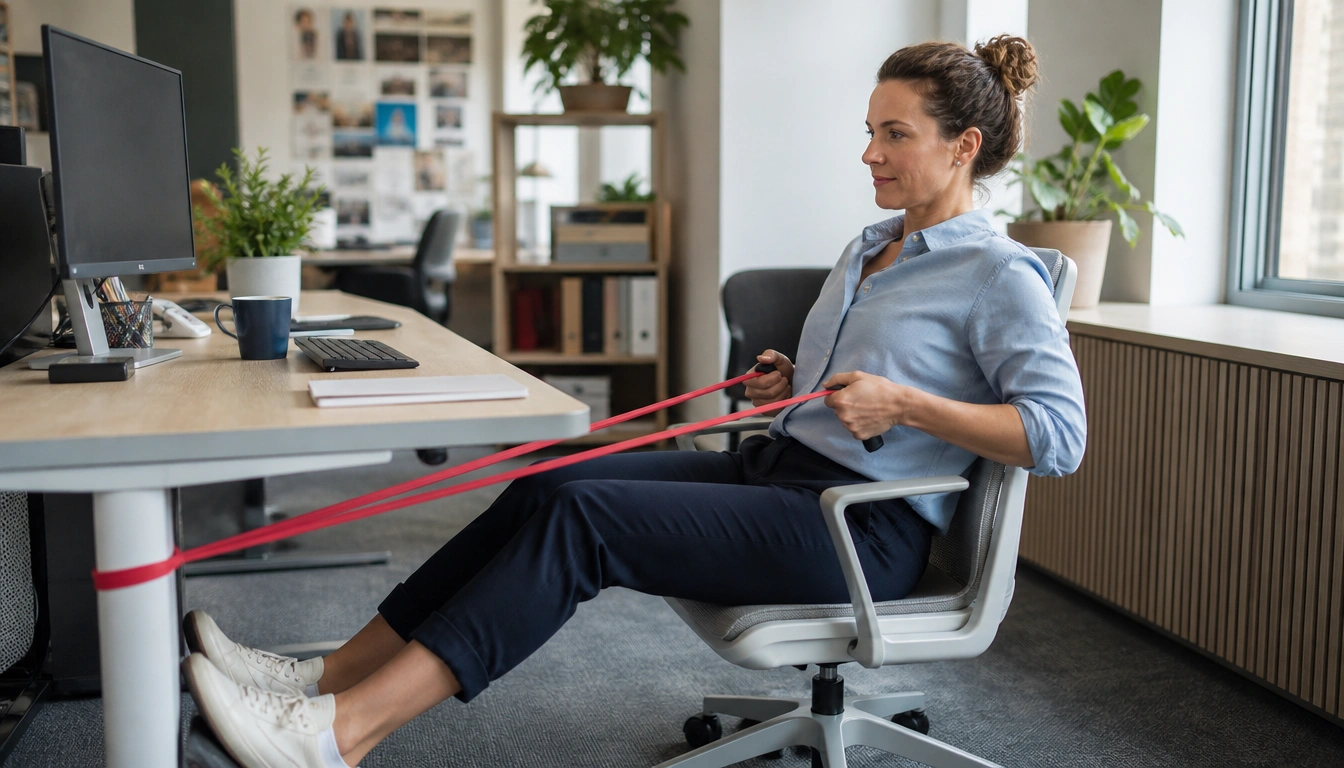
Yes—busy office workers can do a practical resistance band routine at work using five simple moves: external rotation, pull-aparts, rows, an anti-slouch chest press, and a lower-body activation exercise. A realistic start is 1 to 2 sets of 10 to 15 reps per move, at least two days per week, with effort taken near but not necessarily to failure. Use light-to-medium resistance, keep the setup secure, and choose seated versions when space is tight.
Key Takeaways
- Resistance bands are well suited to desk work because they create progressive tension and challenge stabilizing muscles without needing much space.
- Short movement breaks help interrupt long sitting spells and can reduce stiffness while supporting better posture habits over time.
- A beginner routine should cover the upper back, shoulders, chest, and hips so it balances push and pull muscles, not just “core” work.
- For office use, choose a light-to-medium band, inspect it for wear, and avoid overstretching or using an unstable anchor.
- Older adults and people with osteoarthritis usually do better with lighter resistance, smoother control, and higher-quality repetitions than with heavy tension.
Why resistance bands make sense for desk workers
Resistance band exercises at work are popular for a good reason: they fit the realities of office life. You do not need a rack, machine, or much floor space. A band can live in a desk drawer, bag, or file cabinet and still give you a useful strength stimulus during a five-minute break.
The way bands load the body also matters. Because tension rises as the band stretches, the hardest part of the rep often happens near the end of the movement. That progressive resistance is useful for posture-focused work, since it asks the shoulders, upper back, arms, and hips to keep controlling the motion instead of just moving a fixed weight from point A to point B. The American College of Sports Medicine says adults should do muscle-strengthening activity for all major muscle groups at least two days per week, and bands can meet that goal when the work is structured well.
For people who sit most of the day, the goal is not to replace all exercise with desk workouts. The goal is to interrupt static sitting, wake up muscles that go quiet during typing, and make movement easier to repeat consistently. That is where short “movement snacks” help: a few controlled sets can break up stiffness, remind you to stand tall, and support better habits across the workday.
How this starter routine is built
This routine is designed around full-body balance rather than one isolated “posture fix.” Office sitting tends to feed a forward-head, rounded-shoulder pattern while the upper back and hips do less work than they should. The routine counters that by including pulling, pushing, shoulder control, and lower-body activation.
The starting dose is intentionally modest. A practical office setup is 1 to 2 sets of 10 to 15 reps per exercise, done with controlled form and effort that feels challenging near the end of the set. You do not need to grind to failure every time. For most busy adults, the better plan is a small dose that can be repeated consistently.
Space matters too. Every exercise in this routine can be done beside a desk, in a break room, or next to a chair. If you have no private workout area, use seated variations, lighter resistance, and slower tempo. Consistency beats an ambitious routine you never actually do.
Band selection and setup for beginners
For office use, start with light-to-medium resistance. If the band feels too easy, you can shorten the band, slow the tempo, or add a second set before jumping to a much heavier band. That is especially helpful for older adults or people with osteoarthritis, who often do best with smoother loading and a little more repetition rather than very high tension.
Loop bands are convenient for pull-aparts, rows, and hip work. Bands with handles can feel more natural for pressing and rowing, especially if grip comfort matters. If you have no anchor point, you can still do this routine by looping the band around your feet, holding it with both hands, or using a seated position for added stability.
W drill and external rotation
This move targets the rotator cuff and helps restore shoulder control after long hours at a keyboard. Sit or stand tall with elbows bent at 90 degrees and held near your sides. Hold the band between your hands, gently set your shoulder blades down and back, then rotate your forearms outward without letting the elbows drift away from the body.
Common mistakes are shrugging, arching the lower back, or forcing the range of motion. Keep the motion small and clean. If it feels too hard, reduce the band tension or shorten the movement. If it feels too easy, slow the return phase rather than yanking on the band.
Band pull-aparts
Pull-aparts are one of the simplest ways to challenge the upper back and rear shoulders. Hold the band in front of you at chest or shoulder height with straight arms. Pull it apart by moving the hands away from each other and gently squeezing the shoulder blades together, then return with control.
This helps counter rounded shoulders because it asks the upper back to do the opposite of the slumped desk position. Keep the neck relaxed and avoid turning the move into a shrug. If needed, use a lighter band or bend the elbows slightly to make the drill more manageable.
Rows and chest press for balanced upper-body work
Rows and presses help keep the routine balanced. If you only do pulling work, you may improve posture but still miss the front-of-body strength needed for day-to-day tasks. If you only press, you can reinforce the same forward pattern that desk work already encourages. A push-pull balance is more useful.
Seated or standing band rows
Rows build the mid-back and lats, which are important for resisting the forward pull of desk posture. Sit on the edge of a sturdy chair or stand on the band if that feels safer. Keep the spine neutral, draw the elbows back toward the lower ribs, and pause briefly before returning slowly.
If you are seated, make sure the chair does not roll and that your feet stay planted. If the band rides up toward the shoulders or you lean back to cheat the rep, the resistance is probably too heavy. A cleaner rep is more valuable than a bigger one.
Anti-slouch chest press
Wrap the band behind your upper back or anchor it securely behind you, then press forward from chest level. Keep the ribs from flaring and avoid shrugging the shoulders toward the ears. The goal is to press without turning the body into a backbend.
This movement helps balance the pulling work and can be done standing or seated. If you have limited space, stay close to the desk and use a smaller range rather than forcing a long press. The best version is the one you can repeat with control.
Lower-body activation for long sitting days
Desk work does not just affect the shoulders. Long sitting can leave the glutes and hips underused, which is part of why many people feel stiff when they stand up. A lower-body activation drill helps wake up the muscles that support walking, standing, and climbing stairs.
One simple option is seated leg extensions with a light band. Another is pressing the knees gently outward against a loop band placed above the knees while seated or standing. Keep the movement controlled and focus on the hips working, not on momentum. If your knees or hips are sensitive, stay with a smaller range and lighter resistance.
This lower-body piece is not meant to replace a full leg workout. It is a brief antidote to sitting—enough to remind the hips and thighs to do their job again.
A realistic weekly plan for busy office workers
A realistic plan is easier to stick with than a perfect one. Aim to do the full routine at least two days per week, in line with ACSM guidance for muscle strengthening. If your week is hectic, think of the routine as something you attach to breaks you already take: after a meeting, before lunch, or when you stand up for coffee.
Each session can last five to ten minutes. One round may be enough on very busy days; on better days, do two rounds. You can also split the routine into smaller movement snacks: rows and pull-aparts in one break, hip and chest work in another. That approach still helps interrupt sitting time and can feel less awkward in a shared office.
If you miss a day, do not try to “make up” for it with a marathon session. Return to the same simple plan. The routine works best when it feels easy to restart.
How to progress without overdoing it
Progress should be slow enough that your joints and workday can keep up. The first sign that a band is too light is that you can breeze through the reps with no challenge and little control. The first sign that it is too heavy is that you shrug, lean, hold your breath, or lose the target position before the set is done.
Useful ways to progress include adding a second set, slowing the lowering phase, increasing range only if posture stays clean, or choosing a slightly stronger band. For older adults or people with osteoarthritis, lighter tension and higher repetitions may be the better choice, especially if the joints feel better with smoother movement.
Effort should feel focused, not forced. If your technique gets messy, the band is probably doing too much for that moment. Back off a little and keep the pattern.
Desk ergonomics still matter
Band work is helpful, but it is not a fix for a badly arranged workstation. If your monitor is too low, your chair is too deep, or your keyboard forces you to reach, your body will keep fighting the setup for hours after the workout ends. Exercise and ergonomics should work together.
Adjust the monitor so you are not constantly dropping your chin. Keep the keyboard and mouse close enough that your shoulders can stay relaxed. Use the chair so your feet are supported and your lower back is not collapsing into the seat. Small setup changes can reduce the amount of compensating your muscles have to do.
That pairing matters for posture goals. The routine builds capacity; the workstation reduces the strain that creates the problem.
Safety checks and when to stop
Before each session, inspect the band for cracks, thinning, tears, or worn spots. If it looks damaged, replace it. A snapped band can hit the face, eyes, or skin. Also avoid overstretching the band beyond a sensible working range, and never attach it to a sharp, unstable, or moving object. If you anchor it, make sure it will not slip.
Choose seated or standing versions based on the space you have and what feels stable. If you are in a narrow workspace, seated work may be safer and less noticeable. If you feel neck pain, sharp shoulder pain, radiating symptoms, numbness, tingling, or worsening back pain, stop and reassess rather than pushing through. Persistent or severe symptoms deserve evaluation by a healthcare professional or physical therapist.
For office exercise, safety is mostly about good judgment: light enough to control, secure enough to trust, and simple enough to repeat.
Frequently Asked Questions
How many days per week should an office worker do resistance band exercises?
A practical target is at least two days per week for strength work, matching ACSM guidance. For office routines, that can mean two short sessions or one short session repeated twice in the week, plus brief movement breaks on other days.
What resistance band type or strength is best for beginners at a desk?
Start with a light-to-medium band. Loop bands are convenient for lower-body work and pull-aparts, while handled bands can feel easier for rows and presses. The best band is one that lets you keep good form without shrugging or straining.
Can resistance bands really help with rounded shoulders and sitting posture?
They can help, especially when the routine includes rows, pull-aparts, and external rotation. Bands strengthen the upper back and shoulder stabilizers that desk work tends to underuse, but they work best alongside better workstation setup and regular movement breaks.
How do I set up a band safely in a small office space?
Use seated or standing variations if you do not have an anchor. If you do anchor the band, make sure the point is solid, stable, and away from sharp edges. Check the band for wear before each use and avoid overstretching it.
What should I do if band exercises cause neck, shoulder, or back pain?
Stop the exercise and reduce the load or range only if the movement is otherwise comfortable. Sharp pain, numbness, tingling, radiating symptoms, or pain that keeps getting worse are reasons to stop and seek professional care rather than trying to push through.
The Bottom Line
A resistance band routine can fit into office life without a gym, a lot of space, or a long workout window. The most useful version is simple: a few pulling, pressing, shoulder-control, and lower-body moves done with good form.
For most desk workers, the sweet spot is a small dose done consistently: 1 to 2 sets of 10 to 15 reps, at least two days per week, with light-to-medium resistance and safe setup. If the routine feels awkward, shorten it, sit down, or lighten the band instead of forcing it.
Pair the exercises with better ergonomics and regular movement breaks, and you will get more out of the routine than from exercise alone. If pain is sharp, worsening, or unusual, stop and get it checked.
Medical disclaimer
Medical disclaimer: This content is for educational and informational purposes only and is not a substitute for professional medical advice, diagnosis, or treatment. Dietary needs and supplement suitability vary by individual.
Sources
- American College of Sports Medicine (ACSM) — acsm.org. Accessed October 2026.
