
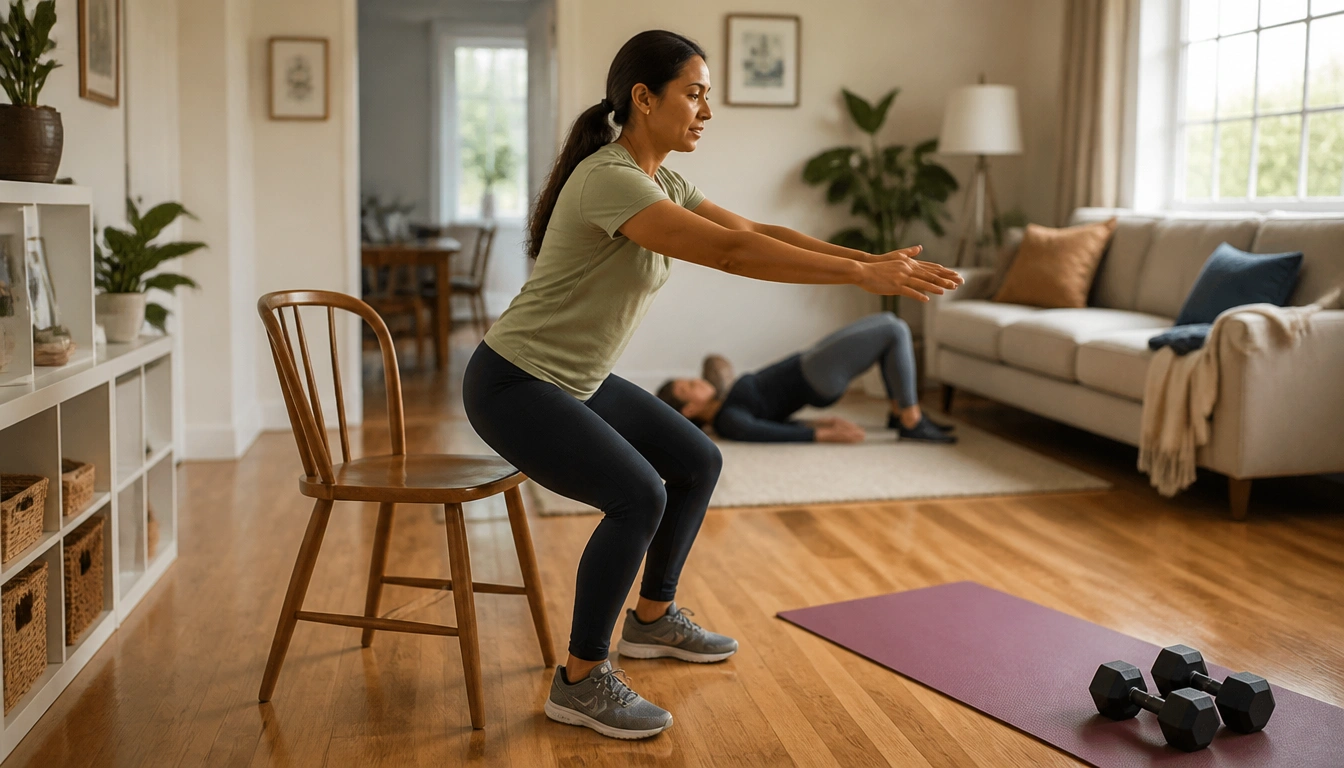
The safest and most effective no-equipment leg workout for an absolute beginner is a simple routine built around sit-to-stands, glute bridges, and standing calf raises, done with controlled form on 2 to 3 non-consecutive days per week. Start with easy sets, stop with about 2 repetitions in reserve, and progress gradually as the movements feel steadier and less tiring.
Key Takeaways
- A basic bodyweight leg routine can build strength, balance, and confidence without gym equipment.
- For beginners, 2 to 3 short sessions per week on non-consecutive days is a practical starting point.
- Sit-to-stands, glute bridges, and calf raises cover the major lower-body muscles in a simple home setup.
- You do not need to train to failure; leaving about 2 reps in reserve is usually enough for progress.
- Sharp joint pain, dizziness, chest symptoms, or instability are stop signs, not something to push through.
Why bodyweight leg training works for absolute beginners
Bodyweight leg training works well because the first gains for a new lifter are often neurological. Your nervous system learns how to recruit muscles more efficiently, coordinate the movement, and keep you stable. That is why a simple no-equipment leg workout can feel surprisingly effective even before it becomes physically demanding.
For absolute beginners, the goal is not to prove toughness. The goal is to practice useful movement patterns that train the thighs, glutes, hamstrings, and calves while staying in control. The Centers for Disease Control and Prevention recommends muscle-strengthening activity for all major muscle groups on at least 2 days per week, and bodyweight training fits that guidance well when space, time, or confidence are limited.
This kind of routine also has a practical benefit: it teaches everyday strength. Standing up from a chair, climbing stairs, carrying groceries, and keeping balance during a trip or stumble all rely on the lower body. A beginner does not need machines to begin preparing for those demands.
In short: a home routine can be effective, safe, and good enough to start with. The most important factors are consistency, control, and gradual progress.
The beginner workout itself
The simplest starter routine is a three-exercise circuit: sit-to-stands, glute bridges, and standing calf raises. Together, they train the front of the thighs, the hips and hamstrings, and the lower legs without requiring a bench, dumbbells, or a gym.
If you want a very basic first session, think of it as practice rather than a test. Do one set of each exercise at a pace that lets you move smoothly. If that feels manageable, build toward more sets over time. A good beginner workout should leave you feeling used, not wrecked.
Here is the structure:
- Sit-to-stands: train standing strength and leg coordination.
- Glute bridges: train the back side of the hips and thighs.
- Standing calf raises: train the lower legs and ankle support.
That trio gives you a complete lower-body foundation with very little setup. It is also easy to repeat, which matters more than variety when you are just starting out.
How to perform each move
Sit-to-stands: Place a sturdy chair behind you. Stand with feet about shoulder-width apart, brace lightly through your trunk, and reach your hips back until you touch the chair. Keep your feet flat and stand back up by pressing through the whole foot. If needed, use your hands lightly on the chair arms or thighs for help at first. The easiest safe version is a higher chair and a slow descent.
Glute bridges: Lie on your back with knees bent and feet flat on the floor, about hip-width apart. Tighten your abdomen gently, then lift your hips until your body makes a straight line from shoulders to knees. Pause briefly, then lower with control. If lying flat is uncomfortable, especially in pregnancy or late postpartum recovery, choose a modified position and ask a clinician about the best setup for you.
Standing calf raises: Stand near a wall, countertop, or chair for light support. Rise onto the balls of your feet, pause for a moment, and lower slowly. Keep the movement smooth rather than bouncy. If balance is limited, hold more support and reduce the range of motion while you learn the pattern.
For all three exercises, the easiest setup is the one that lets you stay steady, move slowly, and feel the target muscles working without sharp discomfort.
How much to do, how to progress, and what to avoid
Beginners usually do best with a small amount of work done well. A practical starting point is 1 to 2 sets of each exercise, with about 6 to 12 controlled repetitions per set, depending on your current tolerance. Rest long enough to recover your breathing and keep your form steady before the next set. For many people, 60 to 90 seconds is enough, but longer rest is fine if you need it.
Training with about 2 repetitions in reserve means you stop while you could still do a couple more reps with good form. That is a useful target for beginners because it supports progress without forcing fatigue so high that technique falls apart. You do not need to reach failure to make these exercises productive.
A simple weekly plan is 2 to 3 sessions on non-consecutive days, such as Monday, Wednesday, and Friday. That gives your muscles and joints time to recover, especially when you are returning after a long break.
To make the workout harder without equipment, choose one small change at a time:
- Add a few reps per set.
- Slow the lowering phase.
- Pause for a second at the bottom or top.
- Use a slightly lower chair for sit-to-stands.
- Add supported reverse step-backs once the basic routine feels stable.
Common mistakes are easy to spot: rushing the reps, letting the knees collapse inward, arching the lower back during bridges, and treating pain as the goal. The movement should feel like work, but it should not feel sloppy or forceful. If form gets messy, reduce the challenge before adding more.
Who should modify the workout
Older adults: A higher chair, lighter range of motion, and extra support from a countertop can make the routine safer and more comfortable. Starting with fewer reps is fine. The best version is the one you can repeat regularly with confidence.
People with knee discomfort: Sit-to-stands are often easier to tolerate than deep squats because the chair limits depth. You can also keep the chair a bit higher, move more slowly, and stop well before pain. Reverse step-backs are usually easier to control than forward lunges, but they should be introduced only when the basic pattern feels stable.
Absolute deconditioned beginners: Treat the first few sessions as skill practice. Your body may need time to relearn how to squat, bridge, and balance. A small amount of soreness is normal, but exhaustion is not required. If you need to start with one set and fewer reps, that is still a real workout.
People who are pregnant or postpartum may need extra adjustments. Prolonged flat-on-the-back exercise may not be comfortable for everyone, especially later in pregnancy, and some people may prefer a supported incline position or a different bridge variation. Because postpartum recovery varies, individualized guidance from a clinician or pelvic health professional can be helpful.
Safety rules and stop signs
Normal training discomfort usually feels like muscle effort, mild burn, or next-day soreness in the working muscles. That is different from warning signs. Sharp or localized joint pain, especially in the knees, hips, or lower back, is a sign to stop and reassess. Dizziness, chest discomfort, unusual shortness of breath, or a feeling that a joint may give way also mean you should stop exercising and seek medical advice if needed.
It also helps to separate fatigue from instability. Fatigue can make the exercise feel harder. Instability looks like wobbling, buckling, or losing control of the movement. If control is disappearing, the exercise is too hard for that day.
If you have a recent injury, severe arthritis, a history of lower-limb surgery, or a medical condition that affects exercise safety, get individualized guidance before starting a new routine. Public health advice supports activity, but your personal situation may require changes in range, tempo, or exercise choice.
How to make it a habit at home
The easiest way to stay consistent is to attach the routine to something you already do. Do sit-to-stands after brewing coffee, glute bridges before your shower, or calf raises while watching a short program. The workout becomes easier to repeat when it is linked to an existing habit instead of waiting for a perfect time.
Keep the routine short enough to fit a normal day. A beginner is more likely to repeat 8 to 15 minutes of focused work than a plan that feels like a project. Put the chair, mat, or support surface in the same place each time so there is less friction.
It can also help to think in weekly terms instead of daily perfection. Two or three good sessions in a week are enough to build momentum. If one day feels off, you do not need to make up for it with a harder workout later. Just return to the next planned session.
How nutrition, hydration, and recovery support progress
Strength training works best when recovery is supported outside the workout. Hydration matters because even mild dehydration can make exercise feel harder than it should. A regular pattern of meals also helps energy stay steady enough to practice movement with good form.
Protein supports muscle repair, and a balanced diet with enough total food helps your body adapt to the new work. You do not need a special supplement plan to begin. Protein-rich foods such as beans, lentils, eggs, dairy, fish, poultry, tofu, and other soy foods can fit into ordinary meals.
Sleep and rest days matter too. New exercisers often underestimate how much adaptation happens between sessions. If a workout leaves you unusually sore or drained, that is a sign to keep the next session easy rather than pushing harder. Recovery is part of the program, not time off from it.
Practical rule: start small, repeat the routine, and let easy progress build confidence before you chase harder variations.
Frequently Asked Questions
How many days per week should a beginner train legs with bodyweight exercises?
For most absolute beginners, 2 to 3 non-consecutive days per week is a practical starting point. That fits public health guidance for muscle-strengthening activity and gives your muscles time to recover between sessions.
How many reps and sets should an absolute beginner do?
A reasonable starting point is 1 to 2 sets of 6 to 12 controlled reps per exercise, adjusted to your current tolerance. If your form breaks down before the target is reached, do fewer reps and build up gradually.
How do I know if a bodyweight leg exercise is too hard or unsafe?
If you feel sharp joint pain, dizziness, chest symptoms, unusual shortness of breath, or your leg feels unstable, stop. Also reduce the challenge if your form is collapsing, your balance is poor, or the movement causes lingering joint pain afterward.
Can older adults or people with knee pain do no-equipment leg exercises?
Often, yes, but the exercise may need to be modified. A higher chair, smaller range of motion, more support from a wall or counter, and slower pacing can make the routine more comfortable. Pain that is sharp or worsening should be checked by a clinician.
Is it okay to do glute bridges if I’m pregnant or postpartum?
Sometimes, but it depends on comfort and your individual recovery. Some pregnant or postpartum people should avoid prolonged flat-on-the-back positions or may need a modified version. Because needs vary, it is best to ask your obstetric clinician, midwife, or pelvic health physical therapist for personalized advice.
The Bottom Line
A no-equipment leg workout can be simple and effective for absolute beginners. Start with sit-to-stands, glute bridges, and standing calf raises, and keep the first few weeks focused on control, not intensity.
Two to three short sessions per week, with about 2 reps in reserve, is enough to build a solid foundation. Progress slowly by adding reps, slowing the lowering phase, or lowering the chair height only when the movement feels steady.
If pain is sharp, localized, or paired with dizziness, chest symptoms, or instability, stop and get checked. Consistency and safe progress matter far more than doing a harder version too soon.
Medical disclaimer
Medical disclaimer: This content is for educational and informational purposes only and is not a substitute for professional medical advice, diagnosis, or treatment. Dietary needs and supplement suitability vary by individual.
