
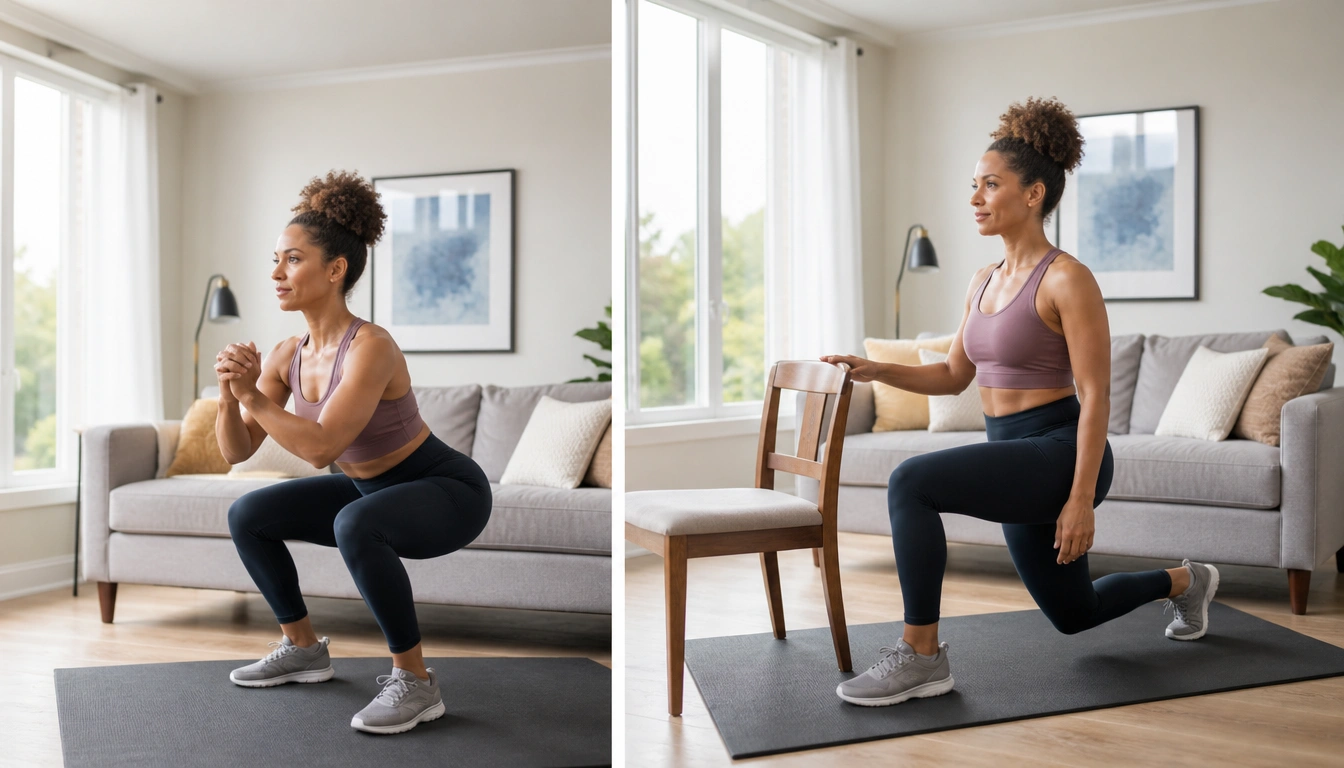
The best safe and effective no-equipment leg workout at home is a simple routine built around squat, lunge, hinge, and calf-raise patterns. Done with good form, it can improve lower-body strength, balance, and everyday movement. For most adults, aim for muscle-strengthening work at least 2 days per week, start with easier versions if needed, and progress by changing tempo, range, reps, or rest instead of rushing to weights.
Key Takeaways
- A balanced home leg routine should train squatting, lunging, hip hinging, and calf work, not just one exercise.
- You do not need equipment to make progress; slower lowering, shorter rest, and single-leg work can increase the challenge.
- Beginners and older adults can start with chair-assisted sit-to-stands and supported movements before full squats or lunges.
- The CDC and NHS recommend muscle-strengthening activities for major muscle groups at least 2 days per week.
- Stop the workout and seek medical advice for sharp pain, chest symptoms, dizziness, major swelling, or possible clot signs.
What a no-equipment leg workout should cover
A no-equipment leg workout at home works best when it trains the movement patterns you use in daily life. That usually means a squat pattern for getting up and down, a lunge pattern for stepping and balance, a hinge pattern for the back of the legs and hips, and calf raises for the lower legs. Together, those movements can help build strength, stability, and endurance without needing a gym or special setup.
The goal is not to copy a machine-based workout at home. The goal is to use body weight well. A well-designed routine can support standing from a chair, climbing stairs, carrying groceries, and moving with more confidence. The Centers for Disease Control and Prevention and the NHS both advise muscle-strengthening work for the major muscle groups at least 2 days a week, which includes the legs, hips, and calves.
If you want a simple starting point, keep the routine short and repeatable. A strong home session often uses a few carefully chosen exercises rather than a long list of variations. That makes it easier to keep good form and easier to stick with over time.
How to structure the workout
A practical beginner-friendly structure is to choose four exercises and do each one for either a set number of repetitions or a timed interval. For example, you might do 2 to 4 sets of 8 to 15 controlled reps, or 30 to 40 seconds of work followed by 20 to 30 seconds of rest. Both styles can work well at home; choose the one that helps you stay focused and in control.
Rest should be long enough that your form stays clean. If your knees cave inward, your heels lift, or you rush through reps, the set is probably too hard or the rest is too short. A short home workout can still be effective if the effort is steady and the technique is honest.
A simple sequence is squat, hinge, lunge, then calf raise. You can repeat that circuit 2 or 3 times. If you are new to exercise, start with fewer reps and more rest. If you are already active, use slower tempo, a fuller but comfortable range, or extra rounds instead of jumping straight to weights.
Form cues and common mistakes
Squat pattern: Keep your feet about shoulder-width apart, send your hips back and down, and keep your chest lifted. A common mistake is letting the knees collapse inward or dropping too fast and bouncing at the bottom. Keep pressure through the whole foot.
Lunge pattern: Step forward or backward and lower with control until both knees are comfortably bent. Keep your front knee tracking over the middle of the foot. A common mistake is taking a stance that is too narrow or leaning so far forward that balance becomes shaky.
Hinge pattern: With a glute bridge or hip-hinge style movement, think about driving through the heels and using the hips, not the lower back. A common mistake is over-arching the back at the top. Move smoothly and keep the ribs from flaring.
Calf raise pattern: Rise slowly onto the balls of the feet, pause briefly, then lower with control. A common mistake is rushing the lowering phase or letting the ankles wobble. If needed, lightly hold a wall or chair so you can focus on the movement.
Good form matters more than speed. If a movement feels unstable, reduce the range and slow down. That usually improves both safety and effectiveness.
Beginner and low-impact modifications
If you are new to exercise, returning after a break, or dealing with knee or hip sensitivity, start with easier versions that still train the same pattern. Chair-supported sit-to-stands are often a smart starting point for the squat pattern. Sit down under control, stand up without using momentum, and use your hands on the chair or thighs only if needed.
For lunges, try a shallow split stance and hold onto a wall or sturdy chair. You can also shorten the range so you do not lower very far. If stepping into a lunge feels too challenging, replace it with a controlled step-back touch or a supported split squat hold.
For the hinge pattern, glute bridges can be easier than standing hinges because they remove some balance demand. For calf raises, do both feet together and use support from a countertop if balance is uncertain. The idea is to keep the movement comfortable enough that you can practice it well.
Older adults often benefit from an extra focus on balance. Adding a brief supported single-leg stand or slow sit-to-stand can help carry over to real-life movement while keeping fall risk in mind.
How to progress without weights
Once the basic routine feels manageable, increase the challenge without grabbing dumbbells right away. One of the simplest ways is to slow the lowering phase. For example, take 3 to 4 seconds to lower into a squat or lunge, then stand back up with control. This increases time under tension and makes the same exercise more demanding.
You can also shorten rest periods, add another set, or use a slightly deeper range if your joints tolerate it. Another strong option is to move from two-leg work to single-leg variations, such as split squats, staggered squats, or single-leg calf raises with support nearby. These progressions require more control and can improve balance as well as strength.
Progress does not need to be dramatic. If you can complete the same workout with better control, less wobble, or a slower descent than last week, that is progress. For home training, consistency matters more than chasing exhaustion.
Who should modify or be cautious
Older adults, people returning from inactivity, and anyone with knee or hip sensitivity should use a conservative starting point and build gradually. That may mean more chair support, shallower ranges, fewer reps, or shorter sessions. It can also mean choosing supported movements first and postponing full lunges until balance and confidence improve.
People who are pregnant or postpartum should match exercise choices to their current medical guidance and symptoms, and should not push through pelvic floor pressure, heavy fatigue, or pain. If you have a history of joint injury, arthritis, significant balance problems, or a medical condition that affects exercise tolerance, it is sensible to get individualized guidance before starting a new routine.
For most people, the right version of the workout is the one you can do with control, without sharp pain, and with a clear path to small progress over time.
When to stop and get medical advice
Stop the workout if you feel sharp joint pain, chest discomfort, dizziness, faintness, or unusual shortness of breath. Those symptoms are not part of normal exercise discomfort and should be taken seriously.
Also stop and seek medical advice if you notice sudden one-sided calf swelling, warmth, throbbing pain, or other signs that could suggest a blood clot. If a leg joint is swollen without a clear reason, or if an old injury starts behaving differently, it is better to get checked before continuing.
If you are unsure whether symptoms are exercise-related or medical, pause the routine and speak with a healthcare professional. A safe workout plan should feel challenging, not alarming.
How to fit it into a weekly home routine
A simple schedule is two leg sessions per week, separated by at least a day of recovery. That matches the muscle-strengthening guidance from the CDC and NHS. You can pair the workout with another home habit so it is easier to remember: before morning coffee, after a walk, or while dinner is cooking.
For example, you might do a 10-minute circuit of sit-to-stands, supported lunges, glute bridges, and calf raises on Monday and Thursday. On other days, you can keep moving with walking, light mobility work, or gentle balance practice.
Recovery matters too. Drink enough fluid through the day and eat balanced meals that include protein, carbohydrates, and micronutrients. That supports muscle repair and makes it more likely you will recover well enough to repeat the routine next time. The best home leg workout is the one you can do regularly, safely, and with enough energy left to do it again next week.
Frequently Asked Questions
How many days per week should I do a no-equipment leg workout?
A good target is at least 2 days per week of muscle-strengthening work for the major muscle groups, including the legs. You can spread those sessions out, such as Monday and Thursday, so you have recovery time between them.
What exercises should be in a beginner home leg workout?
A beginner routine should usually include a squat pattern, a lunge pattern, a hinge pattern, and calf raises. Chair-assisted sit-to-stands, supported split squats, glute bridges, and supported calf raises are useful starting points.
How can I make bodyweight leg exercises harder without weights?
You can slow the lowering phase, add reps or sets, shorten rest, pause at the hardest point, or move to single-leg variations. Those changes increase the demand without needing equipment.
What should older adults or beginners do instead of full squats and lunges?
Start with supported sit-to-stands, shallow squats, or short-range step-back movements while holding a wall or sturdy chair. The goal is to train the same pattern with less balance demand and more control.
When should I avoid a home leg workout or get medical advice first?
Get medical advice before continuing if you have chest symptoms, dizziness, sharp joint pain, sudden swelling, or possible clot signs such as one-sided calf swelling, warmth, or throbbing pain. Those need prompt attention.
The Bottom Line
A safe, effective no-equipment leg workout at home can be built from four movement patterns: squat, lunge, hinge, and calf raise. Done with control, it can improve strength, stability, and everyday function without special equipment.
Start with the easiest version you can do well, then progress through tempo, range, reps, rest, and single-leg variations. For most adults, twice weekly is a practical minimum target for muscle-strengthening work.
If pain is sharp, symptoms feel unusual, or balance is not secure, back off and get medical advice when needed. The best routine is the one that is simple enough to repeat and challenging enough to keep improving.
Medical disclaimer
Medical disclaimer: This content is for educational and informational purposes only and is not a substitute for professional medical advice, diagnosis, or treatment. Dietary needs and supplement suitability vary by individual.
Sources
- Centers for Disease Control and Prevention (CDC) — cdc.gov. Accessed October 2026.
- National Health Service (NHS) — www.nhs.uk. Accessed October 2026.
- National Health Service (NHS) — www.nhs.uk. Accessed October 2026.
