
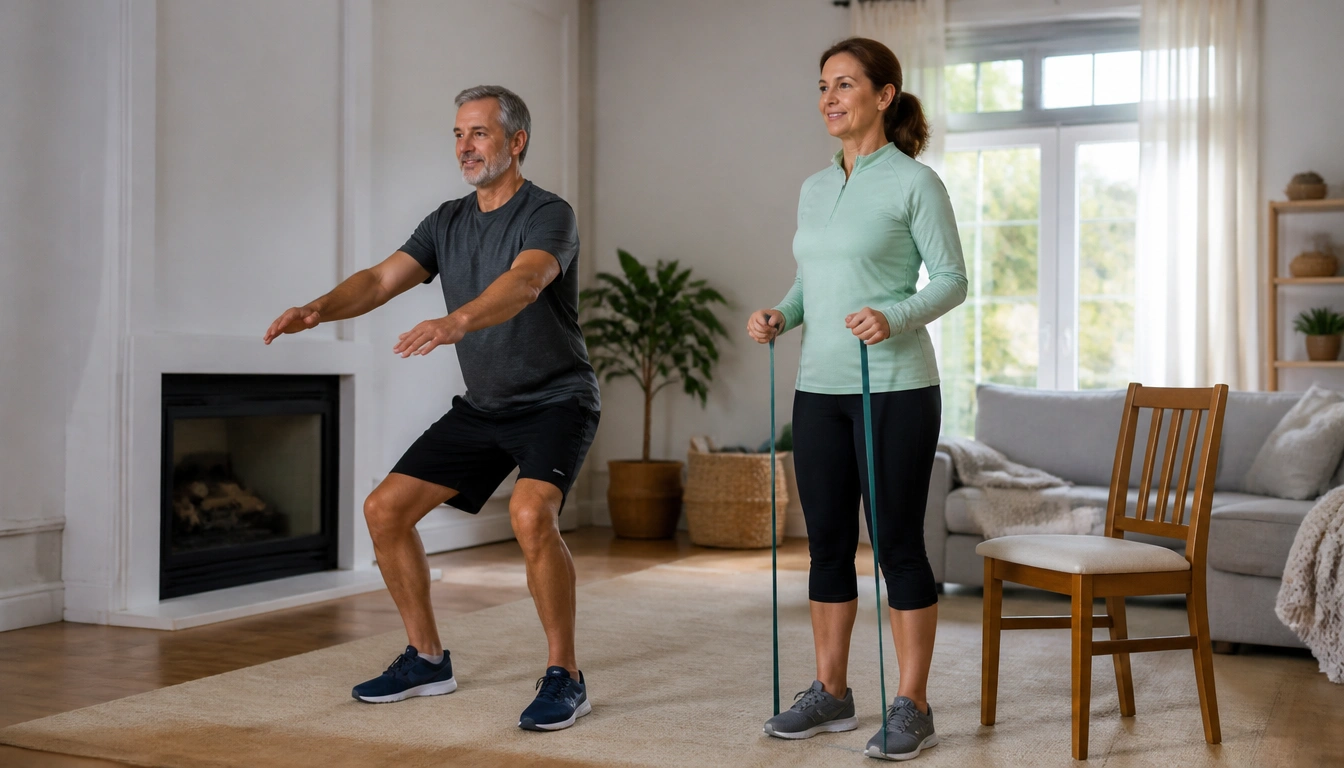
A safe, effective after-work exercise routine for adults over 50 is usually a short, moderate, low-impact session that starts with a brief warm-up, includes about 20 minutes of walking, cycling, strength work, or a mix of all three, and ends with a cool-down and balance work. The best version is the one you can repeat most days without feeling drained or sore the next day.
Key Takeaways
- Break up the workday first: a short transition walk or mobility block helps reverse stiffness from sitting and makes evening exercise feel easier.
- For adults over 50, the most useful routine combines cardio, strength, and balance instead of relying on just one type of exercise.
- A 30-minute framework works well: 5 minutes to warm up, 20 minutes for the main block, and 5 minutes to cool down.
- On exhausted days, reduce the intensity or shorten the session rather than skipping movement entirely.
- Choose joint-friendly options such as brisk walking, cycling, chair squats, wall push-ups, rows, and supported balance drills.
- If you have heart, blood pressure, balance, or joint concerns, get medical guidance before starting a new routine or pushing intensity.
Why an after-work movement routine matters more after 50
After a long workday, an after-work movement routine for adults over 50 does more than “burn calories.” It helps undo the effects of sitting, which can leave the hips, upper back, and calves stiff while circulation slows down. A short bout of movement can help restore blood flow, loosen postural tension, and make the transition from work mode to evening mode feel less abrupt.
That matters more with age because recovery tends to take longer, and joints and soft tissues can feel less forgiving after hours in one position. A well-timed routine can support mobility, reduce that locked-up feeling, and make it easier to keep doing the daily tasks that protect independence. It can also help many people feel calmer after work, especially when the day has been mentally demanding.
How to judge intensity without overdoing it
For most adults over 50, a moderate-effort session is the sweet spot after work. The “talk test” is a practical guide: you should be able to speak in short sentences, but not sing comfortably. If you are gasping or bracing against pain, the effort is probably too high for an evening workout.
That does not mean the routine has to be easy to the point of being meaningless. It should feel like you are moving on purpose, but not emptying the tank. On tired days, consistency usually beats intensity. A shorter walk, lighter resistance, or fewer rounds of strength work can preserve the habit and still support fitness.
Public-health guidance from the U.S. Department of Health and Human Services and the CDC emphasizes a mix of aerobic activity, muscle strengthening, and balance work for older adults. That mix matters because each part supports a different piece of function: endurance, strength for daily tasks, and stability for fall prevention.
The 30-minute after-work exercise routine
A simple 30-minute structure helps the routine feel doable on workdays. Start with five minutes of easy movement to shift out of work posture. March in place, roll your shoulders, gently rotate your torso, and do a few relaxed arm swings. If you sit all day, include a brief walk around the house or building before the main block.
Use the next 20 minutes for the main movement block. Some days that may be brisk walking or cycling. Other days it may be a few rounds of strength exercises. You do not need to cram everything into one evening to make progress, but the session should do more than just stretch.
Finish with five minutes of cool-down. Slow your pace, then do gentle static stretches for the calves, chest, hips, and upper back. Hold each stretch without bouncing and keep breathing evenly. You want to leave the session feeling more open than when you started, not more tense.
Best options for the 20-minute main block
Brisk walking is one of the simplest choices because it is easy to start, easy to scale, and gentle on most joints. Stationary cycling is another strong option, especially if your knees or hips prefer seated movement. Both can deliver aerobic work without the impact of running or jumping.
If strength is the priority, use basic movements that train the muscles you rely on every day. Chair squats or sit-to-stands train the legs and hips. Wall push-ups build upper-body strength without putting the body on the floor. Resistance-band rows help offset the rounded posture that can build up during desk work and driving.
A practical circuit might look like this: walk or pedal for a few minutes, then do a set of chair squats, wall push-ups, and rows, then repeat. If you prefer one focus per day, that works too. The goal is to accumulate useful movement, not create a perfect gym session.
| Exercise | Why it helps | Easier version | Harder version |
|---|---|---|---|
| Brisk walking | Builds aerobic fitness and circulation | Easy walk | Faster pace or gentle hills |
| Chair squats | Supports leg strength and daily function | Higher chair or partial range | Lower chair or slower tempo |
| Wall push-ups | Strengthens chest, arms, and shoulders | Stand closer to the wall | Use a countertop or lower surface |
| Rows with a band | Improves upper-back strength and posture | Light band, smaller range | Heavier band or longer sets |
How to build a week without overcomplicating evenings
Adults over 50 do best when the week includes more than one kind of movement. The public-health target of 150 minutes of moderate aerobic activity each week can be spread across shorter after-work sessions, rather than saved for a few long workouts. That makes the habit easier to fit around work, family, and energy swings.
Strength training matters on at least two days per week because muscles are part of how you move, balance, and protect joints. Balance work can be folded into the cool-down or done on its own for a few minutes. Think of balance as a skill, not a separate fitness category you only do when you remember.
A simple week might include walking or cycling on some days, strength circuits on others, and a lighter mobility or balance-focused session when fatigue is higher. You do not need to make every evening a hard workout. A sustainable pattern is usually better than an ambitious plan that collapses by Thursday.
Joint-friendly modifications for stiffness, arthritis, and low-energy days
If your joints are stiff after work, the safest move is usually to reduce impact before you reduce movement altogether. Swap jumping or fast changes of direction for walking, cycling, marching in place, or seated movement. If standing long is uncomfortable, use a chair-based version for part of the routine.
For arthritis or osteoarthritis, choose smooth motions and keep the range comfortable. A sit-to-stand from a higher chair may feel better than a deep squat. A wall push-up may be more tolerable than floor work. Supported balance drills, such as holding a countertop while standing on one leg, can build stability without forcing you into a risky position.
On very low-energy days, keep the routine alive by shrinking it. Do the warm-up, one or two rounds of strength work, or a 10-minute easy walk. The point is to stay in motion often enough that the habit survives busy weeks, flare-ups, and tired evenings.
Safety rules, hydration, and when to stop
Hydration matters because many people finish the workday mildly dehydrated without realizing it. A glass of water before exercise and another after can help, especially if the office or commute leaves you dry or drained. If you have not eaten for a while, a light snack may help more than powering through on empty.
Stop exercising and get medical help if you develop chest pain, unusual shortness of breath, dizziness, or a sharp joint or muscle pain that feels different from normal effort. Those are not signs to push harder.
It is also wise to ask for medical clearance before starting a new evening exercise routine if you have heart disease, uncontrolled blood pressure, diabetes, major joint problems, or you have been inactive for a long time. The National Institute on Aging and the NHS both recommend tailoring activity to your current ability and health status, not your old fitness level.
How to make the habit stick after work
The easiest routine is usually the one that requires the fewest decisions. Lay out shoes and clothes before work, choose a regular start time, and keep the equipment simple. A resistance band, sturdy chair, and comfortable walking shoes can cover most evenings.
It helps to build a clear transition from work to movement. Change clothes, drink some water, and start with five minutes of easy motion before you decide whether you “feel like” exercising. That small start lowers friction and often leads to a fuller session.
When motivation is low, choose the easiest sustainable version of the plan. A short walk is better than nothing. A short strength circuit is better than skipping the week. Over time, repeatability matters more than perfect effort, especially when your goal is to move more after work without overdoing it.
Frequently Asked Questions
How long should an after-work workout be for adults over 50?
A useful starting point is about 30 minutes, but it does not have to be exact. A 5-minute warm-up, 15 to 20 minutes of main work, and a 5-minute cool-down can be enough to build a consistent habit. On busy days, even a shorter session is worthwhile if it stays moderate and regular.
What are the best low-impact exercises after a sedentary workday?
Brisk walking, stationary cycling, chair squats, wall push-ups, resistance-band rows, and supported balance drills are all good low-impact choices. They help restore circulation, improve posture, and build strength without the pounding of higher-impact exercise.
Should an over-50 exercise routine include strength, balance, and cardio?
Yes. Public-health guidance for older adults supports a multicomponent routine because each type of exercise does something different. Cardio supports heart and endurance fitness, strength helps with daily function, and balance work can reduce fall risk and improve stability.
What should I do on days when I’m too tired to work out after work?
Reduce the intensity instead of skipping movement entirely. Try a short walk, a lighter strength circuit, or just the warm-up and cool-down. Keeping the habit alive is usually more useful than forcing a hard workout when you are already depleted.
When should adults over 50 get medical clearance before starting an evening exercise routine?
Get clearance if you have heart disease, uncontrolled blood pressure, diabetes, significant joint problems, a long period of inactivity, or symptoms such as chest pain, dizziness, or unusual shortness of breath with activity. A clinician can help you choose a safe starting point.
The Bottom Line
A good after-work movement routine for adults over 50 should feel practical, not punishing. Aim for a short warm-up, moderate main work, and a cool-down that helps you leave stiffness behind rather than adding new fatigue.
The most useful routine is the one you can repeat most days: low-impact cardio, simple strength work, and a little balance training across the week. If you are tired, shrink the session instead of abandoning it. That keeps the habit alive and supports fitness, function, and stress relief over time.
Medical disclaimer
Medical disclaimer: This content is for educational and informational purposes only and is not a substitute for professional medical advice, diagnosis, or treatment. Dietary needs and supplement suitability vary by individual.
Sources
- National Institutes of Health (NIH) — nih.gov. Accessed November 2026.
- National Institutes of Health (NIH) — nih.gov. Accessed November 2026.
- National Health Service (NHS) — www.nhs.uk. Accessed November 2026.
- Academic Research Institution — harvard.edu. Accessed November 2026.
