
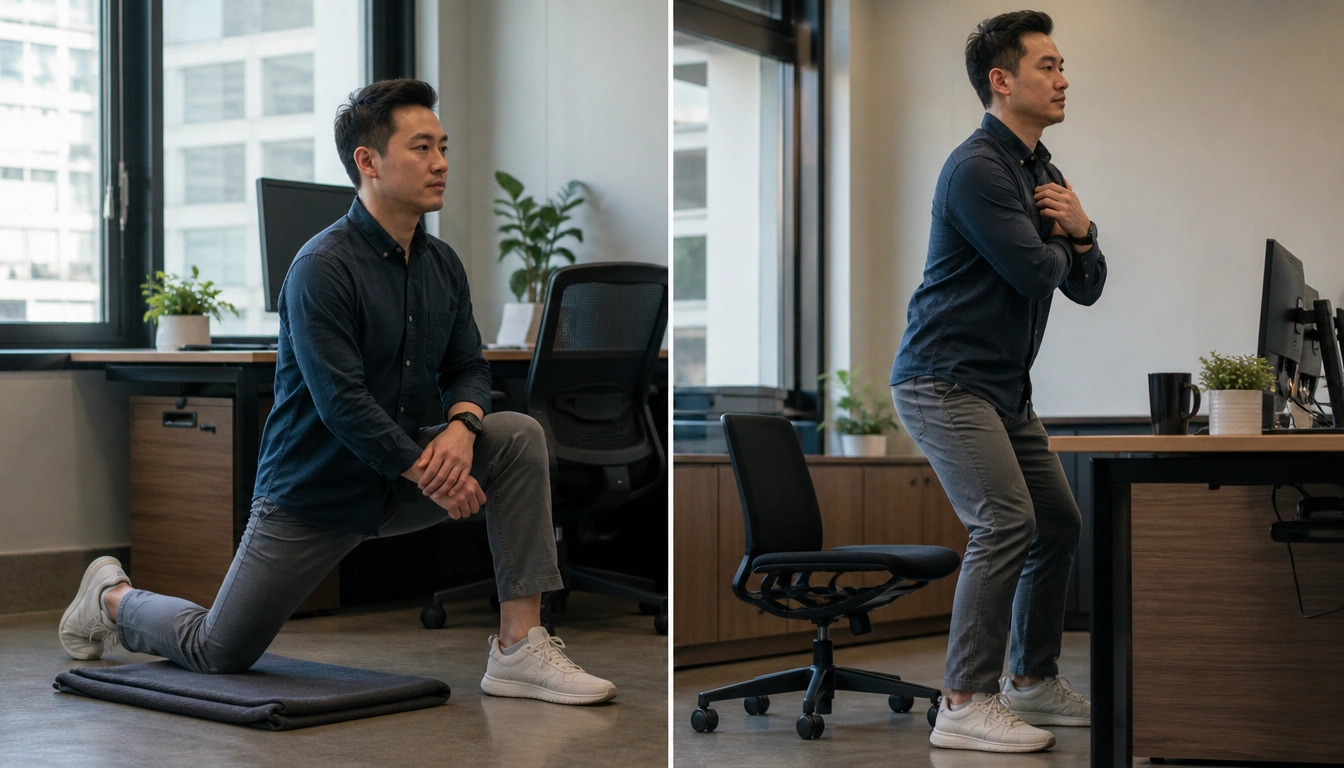
The simplest effective hip mobility routine for office workers is a short combination of one hip flexor stretch, one glute-focused stretch, and one active standing move such as sit-to-stands. Do it once or twice during the workday, and pair it with brief movement breaks every 30 to 60 minutes. That approach is more useful than one long stretch session at the end of the day because it addresses both tissue stiffness and loss of active control.
Key Takeaways
- Long sitting keeps the hips folded for hours, which can make hip flexors feel tight and leave the glutes less active.
- Mobility is not the same as flexibility: stretching helps range, but active movement helps you use that range safely.
- A practical office routine can be done in about 5 minutes with no special equipment.
- Small movement breaks every 30 to 60 minutes matter more than trying to fix eight hours of sitting all at once.
- Mild stretching discomfort is normal, but sharp pain, night pain, swelling, or numbness should be checked by a clinician.
Why desk sitting makes hips feel tight and why that matters
Desk work keeps the hips in a flexed position for long stretches of time. Over the day, that posture can make the front of the hip feel shortened and the back side of the hip feel underused. People often describe this as “tight hips,” but the feeling is usually not just about one muscle being short. It is also about how the joint and surrounding muscles have been held and used for hours.
That matters because the hips are built to do more than bend and sit. They help you walk, climb stairs, stand up from a chair, and transfer force between the trunk and legs. When the hips do not extend well after prolonged sitting, the lower back often picks up some of the work. That can contribute to stiffness, awkward walking, or a sore low back after a long workday.
Public health guidance from the CDC and the World Health Organization also emphasizes that adults should limit long periods of sitting and break up sedentary time. For office workers, the practical goal is not to “erase” sitting, but to interrupt it often enough that the hips do not stay compressed for hours.
Mobility vs. flexibility: why office workers need active control
Flexibility is passive range. It tells you how far a muscle or soft tissue can be stretched when something else moves it. Mobility is different: it is the active range you can control through a joint while your body does the work. For hips that spend most of the day in a chair, both matter.
Stretching can help restore comfort and range, especially when the hip flexors and deep glute muscles feel stale from sitting. But if you only lengthen tissue passively and never ask the hip to produce force or control a new position, the benefit may be limited. That is why a useful office routine pairs stretching with an active movement like sit-to-stands.
There is another reason to avoid overdoing long, aggressive holds. Early stretching gains are often explained more by the nervous system becoming more comfortable with the position than by the muscle physically lengthening right away. In plain terms, your body learns that the stretch is safe. That supports a routine built on consistency and moderate effort, not forcing a deep stretch once in a while.
If you want the hips to feel better during walking, standing, and rising from a chair, think in terms of active control. Stretch the tissues that feel locked up, then reinforce the new range with a movement that uses the hips in a real-world pattern.
The 5-minute hip routine for office workers
This routine is designed for limited space, normal work clothes, and low embarrassment. You can do it in a private corner, an empty office, a conference room, or even beside your desk if there is enough room to kneel safely. Aim for a gentle stretch, not a test of toughness.
Kneeling hip flexor stretch
Start in a half-kneeling position with one knee on the floor and the other foot flat in front of you. Keep your torso upright, lightly brace your stomach, and tuck the pelvis only a little as you shift forward. You should feel the stretch along the front of the hip and thigh of the kneeling leg.
Hold for about 30 seconds, then switch sides. Repeat once more if time allows. If kneeling is uncomfortable, place padding under the knee or use a folded towel. The goal is a steady pull, not a deep arch in the low back.
Figure-4 stretch
Sit tall in a sturdy chair and cross one ankle over the opposite knee so the leg forms a “4.” Keep the spine long and hinge slightly forward from the hips until you feel a stretch in the outer hip or glute of the crossed leg. If seated is not practical, you can do the same position lying on your back at home.
Hold for about 30 seconds per side. This stretch is useful for the outer hip and deep rotators, which often feel grumpy after long periods of sitting and limited hip rotation.
Sit-to-stands
Stand up from your chair without using your hands if possible, then lower back down with control until the seat lightly touches the back of your legs. Keep your feet flat and press through the whole foot as you rise. Think “stand tall” rather than “launch upward.”
Do 8 to 12 smooth repetitions. This is the active piece that helps the hips use the range you just opened up. If your chair is low or soft, start with a higher seat or use a firmer chair so the movement stays clean.
That combination takes only a few minutes, but it covers three useful goals: front-of-hip length, outer-hip comfort, and active hip function. If you have time for only one piece, choose the sit-to-stands plus one stretch, then come back later for the second stretch.
How to fit the routine into a workday
The easiest way to make hip mobility stick is to attach it to moments that already happen. For example, do a short round after a meeting, before lunch, after a long call, or when you return from the restroom. Those small anchors are easier to remember than a vague goal to stretch “sometime later.”
A useful workplace habit is the 30-to-60-minute reset rule: get up, walk, change position, or do a brief movement break for a minute or two at least every 30 to 60 minutes. That does not have to mean full exercise clothes or a sweaty workout. Even standing, taking a few steps, or doing a few controlled sit-to-stands can reduce the cumulative effect of sitting still.
A practical pattern is this: move briefly through the day, then do the full 5-minute hip routine once or twice daily. Many people do best with one session in mid-morning or mid-afternoon and another after the longest uninterrupted block of sitting. If you only stretch once at the end of the day, you may feel temporary relief without changing the pattern that created the stiffness.
Public health bodies such as the CDC and WHO also recommend regular weekly activity beyond the workday, including aerobic movement and strengthening work. The office routine is not a replacement for general exercise, but it can make the time you spend sitting less punishing and may help you arrive at your workouts or walks feeling less stiff.
Workspace setup that reduces hip compression
Good chair setup will not replace movement, but it can reduce how much the hips stay compressed all day. Start with your feet. They should rest flat on the floor if possible, or on a footrest if the chair height leaves them dangling. When the feet are supported, the pelvis and hips usually settle into a more manageable position.
Next, check chair height. A seat that is too low can keep the hips bent more sharply than necessary, especially if the chair is soft and sinks under body weight. That position can make the front of the hip feel more crowded. A firmer chair with thighs roughly parallel to the floor is often easier on the hips than a deep couch-like seat.
If you work long hours at a computer, try to keep your knees and hips in a comfortable, uncrowded relationship rather than collapsing into a deep slump. Small changes can help: scoot back so your pelvis is supported, keep your monitor and keyboard at a workable height, and avoid sitting with one leg tucked under the other for long periods.
These adjustments are not glamorous, but they matter because they reduce the number of hours your hips spend in a compressed position. The less extreme the sitting posture, the less dramatic the “reset” needed later.
How to simplify or progress the routine
If you are new to mobility work, start with the minimum effective version. One round of the kneeling hip flexor stretch, one round of the figure-4 stretch, and a set of sit-to-stands is enough to begin with. Keep the stretches gentle and the repetitions controlled. The best routine is the one you can repeat tomorrow.
If floor work is awkward or you share a workspace, simplify further. You can skip kneeling and use a seated figure-4 stretch, then add standing hip extensions or sit-to-stands beside your desk. If sitting on the floor is not realistic, that does not mean you cannot train hip mobility at work.
If your hips tolerate the routine well, progress by improving control rather than chasing a bigger stretch. Options include holding the kneeling stretch a little longer, adding one extra round, or slowing the lowering phase of the sit-to-stand. You can also add a brief glute squeeze at the top of each stand to remind the hips to do more of the work.
For people with very tight or irritable hips, less is often better at first. Shorter holds done consistently usually beat long, forceful sessions that leave you sore and less willing to repeat the routine. The goal is to teach the body to move well during ordinary workdays, not to force a dramatic change in one afternoon.
Safety rules: what is normal and when to get help
A good stretch should feel like tension or a deep pull, not stabbing pain. Mild discomfort is acceptable if it eases as you settle into the position. Sharp pinching in the front of the hip, catching, locking, or pain that makes you brace and hold your breath is a sign to back off.
Stop and seek medical advice if hip pain is persistent, if it wakes you at night, if you notice swelling, if the joint feels unstable, or if you have numbness, tingling, or pain that travels down the leg. Those symptoms need more than a self-stretching plan. They may point to a problem that should be evaluated by a physical therapist, doctor, or other qualified clinician.
Be extra cautious if you have had a recent injury, a known hip condition, unexplained weight-bearing pain, or a history of back or nerve symptoms. In those cases, the safest route is individualized guidance rather than trying to push through a generic routine.
For most healthy office workers, a well-dosed mobility routine is safe and useful. The rule is simple: mild stretch sensation is acceptable; worsening pain, night pain, swelling, or numbness is not.
Frequently Asked Questions
How often should office workers do hip mobility exercises during the day?
A short reset every 30 to 60 minutes is a good workday habit, even if it is just standing, walking a few steps, or changing position. Many people also benefit from one or two dedicated 5-minute hip mobility sessions during the day, especially after long blocks of sitting.
What is the difference between hip mobility and hip flexibility?
Flexibility is passive range, or how far a muscle can be stretched. Mobility is active range, meaning how well you can control the hip through that range on your own. Office workers usually need both: enough flexibility to loosen stiff tissues and enough mobility to use the hip well when standing and walking.
Which stretches are best for tight hip flexors from sitting?
The kneeling hip flexor stretch is one of the most useful options because it directly targets the front of the hip. It works well when paired with an active move like sit-to-stands. A figure-4 stretch can also help if the outer hip and glutes feel stiff from long sitting.
Can I do a hip mobility routine at my desk without special equipment?
Yes. You can do seated figure-4 stretches, standing hip movements, and sit-to-stands with an ordinary office chair. If you have a little more room, a kneeling hip flexor stretch is useful too. A towel or folded jacket can make kneeling more comfortable if you need padding.
When does hip tightness require a physical therapist or doctor instead of self-stretching?
Get evaluated if the pain is sharp, persistent, or worsening; if it wakes you at night; if you notice swelling; or if you have numbness, tingling, or pain traveling down the leg. You should also seek help if the hip feels locked, unstable, or if stretching repeatedly makes things worse.
The Bottom Line
A simple hip mobility routine for office workers does not need to be fancy. A kneeling hip flexor stretch, a figure-4 stretch, and sit-to-stands can address the stiffness that builds from long sitting while also teaching the hips to work actively again.
The biggest upgrade, though, is not a single stretch. It is building a habit of brief movement breaks every 30 to 60 minutes and using chair setup that does not keep the hips deeply compressed all day. That combination is more practical than waiting until evening to fix everything at once.
If your symptoms are mild, consistent movement usually helps. If you have night pain, swelling, numbness, or pain that does not behave like ordinary tightness, stop self-treating and get a professional assessment.
Medical disclaimer
Medical disclaimer: This content is for educational and informational purposes only and is not a substitute for professional medical advice, diagnosis, or treatment. Dietary needs and supplement suitability vary by individual.
Sources
- World Health Organization (WHO) — who.int. Accessed November 2026.
- Centers for Disease Control and Prevention (CDC) — cdc.gov. Accessed November 2026.
- National Health Service (NHS) — www.nhs.uk. Accessed November 2026.
- National Health Service (NHS) — cuh.nhs.uk. Accessed November 2026.
- Academic Research Institution — harvard.edu. Accessed November 2026.
