
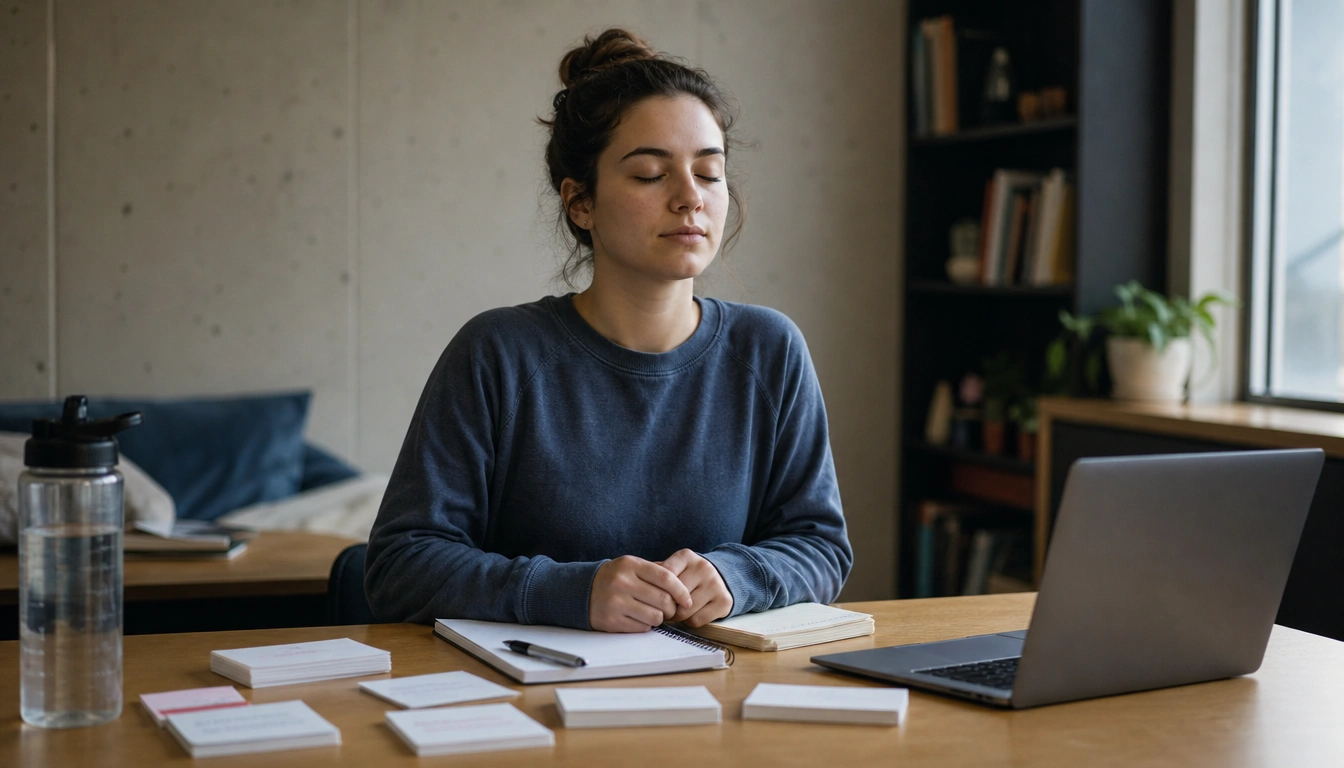
A helpful routine for exam stress is to study with active retrieval, protect sleep as much as possible, and use a short reset when panic rises. In practice, that means reviewing with self-tests instead of rereading, keeping caffeine modest, doing a brief breathing-and-movement break when your mind starts to spiral, and using a quick brain dump if you blank during the exam.
Key Takeaways
- Passive rereading can feel productive, but active retrieval gives you clearer evidence of what you actually know and usually lowers anxiety.
- A short study rhythm with focused blocks and movement breaks works better than all-day cramming for most students.
- If panic spikes, a three-minute reset can help: paced breathing, brief movement, then one tiny action to restart thinking.
- Sleep, food, hydration, and caffeine habits matter because they shape attention, memory, and emotional control during exams.
- Ongoing panic, insomnia, or symptoms that disrupt daily life are signs to contact counseling, student health, or another clinician.
Why exam stress shows up so strongly
Exam stress is not just “in your head.” When a test feels high-stakes, the brain’s threat system can trigger adrenaline and cortisol, which may briefly sharpen alertness. That can be useful at first, but if the stress response stays switched on, it can interfere with working memory, sleep, and flexible thinking. The result is the familiar cycle of racing thoughts, shallow breathing, and trouble recalling information you know well.
That is why a routine matters. A stable routine gives your brain fewer unknowns to manage. It also gives you a repeatable plan for three moments that matter most: the weeks before the exam, the morning of the exam, and the moment panic starts to climb. According to the National Institutes of Health, stress management works best when body-based tools and practical habits are used together rather than relying on one trick alone.
Think of the goal as reducing uncertainty, not eliminating nerves. Some nervousness is normal and can help you focus. The problem starts when stress becomes so intense that it blocks sleep, concentration, or retrieval. A good exam stress routine for college students should make studying feel more concrete, not more chaotic.
How to study so anxiety drops instead of rises
The fastest way to lower exam anxiety is often to replace “I keep reviewing, but I still do not know it” with “I can prove I know this.” That is where active retrieval helps. Self-testing, flashcards, and teach-back force your brain to pull information out of memory instead of only recognizing it on the page. Research and academic student-success guidance support this shift because retrieval practice is more effective than rereading for durable learning and better self-calibration.
Passive review can create a fluency illusion. When you reread notes, highlight pages, or watch the same lecture clip repeatedly, the material can start to feel familiar. Familiar does not always mean retrievable under pressure. That gap is one reason anxiety grows during exams: you sense uncertainty, but you do not have clear evidence of mastery. By contrast, a missed flashcard tells you exactly what to fix.
A practical study routine does not need to be elaborate. Use short focused blocks, then step away for a real break that includes movement or a change of setting. A simple pattern is one concentrated study block followed by a brief reset. The exact timing can vary, but the principle is the same: work in a way that protects attention instead of grinding it down.
If you are cramming, prioritize the highest-yield topics and use active recall first. Start with questions, not rereading. For example, close the book and write everything you remember from a chapter heading, then check what you missed. Teach the material out loud as if you were helping a classmate. That process shows gaps faster than passive review and usually feels less overwhelming because the work becomes specific.
Day-before and morning-of routine
The day before an exam is not the time to “win” by staying up late. Sleep supports memory consolidation, attention, and emotion regulation, and student health guidance consistently treats it as a core part of exam preparation. A late-night study sprint may feel urgent, but it often leaves you slower and more anxious the next day.
Use the evening before to lower friction. Stop heavy studying early enough to wind down. Choose a light, familiar meal, drink water, and prepare what you need for the morning so you are not making decisions while stressed. If caffeine is part of your routine, avoid using it to patch over an all-nighter or to rescue a badly slept night. Large doses of caffeine or energy drinks can worsen jitters, sleep disruption, and a racing heart.
On the morning of the exam, aim for boring and predictable. Eat something gentle but sustaining if that works for your stomach, and hydrate normally. Do a short pre-exam reset before you leave or before you sit down. That might be a few minutes of quiet breathing, a brief walk, or a quick review of only the most essential cues. The point is to arrive feeling organized, not overdriven.
If you are prone to morning panic, reduce decision fatigue. Lay out your clothes, pack your materials, and decide your caffeine plan the day before. A calm morning is usually the result of preparation, not motivation.
The 3-minute panic reset
When panic spikes, do not try to solve your whole semester in your head. Use a short reset that tells your nervous system the danger has passed enough for you to think again. The goal is not instant calm; it is enough control to restart working memory.
First, breathe slowly and evenly for about a minute. A paced exhale helps slow the stress response. You do not need a perfect breathing pattern; you just need a slower rhythm than the one panic gave you. Second, move briefly. Unclench your jaw, roll your shoulders, stand if possible, or press your feet into the floor. Small movement helps interrupt the physical loop of tension.
Third, choose one micro-action. Open to the next question, write the formula you remember, or outline a single sentence. The action should be tiny enough that your brain cannot argue with it. That small win is often what gets momentum back. According to NIH-based stress resources, combining breathing with grounding or movement can help shift the body out of the alarm state more effectively than trying to “think your way out” of panic alone.
What to do if your mind goes blank during the exam
If your mind goes blank, do not interpret that as failure. A blank moment often reflects stress interfering with retrieval, not the absence of knowledge. The move is to stop staring at the blank space and create a new starting point.
Use a brain dump. Take the first minute to write down formulas, key terms, dates, steps, or mnemonics you want out of short-term holding. This clears space in working memory and can reduce the pressure to remember everything at once. If the exam allows scrap paper, use it early. If not, jot the essentials in the margin where permitted or on the blank page in front of you.
Then scan for an easy entry point. Answer the question you can access first, even if it is not the one you planned to do first. Often, the act of writing one answer loosens the rest of the exam. If a question still feels blocked, leave a quick mark and move on before the worry loop gets louder.
The goal is traction, not perfection. Many students recover after a blank period once they stop trying to force the exact answer immediately.
Adjustments for high achievers, perfectionism, and learning differences
Students who usually perform well can be especially vulnerable to exam stress because pressure feels tied to identity. If you are used to succeeding easily, a hard class or a stacked exam week may feel unusually threatening. Perfectionism can make this worse by turning a normal challenge into a verdict on your future.
A better standard is “prepared enough to perform,” not “perfectly ready.” That means finishing the most important material, not endlessly polishing the least important details. It also means noticing when more studying is no longer useful. If you are rereading the same page repeatedly without improving recall, switch to self-testing or a different topic.
Students with ADHD, learning differences, or processing challenges may need a more individualized plan. Shorter study blocks, written cues, quieter environments, or extra time can make a major difference. Campus disability and learning support offices exist for this reason. Accommodations are not a shortcut; they are a way to let your effort count under fair conditions.
If your stress is tied to perfectionism, it can help to separate academic performance from personal worth. That does not make the exam easier, but it can reduce the extra pressure that turns normal nervousness into a spiral.
When exam stress is no longer just stress
Normal exam stress comes and goes with the schedule. It may be unpleasant, but you can still sleep, study, and function. The time to seek help is when stress stops being situational and starts disrupting daily life.
Reach out to counseling, student health, or another clinician if you have repeated panic attacks, persistent dread, major sleep problems, or physical symptoms such as chest tightness or severe stomach distress that do not settle. Also seek support if you feel hopeless, unusually numb, or unable to care about things you normally value. NIH mental health guidance supports getting help when symptoms are lasting, intense, or interfering with school and daily life.
If you are relying on stimulants, sedatives, or energy drinks to get through the day, that is another reason to check in with a professional. These patterns can worsen anxiety and sleep problems instead of solving them. Getting help early is usually easier than waiting until the stress has completely derailed your routine.
Common mistakes that make exam stress worse
Cramming is the most common trap. It can create the feeling of progress while actually increasing overload and reducing sleep. If you have a crowded schedule, try to shift from marathon review to shorter, repeated sessions with active recall. Even modest structure helps more than random bursts of panic studying.
All-nighters are another problem. They tend to weaken attention and memory at the exact time you need both. If you are behind, it is usually better to sleep and use the remaining time strategically than to keep forcing study when your brain is already depleted.
Energy drinks and oversized caffeine doses can make test anxiety feel sharper. A little caffeine may help some students, but overdoing it can increase jitters, heart racing, and sleep loss. If you already feel panicky, more stimulant is usually the wrong direction. And if you feel panic rising, do not try to power through it by ignoring your body. Pause, reset, and return to one small task.
A simple exam stress routine for college students is not glamorous, but it works best when it is consistent: active retrieval over rereading, sleep over all-nighters, and short resets over spirals.
Frequently Asked Questions
How can I stop my mind going blank during an exam?
Start with a brain dump: write down formulas, keywords, or steps you keep in short-term memory. Then answer the easiest question first. A blank moment is often stress interfering with retrieval, so creating an easy entry point helps your memory come back online.
What should I do in the 3 minutes before an exam if I feel panicked?
Use a short reset: slow your breathing, relax your shoulders or move briefly, and then choose one tiny action such as reviewing one cue card or writing one formula from memory. The goal is to lower the panic enough to think, not to force perfect calm.
What is the best study routine when I’m cramming but still want to avoid overload?
Use active retrieval first. Spend a focused block on self-testing, flashcards, or teach-back, then take a real break before the next block. If time is tight, cover the highest-yield topics and avoid rereading the same pages repeatedly.
How do I know if my exam stress is normal versus severe enough to need help?
Normal stress usually rises around exams but still lets you sleep and function. Get help if you have repeated panic attacks, ongoing insomnia, severe dread, chest tightness, major stomach symptoms, or hopelessness that is interfering with daily life.
What foods, caffeine habits, or sleep routines actually help before exams?
A steady routine helps most: eat a light, familiar meal, hydrate normally, and protect sleep the night before. Use caffeine cautiously and avoid large energy drink doses, especially late in the day, because they can worsen jitters and disrupt sleep.
The Bottom Line
A practical exam stress routine does not have to be complicated. Study with active retrieval, protect sleep as much as you can, and use a short breathing-plus-movement reset when anxiety spikes. Those habits help your body calm down and give your brain a better chance to recall what it knows.
If panic is frequent, sleep is collapsing, or stress is starting to affect daily functioning, do not treat that as something to push through alone. Campus counseling, student health, and disability support can help you build a plan that fits your situation and your workload.
Medical disclaimer
Medical disclaimer: This content is for educational and informational purposes only and is not a substitute for professional medical advice, diagnosis, or treatment. Dietary needs and supplement suitability vary by individual.
