
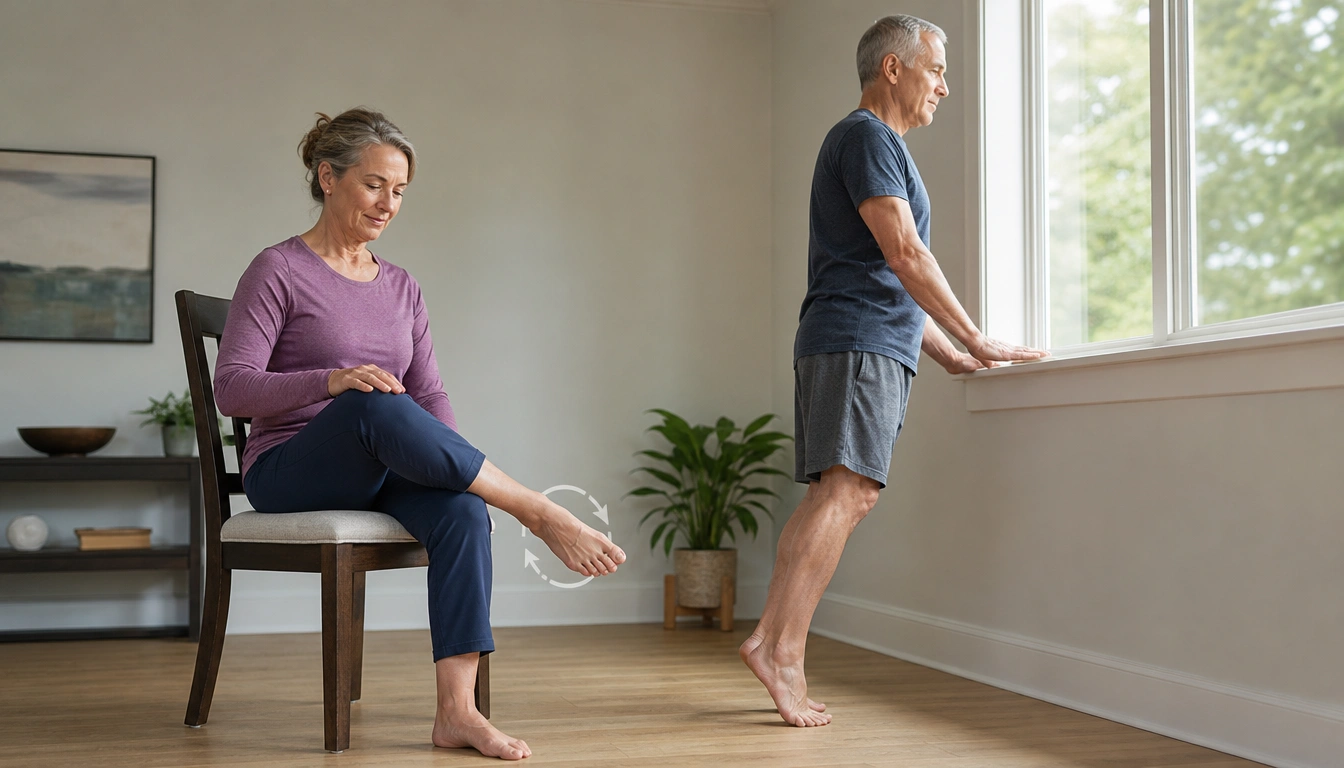
Adults over 50 usually do best with simple ankle mobility work that improves dorsiflexion, plantarflexion, and foot control for walking. The most useful options are seated ankle circles or alphabet drills, supported heel lowers, and toe-spread or towel exercises. Keep the effort gentle to moderate, and pause or modify if movement causes sharp pain, new swelling, instability, or worsening numbness.
Key Takeaways
- Dorsiflexion helps your toes clear the floor; plantarflexion helps you push off and stay stable at the end of each step.
- As people age, walking often becomes shorter and more guarded if the ankles lose motion or power.
- A few minutes of ankle work most days can fit into a morning routine, TV time, or a post-walk cool-down.
- Supported heel lowers can train mobility and calf strength at the same time, which is useful for walking.
- Past sprains, arthritis, swelling, or neuropathy may require smaller ranges, slower pacing, or professional guidance.
- Supportive shoes can help for walking, but barefoot or minimalist foot work is only appropriate on safe surfaces and when the foot can tolerate it.
Why ankle mobility matters for walking after 50
For walking, the ankle is not a small side player. It is the joint that helps your foot clear the ground, accept your body weight, and push you forward into the next step. According to the National Institute on Aging, lower-body weakness and balance problems are major contributors to falls in older adults, and the ankle is part of both of those issues.
When ankle motion is limited, you may compensate by lifting the knee higher, swinging the leg wider, or taking shorter steps. Those changes can make walking feel less smooth on curbs, rugs, gravel, or uneven pavement. You may also notice that you do not trust the foot to respond quickly when the surface changes.
Good ankle mobility does not mean extreme flexibility. It means you can move through enough range to walk efficiently, adapt to the ground, and recover if your step lands a little off target.
How aging changes gait and why the ankle matters
As adults age, walking often becomes more cautious. Research summarized in exercise and rehabilitation literature shows that older adults may shift away from a strong ankle-driven push-off and toward a more guarded, hip-dominant pattern. That shift can help protect the body, but it can also reduce stride length and slow walking speed.
You may notice this pattern as a smaller step, less spring at the end of the stride, or a sense that you are “shuffling” instead of rolling through the foot. Some people also feel less stable during turns or when stepping over an object. A stiff or underpowered ankle gives less help during these moments, so the hips and trunk have to do more work.
That matters because walking is not just about moving straight ahead. It is also about adapting to daily surprises: a driveway crack, a curb, a driveway slope, a loose mat, or a quick shift in direction. The ankle helps handle those changes with less effort.
The two ankle motions that matter most
Dorsiflexion is the motion that pulls the toes up toward the shin. During walking, it helps your foot clear the ground during the swing phase, which lowers the chance of catching a toe on the floor. It also supports dynamic balance, because the ankle can adjust more effectively when the body shifts forward.
Plantarflexion is the motion that points the foot downward, as if pressing a gas pedal. It matters most near the end of stance, when the foot helps propel you forward and contributes to postural stability. If plantarflexion is weak or stiff, you may feel less push-off and more effort with each step.
Both motions are useful, but they are not trained the same way. Dorsiflexion often benefits from gentle mobility and stretching. Plantarflexion usually needs a mix of mobility and controlled strengthening so the calf and foot can produce force safely.
| Motion | Why it matters for walking | What you may notice when it is limited |
|---|---|---|
| Dorsiflexion | Helps toes clear the ground and supports balance | More toe catching, shorter steps, less confidence on uneven surfaces |
| Plantarflexion | Helps with push-off and stability at the end of the step | Less spring, slower pace, more effort during longer walks |
A low-equipment ankle mobility routine you can actually keep up
This routine is designed for daily life, not a gym. It works well in the morning, after a walk, or while waiting for the kettle, TV ads, or a phone call.
Seated ankle circles or the alphabet
Sit in a stable chair. Lift one foot slightly off the floor and draw slow circles, then trace the alphabet with your big toe. Move within a comfortable range and keep the motion smooth. This is a simple way to wake up the ankle joint and move it through several directions without loading it heavily.
Supported heel lowers
Stand facing a wall, counter, or sturdy rail. Place the balls of your feet on a low step or thick book only if the setup feels secure; otherwise, do the motion on flat ground and shift gently onto your toes. Rise slightly, then lower the heels slowly. This trains the calf and ankle together, which is useful for walking propulsion.
Toe spreads and towel scrunches
While seated, spread your toes apart, then relax. You can also place a small towel on the floor and use your toes to scrunch it toward you. These movements build foot awareness and support the base that the ankle works on.
If you prefer a very simple version, choose just one seated drill and one standing drill. Consistency matters more than doing a long routine once in a while.
How to progress safely without overdoing it
For most healthy adults, ankle mobility should feel like mild effort, light stretching, or a warm, working sensation. You are looking for movement that feels controlled, not forced. A gentle range done often is usually more useful than an aggressive stretch done rarely.
A good rule is to start with a small dose and build only if the ankle settles well afterward. If you feel a little stiffness that eases as you move, that is often acceptable. If pain increases during the set, changes your walking pattern, or lingers afterward, the dose is probably too much.
Use the ankle work as part of a larger walking plan. Short walks plus brief mobility practice are often more sustainable than trying to fix everything in one session. The goal is to make walking feel easier over time, not to chase a dramatic stretch sensation.
How to modify ankle work for past injuries, arthritis, or neuropathy
Many adults over 50 have an old sprain, fracture, or lingering joint irritation. In those cases, the ankle may need slower, smaller movements and more attention to alignment. Avoid forcing the foot into an end range if that creates sharp pain or a sense of joint pinching.
If you have arthritis or swelling, choose movements that warm the joint without compressing it heavily. Some days a seated drill will feel better than a standing one. Swelling often changes how the joint moves, so it can help to reduce load and check whether symptoms settle after rest.
With neuropathy or reduced sensation, the problem is not only stiffness. Sensory feedback may be dulled, which means you may not feel small changes in pressure or position as clearly. In that case, use a stable surface, go slower, and consider checking in with a physical therapist or podiatrist for a safer plan. The National Institutes of Health notes that neuropathy can affect balance and foot function, so caution matters.
Pause or seek medical advice if you have a recent sprain or fracture, sudden swelling, warmth, locking, new instability, open skin, or pain that is sharp rather than mildly stretching. Those signs deserve evaluation before you push mobility work further.
Footwear, sensation, and safe barefoot practice
Supportive shoes can be helpful for walking, especially if you need cushioning, stability, or a reliable fit. But very rigid or heavily cushioned shoes can also reduce how much the sole of the foot feels the ground. That reduced sensory input may matter if you already have balance concerns.
Some foot exercises can be done barefoot or in thin socks on a safe indoor surface, but that is not the same as walking barefoot everywhere. Barefoot work is best reserved for clean, uncluttered floors and for feet that can tolerate the load. If you have neuropathy, diabetes-related foot risk, marked deformity, or a history of skin breakdown, barefoot practice may not be appropriate.
The safest approach is usually flexible: use supportive shoes for most walking, then remove them briefly for controlled seated or standing foot drills if your feet tolerate it.
How to make ankle mobility part of everyday walking
Habits work better than perfect plans. Attach ankle mobility to things you already do: after brushing your teeth, while the coffee brews, before your first walk, or after you take off your shoes at home. Even two or three minutes can be enough to create a routine you will repeat.
For walking-focused consistency, pair mobility with your walk itself. Before you head out, do a few ankle circles and a set of toe spreads. After the walk, try supported heel lowers or a short seated alphabet. This links the exercise to the behavior you want to improve, which makes it easier to remember.
If you walk several days per week, a brief ankle routine on most of those days is usually more practical than waiting for one longer session. Keep the plan simple enough that you can do it when you are busy, traveling, or tired. The best routine is the one you can repeat without dreading it.
If you work with a caregiver or trainer, ask them to watch your step length, toe clearance, and balance on turns. Small changes in walking often show up before pain does, and early attention can make the routine more effective.
Frequently Asked Questions
How does ankle dorsiflexion affect walking and balance after 50?
Dorsiflexion helps the toes clear the floor during the swing phase of walking. If it is limited, you may catch your toes more easily, take shorter steps, or feel less steady on uneven ground. It is one of the most useful ankle motions to keep working on for safer walking.
What are the safest ankle mobility exercises for older adults?
The safest options are usually seated ankle circles or alphabet drills, gentle toe spreads, and supported heel lowers. These can be scaled up or down easily and done without special equipment. If standing work feels unstable, start seated and build gradually.
How often should adults over 50 work on ankle mobility for walking?
Most people do well with brief work on most days, or several times per week at minimum. The exact schedule depends on pain, stiffness, injury history, and overall activity level. Short, regular practice is usually more useful than a long session once in a while.
Can ankle stiffness contribute to tripping or falls?
Yes. Limited ankle motion can make it harder to clear the ground, adjust to uneven surfaces, and recover from small balance disturbances. That does not mean every trip is caused by the ankle, but ankle stiffness can be one important contributor.
When should someone with ankle stiffness see a physical therapist or podiatrist?
Seek evaluation if stiffness is one-sided, getting worse, linked with numbness, or paired with recurrent tripping, swelling, or pain that does not settle. You should also get checked after a recent sprain or fracture, or if walking feels unsafe or unpredictable.
The Bottom Line
If your goal is easier, safer walking after 50, focus on ankle motion that supports toe clearance, push-off, and balance. The most practical starting points are seated circles or alphabet work, supported heel lowers, and simple toe exercises.
Keep the work gentle, frequent, and tied to daily habits. If you have past injury, arthritis, neuropathy, or swelling, scale the movement to what feels stable and seek individualized help when symptoms are persistent or unusual.
Medical disclaimer
Medical disclaimer: This content is for educational and informational purposes only and is not a substitute for professional medical advice, diagnosis, or treatment. Dietary needs and supplement suitability vary by individual.
