
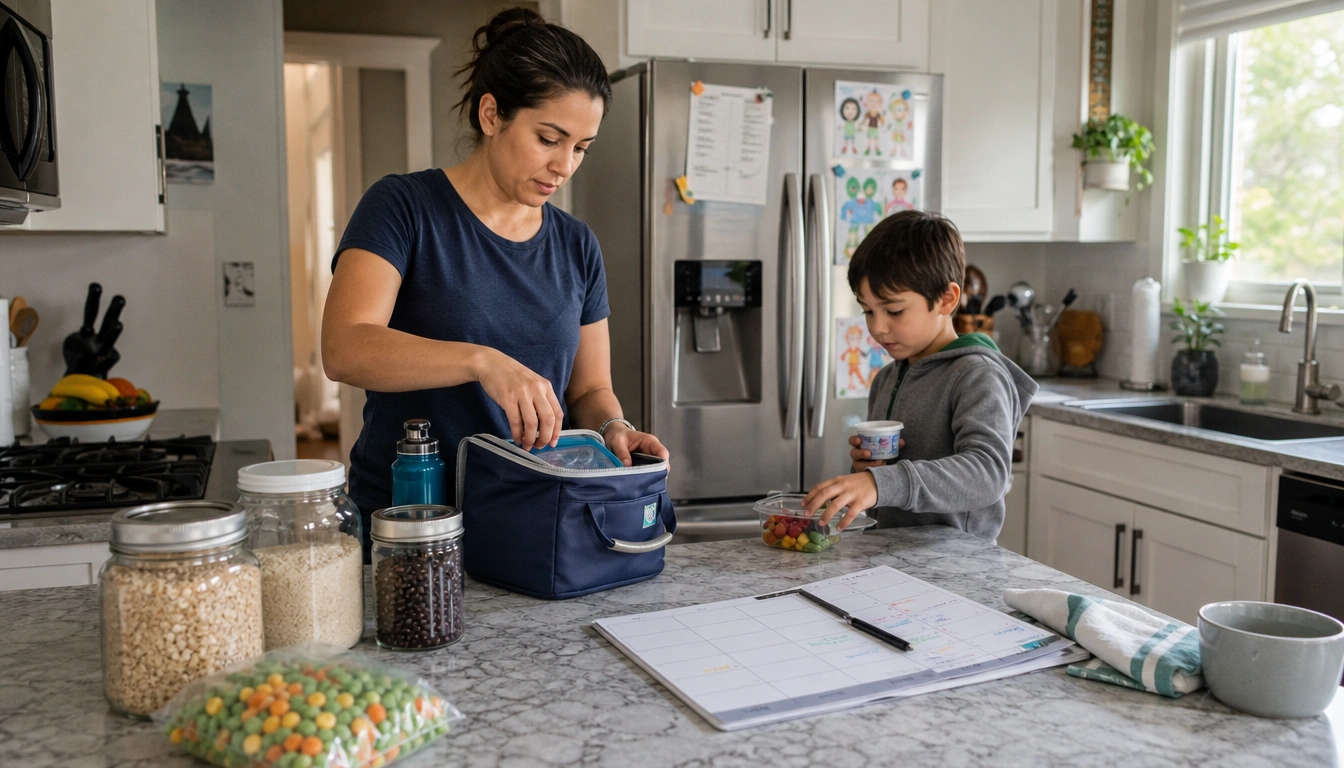
A budget-friendly routine for busy school weeks works best when it reduces decisions, not adds them. Start with a quick pantry and freezer check, map a few simple meals around low-cost staples, and use leftovers on purpose instead of treating them as an afterthought. Pair that with school breakfast or lunch programs when eligible, and keep food safety in mind so the routine stays practical and safe.
Key Takeaways
- Use a short weekly plan built from what you already have, then buy only the gaps. That lowers waste and avoids duplicate purchases.
- Lean on low-cost staples such as oats, rice, beans, lentils, frozen vegetables, seasonal produce, whole grains, and affordable proteins.
- Make mornings easier by setting out breakfast and lunch components the night before so school days do not depend on last-minute convenience food.
- Plan dinners with leftovers in mind so one cooking session can cover more than one meal without extra stress.
- Adjust portions by age and activity level: younger children usually need smaller, nutrient-dense meals, while teens often need larger servings and more calories.
- Use school meal programs, pantry checks, and food safety rules as part of the routine, not as backup thoughts.
Why school weeks are the hardest time to stay healthy on a budget
School weeks squeeze together time, money, and energy. Mornings move fast, afternoons bring homework and activities, and dinner often happens when everyone is already tired. That is exactly when families are most likely to overspend on convenience foods or skip the planning that keeps meals steady.
The CDC notes that consistent family routines around nutrition, sleep, and activity support children’s growth, learning, and overall health. In practice, that means a simple weekday food routine can do two jobs at once: it can support child health and school performance while also making grocery spending more predictable.
The easiest version is not a perfect meal plan. It is a short list of breakfasts, lunches, and dinners that repeat in some form each week. Start by checking the pantry, fridge, and freezer before shopping. Use what is already there, then build a simple 5-day menu around flexible staples such as oats, rice, beans, lentils, frozen vegetables, seasonal produce, whole grains, and affordable proteins like eggs, yogurt, peanut butter, canned tuna, tofu, or chicken when budget allows.
A routine like this lowers decision fatigue. Instead of asking “What can we make?” every day, the household follows a small set of dependable meals that are easy to repeat, adjust, and scale.
Use unit pricing and bulk buying strategically
Bulk buying only saves money when the food is actually used. USDA budgeting guidance and extension education sources emphasize that the best value is often a low-cost staple that fits the household’s real storage space and cooking habits. A large bag of rice or frozen vegetables can be a bargain; an oversized package that spoils or gets forgotten is not.
Unit pricing helps make that decision clearer. Check the price per ounce, pound, or count rather than the sticker price alone. The larger package is not automatically cheaper. Sometimes the store brand, smaller package, or different form of the same food costs less per serving.
A good rule is to buy in bulk only for foods your family already uses often and can store safely. Dry oats, beans, pasta, rice, flour, and frozen vegetables usually fit that pattern. Foods that spoil quickly, get stale, or require special storage are better purchased in amounts your household can finish during the week.
Inventory matters just as much as price. Before shopping, write down what needs to be used first from the pantry, freezer, and fridge. That small step can turn “I need to buy dinner” into “We already have the rice, beans, and vegetables for two meals.” It is one of the simplest ways to reduce waste before it starts.
Make breakfast and lunch almost automatic
Mornings are where many routines break down. The solution is to move a little work to the night before. Pack lunches, portion snacks, and set out breakfast items so the next day starts with a short, repeatable sequence instead of a scramble.
For breakfast, choose foods that can be served quickly or assembled with almost no thinking: oatmeal, overnight oats, whole-grain toast with peanut butter, yogurt with fruit, hard-boiled eggs, or a simple cereal paired with fruit. The goal is not variety every day. The goal is a few reliable options that keep kids fed and help them get out the door without a rush purchase.
For lunch, think in components rather than elaborate recipes. A sandwich, wrap, or grain bowl becomes easier when the parts are already ready: cooked rice, beans, chopped vegetables, fruit, cheese, hummus, or leftover protein from dinner. Packing a lunchbox becomes less expensive when it is based on what is already in the kitchen instead of convenience snacks bought at the last minute.
Many families also do better with a “launch pad” near the door: school bags, water bottles, lunch boxes, and tomorrow’s breakfast items all in one place. That small habit can save time, reduce forgotten items, and lower the chance of replacing missing food with a more expensive stop on the way to school.
Turn dinners into planned-overs
Planned-overs are leftovers with a plan. Instead of cooking one dinner and hoping the rest gets used, you decide in advance how the extra food will become tomorrow’s meal. That shift turns leftovers into part of the budget strategy rather than food waste.
Batch cooking works well here, especially for soups, stews, chili, roasted vegetables, rice dishes, casseroles, and slow-cooker meals. Cook a larger amount once, then divide it into meals that make sense for the week. A roast chicken can become dinner on night one, filling for wraps or sandwiches on night two, and a soup base later in the week. Beans and rice can appear as a side dish, then return in a burrito bowl or soup.
This approach is especially helpful when school evenings are packed. One cooking session can serve multiple purposes: dinner tonight, lunch tomorrow, and maybe a backup meal for the next busy evening. Families do not need fancy recipes. They need a small number of meals that hold up well in the fridge, reheat easily, and can be changed with different toppings or sides.
To keep it practical, plan only as much as your household will actually eat before the food loses quality. The purpose is not to cook endlessly. It is to make each effort stretch further without creating another chore.
How to adapt the routine for different ages and appetites
Younger children and teens often need different meal patterns, and the budget routine should reflect that. Younger children usually do better with smaller, more frequent portions and nutrient-dense foods that are easy to eat. Teens, especially those in sports or growth spurts, may need larger portions and more calories overall.
That does not mean buying separate foods for every age. It means using the same base ingredients in different amounts. A child might get a small bowl of oats with fruit, while a teen gets a larger bowl with extra peanut butter or yogurt. A younger child may need half a sandwich and fruit, while a teen may need a full sandwich plus beans, soup, or a second serving of rice or pasta.
CDC guidance on healthy routines supports a broader view of nutrition: meals should help children stay energized for school, not just get through the day. So if appetite is high after practice or low before school, the routine should flex around that reality. Affordable foods that work well across ages include eggs, beans, peanut butter, yogurt, cheese, oats, rice, potatoes, pasta, fruit, and frozen vegetables.
For households with several children, the easiest strategy is often a shared meal with adjustable portions. That keeps shopping simpler while still respecting different needs.
How to handle allergies, picky eating, and cultural preferences on a budget
A budget routine works best when it is realistic for the people eating it. If a child has allergies or intolerances, the safest and most affordable plan is often built around naturally suitable foods rather than expensive specialty substitutes. For example, rice, potatoes, corn, beans, fruits, vegetables, eggs, and many plain meats can fit a wide range of dietary needs depending on the issue.
Families dealing with picky eating often do better with repetition and small changes than with constant reinvention. A child may refuse a new dish the first time but accept the same ingredients in a different form later in the week. That might mean serving the rice separately from the sauce, keeping vegetables on the side, or offering a familiar fruit with a new protein.
Cultural food preferences also matter. The most sustainable budget routine is one that fits the foods your family already likes and knows how to cook. If a household regularly uses tortillas, lentils, rice, or stewed vegetables, those can be the core of the plan. Familiar food is not a barrier to healthy eating; it is often the reason a routine lasts.
The best test is simple: if a meal is cheap but no one will eat it, it is not actually helping the budget.
Food safety basics for batch cooking and leftovers
Food safety matters because the school-week routine depends on leftovers doing real work. The USDA and CDC advise cooling cooked foods promptly, storing them in shallow containers, and keeping refrigerator leftovers within safe time limits. For many cooked perishables, that usually means using or freezing them within about 3 to 4 days.
Reheat leftovers thoroughly until steaming hot, and do not rely on smell or appearance to judge safety. If a food has sat out too long, was cooled too slowly, or seems questionable, it is safer to discard it than to stretch the budget by risking illness.
It also helps to label containers with the date so there is no guessing later in the week. A shelf in the fridge for “eat first” foods can keep older leftovers from getting lost behind newer groceries. That is especially useful in busy homes where meals are grabbed quickly between work, school, and activities.
Food safety is not about being extra cautious for its own sake. It is what lets batch cooking actually save time and money without creating a new problem.
When school meal programs or community resources should be part of the plan
Not every meal has to come from home. If your family qualifies for school breakfast or lunch programs, those meals can be a major cost-saving tool. USDA and CDC resources support school meal programs because they provide structured, nutritious meals that can reduce the pressure on the household food budget while helping children eat regularly during the school day.
Using school meals does not mean giving up on healthy eating at home. It means building a routine around the meals that are already available and affordable. For some families, breakfast at school reduces morning stress and grocery costs. For others, lunch programs mean one less meal to pack and one less item to buy for the lunchbox.
If food is still tight, community food banks, local pantries, SNAP, and WIC can also play a role. Those resources are not a sign that the household has failed to plan. They are part of a practical response when the budget is too stretched to cover every need comfortably. If you are unsure whether your family qualifies, it is worth checking rather than trying to carry the full load alone.
A steady school-week routine often works best when home meals, school meals, and community supports all fit together.
Frequently Asked Questions
How can I build a simple school-week meal plan on a tight budget?
Start with what you already have, then choose a few repeatable breakfasts, lunches, and dinners for the week. Build meals around oats, rice, beans, eggs, frozen vegetables, fruit, and other low-cost staples. A short, realistic plan is easier to follow than a detailed menu that gets ignored when the week gets busy.
What are the cheapest healthy foods that work well for breakfasts, lunches, and dinners?
Common budget-friendly options include oats, rice, beans, lentils, potatoes, eggs, peanut butter, yogurt, whole-grain bread, frozen vegetables, seasonal fruit, and canned tuna or chicken. The cheapest choice depends on local prices, so unit pricing helps compare value more accurately.
How can I use leftovers and batch cooking without wasting food or risking safety?
Cook larger meals that can become planned-overs for the next day, and store leftovers in shallow containers in the fridge right away. Use or freeze most cooked perishables within about 3 to 4 days and reheat leftovers thoroughly. Labeling containers with dates makes the system easier to follow.
How can school lunch and breakfast programs help lower costs if my family qualifies?
School meal programs can reduce the number of meals you need to buy and pack at home, which can lower grocery bills and morning stress. They also provide a predictable option when school mornings are hectic. If your child qualifies, they can be part of a practical budget plan rather than a last resort.
How do I adjust a budget routine for teens versus younger children?
Younger children usually do better with smaller, more frequent, nutrient-dense meals, while teens often need larger portions and more calories. Use the same base foods for both, but serve different amounts. Teens may also need extra snacks or a larger dinner portion after sports or active days.
The Bottom Line
A good school-week routine is less about perfect meal prep and more about reducing daily decisions. Inventory what you have, plan a few repeatable meals, and use leftovers on purpose so the week feels more manageable.
The most useful budget habits are the ones that are simple enough to repeat: check unit prices, keep pantry and freezer lists, pack breakfasts and lunches ahead of time, and use school meal programs when they fit your family’s situation.
If food safety, allergies, or a child’s eating pattern make the routine harder to manage, adjust the plan rather than forcing it. A calm, realistic system that people will actually use is usually the one that saves the most money and stress over time.
Medical disclaimer
Medical disclaimer: This content is for educational and informational purposes only and is not a substitute for professional medical advice, diagnosis, or treatment. Dietary needs and supplement suitability vary by individual.
Sources
- U.S. Government / Health Authority — usda.gov. Accessed November 2026.
- Centers for Disease Control and Prevention (CDC) — cdc.gov. Accessed November 2026.
- Centers for Disease Control and Prevention (CDC) — cdc.gov. Accessed November 2026.
- Academic Research Institution — msu.edu. Accessed November 2026.
- Academic Research Institution — ucanr.edu. Accessed November 2026.
- Academic Research Institution — ndsu.edu. Accessed November 2026.
