
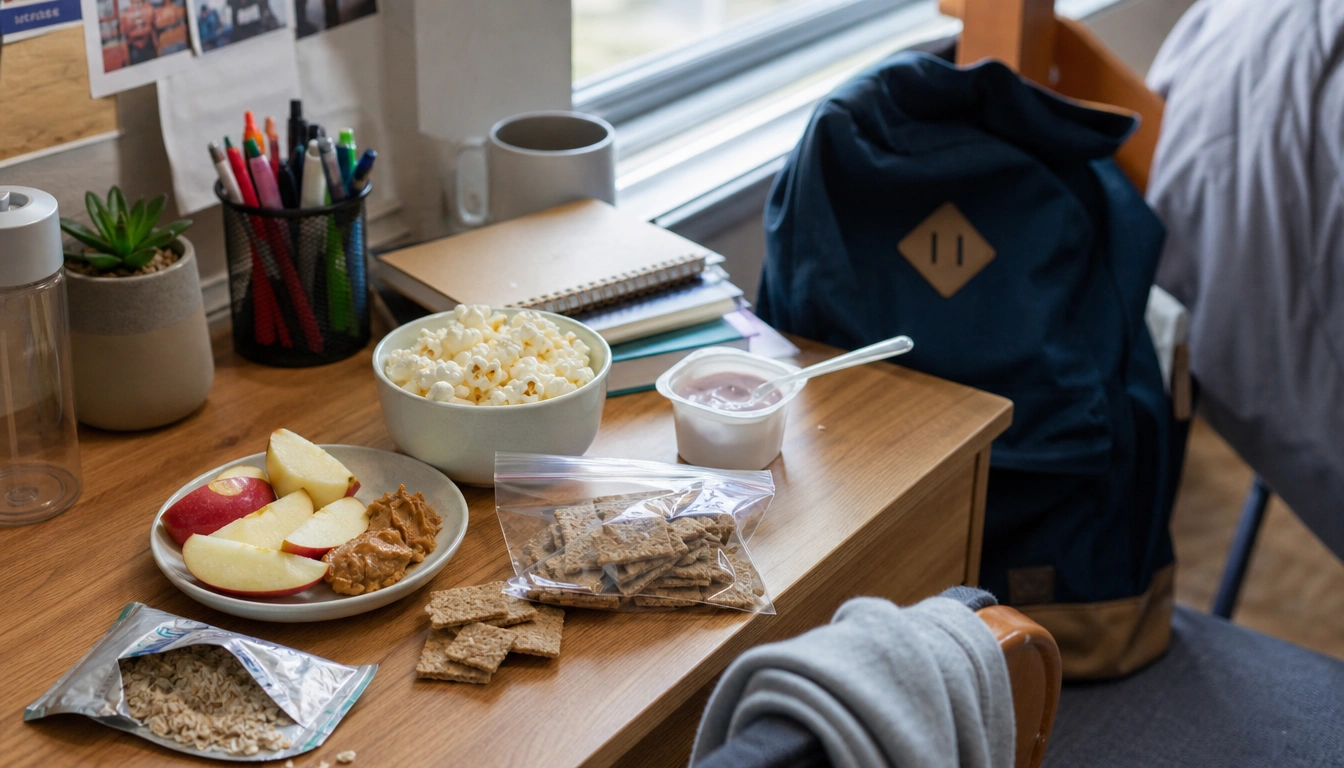
The best healthy snacks for college students are simple “combo snacks” that pair a fiber-rich carb with protein or healthy fat. Good grab-and-go choices include fruit with peanut butter, yogurt with oats, popcorn with nuts, crackers with tuna, and shelf-stable options like oatmeal packets and roasted peanuts. These are quick, budget-friendly, and more likely to keep you full between classes than snacks made mostly of refined carbs or added sugar.
Key Takeaways
- Aim for snacks that combine fiber-rich carbohydrates with protein or healthy fat to support steadier energy and better fullness.
- For dorms and backpacks, choose no-cook options like nuts, popcorn, tuna packets, fruit, yogurt, cheese sticks, and whole-grain crackers.
- Budget staples such as oats, peanut butter, peanuts, canned fish, and popcorn can stretch food dollars without relying on expensive snack bars.
- Check labels on packaged snacks: a “healthy” bar or flavored yogurt can still be high in added sugar, sodium, or low in protein and fiber.
- Student-athletes and very active students often need larger or more frequent snacks than less active peers.
- If you have food allergies or share storage space, pack and store snacks carefully to reduce cross-contact and spoilage risks.
Why college snacking gets tricky
College schedules make regular meals hard to protect. Classes, labs, commuting, clubs, part-time work, and late study sessions can leave long gaps between meals, which is when students often reach for whatever is cheapest and closest. The result is usually not a carefully planned snack, but a vending-machine choice, a pastry, or a bagged snack that is easy to eat quickly and easy to overeat.
Stress and sleep disruption matter too. When you are tired or rushed, you are more likely to crave fast-digesting, highly processed foods. Campus dining can help, but it is not always open when you need it, and dorm kitchens are often limited or shared. That is why the best college snacks are usually the ones that require almost no prep, can survive in a backpack or desk drawer, and still offer enough staying power to get you through a study block.
Food budget is part of the picture as well. Many students are trying to make meals last longer, and some are dealing with food insecurity. In that setting, a practical snack is not a “bonus” food. It can be a bridge between classes, a replacement for a missed meal, or a way to avoid getting so hungry that you overspend later on convenience food.
The best snack formula for steady energy
A useful snack formula is simple: pair a fiber-rich carbohydrate with protein or healthy fat. That combination tends to digest more slowly than a lone carb snack and can help you feel satisfied for longer. Think fruit plus nuts, crackers plus tuna, or oats plus yogurt. Harvard Health and other clinical nutrition guidance describe this as a practical way to reduce sharp blood sugar swings that can make you feel hungry again too soon.
Why it works: fiber slows how quickly food moves through the stomach and intestines, while protein and fat add staying power. A single apple or a handful of pretzels may be fine if you just need a light bite, but they are less likely to carry you through a long lecture or a two-hour library session. Adding even a small amount of protein or fat often makes the snack more useful.
That does not mean every snack has to be perfectly balanced. The goal is to avoid building a snack around only refined starch or sugar. If all you have is fruit, great. If you can add peanut butter, yogurt, seeds, cheese, tuna, or nuts, the snack usually becomes more filling and more study-friendly.
Dorm-friendly snack categories by use case
Backpack snacks: These should travel well, resist squishing, and not need utensils. Good options include apples, bananas, trail mix, peanuts, roasted chickpeas, popcorn, whole-grain crackers, and single-serve nut butter packets. These are the kinds of snacks you can carry to class, keep in a bag, and eat quickly between commitments.
Library snacks: Choose foods that are quiet, low-mess, and not strongly scented. Packaged tuna may be great nutritionally, but it may not be ideal in a shared study space. Better choices are a banana with peanut butter, a granola-and-nut mix with lower added sugar, string cheese, or a yogurt cup if you have a cold pack and the library allows food.
Late-night study snacks: At night, the biggest trap is reaching for sweets that lead to a quick energy rise and crash. A better option is something small but satisfying, such as oatmeal, yogurt with oats, crackers with hummus, or popcorn with nuts. These choices are more likely to keep you alert without feeling heavy.
Post-workout snacks: If you train, practice, or spend long hours on your feet, recovery snacks should often include more carbohydrate and protein than a sedentary student might need. A yogurt cup with fruit, a turkey or tuna sandwich on whole-grain bread, or crackers with a protein source can work well after activity.
Affordable staple ingredients that stretch a budget
Cheap does not have to mean nutritionally empty. Some of the most useful college snacks are also the most affordable. Oatmeal packets are fast, shelf-stable, and easy to upgrade with peanut butter or fruit. Plain peanuts and other unsalted nuts offer protein and fat in a small package, so a modest portion can go a long way. Popcorn is another budget-friendly staple because it is a whole grain with volume, which helps it feel like a real snack rather than a handful of crumbs.
Canned tuna or salmon can be excellent if you have access to a can opener and somewhere to eat. They pair well with crackers, bread, or even prewashed greens if you have a fridge. Peanut butter is a classic student staple because it is inexpensive, portable, and easy to combine with fruit or crackers.
Yogurt and fruit are often affordable too, especially if you buy larger containers and portion them out, though a single-serve cup may be more practical for busy days. Crackers are most useful when you choose whole-grain versions and pair them with protein. The general rule is to favor staples that can be mixed and matched in several ways, so one grocery trip gives you multiple snack combinations.
How to choose packaged snacks
Packaged snacks are not automatically bad, but the front of the package can be misleading. A “protein” bar, a “smart” muffin, or a flavored yogurt can still be high in added sugar, low in fiber, or surprisingly high in sodium. A quick label check helps you avoid paying for marketing instead of nourishment.
Start with the ingredient list. If sugar, syrups, or refined grains are near the top, the snack may function more like candy or dessert than a filling between-meal option. Then look at the nutrition facts panel for fiber and protein. Snacks that provide a meaningful amount of both are usually more useful for long gaps between meals than snacks built mostly from white flour and sweeteners.
Sodium matters too, especially if you rely on packaged snacks often or already get plenty from dining hall meals. The Dietary Guidelines for Americans encourage patterns that emphasize minimally processed foods, whole grains, beans, nuts, seeds, fruit, vegetables, and lean proteins. That does not mean every packaged snack is off-limits. It means the best packaged snacks should support those patterns rather than replace them.
Simple snack assembly ideas with almost no prep
Assembly snacks are ideal when time, energy, and kitchen access are limited. You are not cooking from scratch; you are combining a few foods that work together. Try apple slices with peanut butter, banana with peanuts, whole-grain crackers with tuna, popcorn with seeds, yogurt with oats, or carrots with hummus. These are all easy to scale up or down depending on hunger.
If you have only shelf space, lean on combinations that do not need refrigeration right away. Examples include oatmeal packets plus nuts, peanut butter plus crackers, popcorn plus roasted chickpeas, or an apple plus a single-serve nut butter packet. If you have a fridge, you can add cheese sticks, yogurt, hard-boiled eggs, or cut fruit to the mix.
The point is not to build the “perfect” snack. It is to create a fast option that is better than a random vending-machine choice and more filling than a single carbohydrate by itself. That small upgrade can make a noticeable difference during long days on campus.
Food-safety and allergy considerations for shared dorms
Shared living spaces make food safety more important. Perishable snacks need refrigeration or an insulated bag with a cold source, and leftovers should not sit out for long periods. If you are packing yogurt, cheese, tuna, or cooked eggs for later, think ahead about how long they will be away from cold storage.
Allergens deserve special attention. Peanuts, tree nuts, dairy, eggs, fish, shellfish, soy, wheat, and sesame can all matter in dorms and common areas. If you or a roommate has allergies, keep containers sealed, wipe shared surfaces, and respect campus allergen-free rules. Do not assume that a “healthy” snack is automatically safe for everyone.
If you use shared refrigerators or cabinets, label your food clearly and store it in a way that reduces accidental mix-ups. When in doubt, choose individually packaged foods with intact seals, especially if you are carrying them in a backpack or storing them in a crowded common space.
How to adjust snack size based on activity and hunger
Snack size should match the day you are actually having. A sedentary student who just needs something between classes may do well with a smaller snack, while a student-athlete, dancer, campus worker, or anyone with long active days may need a larger or more frequent snack. The same goes for students who are replacing a missed meal rather than simply bridging a short gap.
If you are genuinely hungry, a tiny snack may not be enough. In that case, build a more substantial option by adding another food group: fruit plus yogurt, crackers plus tuna, oatmeal plus peanut butter, or trail mix plus a piece of fruit. If you are only slightly hungry, a lighter snack may be enough to keep you steady until the next meal.
Pay attention to patterns. If you are always starving at the same time each day, your snack may be too small, too low in protein, or too low in fiber. If you are eating out of stress rather than hunger, a planned snack can still help, but it may be better to choose something simple and portioned instead of grazing from a large package. For ongoing trouble with food access, restrictive eating, or constant fatigue, campus health services or a registered dietitian can help you sort out what is going on.
Frequently Asked Questions
What snack combinations help me stay full and focused between classes?
The most reliable options combine a fiber-rich carb with protein or healthy fat. Good examples are fruit with peanut butter, yogurt with oats, crackers with tuna, or popcorn with nuts. Those combinations tend to be more filling than fruit, chips, or sweets alone.
What are the best shelf-stable healthy snacks for a dorm room or backpack?
Good shelf-stable choices include oatmeal packets, peanuts, roasted chickpeas, whole-grain crackers, popcorn, shelf-stable tuna packets, and single-serve nut butter. These are easy to store, portable, and useful when you do not have a fridge or kitchen.
How can I build healthy snacks on a student budget?
Use low-cost staples that can be mixed in different ways. Oats, peanut butter, peanuts, popcorn, canned fish, crackers, and seasonal fruit often give better value than expensive bars or snack packs. Buying larger containers and portioning them yourself can also save money.
What should I look for on nutrition labels when buying packaged snacks?
Check the ingredient list first, then the fiber, protein, sugar, and sodium on the Nutrition Facts label. A snack that looks healthy on the front can still be high in added sugar or low in protein and fiber. Look for foods that are more like real ingredients than candy in disguise.
What healthy snack options work best before or after studying or workouts?
Before studying, choose something steadying and not too heavy, such as yogurt with oats or crackers with peanut butter. After workouts, choose a snack with more carbohydrate and protein, such as fruit and yogurt, tuna with crackers, or a turkey sandwich if you need more recovery fuel.
The Bottom Line
The fastest healthy snacks for college students are usually simple combinations, not complicated recipes. Pair fiber-rich carbs with protein or healthy fat, and you will usually get better fullness and steadier energy than you would from a snack made mostly of refined starch or sugar.
For busy campus life, the most useful foods are the ones you can carry, store, and assemble easily: fruit, nuts, popcorn, oats, peanut butter, yogurt, crackers, and canned fish. These staples also fit tighter budgets better than many packaged “health” snacks.
If you are very active, snack more often or choose larger portions. If food access is a struggle, focus on the most affordable shelf-stable options you can keep on hand and use campus resources when needed.
Medical disclaimer
Medical disclaimer: This content is for educational and informational purposes only and is not a substitute for professional medical advice, diagnosis, or treatment. Dietary needs and supplement suitability vary by individual.
Sources
- National Institutes of Health (NIH) — nih.gov. Accessed November 2026.
- National Institutes of Health (NIH) — nih.gov. Accessed November 2026.
- Academic Research Institution — harvard.edu. Accessed November 2026.
- Mayo Clinic — mayoclinic.org. Accessed November 2026.
- Mayo Clinic — mayoclinic.org. Accessed November 2026.
