
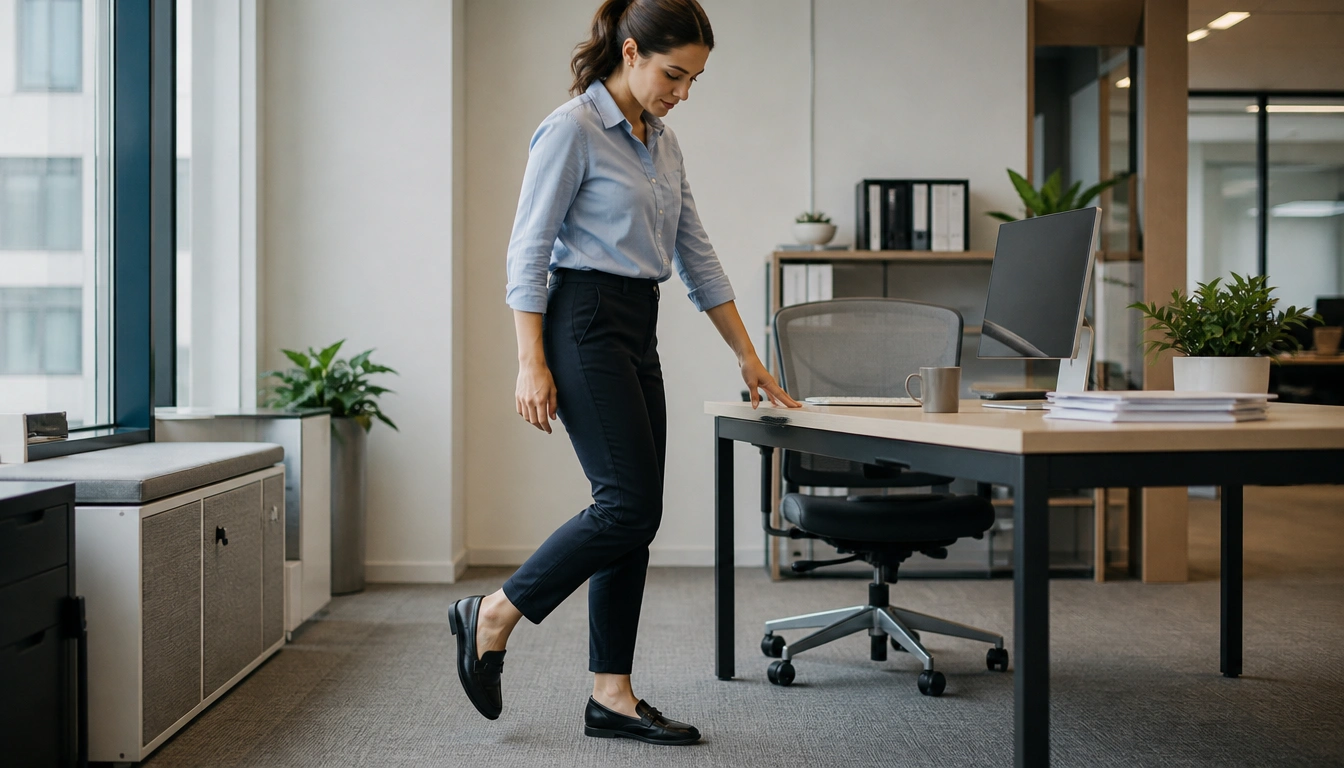
You can improve ankle mobility for walking in just a few minutes a day by focusing on gentle, repeatable dorsiflexion work and short movement breaks. For busy office workers, the most useful approach is a desk-friendly routine built around micro-bouts, such as ankle circles, heel-to-toe rocking, and knee-to-wall drills. Done consistently, this can reduce stiffness and help walking feel less effortful, especially after long sitting periods.
Key Takeaways
- Ankle dorsiflexion is the walking-specific motion that lets your shin move forward over your foot; when it is limited, walking mechanics often get less efficient.
- Long sitting can leave the ankle stuck in a shortened position for hours, which contributes to stiffness over time.
- You do not need a full workout session—short mobility breaks anchored to daily habits are usually more realistic for office workers.
- If you have a history of ankle sprains or chronic instability, mobility work should usually be paired with strengthening and balance practice.
- Sharp pain, swelling, numbness, or inability to bear weight are not normal stiffness and should stop self-treatment.
- Footwear matters: rigid shoes or frequent heel use can encourage more plantar-flexed positioning during the workday.
Why ankle mobility matters for walking after long desk hours
Your ankles do more than move up and down. They help your body accept weight, roll forward over the foot, and push off efficiently with each step. According to the American College of Sports Medicine, movement quality matters as much as movement quantity when you are trying to stay active during the day. For office workers, ankle stiffness often shows up first as that awkward feeling that your walk is shorter, heavier, or less smooth after sitting.
Good ankle mobility is especially useful because walking is repeated thousands of times a day. Small restrictions can become big habits if the body keeps working around them. When your ankle moves well, the rest of the leg does not have to compensate as much. That can make walking feel easier without requiring extra effort from your knees, hips, or lower back.
How sitting changes ankle position and stiffness over time
Long stretches in a chair often place the ankle in a neutral or slightly shortened position for hours. That may not seem like much, but repeated day after day, it reduces the variety of positions the joint experiences. The result is not just “tight muscles.” It is a gradual loss of comfortable joint motion and coordination.
Public health guidance from the CDC encourages breaking up prolonged sitting with movement. That advice matters for the ankles too. When the lower leg rarely gets to move through full ranges, the surrounding tissues adapt to the most common position they see. For many office workers, that means the ankle becomes less ready for walking demands by the end of the workday.
Another factor is how little the ankle has to work while seated. If the foot stays planted on the floor or tucked under a chair, the calf and ankle do not get the small loading changes that help maintain mobility. That is why brief movement snacks tend to work better than waiting for one big stretch session later.
The walking mechanism: why dorsiflexion is the key motion to restore
Among the ankle movements, dorsiflexion is the one most tied to walking comfort. Dorsiflexion is the motion of bringing the shin forward over the foot. During normal gait, that motion helps your body move smoothly over the standing leg without forcing the foot to collapse or the leg to twist around the restriction.
When dorsiflexion is limited, the body usually finds another way to keep walking. That workaround may involve the arch flattening more than usual, the leg rotating outward, the knee bending or tracking oddly, or the lower back taking on extra motion. The body is always trying to get the task done, but the compensation often makes walking feel less efficient.
Clinical guidance from Hospital for Special Surgery and similar exercise resources supports using controlled mobility work to restore useful range gradually rather than forcing it. For a desk worker, that means focusing on the movement that directly affects walking, not just any generic calf stretch.
Common compensation patterns when ankle mobility is limited during gait
Limited ankle mobility does not stay local. During walking, the body tends to borrow movement from other places. One common pattern is arch collapse, where the foot rolls in more to “fake” the missing ankle motion. Another is turning the foot out slightly, which can make the shin clear the foot more easily but changes the line of force through the leg.
Some people feel this as extra work at the knee. Others notice a sense that the hip is doing too much to carry the leg forward. In some cases, the lower back feels stiff or irritated because it is helping create motion that the ankle should have supplied. None of these changes automatically mean injury, but they do mean the walking pattern is compensating.
If you have ever noticed that your gait feels better after a few minutes of movement, that is a clue that the limitation is often modifiable. The goal is not perfection. It is to reduce the amount of compensation needed for ordinary walking.
A busy-office-worker routine that fits into the workday
For most desk workers, the best routine is short, low-friction, and easy to remember. Pair it with existing habits instead of trying to schedule a separate workout. The National Institute on Aging and the CDC both support breaking up sedentary time with regular movement, and that idea works well here.
Three desk-friendly ankle mobility drills
Seated ankle circles: Lift one foot slightly off the floor and trace slow circles with your toes in one direction, then the other. Keep the motion smooth rather than forceful. This helps the ankle explore multiple directions.
Heel-to-toe rocks: Stand and shift gently back onto your heels, then forward onto your toes. This encourages the ankle to move between plantar flexion and dorsiflexion without needing much space.
Knee-to-wall drill: Face a wall with one foot forward. Keep the heel down and bend the knee toward the wall. Move only as far as you can control. This is one of the most walking-specific drills because it targets dorsiflexion directly.
These drills can be done in brief bouts during the day. Two to five minutes is enough to be useful if you do it consistently. The best trigger is the one you will actually keep: after a meeting, while coffee brews, after a bathroom break, or when you stand up to answer a call.
How to make it stick without relying on willpower
Habit stacking is the simplest strategy. Attach one drill to a routine you already do every workday. For example, do ankle circles after opening your laptop, heel-to-toe rocks before lunch, and the knee-to-wall drill after your afternoon stand-up. The point is not to create a perfect schedule. It is to make ankle movement nearly automatic.
If privacy is limited, start with seated work. If you have a little space, use standing drills during low-pressure moments. A few short sessions spread across the day usually fit office life better than one longer session you keep postponing.
What to expect: stiffness, mild stretch, and normal vs not-normal sensations
Some mild stiffness is normal, especially at first. You may feel a gentle pulling sensation in the calf, the front of the ankle, or the top of the foot. That kind of sensation usually means the tissues are being asked to move through a range they have not used much lately.
What should not happen is sharp pain, catching, major swelling, numbness, tingling, or a feeling that the ankle is unstable. Those are signals to stop and reassess rather than trying to push through. If you cannot bear weight comfortably, or if pain is localized around the ankle bones, self-treatment is not the right first step.
A useful rule is this: stretching discomfort should feel broad, manageable, and short-lived. Pain tends to feel sharper, more specific, or worsening as you continue. If the sensation changes from “tight” to “angry,” back off.
When mobility is not enough and how footwear affects the workday
If you have a history of ankle sprains, repeated rolling episodes, or chronic instability, mobility alone may not solve the problem. A more mobile ankle still needs control. In those cases, mobility should be paired with strengthening and balance work so the foot and ankle can use the new range safely. That may include calf strength, foot intrinsic work, and single-leg stability practice under professional guidance when needed.
Footwear also matters. Rigid shoes, very soft shoes with little support, or frequent heel use can all influence how the ankle sits during the workday. Shoes that keep the ankle in a more plantar-flexed position may contribute to stiffness over time, especially if they are worn for many hours. If your job requires specific footwear, try to balance that with more deliberate movement breaks.
Workplace habits can help too. Standing up more often, walking short loops during calls, and avoiding long periods with feet tucked under a chair all reduce the chance that the ankle will stay in one position too long. These changes are small, but they add up over the week.
How to progress safely without forcing range of motion
Progress should feel gradual, not dramatic. Start with small, pain-free motions and increase the number of repetitions or the depth of the movement only when the current version feels easy and controlled. You do not need to force a deeper stretch to make progress. In many cases, consistent exposure works better than aggressive pushing.
A practical way to progress is to improve one variable at a time. You might first build the habit of doing ankle mobility twice a day. Then, once that feels stable, make the knee-to-wall drill slightly deeper or add a brief standing walk after each mobility bout. The goal is not to chase a perfect range. It is to make walking feel more natural and less compensatory over time.
If symptoms worsen, if one ankle is much more limited than the other without a clear reason, or if previous injury is part of the picture, a physical therapist or clinician can help you tailor the plan. For most busy office workers, though, the safest and most realistic path is steady, low-dose mobility paired with regular walking and better movement breaks.
Frequently Asked Questions
What ankle mobility exercises can I do at my desk without equipment?
Seated ankle circles are the easiest starting point, followed by heel-to-toe rocks when you can stand briefly. If you have a wall nearby, the knee-to-wall drill is also useful. These options need no equipment and can be done in short sets between tasks.
How often should office workers do ankle mobility work for walking?
Short daily practice is usually more realistic than occasional long sessions. Many people do best with a few brief bouts spread through the workday, especially after long sitting blocks. Consistency matters more than duration for building a useful habit.
How do I know whether my ankle stiffness is normal or a sign of injury?
Normal stiffness usually feels like a mild stretch or tightness that eases as you move. Stop self-treatment if you have sharp pain, swelling, numbness, tingling, catching, or trouble bearing weight. Those signs deserve medical assessment rather than more stretching.
Can ankle mobility help knee, hip, or lower-back discomfort during walking?
It can help when those areas are compensating for limited ankle motion. Better dorsiflexion may reduce the need for the arch, knee, hip, or back to borrow motion. If pain persists, though, a clinician should evaluate whether something else is contributing.
What should I do if I have a history of ankle sprains or instability?
Add strengthening and balance work instead of doing mobility alone. Old sprains can leave the ankle more mobile but less stable, so control matters as much as range. If the ankle gives way often or feels unreliable, a physical therapist can help build a safer plan.
The Bottom Line
If your ankles feel stiff after hours at a desk, the most useful fix is usually not a long workout. It is a few minutes of targeted dorsiflexion work, repeated often enough to keep the joint ready for walking.
Use micro-bouts, not motivation, as the main strategy. Pair ankle circles, heel-to-toe rocks, or a knee-to-wall drill with daily triggers so the routine fits real office life.
If stiffness comes with sharp pain, swelling, numbness, instability, or a history of repeated sprains, get evaluated rather than forcing range. Mobility is helpful, but it works best when matched to the actual cause of the limitation.
Medical disclaimer
Medical disclaimer: This content is for educational and informational purposes only and is not a substitute for professional medical advice, diagnosis, or treatment. Dietary needs and supplement suitability vary by individual.
Sources
- Centers for Disease Control and Prevention (CDC) — cdc.gov. Accessed November 2026.
- American College of Sports Medicine (ACSM) — acsm.org. Accessed November 2026.
- Hospital for Special Surgery (HSS) — hss.edu. Accessed November 2026.
- American College of Sports Medicine (ACSM) — acsm.org. Accessed November 2026.
