
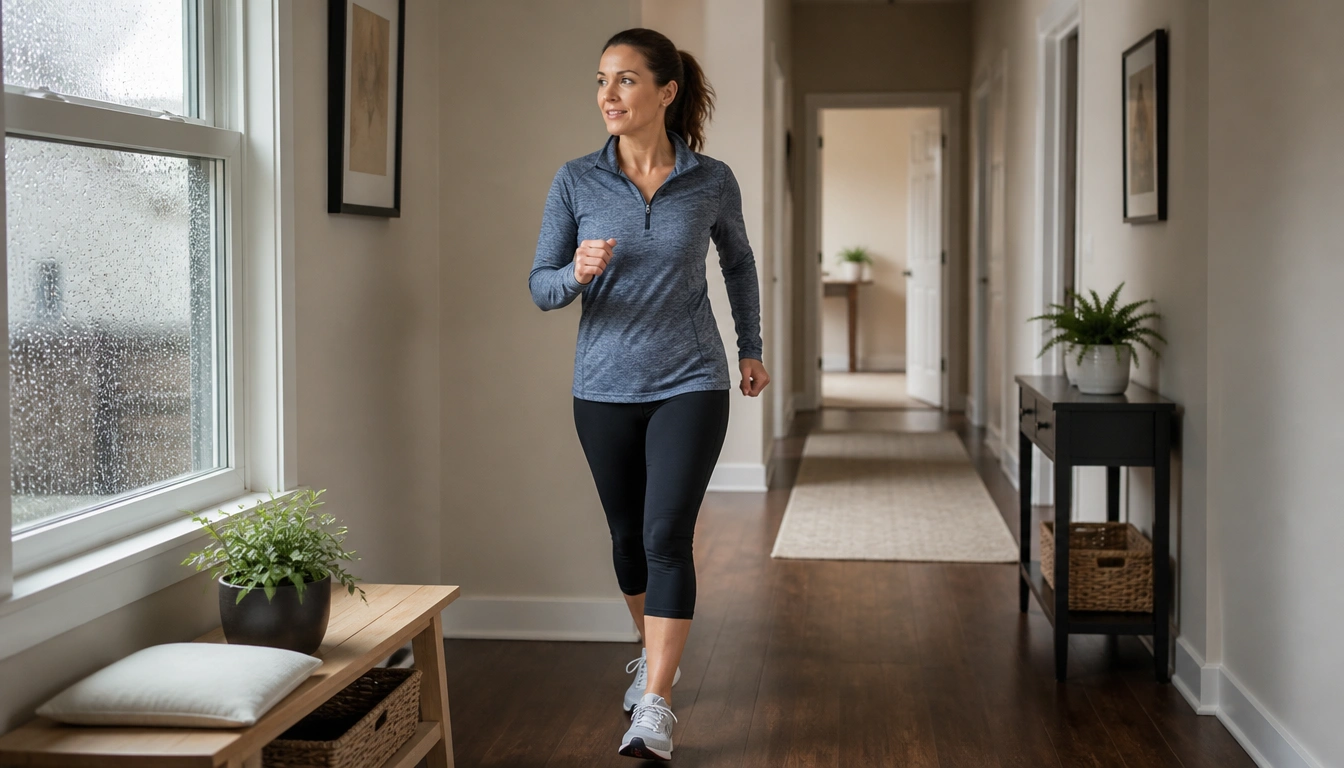
Yes—indoor walking can be a real workout at home if you make it purposeful enough to reach moderate intensity and accumulate time toward your weekly goal. A rainy-day indoor walking routine can be as simple as hallway laps, step-in-place intervals, or short walking bouts spread through the day. The main goals are safety, a brisk-but-controlled pace, and enough total movement to support your health.
Key Takeaways
- Three 10-minute walks can still help you build toward the weekly 150-minute moderate-intensity target.
- Use the talk test: you should be able to talk, but not sing, if the pace is truly moderate.
- Hallway loops, room circuits, and step-in-place intervals work well when space is tight.
- Supportive shoes and a clear floor matter more indoors, because slips, rugs, and cords can turn a walk into a fall risk.
- Older adults may benefit from pairing walking blocks with simple strength or balance moves.
- If you have joint instability, chest symptoms, dizziness, or a major medical condition, check with a clinician before starting or changing a routine.
Rainy-day indoor walking goals
A rainy-day indoor walking routine is most useful when it replaces the habit of an outdoor walk rather than feeling like a temporary compromise. The goal is not just to “move around” the house. It is to create enough steady, rhythmic activity to support your weekly aerobic target. Public health guidance from the CDC and the U.S. Department of Health and Human Services says adults should aim for at least 150 minutes of moderate-intensity aerobic activity each week, and brisk walking is one of the simplest ways to get there.
If the weather has knocked you off schedule, shorten the decision-making process. Pick a time, pick a route, and decide on a minimum dose before you start. For many people, that means one 30-minute walk, two 15-minute walks, or three 10-minute bouts across the day. Shorter bouts still count when they add up, and they are often easier to fit around work, caregiving, or limited space.
Indoor walking also has a practical advantage: you control the surface. That can make it a good fallback when sidewalks are wet, icy, or too dark. For people who want low-impact movement, walking is easier on the joints than running or jumping, while still giving your heart, lungs, and muscles useful work.
How to set up a safe walking path at home
Before you start, make the walking path easy to follow and hard to trip over. That matters more indoors, where cords, toys, rugs, pet bowls, and furniture edges can interrupt your stride. A safe route can be a hallway loop, a circle through connected rooms, or a straight-out-and-back path if you have enough space.
If you use a hallway, check that you can turn around without twisting quickly or backing up into furniture. If you use a room circuit, keep the corners wide and the route consistent so you do not have to scan the floor every few seconds. For many homes, a “loop” through the living room, hall, and kitchen works better than trying to march in one spot the whole time.
When floor space is limited, step-in-place walking is a valid option. You can march, side-step, or alternate knee lifts in place while watching a screen or listening to music. The point is to keep the movement steady and purposeful. Bare feet and slippery socks are not a good tradeoff on hard floors. Supportive shoes usually make indoor walking safer and more comfortable, especially if your joints are sensitive.
How to make indoor walking count as moderate-intensity exercise
The easiest way to tell whether your indoor walking is brisk enough is to use the talk test and a few body cues together. According to the CDC and NHS, moderate intensity usually feels like a warmer body, faster breathing, and an effort level where you can talk but not sing. If you are strolling slowly enough to carry on a long conversation with no change in breathing, you may need to pick up the pace.
Try this self-check after a few minutes of walking: Are your arms swinging naturally? Do you feel your breathing change, even if it is still controlled? Do you have a light sense of working, rather than feeling almost no effort? If yes, you are probably closer to moderate intensity. If you are breathing hard, unable to speak in short phrases, or feeling strained, you may have moved beyond the intended zone and should ease back.
One helpful approach is to build speed gradually. Start with a comfortable pace for a minute or two, then shorten your steps slightly and walk with more purpose. If you use music, choose a beat that encourages a steady stride instead of a shuffle. A fitness tracker or step counter can help with feedback, but you do not need technology to make this work. Your breath, posture, and ability to talk are usually enough.
A simple rainy-day indoor walking routine
A good home walking routine usually works best in three parts: warm-up, main walking blocks, and cool-down. This keeps the workout predictable and makes it easier to repeat on days when motivation is low. You do not need equipment, and you do not need to keep the same format every day.
Start with five minutes of easy movement. Walk slowly, roll your shoulders, and let your breathing settle into a relaxed rhythm. Then move into your main blocks. A practical structure is 10 minutes of brisk walking, a brief reset, and another 10 minutes of walking. If you have more time and energy, add a third block later in the day.
During each walking block, aim for a smooth pace you can sustain without bouncing or holding your breath. You can use hallway laps, a room circuit, or step-in-place marching. Between blocks, stand tall, sip water if you want, and bring your breathing back under control. Finish with three to five minutes of easier walking or gentle marching to cool down. That helps your body transition out of the session instead of stopping abruptly.
If a longer session feels daunting, start smaller and build consistency first. Even a short indoor routine is more useful than skipping movement entirely because of bad weather. Over time, you can combine blocks to reach your preferred workout length.
How to adapt the routine when space is tight
Small apartments, cluttered living rooms, and busy homes can still support a worthwhile indoor walking routine. The trick is to stop thinking in terms of distance and think in terms of movement time. A hallway loop may only be a few steps long, but if you keep moving with purpose, it still contributes to your weekly aerobic total.
Screen-time walking is one of the easiest ways to use limited space. March in place during a show, walk laps during a phone call, or alternate side-steps with light arm swings while listening to a podcast. These options are especially helpful on rainy days when you might otherwise sit longer than planned.
If you have very little space, alternate movement patterns so you do not feel stuck in one repetitive pattern. For example, march in place for two minutes, side-step for one minute, and do a gentle hallway pass or room loop for two minutes. The variation can make the session feel less monotonous while still keeping the effort steady.
| Space option | Best for | Useful cue |
|---|---|---|
| Hallway loop | Homes with a clear corridor | Keep turns smooth and avoid quick pivots |
| Room circuit | Small homes with open furniture gaps | Use the same path each time |
| Step-in-place marching | Very limited floor space | Lift your feet enough to feel active, not cramped |
| Screen-time walking | People who need an easy habit anchor | Walk during one show, call, or playlist |
How to layer in strength or balance breaks
For older adults, and for anyone who wants a more functional home routine, walking can be paired with brief strength or balance work. The National Institute on Aging and other professional guidance support multicomponent activity for older adults because it helps preserve daily function. You do not need equipment or a separate workout room to do this well.
Try inserting a short strength move between walking blocks. Good options include sit-to-stands from a sturdy chair, wall or counter push-ups, or slow calf raises while holding a stable surface. These moves use large muscle groups and can make the routine feel more complete without turning it into a high-impact workout.
Balance work can be simple, too. You might practice heel-to-toe standing near a countertop, shift weight from one foot to the other, or stand on one leg for a few seconds with support nearby. Keep it safe and controlled. If a movement makes you wobble hard or forces you to hold your breath, scale it back.
A practical pattern is: walk for 5 to 10 minutes, do one strength or balance drill for a short set, then walk again. This can help you stay active without needing a long uninterrupted block of time. It also gives your body a more varied challenge than walking alone.
Joint comfort and footwear tips
Indoor walking is usually a low-impact option, but comfort still matters if you have knee, hip, or ankle concerns. A flat, predictable route can be easier to tolerate than outdoor walking in wet or uneven weather, but you still want supportive shoes and a stride that feels smooth. If your shoes are worn out or too loose, your feet may slide inside them and aggravate the lower legs or feet.
If your knees or hips are sensitive, shorten your stride slightly and keep your steps controlled. Avoid slamming your feet down or twisting quickly during turns. A gentle arm swing can help you walk with rhythm without overloading the joints. If standing in one place bothers you more than walking, keep your session moving rather than parking in a single spot for too long.
Walking barefoot on hard floors can feel natural for a minute, but it is often less supportive and less stable than wearing shoes. That matters more if you have arthritis, balance concerns, or a history of ankle sprains. If a specific joint starts to ache in a sharp or unusual way, stop and reassess rather than trying to push through.
Warm muscles and a gradual start also help. The first few minutes should feel easier than the middle of the workout. If you need longer to loosen up, make the warm-up longer instead of forcing the pace too soon.
When to slow down, stop, or get medical advice
Some people should check with a healthcare professional before starting a new indoor walking routine, especially if they have cardiovascular disease, diabetes, kidney disease, major balance problems, or a history of unexplained symptoms during exercise. This is also wise if you have been mostly inactive and are beginning again after a long break. Individual medical advice matters more when symptoms or multiple conditions are involved.
Stop the session and seek medical advice if you develop chest discomfort, dizziness, faintness, severe shortness of breath, or sharp pain. If a joint feels unstable, gives way, or swells after walking, that is also a sign to pause and get checked. Mild muscle effort is normal; pain that changes your gait is not something to ignore.
For pregnancy or the postpartum period, moderate indoor walking is often an accessible option, but intensity should stay controlled and progression should be gradual. If you were inactive before pregnancy, start conservatively and ask a clinician for personalized guidance if you are unsure how hard to work.
Home safety matters every time. If the floor is slippery, a rug moves underfoot, or the path is crowded, fix the environment before you walk. A safe routine is the one you can repeat consistently without taking avoidable risks.
Frequently Asked Questions
How long should an indoor walking workout be to count toward weekly exercise goals?
You can break indoor walking into shorter bouts and still work toward your weekly target. Many adults use 10-minute blocks, such as three 10-minute walks, if that is easier to fit into the day. The total time across the week matters most for meeting the aerobic goal.
What pace makes indoor walking count as moderate-intensity exercise?
A moderate pace should make you breathe a little faster and feel warmer, but you should still be able to talk. If you can sing comfortably, the pace is probably too easy. If you cannot speak in short phrases, slow down a bit.
How can I walk indoors in a small apartment or limited space?
Use what you have: a hallway loop, a room circuit, or marching in place. You can also walk during screen time, phone calls, or music playlists. The goal is steady movement with purpose, not a large amount of floor space.
Is indoor walking safe if I have knee pain or arthritis?
It is often a good low-impact option, but comfort and stability matter. Wear supportive shoes, avoid slippery floors, and shorten your stride if needed. If you have sharp pain, joint instability, swelling, or a medical condition that affects exercise safety, check with a clinician first.
Should older adults add balance or strength work to an indoor walking routine?
Yes, that can be a smart addition. Brief sit-to-stands, wall push-ups, calf raises, or supported balance drills can make the routine more functional. Keep the moves simple and safe, and use a sturdy surface for support when needed.
The Bottom Line
A rainy-day indoor walking routine works best when you treat it like a real workout: clear the floor, choose a safe path, and walk with enough purpose to reach moderate intensity. Short bouts still count when they add up across the day.
If space is tight, hallway laps, room circuits, and step-in-place intervals can keep you on track without equipment. Add light strength or balance work if that fits your needs, especially if you are older or want a more functional routine.
If you have joint instability, chest symptoms, dizziness, or a medical condition that could affect exercise safety, get personalized advice before you start. Otherwise, the simplest plan is often the one you will repeat when the weather keeps you inside.
Medical disclaimer
Medical disclaimer: This content is for educational and informational purposes only and is not a substitute for professional medical advice, diagnosis, or treatment. Dietary needs and supplement suitability vary by individual.
Sources
- Centers for Disease Control and Prevention (CDC) — cdc.gov. Accessed November 2026.
- National Health Service (NHS) — www.nhs.uk. Accessed November 2026.
- Centers for Disease Control and Prevention (CDC) — cdc.gov. Accessed November 2026.
- Centers for Disease Control and Prevention (CDC) — cdc.gov. Accessed November 2026.
- Centers for Disease Control and Prevention (CDC) — cdc.gov. Accessed November 2026.
- National Health Service (NHS) — www.nhs.uk. Accessed November 2026.
- American College of Sports Medicine (ACSM) — acsm.org. Accessed November 2026.
