
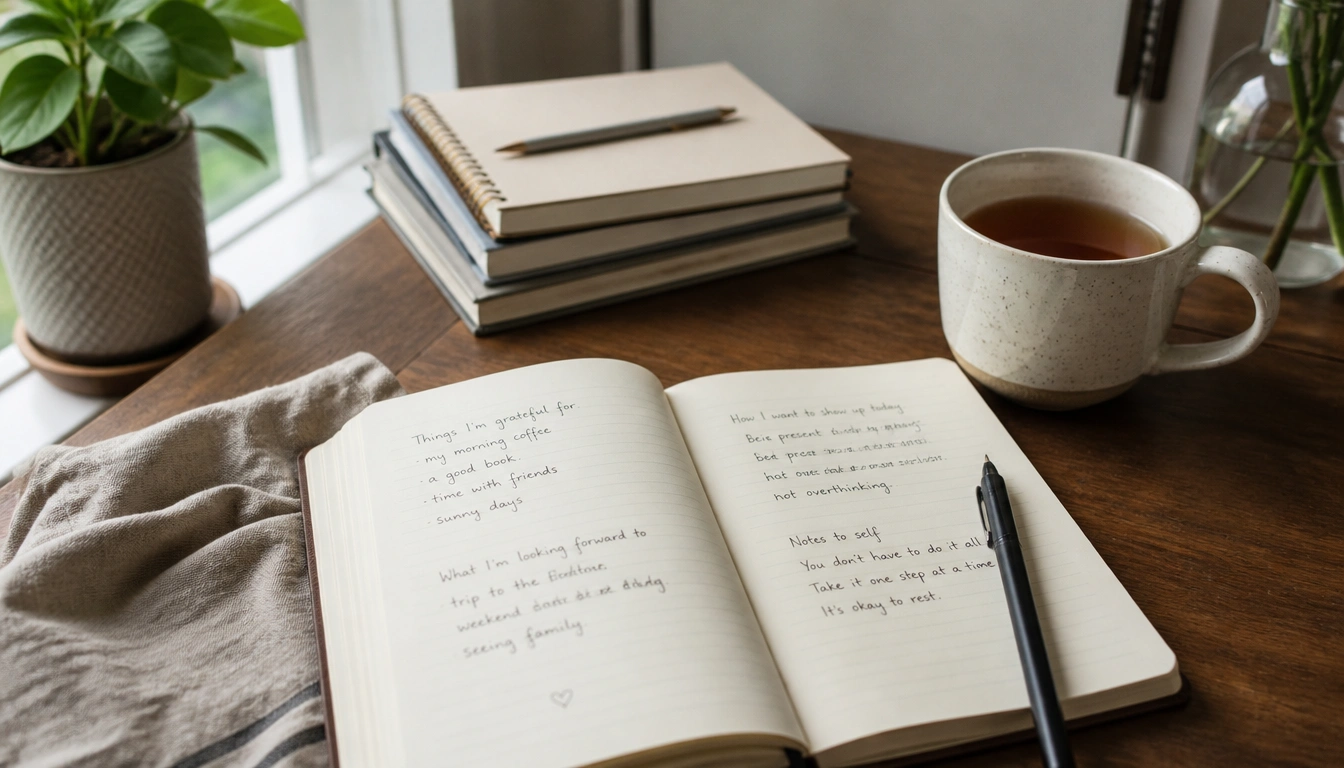
Start a wellness journal by making it very small: write for 3 to 5 minutes, 2 to 3 times a week, and use a simple prompt, gratitude list, or short brain dump instead of a blank page. You do not need perfect handwriting or deep insights. The goal is to notice what you feel, what is stressing you, and what helps you cope, in a way you can actually keep doing.
Key Takeaways
- A wellness journal works best when it helps you name emotions, spot patterns, and slow down rumination—not when it becomes another chore.
- Beginners often do better with structure: prompts, gratitude lists, or problem-solving notes can feel easier than open-ended free-writing.
- Start with 3 to 5 minutes, 2 to 3 times per week, and tie it to something you already do, like tea, brushing your teeth, or bedtime.
- You can journal on paper, in a notes app, or with a journaling app; the best format is the one you will actually use.
- If journaling leaves you more distressed, switch to a more structured format and pause trauma-focused writing until you feel supported.
Why a wellness journal is worth trying
A wellness journal is a simple place to write about mood, stress, routines, and what is helping or hurting your well-being. For an absolute beginner, that may sound small, but small is the point. Journaling is not about producing polished pages. It is about creating a steady habit of noticing your inner life before it gets lost in the noise of the day.
There is a science-backed reason this can help. Research on affect labeling suggests that putting feelings into words can help regulate emotional responses. In plain language, naming what you feel may reduce the brain’s alarm response and support calmer, more organized thinking. Journaling can also interrupt rumination, the loop of repeating the same distressing thoughts without getting anywhere useful. Externalizing those thoughts on paper or screen can make them feel less crowded inside your head.
That does not mean journaling is a cure-all. Systematic reviews of journaling-style practices show modest benefits for stress, anxiety, and distress, especially when the practice is regular and realistic. The value is often in the repetition: noticing patterns, sorting through emotions, and creating a pause between a feeling and your reaction.
Public health guidance from organizations such as the CDC also places journaling within a wider stress-management toolbox alongside sleep, movement, and breathing practices. That framing matters. A wellness journal is a supportive habit, not a test of self-discipline.
Choose a beginner format that fits your brain
If you have never journaled before, the format matters more than the “right” words. Different styles work for different people, and the best one is the format that feels easiest to begin.
Brain dump: Write whatever is in your head for a few minutes. This is useful when your thoughts feel tangled and you want to clear mental clutter. Do not edit for grammar or style.
Gratitude list: Write three specific things you appreciated today. They can be tiny, like a warm drink, a quiet ride home, or a text from a friend. This format is gentle and often easier on low-energy days.
Prompt-based entry: Use one question to guide you. Examples include: “What is taking up the most space in my mind right now?” or “What is one thing I can control today?” Prompts reduce blank-page pressure.
Problem-solving notes: If your mind is full of one practical issue, write the problem, one possible next step, and what support you might need. This can be useful when journaling is meant to help you organize, not simply unload.
You can mix formats. A beginner might use gratitude on one day, a prompt on another, and a short brain dump when stress spikes. Flexibility is a strength, not a failure to be consistent.
How to start without burning out
Many people quit journaling because they start with an unrealistic version of it: daily pages, long reflections, or pressure to be insightful every time. A better starting point is much smaller. Think 3 to 5 minutes, 2 to 3 times per week. That is enough to build familiarity without turning the habit into a burden.
Consistency matters more than volume. A short journal session that you repeat is more useful than an ambitious plan you abandon. If you only have energy for three sentences, write three sentences. If you only want one prompt and one line of answer, that counts.
Here is a beginner-friendly structure you can repeat:
- Write today’s mood in one word.
- Describe one thing stressing you.
- Write one thing that helped, even a little.
If you prefer less structure, set a timer for a few minutes and stop when it ends. The timer protects you from overthinking and keeps the practice contained. For many beginners, that boundary is what makes the habit feel safe enough to repeat.
Make the habit easier to remember
The most reliable journaling habit is usually the one that fits into a routine you already have. This is called an habit anchor, and it lowers the amount of willpower needed to begin. You might journal after brushing your teeth, while drinking morning coffee or tea, after lunch, or just before bed.
Reduce friction in the environment too. Keep the notebook open on a desk, place a pen beside it, or pin your journaling app to the home screen. If you must hunt for supplies, the habit becomes harder than it needs to be.
Some people also do better when the entry point is obvious. A sticky note on the mirror, a reminder on the phone, or a notebook left on the pillow can cue the behavior without forcing motivation. The idea is not to pressure yourself. It is to make the next step easy.
Try to think in terms of “showing up” rather than “doing it perfectly.” You are building recognition and comfort first. Insight tends to come later, after the practice has become familiar.
What to do when you feel awkward or blank
Feeling awkward is normal. Many beginners open a notebook and immediately think, “I have nothing to say,” or “This sounds silly.” That reaction does not mean journaling is not for you. It often means you are encountering a new habit without a script.
When you go blank, lower the bar. Start with a sentence stem such as:
- Right now I feel…
- The hardest part of today is…
- One thing I need less of is…
- One thing that would help is…
If perfectionism gets in the way, remind yourself that the journal is private. You do not need elegant handwriting, complete sentences, or a meaningful ending. Cross-outs, fragments, and messy lines are normal. The point is to get thoughts out of your head, not to create something display-worthy.
If you still feel stuck, write about the obstacle itself: “I do not know what to write, and that is making me avoid this.” Naming the barrier can be a useful entry point. Often the first honest sentence is enough to get the page moving.
When journaling feels worse, and how to choose paper or digital
Sometimes journaling does not feel calming. If open-ended writing makes you spiral into repetitive worries, that may be a sign that rumination is taking over. In that case, switch from free-writing to something more structured. Gratitude lists, short check-ins, or problem-solving notes can be more grounding than an open page.
Watch for a pattern. If writing about stress reliably leaves you more activated, more panicked, or more stuck in the same loop, that version of journaling may not be the right fit right now. The goal is support, not emotional flooding.
Format choice can matter here too. Some people think better on paper; others think better when typing. Paper may feel slower and more reflective, while digital journaling can be easier to search, edit, and carry everywhere. People with attention differences, hand pain, limited mobility, or busy schedules may prefer a notes app or journaling app. Others like the tactile feel of a notebook and pen.
| Format | Helpful for | Possible downside |
|---|---|---|
| Paper notebook | Slowing down, privacy, a tactile routine | Easy to forget, easy to judge the handwriting |
| Notes app | Fast capture, portability, low friction | Can invite distractions from other phone notifications |
| Journaling app | Prompts, reminders, searchability, structure | May feel too guided or require setup |
| Bullet journal style | People who like lists and simple organization | Can become overcomplicated if you try to make it decorative |
Choose the format that fits your attention style and your life. Convenience usually beats idealism.
How beginners can adapt the practice across life stages
Teenagers often need a journal that respects privacy and time pressure. A few lines after school, a mood check-in before bed, or a prompt about what felt stressful today can be enough. The goal is not to create a long record of every feeling. It is to make space for school, social stress, and changing emotions.
Busy adults usually benefit from the simplest possible routine. A short entry after dinner, during a commute pause, or before turning off the light may be more realistic than a formal sitting. Adults often do best when journaling is linked to one concern they actually want help with, such as sleep, stress, boundaries, or decision-making.
Older beginners may prefer larger handwriting, a comfortable notebook, or a digital format that is easier to read. Some older adults enjoy reflective prompts about energy, gratitude, routine, or relationships. Others want to track symptoms, sleep, or daily functioning. The best approach is the one that feels clear and manageable.
Across all age groups, the same principle holds: make the journal fit the person, not the other way around.
When journaling is not enough
Journaling can support wellness, but it does not replace clinical treatment. If you are dealing with severe anxiety, depression, trauma symptoms, intrusive thoughts, or persistent hopelessness, use journaling as a supplement rather than a stand-alone solution.
Be especially careful with trauma-focused writing. If writing about painful experiences triggers panic, severe distress, flashbacks, or other intrusive symptoms, stop. That is a sign to step back and get support, not to push harder. Safe journaling should feel contained and manageable, not overwhelming.
Seek help from a licensed mental health professional or primary care clinician if your symptoms interfere with daily life, you cannot function as usual, or you are worried about your safety. If you ever have thoughts of self-harm, seek urgent help right away. Journaling may still be useful later, but it should never delay real care when real care is needed.
Used thoughtfully, a wellness journal can be one small stabilizing habit among many. It is not a test of strength. It is a tool for noticing, sorting, and responding with a little more clarity.
Frequently Asked Questions
How often should a beginner journal to build a habit without burning out?
Start with 2 to 3 times per week for 3 to 5 minutes. That is usually easier to sustain than daily journaling, especially if you are new or tired. Once the habit feels natural, you can increase frequency if you want to.
What should I write in a wellness journal if I have no idea where to start?
Use a simple prompt, mood check-in, or gratitude list. Good starter lines include: “Right now I feel…,” “What is stressing me most is…,” or “Three things I appreciated today were….” You only need a few words to begin.
Is free-writing better than using prompts or gratitude lists for beginners?
Not always. Free-writing can help some people, but it can also intensify rumination if you already feel overwhelmed. Beginners often do better with prompts, gratitude lists, or problem-solving notes because they provide structure and reduce blank-page pressure.
Can journaling make anxiety or rumination worse, and how do I know if it is not helping?
Yes, it can happen. If writing regularly leaves you more agitated, stuck in repetitive worry, or emotionally flooded, switch to a more structured format and shorten the session. If trauma-focused writing triggers severe distress or intrusive symptoms, stop and seek support.
Do I need a notebook, or can I use a phone or digital app instead?
You can use either. Paper works well if you like a tactile routine, while notes apps and journaling apps are often easier for busy schedules, travel, or accessibility needs. The best format is the one you will actually keep using.
The Bottom Line
A beginner wellness journal does not need to be deep, daily, or beautifully written. Start small, use structure when you need it, and keep the habit attached to something you already do. That is often enough to make journaling feel useful instead of overwhelming.
If blank pages make you freeze, try a prompt, a gratitude list, or a short problem-solving note instead of free-writing. And if journaling makes you feel worse, scale back, change the format, or reach out for professional help if distress is significant.
Medical disclaimer
Medical disclaimer: This content is for educational and informational purposes only and is not a substitute for professional medical advice, diagnosis, or treatment. Dietary needs and supplement suitability vary by individual.
