
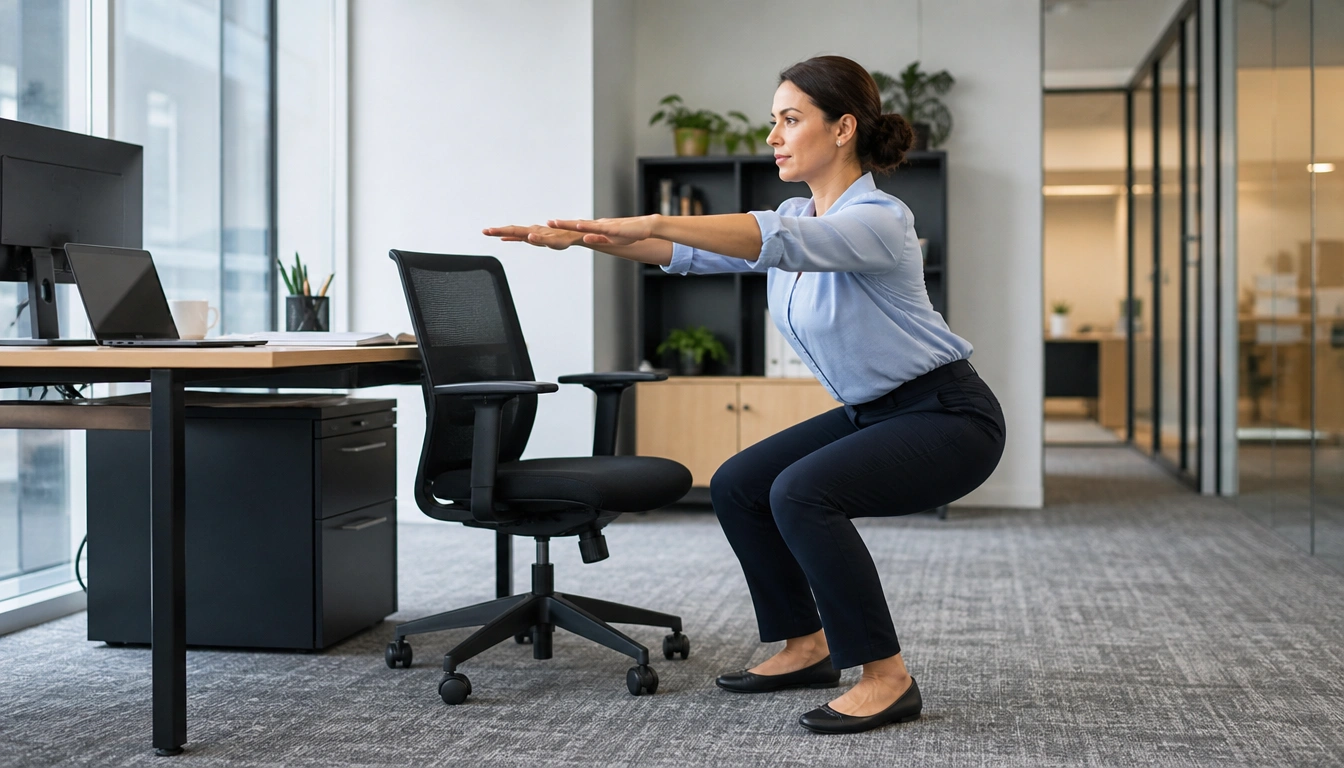
You can do common bodyweight exercises at your desk or in your office safely if you check your setup first, keep the movements small and controlled, and use pain-free range of motion. A stable chair, sturdy desk, clear floor space, and supportive footwear matter as much as the exercise itself. Start with a few easy reps, then build gradually. If a movement causes sharp pain, numbness, tingling, or swelling, stop and get checked.
Key Takeaways
- Short movement breaks can help interrupt long sitting periods, reduce stiffness, and make it easier to keep moving through the workday.
- Good form matters more than speed: keep knees tracking over toes, spine neutral, and hands or feet placed on stable surfaces.
- For knee discomfort or osteoarthritis, reduce squat and lunge depth, use a higher chair, or hold onto support.
- Desk push-ups, chair squats, reverse lunges, and calf raises can all be scaled up or down without gym equipment.
- Sharp pain, pinching, radiating discomfort, numbness, tingling, or swelling are stop signs, not cues to push harder.
Why movement snacks matter for desk workers
Bodyweight exercise at your desk works best when you think in short movement snacks, not full workouts. Long stretches of sitting can leave the hips, spine, and shoulders underused while the calves and glutes stay quiet. That often shows up as stiffness, afternoon fatigue, and the rounded posture many office workers notice by the end of the day.
Brief bouts of movement help interrupt that static load. The goal is not to replace your normal exercise routine, but to break up sitting time, wake up underused muscles, and make the next block of desk work feel easier. Public health guidance from the CDC still matters here: weekly activity targets are the larger goal, but short movement breaks support that goal by making the day less sedentary.
Think of each office set as a reset. A few controlled reps can increase circulation, remind your body how to stand and squat well, and reduce the temptation to stay frozen in one posture for hours. That is especially useful during the mid-afternoon slump, when energy dips and form tends to get sloppy.
How to use this checklist in the office
Before you start, scan the space. Move cords, slide away rolling chairs, and make sure the surface you plan to use will not tip or slide. If your chair has wheels, lock them or push the chair against a wall. If your desk wobbles, do not use it as a support point for push-ups or balance work.
Pace matters too. Start with a few controlled repetitions of each exercise rather than trying to race through a circuit. A practical starting point is one short round of each movement, then a second round later if you still feel good. The best dose is the one you can repeat consistently without aggravating your joints or looking rushed in a shared workspace.
Use easy breathing and keep effort moderate. You should feel like you are working, but still able to speak in full sentences. If your form changes because you are tired, shorten the range or stop the set. For most office workers, consistency beats intensity.
Chair squat and sit-to-stand
The chair squat is one of the most useful office movements because it trains the legs and hips without needing floor space. Stand in front of a stable chair with your feet about shoulder-width apart. Before lowering, hinge your hips back as if reaching for the seat. That helps keep the movement organized through the hips instead of dumping stress into the knees.
As you sit back, keep your chest open and your spine neutral. Your knees should track in line with your second and third toes rather than collapsing inward. Touch the chair lightly or hover just above it, then stand by driving through the midfoot and heels. Finish tall without leaning back or clenching hard at the top.
If the full squat feels too deep, use a higher chair, a partial range, or a slower sit-to-stand pattern. This is especially helpful for people with knee osteoarthritis or sensitive knees. A reduced depth is not a failure; it is a smart way to keep the movement pain-free while you build tolerance.
Common mistakes include dropping straight down, letting the knees cave inward, or bending so far forward that the chest collapses. If the chair is too low or your legs feel shaky, take a wider stance or use your hands lightly on the desk for balance during the first few reps.
Desk push-up
A desk push-up turns the edge of a sturdy desk into a simple upper-body exercise. Place your hands slightly wider than shoulder-width apart on a secure surface. Step your feet back until your body forms a straight line from head to heels. If your desk is unstable, use a wall instead; safety comes before difficulty.
Brace your core and squeeze your glutes so your hips do not sag or pike upward. As you lower, bend the elbows at about a 45-degree angle from your torso rather than flaring them straight out to the sides. Keep your neck long and your gaze just ahead of your hands so you do not crane your head forward.
Press smoothly back to the starting position without slamming into locked elbows. If the movement feels too hard, walk your feet closer to the desk or switch to a wall push-up. If it feels too easy, step the feet farther back or lower the hand position slightly, as long as the desk remains stable and your shoulders feel comfortable.
For shoulder safety, control the lowering phase and avoid shrugging. The goal is a clean line through the trunk, not a big range of motion at any cost.
Reverse lunge and supported step-back
The reverse lunge is useful for balance, hip strength, and leg control, but it should stay pain-free and well supported. Stand near a desk or wall if balance is a concern. Step one foot back gently, then lower until the front knee bends to a comfortable angle and the back knee moves toward the floor without touching it.
Keep the trunk upright and the front knee stacked over the ankle. Avoid letting the front knee drift far forward or collapse inward. The back heel will rise, but the weight should stay controlled through the front foot and the toes of the back foot. Push back to standing by pressing through the front leg and the ball of the back foot.
If lunges irritate the knees, reduce the depth, shorten the step, or hold onto a stable surface. You can also use a split-stance mini squat instead of a full step-back. For people with knee osteoarthritis, a smaller range is often better than trying to force depth that causes pain. The movement should feel controlled, not wobbly or forced.
Balance concerns are common in office settings, especially when you are in work shoes or tight clothing. A hand on the desk, a slower tempo, and a smaller range all help make the movement safer without removing its value.
Standing calf raise and a simple office movement circuit
Standing calf raises fit office breaks because they take up almost no space and are easy to repeat between tasks. Stand tall with your weight spread evenly across both feet, then rise smoothly onto your toes. Pause briefly at the top, then lower the heels with control. Hold the back of a chair or the edge of a desk lightly if you need balance support.
Keep your posture long and avoid rocking forward or backward. The movement should come from the ankles and calves, not from swinging the body. A controlled pace matters more than height. If you cannot rise very high, that is fine; steady reps with good control are still useful.
A simple office circuit is to rotate through chair squats, desk push-ups, reverse lunges, and calf raises once, then repeat later in the day if needed. You do not need to chase exhaustion. A few calm reps of each movement can interrupt sitting time and make it easier to stay mobile. That is the point of exercise snacks: frequent, manageable movement that fits into a real workday.
If your schedule is packed, treat the circuit as a menu rather than a rule. On some breaks you may only have time for calf raises and sit-to-stands. On others, you may add push-ups or lunges. The best routine is the one you can do without turning your office into a gym.
Who should modify or avoid certain movements
Some workers need extra caution. If you have knee osteoarthritis, keep squat and lunge depth limited to a comfortable range and use support whenever needed. If your balance is unreliable, favor chair squats, wall push-ups, or supported calf raises before trying unsupported lunges.
Recent surgery, acute joint swelling, or an active injury changes the plan. In those cases, get individualized guidance from a clinician or physical therapist before starting office exercises. People with significant shoulder pain may also need to modify push-up angle or use a wall instead of a desk.
The decision rule is simple: discomfort from effort is acceptable, but joint pain that feels sharp, pinching, unstable, or worsening is not. If a movement consistently irritates the same area, change the exercise rather than trying to tough it out.
Workspace safety checklist for feet, furniture, and clothing
Office exercise is safer when the environment is set up on purpose. Check that the chair is stable and the desk is sturdy enough to bear your body weight. Clear the floor of bags, cords, and loose items. If your desk area is crowded, use a wall or a clear hallway instead of squeezing into a tiny gap.
Footwear and clothing matter more than many people expect. High heels can reduce ankle mobility and make balance work harder. Tight skirts, narrow trousers, or stiff fabrics can limit your squat depth and stepping pattern. Supportive flat shoes are usually the easiest option for office exercise, though some people prefer to do balance-focused work in stable, barefoot-friendly settings if privacy and workplace rules allow it.
Also think about privacy and social comfort. If a movement feels awkward in an open office, use a quieter corner, a conference room, or a scheduled break. The goal is to make movement normal enough that you actually repeat it. A short, discreet routine done several times a day is more valuable than one ambitious session that never happens again.
Finally, remember that the best office setup is the one that does not create new risks. Stable furniture, clear space, and sensible clothing choices protect you from the avoidable problems that turn a useful movement break into a bad one.
Frequently Asked Questions
How often should office workers stand up or move during the day?
A practical target is to change position or move briefly at least every 30 minutes. That does not mean you need a full workout each time. Short stands, a few squats, calf raises, or a quick walk to refill water can help break up long sitting periods.
What are the safest bodyweight exercises to do in a small office space?
Chair squats, wall or desk push-ups, supported reverse lunges, and standing calf raises are usually the most office-friendly options because they need little room and can be scaled easily. The safest choice is the one you can do with stable furniture, clear flooring, and controlled form.
How do I modify squats or lunges if I have knee pain or osteoarthritis?
Use a higher chair, reduce depth, slow the movement, and hold onto support if needed. For lunges, shorten the step and stay in a pain-free range. If the movement causes sharp pain or swelling, stop and ask a clinician or physical therapist for guidance.
Can desk push-ups and chair squats still count as exercise if they are short?
Yes. Short bouts of movement still count, especially when you repeat them through the day. They may not replace a planned workout, but they can support strength, mobility, and reduced sitting time. Over a week, those small bouts add up.
What should I do if an exercise causes sharp pain or numbness?
Stop the exercise right away. Sharp pain, pinching, radiating discomfort, numbness, tingling, or new swelling are not signs to push through. If symptoms do not settle quickly, or if they keep returning, get evaluated by a healthcare professional.
The Bottom Line
A good office bodyweight routine is simple, stable, and easy to repeat. Chair squats, desk push-ups, reverse lunges, and calf raises can all be done with little space if you keep the range controlled and the setup safe.
Use your body as the guide. Mild effort and muscle fatigue are normal; sharp pain, numbness, or swelling are not. If your knees, shoulders, or balance are limiting you, adjust the exercise before you try to force it.
Medical disclaimer
Medical disclaimer: This content is for educational and informational purposes only and is not a substitute for professional medical advice, diagnosis, or treatment. Dietary needs and supplement suitability vary by individual.
Sources
- Academic Research Institution — monash.edu. Accessed November 2026.
