
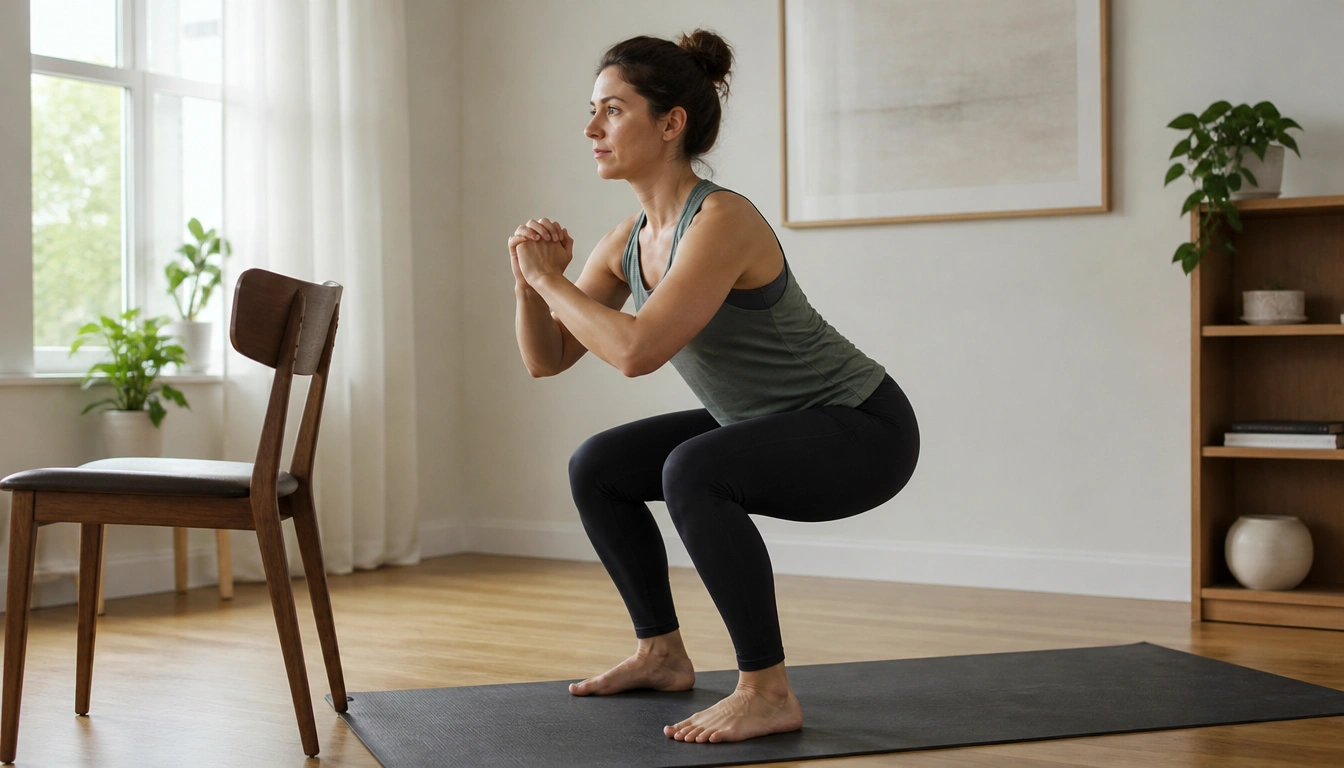
Check your bodyweight exercise form at home by looking for four things: stable alignment, controlled tempo, a pain-free range of motion, and the right regression for your current ability. For squats, push-ups, lunges, and planks, your goal is not depth or speed. Your goal is to keep the target muscles working while your joints stay stacked, your spine stays steady, and your movement stays smooth.
Key Takeaways
- Good form at home means alignment first, not chasing depth, speed, or fatigue.
- For squats, push-ups, lunges, and planks, look for a neutral spine, steady core, and joints tracking in a comfortable line.
- If you are a beginner or older adult, chair squats, wall push-ups, and incline push-ups can preserve the same pattern with less load.
- Shorter range of motion can be the better choice when stiffness, pain, or fatigue makes full depth less controlled.
- Stop exercising if you get sharp joint pain, chest pain, dizziness, palpitations, or unusual shortness of breath.
Why form matters more at home when you train without equipment or supervision
At home, bodyweight exercises can do a lot of good: they build strength, support daily movement, and help adults meet the muscle-strengthening recommendations commonly promoted by public health agencies. The trade-off is that you have fewer external cues. No machine guides your path. No coach is standing beside you to correct a collapsing knee, a sagging lower back, or a rushed rep.
That is why a home bodyweight exercise form checklist is useful. Good form helps the working muscles do the job while reducing unnecessary stress on joints and passive tissues. You do not need perfect symmetry or a competition-style range of motion. You need repeatable mechanics that feel steady, efficient, and safe enough to practice often.
The most useful home rule is simple: if the movement starts to look or feel messy, make it easier before you make it harder. That may mean a higher hand position for push-ups, a chair for squats, a shorter step for lunges, or a plank on the knees. Exercise quality usually improves when the body has less load to manage.
Home setup matters too. Hard floors can be slippery. Furniture can shift. Momentum can hide poor control. A good checklist helps you notice these problems early, before they become a habit.
The 4-move home form checklist: squat, push-up, lunge/split squat, and plank
Use these checkpoints as a quick scan during each set. You do not need to memorize every detail at once. Pick one or two cues per exercise, then add more as the pattern becomes familiar.
Squat
Start with feet about shoulder-width apart, with toes forward or only slightly turned out if that feels better for your hips. As you lower, think about sitting back and down rather than collapsing straight forward. Keep your chest open and your spine neutral.
Watch your knees. They should track roughly in line with the second and third toes instead of caving inward. Keep your heels down and your whole foot grounded, including the heel, big toe mound, and outer edge. If your heels pop up or your back rounds, the depth is probably too much for the moment.
For many people, a usable squat is not a deep squat. It is the deepest position you can hold while still breathing normally, keeping balance, and rising without twisting or wobbling. That may be a half squat, quarter squat, or chair squat.
Push-up
Set your hands slightly wider than shoulder width. Whether you are on the floor, on your knees, or elevated on a sturdy surface, the same pattern should hold: one long line from head through torso to heels or knees.
As you lower, keep your elbows angled about halfway between your sides and a straight-out flare. This usually protects the shoulders better than letting the elbows drift wide. Your core should stay braced enough that your hips do not sag and your lower back does not overarch.
Look a little ahead of your hands so your neck stays in line with your spine. If you feel the movement mostly in the low back or shoulders instead of the chest, triceps, and upper body, the position may need adjusting.
Lunge or split squat
Take a step that gives you room to lower straight down. In a split squat, your feet stay planted; in a lunge, you step in and out. Both are useful. The main goal is balance and control.
Keep your torso tall and your front knee stacked over or slightly behind the front ankle. The back heel stays lifted, and your weight should feel balanced rather than dumped onto the front knee. If you feel wobbling or pinching, shorten the stance or reduce depth.
A reverse lunge is often easier to control than a forward lunge because you step back into position instead of moving your body forward onto a planted leg. For many home exercisers, that makes it a better starting point.
Plank
Set your elbows under your shoulders and extend the legs back. Brace your abdomen and squeeze your glutes so your body forms a steady line, not a hammock or a pike.
Your lower back should not sink, and your hips should not drift high unless you are intentionally modifying the plank. Keep your neck neutral by looking at the floor slightly in front of your hands. If your form breaks after only a few seconds, that is useful information: the plank is currently too hard in that version.
| Movement | Good sign | Common warning sign |
|---|---|---|
| Squat | Knees track over toes, feet stay flat, chest stays controlled | Knees cave in, heels lift, back rounds |
| Push-up | Body stays in one line, elbows stay moderately angled | Hips sag, elbows flare, neck cranes |
| Lunge/split squat | Torso stays tall, front knee stays stacked, movement is steady | Front knee collapses inward, wobbling, excessive forward lean |
| Plank | Ribs and pelvis stay controlled, core is firm, breathing stays steady | Low back drops, hips pike, shoulders shrug |
How to use tempo and range of motion to keep reps controlled and joint-friendly
Tempo is one of the easiest ways to improve form at home. A slower lowering phase helps you notice where alignment changes. It also reduces the chance that momentum will mask weakness or compensation. A useful cue is to lower under control for a couple of seconds, pause briefly if needed, then press or rise without bouncing.
Range of motion should be earned, not forced. Full depth is not automatically better. If your knees ache in a deep squat, your shoulders pinch in a floor push-up, or your back starts to arch in a plank, a shorter range of motion may be the better training choice for now. The same is true if stiffness limits smooth movement in the morning or after long periods of sitting.
Controlled range also helps you choose a repeatable stopping point. For example, a squat may only go to the point where your heels stay down and your spine stays neutral. A push-up may stop at a countertop instead of the floor. A lunge may be shallow enough that the front knee remains calm and stable. That is still valid training.
If pain changes during the session, do not push through it automatically. First, reduce the range, slow the pace, or switch to a simpler version. If the movement remains sharp or unstable even after adjusting, stop that exercise and consider whether you need professional guidance.
Simple regressions that preserve the same movement pattern for beginners and older adults
Regression is not a fallback for failure. It is often the smartest way to keep practicing the same pattern safely. For beginners and older adults, the best variation is the one that lets you move with control, confidence, and minimal joint stress.
For squats, chair squats are especially practical. Sit back to a sturdy chair, lightly touch down, then stand. This gives you a clear depth target and reduces the fear of going too low. If the chair is too low, use a taller seat or hover above it instead of fully sitting.
For push-ups, wall push-ups are the easiest entry point, followed by incline push-ups on a sturdy counter or table. The higher the hands, the less bodyweight you must move. Keep the same alignment cues: straight line through the body, steady core, and elbows that do not flare wide.
For lunges or split squats, a supported split stance can be enough at first. Hold a wall, countertop, or chair for balance while you practice lowering straight down. A reverse lunge is often a good next step because it tends to be more manageable than stepping forward into the descent.
For planks, you can shorten the lever by placing the plank on the knees or by doing a higher incline plank on a counter or bench. The point is to maintain the core brace and spinal position, not to survive the hardest version.
As a weekly framework, many adults do well with two or more muscle-strengthening sessions per week, with enough recovery between sessions to repeat good movement quality. A short, well-controlled workout is more useful than a long session filled with sloppy reps.
How to adapt the checklist for knee, shoulder, back, or core discomfort
Discomfort does not always mean injury, but it does mean your checklist needs to get more specific. The goal is to find the version of the movement that stays within a comfortable, controlled range and does not provoke symptoms afterward.
Knee discomfort: Reduce squat and lunge depth first. Try a chair squat or a reverse lunge, and make sure the knee tracks in line with the toes instead of collapsing inward. If a movement causes sharp pain, swelling, or a sense of giving way, stop and get medical guidance.
Shoulder discomfort: Use a wall or incline push-up before the floor version. Keep elbows from flaring directly out to the side, and avoid letting the shoulders shrug up toward the ears. If overhead reaching or weight-bearing through the arms increases pain, choose the easier angle and reassess.
Back discomfort: Re-check your bracing. In squats and lunges, keep the ribs from flaring and the torso from folding forward too much. In planks, stop before the lower back sags. If back pain is sharp, radiating, or paired with numbness, stop and seek clinical advice.
Core weakness or postural collapse: Shorten the hold time and use an incline or knee-supported plank. You do not need to force a long hold if the back position is slipping. The form standard is more important than the clock.
Home setup and habit tips that make bodyweight training safer and easier to repeat
A good workout space removes avoidable friction. Pick a flat area with enough room to step forward, step back, and lie down if needed. If the floor is slick, use a mat or train on a surface with better traction. If you are using furniture for incline push-ups or support, test it first so you know it does not wobble, slide, or tip.
Stable furniture matters more than many people think. A chair that shifts during a squat or a counter that is too high for a push-up can turn a simple exercise into a balance problem. Before you start, give the surface a firm push. If it moves, replace it with something sturdier.
Habit is easier when the workout is attached to something you already do. A few squat reps after brushing your teeth or a short push-up set before lunch can be enough to keep the pattern alive. Consistency works best when the session feels doable and repeatable, not heroic.
Controlled tempo also belongs in the setup. If you rush because you are distracted or in a hurry, form usually slips. Slow, deliberate repetitions make it easier to notice where you drift, which is exactly why they are so useful at home.
Common form mistakes that reduce effectiveness or increase strain
Some mistakes are obvious, but others are subtle. The first is chasing depth or rep count before control. A squat that goes lower but loses heel contact or spinal control is not better than a shallower squat with clean mechanics.
Another common issue is using momentum. Swinging through lunges, bouncing out of the bottom of a squat, or dropping into a push-up can make the exercise feel easier in the moment, but it also removes the control that protects joints and builds useful strength.
Pay attention to the joints that collapse or drift. Knees that cave inward, elbows that flare hard, shoulders that shrug, or hips that sag are all signs that the load is going somewhere other than the target muscles. If you see that pattern, simplify the movement and retest it with less load.
Finally, do not ignore red flags. Stop exercising if you get chest pain, pressure, tightness, palpitations, dizziness, lightheadedness, sudden severe shortness of breath, or sharp localized pain in a joint. If you have a chronic condition, a recent injury, severe osteoporosis, or another medical concern, it is wise to ask a healthcare professional or physical therapist which versions are appropriate for you before you build a home routine.
Frequently Asked Questions
What are the key form cues for squats, push-ups, lunges, and planks?
For squats, keep your feet grounded, knees tracking over the toes, and your spine neutral. For push-ups, keep a straight line from head to heels or knees and avoid flaring the elbows wide. For lunges, stay tall and keep the front knee stacked. For planks, brace the core and prevent the low back from sagging.
How can I modify bodyweight exercises if I’m a beginner or older adult?
Use the least demanding version that still lets you move well. Common options are chair squats, wall push-ups, incline push-ups, supported split squats, and knee or incline planks. The goal is to keep the same movement pattern with less load and more stability.
How should I adjust range of motion if I have knee, shoulder, or back discomfort?
Shorten the movement first. A smaller squat, a higher push-up surface, or a shallower lunge can reduce strain while still training strength. If pain is sharp, worsening, or lingers after exercise, stop that movement and get medical advice rather than forcing full range.
What signs mean I should stop a bodyweight exercise immediately?
Stop right away for chest pain, pressure, tightness, palpitations, dizziness, lightheadedness, sudden severe shortness of breath, or sharp joint pain. Stop if you feel unstable, lose control of the movement, or notice symptoms that are unusual for you.
How do I make home bodyweight workouts safer without equipment?
Choose a nonslip floor area, clear enough space to move, and use only stable furniture for support. Check that chairs, counters, or tables do not wobble. Move slowly enough to stay in control, because a controlled tempo makes form easier to judge at home.
The Bottom Line
A good bodyweight exercise form checklist at home is mostly about control: steady alignment, smooth tempo, and a range of motion you can repeat without pain or wobble. If the movement breaks down, make it easier before you make it harder.
Use regressions on purpose, not as a last resort. Chair squats, wall push-ups, incline push-ups, supported lunges, and shorter planks all preserve the same movement pattern while reducing stress. For most home exercisers, that is the safest way to build skill and consistency.
If you notice sharp pain, chest symptoms, dizziness, or unusual shortness of breath, stop and seek medical guidance. If you want, the next step is to turn this checklist into a one-page home workout routine you can follow two or three times a week.
Medical disclaimer
Medical disclaimer: This content is for educational and informational purposes only and is not a substitute for professional medical advice, diagnosis, or treatment. Dietary needs and supplement suitability vary by individual.
Sources
- U.S. Government / Health Authority — af.mil. Accessed November 2026.
- U.S. Government / Health Authority — healthysd.gov. Accessed November 2026.
- Academic Research Institution — coloradocollege.edu. Accessed November 2026.
