
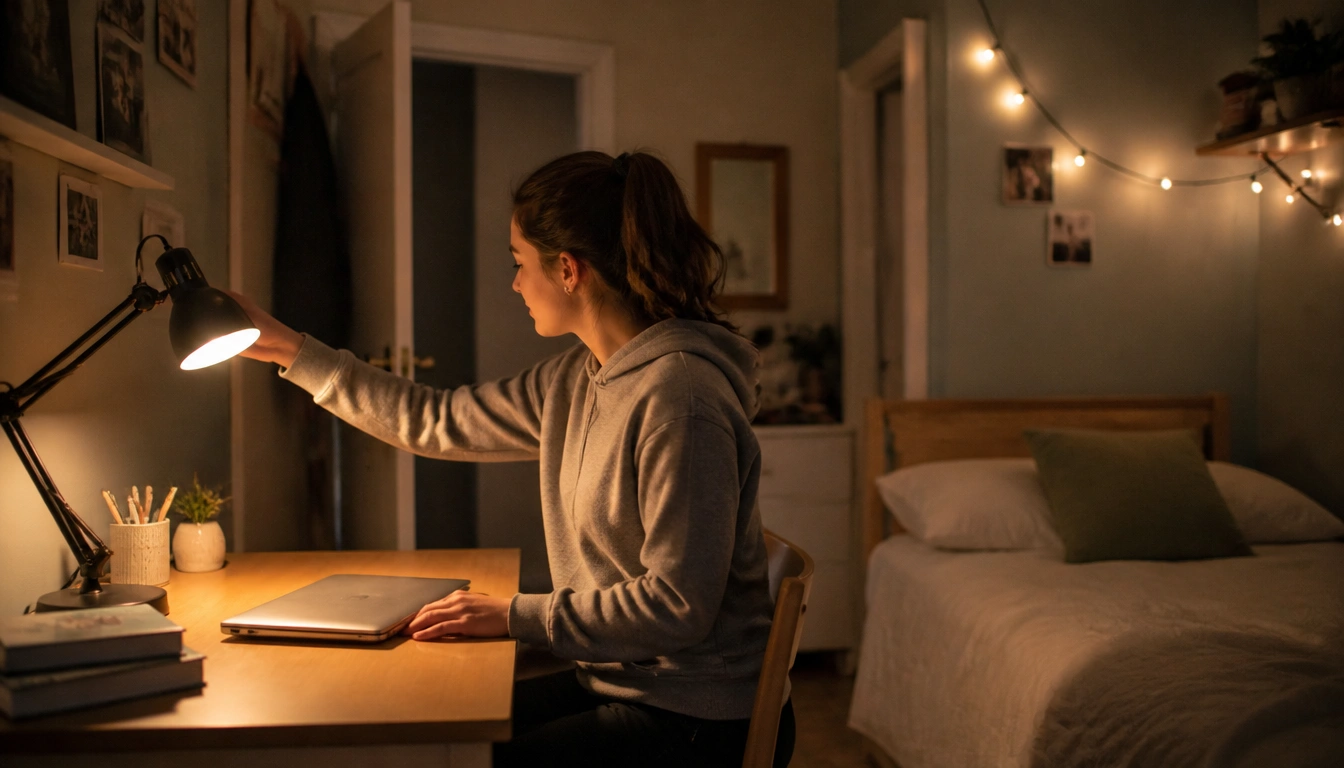
A student working from home should use a short, repeatable shutdown routine: end school or work tasks, step away from screens, dim the lights, do a calming offline activity, and keep the bed for sleep only. Aim for a consistent sleep and wake time, and if you are still awake after about 20 minutes, leave bed for a quiet low-light activity until you feel sleepy again.
Key Takeaways
- Teens usually need 8 to 10 hours of sleep, and adults need 7 to 9 hours, even if their bedtime tends to drift later.
- A “virtual commute” or shutdown ritual helps separate study mode from sleep mode when your room serves both purposes.
- Revenge bedtime procrastination is common in remote learners who delay sleep to reclaim personal time after a long day of obligations.
- If sleep does not come quickly, get out of bed after about 20 minutes and do something quiet and low-stimulation instead of checking email or coursework.
- Shared rooms can still support better sleep with low-cost changes such as dimmer lighting, moving the laptop out of sight, and keeping the bed for sleep only.
Why remote students need a different bedtime routine
For students who work from home, sleep problems often start long before the lights go out. The same desk, chair, laptop, and bed can all become linked to the same mental state: answering messages, finishing assignments, or trying to stay productive a little longer. The brain learns those cues quickly. If your room feels like a place for effort and pressure, it can become harder to feel sleepy when you finally stop.
That is why a bedtime routine for students working from home needs to do more than “relax.” It has to create a clear ending to the day. Public health guidance from the CDC and National Heart, Lung, and Blood Institute emphasizes consistent sleep timing and a wind-down period that helps the body shift from alertness to rest. For remote learners, that shift usually has to be intentional.
This matters even more when school and work continue into the evening. A student who has been reading, typing, problem-solving, or scrolling in the same space for hours may not feel naturally tired when bedtime arrives. A structured routine gives the brain a different signal: the day is over, and the bed is now for sleep.
The circadian problem in a study-room-bedroom
Your body clock responds to cues from light, activity, meals, and regular timing. When those cues are blurred, sleep timing can drift. Studying at night, answering work messages from bed, or moving from one assignment to the next without a stop point can keep the nervous system switched on later than you expect.
Sleep need also changes by age. According to the American Academy of Sleep Medicine and the National Heart, Lung, and Blood Institute, teens ages 13 to 18 need 8 to 10 hours of sleep per night. Adults need 7 to 9 hours. Older teens and many college students may feel naturally sleepy later in the evening, but that delayed timing does not reduce the need for enough total sleep. They still need the full amount for learning, memory, mood, and attention.
That is why “I’m just not a morning person” is not a sleep strategy. A later body clock may explain why a student is awake at midnight, but it does not make short sleep harmless. If a student routinely shortens sleep to fit in more work, the result is often worse concentration, slower learning, and more irritability the next day.
The 60-minute shutdown routine: your virtual commute
A virtual commute is a short sequence that replaces the separation most commuters get from leaving campus or the office. Instead of traveling home, you create a mental boundary inside your space. This works especially well if you study where you sleep.
Start about an hour before bed. First, finish the most important task of the night and decide that nothing else needs to be started. Then close your laptop, log out of school or work accounts, and put materials away. If possible, leave the computer out of sight. Even a small action, like folding the laptop shut and placing it in a bag or on a shelf, can help signal an end to effort.
Next, do one brief closing ritual: tidy the desk, write tomorrow’s top tasks on paper, charge your phone away from the pillow, or set out what you need for the morning. This is not about becoming highly organized. It is about reducing mental looping so your brain stops treating bedtime as another work session.
Finally, move into a different mode. Walk to another part of the room, change clothes, wash your face, or sit somewhere other than the desk. The goal is to mark a transition, not to build a perfect routine.
What to do in the last 30 to 60 minutes before bed
The final part of the night should lower stimulation, not add more. The CDC recommends turning off electronic devices at least 30 to 60 minutes before bedtime when possible. Screens can keep you mentally engaged and expose you to light that makes it harder for the body to prepare for sleep.
If you must use a screen briefly, keep the content boring and stop as soon as possible. Better options are offline and low-key: a paper book, light stretching, a shower, quiet music, journaling, or a short breathing exercise. The point is not to “perform” relaxation. It is to make sleep easier by reducing input.
Movement should stay gentle. A short stretch or slow walk around the room can help if your body feels tense from sitting and studying, but intense exercise late at night may leave some people more alert. Many students also do better when lights are dimmed during this window. Brighter overhead lighting can keep the brain in daytime mode longer than needed.
If your routine includes food, keep it simple. Heavy meals close to bedtime can make sleep less comfortable, especially if they trigger reflux or fullness. Caffeine is another common sleep disruptor. For many students, late afternoon or evening caffeine is enough to keep the body awake long after the assignment is done.
How to set up a sleep-friendly room in a small space
Not every student has the option of a separate bedroom, private office, or quiet apartment. Shared dorm rooms, family homes, and studio spaces require small adjustments rather than a perfect setup. Even then, the room can be shaped to support sleep.
Start with light. Lower the brightness in the room during the wind-down period, and use a small lamp instead of harsh overhead lighting if you can. If morning light is a problem, use curtains, blackout shades, or an eye mask. If noise is the issue, a fan or other steady background sound may help mask sudden disturbances.
Next, change what the bed means. The bed should be for sleep, not for studying, emailing, or scrolling. If you have been using it as a work zone, begin separating the functions now. Keep notes, chargers, and school materials elsewhere. If space is tight, even a basket or box for school items can help keep them visually out of the sleep area.
Another low-cost adaptation is to move the laptop out of sight at night. Put it in a drawer, backpack, or another corner of the room. If the desk is visible from the bed, cover the chair or turn the chair away. These are small changes, but they reduce the chance that your brain keeps associating the bedroom with unfinished tasks.
Common habits that keep remote learners awake
One of the most common patterns is revenge bedtime procrastination. This happens when a student who has spent the day studying, working, or caring for responsibilities stays up late to claim some personal time. The behavior feels understandable, but it usually trades evening freedom for shorter sleep and a harder next day.
Late caffeine is another frequent problem. A drink that seems harmless in the afternoon can still keep the nervous system activated at night. So can heavy meals, especially if they are very late. Bed-based work is also a trap. Once your body learns that bed is a place to answer messages and finish assignments, it becomes harder to associate that space with sleep.
A good corrective step is to plan pleasure earlier. If you need personal time, schedule it before the shutdown routine instead of after it. A short episode, a call with a friend, a hobby, or a snack break earlier in the evening is less likely to push bedtime later than “just one more thing” in bed.
Students should also watch for the habit of chasing productivity after their focus has already dropped. Late-night work often feels efficient because the room is quiet, but tired brains make more mistakes and take longer to recover. Ending work earlier is often the better sleep decision.
What to do if you are not sleepy after 20 minutes
If you go to bed and are still awake after about 20 minutes, do not stay there and battle it out. Leave the bed and do something quiet, dim, and boring until drowsiness returns. The CDC and sleep experts commonly recommend a low-stimulation activity such as reading a physical book, listening to calm audio, or sitting somewhere comfortable with low light.
What should you not do? Do not check grades, coursework, messages, social media, or the clock over and over. Those habits can make the brain more alert and more frustrated. Bright light from a phone or laptop can also send the wrong signal to your body at exactly the time you are trying to wind down.
Once you feel sleepy again, return to bed. If you are repeatedly awake for long stretches, the issue may be more than a routine problem. Still, for many students, this simple change breaks the cycle of lying in bed, getting tense, and learning to associate bed with wakefulness.
When a bedtime routine is not enough
A better routine helps many students, but it does not fix every sleep problem. If you regularly need a long time to fall asleep, wake often during the night, feel unrefreshed after enough time in bed, or struggle with daytime sleepiness despite trying to sleep on time, it is worth talking with a healthcare professional. Persistent insomnia, sleep apnea, delayed sleep-wake disorders, anxiety, depression, and other issues can all affect sleep.
You should also seek help if your sleep schedule keeps slipping later and later, if snoring or breathing pauses are reported by someone else, or if your fatigue is interfering with classes, work, driving, or mood. Sleep hygiene is useful, but it is not a substitute for evaluation when symptoms are ongoing or severe.
For students, that distinction matters. A routine is a tool, not a diagnosis. If the basics are in place and sleep still does not improve, the next step is medical guidance, not just more self-discipline.
Frequently Asked Questions
How can I separate work or study time from sleep when my bedroom is also my workspace?
Use a clear shutdown ritual. Close the laptop, put school materials out of sight, dim the lights, and change location if you can. Even small physical cues help your brain shift from alert mode to sleep mode.
What is the best bedtime routine for a college student who works remotely?
The best routine is one you can repeat every night. End work first, spend 30 to 60 minutes away from screens, do a calm offline activity, and keep a consistent sleep and wake time as much as possible.
How long before bed should I stop using screens and doing schoolwork?
A good target is 30 to 60 minutes before bed. If you absolutely must use a screen, keep it brief and low-stimulation, but try to avoid coursework and stressful messages during that window.
What should I do if I’m in bed but still not sleepy after 20 minutes?
Get out of bed and do something quiet in dim light, such as reading a paper book or listening to calm audio. Return to bed when you feel sleepy again. Avoid checking your phone, email, or the time.
How much sleep do teens and college students need, and can caffeine or late meals ruin the routine?
Teens ages 13 to 18 usually need 8 to 10 hours, and adults need 7 to 9 hours. Caffeine late in the day and heavy meals close to bedtime can make it harder to fall asleep and stay asleep.
The Bottom Line
A student working from home usually needs more than “going to bed earlier.” The routine has to create a real boundary between school, work, and sleep so the bedroom stops feeling like an all-purpose productivity zone.
The most useful changes are simple: keep a consistent schedule, build a 60-minute shutdown ritual, dim the lights, limit screens before bed, and use the bed only for sleep. If you are still awake after about 20 minutes, leave bed and do something quiet until drowsy.
If sleep problems keep happening even after you improve the routine, get medical advice. Ongoing insomnia, frequent waking, loud snoring, or daytime sleepiness can point to a sleep disorder that needs proper evaluation.
Medical disclaimer
Medical disclaimer: This content is for educational and informational purposes only and is not a substitute for professional medical advice, diagnosis, or treatment. Dietary needs and supplement suitability vary by individual.
Sources
- Centers for Disease Control and Prevention (CDC) — cdc.gov. Accessed November 2026.
- National Institutes of Health (NIH) — nih.gov. Accessed November 2026.
- Centers for Disease Control and Prevention (CDC) — cdc.gov. Accessed November 2026.
- National Institutes of Health (NIH) — nih.gov. Accessed November 2026.
- Mayo Clinic — mayoclinic.org. Accessed November 2026.
