
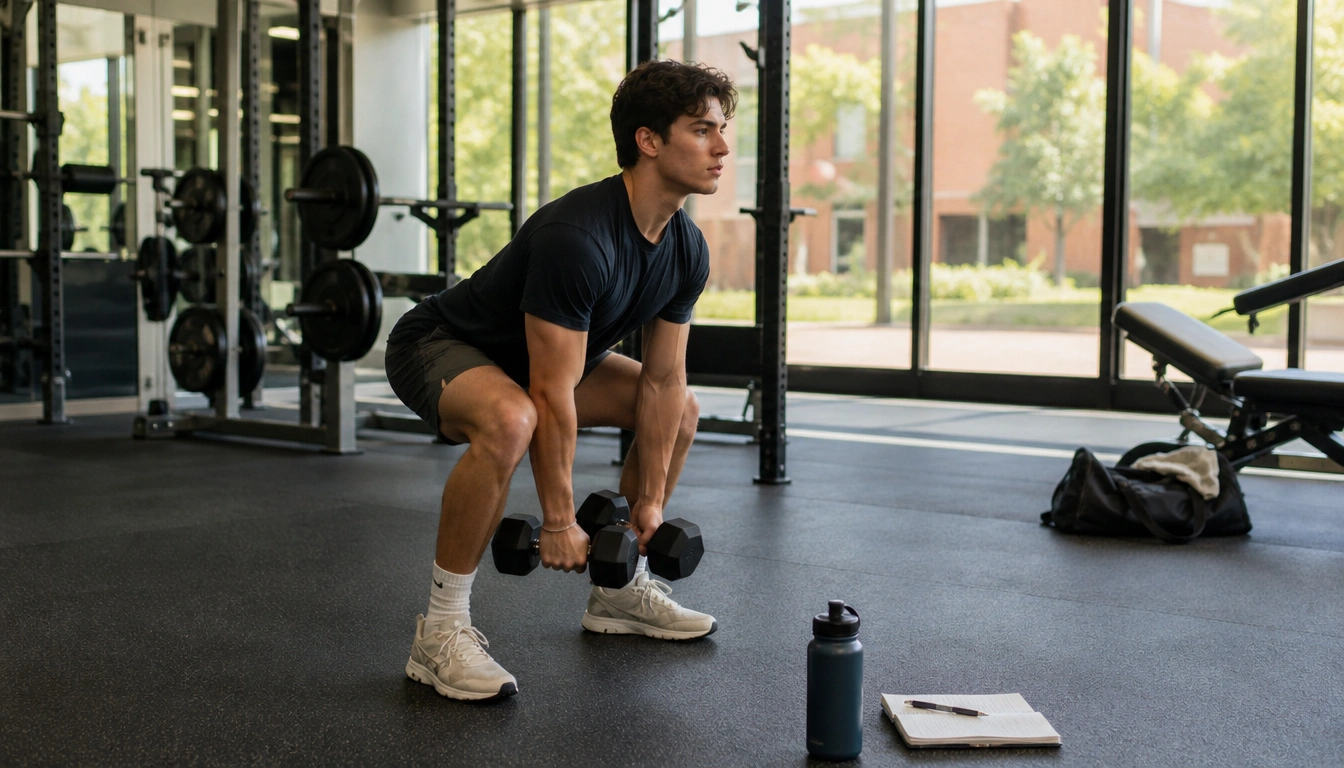
The simplest effective strength-training schedule for most college beginners is two full-body lifting days per week, spaced apart with at least one rest day between them. That approach is easier to maintain during busy semesters, still covers all major muscle groups, and leaves room for classes, labs, work shifts, and exam weeks. If you can handle a third day later, that can help, but two well-planned sessions are enough to start.
Key Takeaways
- Two full-body workouts per week can be enough for a beginner because consistency matters more than a complicated split.
- Aim to train the major movement patterns each week: squat, push, pull, hinge, and core.
- For most beginners, 2 to 4 sets of 8 to 12 reps is a practical starting point for main lifts.
- Rest about 2 to 3 minutes between hard sets so your next set stays strong and controlled.
- If exams get hectic, a shorter minimum-effective-dose workout still helps you keep momentum.
- Normal muscle soreness is common after lifting, but sharp, joint-like, or worsening pain is a reason to stop and get checked.
Why a simpler schedule works better in college
A beginner strength schedule for college students should fit real life, not an ideal calendar. A bodybuilding-style split with five or six lifting days can be hard to maintain when class times change, sleep is uneven, and exam weeks compress everything into survival mode. A simpler plan is usually better because it is easier to repeat week after week, and repetition is what builds results.
For most new lifters, two days per week is a strong starting point because it gives you enough exposure to practice the main lifts, while also leaving recovery time for sore muscles, late-night studying, and unpredictable schedules. Public health guidance and the American College of Sports Medicine both support muscle-strengthening activity on at least two days per week for adults. That is a solid minimum, not a punishment-level target.
The schedule should match your semester, not fight it. If Monday and Thursday work, use them. If Tuesday and Saturday fit better around labs or work, use those. The goal is to pick two days you can realistically protect most weeks. If one workout gets missed, a two-day plan still leaves you with the other session instead of falling completely off track.
If you want more volume later, you can add a third day once the habit feels stable. But for a busy beginner, the best plan is the one you can keep doing during midterms, travel, and low-energy weeks.
The two-day full-body template
A practical beginner setup is two full-body sessions, often called Workout A and Workout B. Each session should cover the major movement patterns across the week: squat, push, pull, hinge, and core. That way, you are not trying to isolate one body part on one day and then wait a full week to train it again.
Workout A
- Squat pattern: goblet squat, leg press, or bodyweight squat
- Push pattern: dumbbell bench press, machine chest press, or push-ups
- Pull pattern: seated row, one-arm dumbbell row, or cable row
- Core: plank or dead bug
Workout B
- Hinge pattern: Romanian deadlift, hip hinge with dumbbells, or hip thrust
- Push pattern: overhead press or incline press
- Pull pattern: lat pulldown, assisted pull-up, or band row
- Single-leg work: reverse lunge, split squat, or step-up
You do not need every possible exercise in the same workout. The idea is coverage, not complexity. If your campus gym is crowded, pick the first available option that fits the same movement pattern. A squat is still a squat whether you use a barbell, a dumbbell, a machine, or your own bodyweight.
For beginners, a session with four exercises is often enough. That keeps the workout focused, lowers decision fatigue, and makes it much easier to leave the gym feeling successful instead of exhausted by options.
How many sets, reps, and how hard to train
For most beginner lifters, a useful starting point is 2 to 4 sets per exercise in the 8 to 12 rep range. That recommendation lines up well with common strength-training guidance and gives you enough work to learn technique, build basic strength, and create a clear signal for adaptation.
The final one or two reps of each set should feel challenging, but your form should stay controlled. You should not need to grind every rep or turn every set into a test of willpower. If you could easily do many more reps, the set is probably too light to drive much progress. If your technique falls apart early, it is probably too hard or too much for where you are right now.
Beginners often do well with the same set and rep range for several weeks before changing anything. That steadiness lets you learn the lifts without constantly chasing a new program. You are building a base, not proving how hard you can suffer.
If you are unsure about load selection, choose a weight that lets you reach the target reps with good form and still feel like you had a few reps left in reserve. That gives you room to improve without turning each session into a form breakdown.
Rest, session length, and recovery basics
For the main lifts in a beginner strength schedule for college students, about 2 to 3 minutes of rest between hard sets is a sensible target. That rest window gives your muscles and nervous system time to recover enough to repeat the effort with decent quality. Shorter rests can make workouts feel rushed and reduce performance on the next set.
Most beginner workouts do not need to be long. If you keep the exercise list simple and avoid long phone breaks, a full-body session can often fit into 30 to 60 minutes, depending on how busy the gym is and how many warm-up sets you need. Longer is not automatically better if it leads to skipping the workout entirely.
Recovery is more than resting between sets. Sleep, food, and stress level all matter. College life can make those hard to control, so the goal is not perfection. It is to do enough work that your body can adapt without draining your energy for class and studying.
On especially busy weeks, it is okay to trim the session instead of canceling it. Keep the big movement patterns, do fewer accessory sets, and move on. That approach preserves the habit and still gives your body a training stimulus.
How to progress without overthinking it
The simplest progression method is to keep the same exercises for several weeks and slowly improve one variable at a time. For example, if you complete all your target reps with good form, add a small amount of weight next time. If you are not ready to add weight, try adding one rep per set first.
That style of progression works well because it is easy to track and easy to recover from. Beginners do not need a complicated spreadsheet or weekly max-out session. They need a clear way to get slightly stronger over time.
A useful rule is to make progress only when the current weight feels manageable with good technique. If you reach the top of your rep range across all sets, consider increasing the load a little in the next session. If the new weight is too challenging, stay there until your reps improve.
During exam weeks, the goal changes from building as much as possible to maintaining momentum. That is where the minimum effective dose matters. Even one shorter workout can help you keep the routine alive, preserve technique, and make it easier to ramp back up when your schedule normalizes.
Progress is not lost because one workout gets missed. What usually derails beginners is trying to make up everything at once. Instead of doubling the next session, return to the plan you can repeat.
How to train with limited equipment
You can meet the same training goal with free weights, machines, bands, or bodyweight, depending on what your campus offers. The movement pattern matters more than the tool. If you can squat, push, pull, hinge, and brace your core with enough effort, you can make real progress.
| Training goal | Free weights | Machines | Bands | Bodyweight |
|---|---|---|---|---|
| Squat | Goblet squat | Leg press | Band squat | Air squat or split squat |
| Push | Dumbbell press | Chest press | Band press | Push-up |
| Pull | Dumbbell row | Seated row | Band row | Inverted row if available |
| Hinge | Dumbbell Romanian deadlift | Hip hinge machine | Band pull-through | Glute bridge or hip hinge drill |
| Core | Loaded carry or plank | Cable anti-rotation press | Band anti-rotation press | Plank or dead bug |
If your dorm setup is all you have, choose harder bodyweight versions, slow the tempo, or use unilateral exercises to increase challenge. If the campus gym is available, machines can be especially helpful because they are simple to learn and easier to use when you are tired or rushed.
The best option is the one that removes friction. A student who actually uses dumbbells twice a week will make more progress than someone with a perfect plan they never start.
Normal soreness versus pain that should stop the workout
Beginners often worry that any discomfort means they are doing something wrong. That is not true. Mild to moderate delayed-onset muscle soreness, or DOMS, is common after new or harder training. It usually feels like a dull ache or stiffness in the muscles and tends to show up after the workout rather than during it.
DOMS is different from warning signs. Sharp pain, sudden pain, pain in a joint rather than the muscle, instability, swelling, numbness, or a popping sensation are all reasons to stop and reassess. Pain that gets worse as you keep moving is also more concerning than ordinary soreness.
If the discomfort is clearly in the muscle you trained and improves with gentle movement, you may simply need more recovery or a lighter session next time. If the pain is localized, severe, or keeps coming back, it is smarter to get guidance from a campus health professional, athletic trainer, or qualified clinician before continuing.
Good training should feel challenging, not alarming. The goal is to leave the gym tired, not injured.
Habits that make college consistency easier
The most reliable way to stay consistent is to make lifting easy to start. One helpful tactic is to attach workouts to an existing routine. For example, go to the gym right after your last class on your chosen training days before you return to your dorm or apartment. Once you sit down, the odds of skipping rise fast.
It also helps to keep your plan visible and simple. Write Workout A and Workout B in your phone notes or planner, and decide in advance which days you will train. Decision fatigue is real, especially during exams, so fewer choices usually means better follow-through.
Pack your gym clothes, water, and headphones earlier in the day so the session has less friction. If a full workout feels unrealistic, set a minimum version you will still do: one or two main lifts, a short accessory movement, and leave. That is often enough to protect the habit.
Food matters too, but you do not need a perfect meal plan to begin. Just make sure you are eating enough across the day and getting some protein at regular meals. The more your workouts fit around your actual campus life, the more likely they are to survive the semester.
Frequently Asked Questions
How many days per week should a college student lift to build strength?
For a beginner, two lifting days per week is a strong and realistic target. It is enough to train all major muscle groups, practice the lifts, and stay consistent through busy semesters. If your schedule is stable later, you can add a third day.
Is a 2-day full-body routine enough for beginners?
Yes. A 2-day full-body routine is often enough for beginners to build strength, especially if the sessions are planned well and done consistently. It is also easier to keep during exam weeks than a more complex split.
What exercises should be in a beginner college strength workout?
A beginner workout should cover squat, push, pull, hinge, and core patterns. Good choices include squats or leg press, presses, rows, deadlifts or hip hinges, and planks or dead bugs. The exact exercise can change based on your equipment and comfort level.
How many sets and reps should a beginner do?
A practical starting point is 2 to 4 sets of 8 to 12 reps for main lifts. The last one or two reps should feel challenging, but your form should stay controlled. If every set feels easy, the weight is probably too light.
Can I still make progress if I miss workouts during exam weeks?
Yes. You can still progress if you miss an occasional workout. Try to complete the next planned session instead of trying to cram everything into one day. During exam weeks, even shorter workouts can help maintain momentum until your schedule settles down again.
The Bottom Line
For most college beginners, the most effective strength plan is the one you can repeat during real semesters, not the one that looks most impressive on paper. Two full-body sessions per week, spaced apart, are enough to build a strong base and keep the routine manageable.
Keep the workouts simple: train the major movement patterns, use a sensible rep range, rest long enough to recover, and progress gradually. If one week gets messy, return to the plan instead of restarting from zero. Consistency is the real advantage.
If you are unsure whether soreness or pain is the issue, err on the side of caution. Mild muscle soreness is common; sharp, joint-like, or worsening pain is not. When in doubt, get checked by a qualified health professional before pushing ahead.
Medical disclaimer
Medical disclaimer: This content is for educational and informational purposes only and is not a substitute for professional medical advice, diagnosis, or treatment. Dietary needs and supplement suitability vary by individual.
