
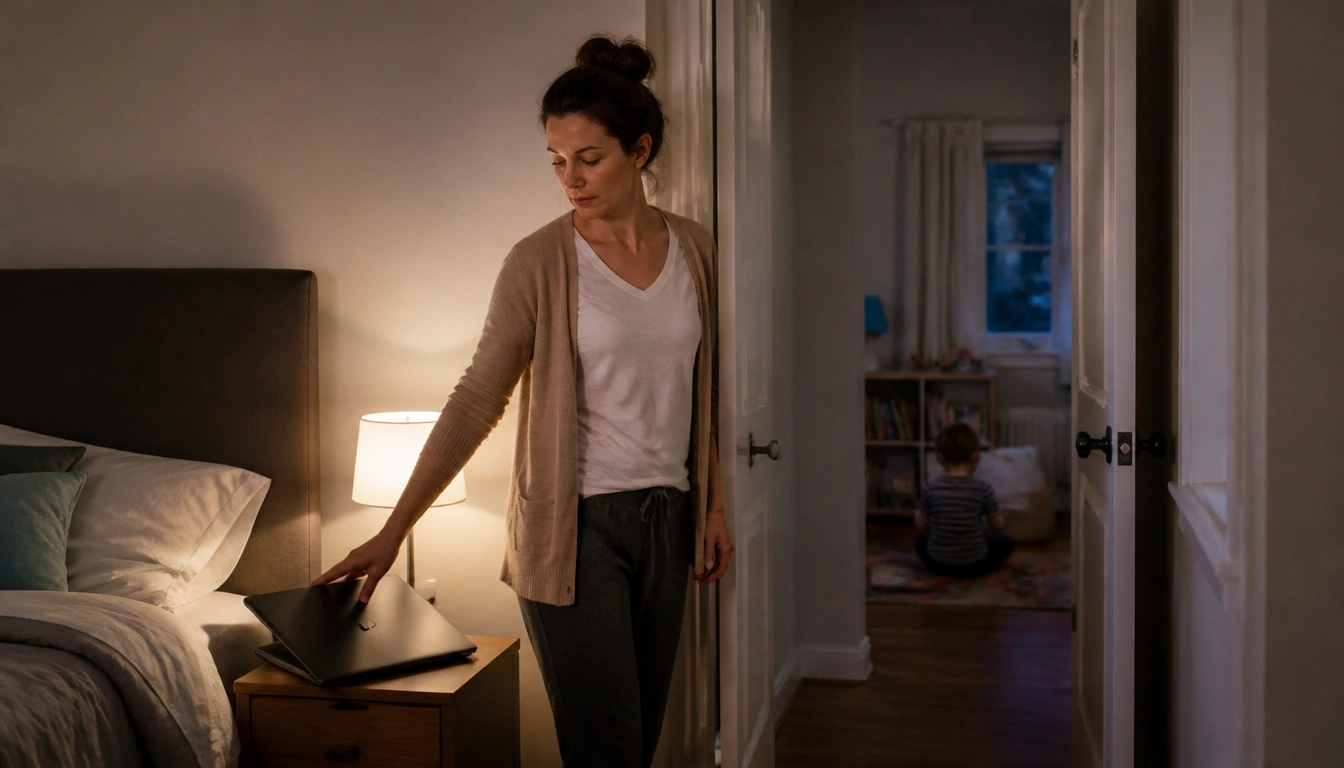
You can build a workable sleep routine by anchoring your day with a consistent wake time, morning light, and predictable meals and activity; creating a hard stop to work; protecting a simple evening wind-down; and using short naps and nighttime reset strategies without letting them take over your sleep drive. If your sleep problems persist, or you have loud snoring, gasping, or daytime sleepiness, it is worth getting medical help.
Key Takeaways
- Treat wake time as the main anchor, even when bedtime is imperfect or children interrupt the night.
- End the workday with a physical and mental shutdown so your brain stops treating the bedroom like an office.
- Use evening light control, a brief brain dump, and low-stimulation tasks to reduce bedtime mental chatter.
- If you must nap, keep it short and earlier in the day so nighttime sleep pressure stays intact.
- If you lie awake in bed, get up after about 20 minutes and return only when sleepy to avoid training the brain to stay alert there.
The unique remote-worker-parent sleep problem
Sleep advice often assumes a clean separation between work, home, and nighttime rest. Remote workers who are parents usually do not have that separation. The same room may hold paid work, homework, dinner, toys, and the laptop you checked after bedtime. That “blended boundary” can keep the brain in problem-solving mode long after work is over.
Parents also deal with fragmented nights. A child waking at 2 a.m. is not the same as staying up for entertainment, but the body still feels the cost the next day. Over time, the combination of irregular hours, evening screens, and pressure to stay available can weaken the signals that tell the body when to be alert and when to sleep.
A practical routine does not try to create a perfect sleep window every night. It creates repeatable signals that support your circadian rhythm, protect sleep drive, and lower mental arousal as much as family life allows.
Build the day around anchors: fixed wake time, morning light, and predictable timing
For busy parents, the most useful anchor is usually a steady wake time. That gives your body a daily reference point, even if the night was rough. A consistent wake time helps stabilize the circadian rhythm, which is the body clock that affects alertness, appetite, and sleep timing.
Morning light matters too. Try to get outside soon after waking, even if only for a few minutes while the kids are getting ready. Daylight is one of the strongest cues that tells the brain the day has started. Pair that with regular meal timing and a predictable activity pattern, and you give your system clearer signals than it would get from drifting between late mornings and rushed evenings.
If your work hours are flexible, resist the temptation to treat every day differently. Small consistency is better than none. A stable “start of day” matters because it keeps the rest of the schedule from sliding later and later.
Create a hard stop to work
Remote work often bleeds into bedtime because there is no commute, no shared exit point, and no obvious moment when the workday ends. That is why a hard stop matters. Close the laptop, put it in a bag or drawer, and make that action part of your shutdown routine. The goal is not just to stop working; it is to give your brain a visible cue that work is over.
A short replacement “commute” can help with the transition. A brief walk outside is ideal if possible, but even a few minutes moving around the block or stepping outside and back in can create separation between work mode and home mode. It can also lower the sense that the workday is still hanging over the evening.
Notification boundaries are part of the same system. Keep work email and chat off your phone at night if your job allows it. If you need to be reachable for true emergencies, use a narrow setting such as Do Not Disturb with only essential contacts allowed through. The point is to prevent every message from feeling urgent.
Design a parent-proof evening wind-down
A useful wind-down does not have to be elaborate. It should simply reduce stimulation and offload mental clutter. One helpful habit is a brain dump: write tomorrow’s tasks, reminders, or worries on paper before bed. Parents often carry the invisible workload of school forms, childcare logistics, meals, and unfinished work tasks. Getting those out of your head can reduce the urge to rehearse them in bed.
Screen timing matters because light from phones, tablets, and laptops can suppress melatonin, the hormone that helps signal sleep readiness. A 1- to 1.5-hour buffer before bed is a realistic target for many families, but even a shorter screen cutoff is useful if that is what your evening allows. During that window, choose lower-stimulation activities such as folding laundry, light reading, stretching, or preparing the next day’s clothes or lunch.
For parents, the wind-down should be practical enough to repeat on stressful days. Repeating a modest routine every night works better than aiming for an ideal routine you cannot sustain.
Optimize the sleep environment for shared-household reality
Shared homes are noisy, and sleep is easier when the room itself does some of the work. Keep the bedroom as dark as possible with blackout curtains, covered LEDs, or an eye mask if needed. Darkness supports the body’s normal nighttime signal.
Temperature also matters. Many sleep experts and health organizations recommend a cool room, roughly in the low 60s to mid-60s Fahrenheit range, though comfort varies. The point is to avoid overheating, which can make sleep onset and staying asleep harder.
Noise is the other big issue in family homes. White noise, a fan, or other steady sound can reduce the impact of sudden household noises. If your phone becomes part of the bedtime routine, place it away from the bed so it is less tempting to check. Keeping the bed for sleep helps the brain keep a cleaner association between that space and rest.
A simple bedroom setup checklist
- Block as much light as you reasonably can.
- Keep the room cool rather than warm.
- Use steady background sound if the house is active.
- Charge the phone away from the pillow.
- Keep work materials out of view.
How to handle fragmented sleep and use naps without wrecking nighttime rest
If children wake during the night, the goal is not to “make up” for every lost minute the next day. The goal is to protect the overall pattern. That starts with keeping your wake time steady and avoiding the habit of sleeping in for long stretches after a rough night, which can push the next bedtime later and make the cycle worse.
Brief naps can be useful for a sleep-deprived parent, especially if you are running on broken rest. The safest approach is a short nap, early in the afternoon, rather than a long or late nap. Short naps can reduce exhaustion without stealing too much from nighttime sleep pressure. If you wake from a nap feeling groggy, it may have been too long for your needs that day.
If you are very tired, use naps as a recovery tool, not a daily replacement for nighttime sleep. And if possible, avoid napping so late that you are no longer sleepy at your usual bedtime.
| Situation | Better choice | Why it helps |
|---|---|---|
| You had a rough night with a child waking | Keep the same wake time and aim for an earlier, calmer evening | Preserves the body clock and reduces schedule drift |
| You feel drained by early afternoon | Take a brief nap rather than pushing through in a fog | Can restore alertness without fully resetting nighttime sleep need |
| You are tempted to nap late in the day | Use another recovery strategy instead, such as a short walk or quiet break | Late naps can make falling asleep at night harder |
What to do if you wake and can’t fall asleep
Lying awake in bed can train the brain to connect the bed with frustration instead of sleep. The practical response is the 20-minute rule: if you are awake and not getting sleepy again, get out of bed and go somewhere dim and quiet. Do a calm activity such as reading something light on paper or listening to something soothing at low volume.
Return to bed only when you feel drowsy again. That reset protects the bed-sleep association. It also helps reduce the cycle of clock-watching, worrying about the next day, and trying harder to sleep, which usually keeps people awake longer.
If children wake you and you need to respond, handle the interruption calmly and then return to the same rule. The aim is not a perfect night; it is preventing one disrupted hour from turning into a long stretch of frustrated wakefulness.
When the problem needs medical help
Some sleep problems are not just about routine. If you have followed good sleep habits for several weeks and still cannot sleep well, or if you feel persistently sleepy during the day, it is time to talk with a healthcare professional. Chronic insomnia can be treatable, including with cognitive behavioral therapy for insomnia, which is often recommended before medication for many adults.
Also watch for signs that suggest something beyond a busy schedule. Loud snoring, gasping during sleep, frequent choking, or unrefreshing sleep can point to sleep apnea. Mood changes, worsening anxiety, or feeling unable to function during the day are also important reasons to seek help.
Parents often normalize exhaustion because the household is busy. But if sleep loss is becoming the default rather than the exception, getting evaluated is a practical step, not an overreaction.
Frequently Asked Questions
What time should remote workers who are parents wake up and go to bed to protect sleep consistency?
A fixed wake time matters more than chasing a perfect bedtime. Aim to wake at the same time most days, then shift bedtime enough to allow as much sleep as your schedule realistically permits. A consistent wake time plus morning light helps stabilize the body clock.
How can I stop working from home from bleeding into bedtime and making it harder to fall asleep?
Create a clear shutdown ritual: close the laptop, silence work notifications, and do a brief replacement commute such as a short walk or change of setting. That physical and mental boundary helps your brain move out of work mode.
What should a busy parent do if they can’t get a full 7–8 hours of sleep because of night wakings?
Keep the schedule as steady as possible, protect the bedroom environment, and avoid trying to compensate with very long naps or major sleep-in days. Short naps can help if you are exhausted, but they should not replace nighttime sleep whenever that can be avoided.
How can I use morning light, evening wind-down time, and nap timing to improve sleep?
Get outside soon after waking, use a low-stimulation wind-down before bed, and keep any nap brief and early in the afternoon. Those habits support circadian timing and sleep pressure without adding extra stimulation at night.
When should I worry that poor sleep is more than a routine problem and get medical help?
Seek medical advice if poor sleep lasts for weeks despite good habits, if you have loud snoring or gasping, if daytime sleepiness is affecting safety or function, or if mood changes are getting worse. Those can be signs of insomnia, sleep apnea, or another condition.
The Bottom Line
A workable sleep routine for remote-working parents is built around anchors, not perfection. Start with a steady wake time, morning light, a hard stop to work, and a short evening wind-down that your family can realistically repeat.
Protect the bedroom as a sleep space, use naps carefully, and follow the 20-minute rule if you are awake in bed. If poor sleep keeps going, or you notice snoring, gasping, or daytime sleepiness, it is reasonable to get medical help rather than pushing through indefinitely.
Medical disclaimer
Medical disclaimer: This content is for educational and informational purposes only and is not a substitute for professional medical advice, diagnosis, or treatment. Dietary needs and supplement suitability vary by individual.
Sources
- National Institutes of Health (NIH) — nih.gov. Accessed November 2026.
- National Health Service (NHS) — hey.nhs.uk. Accessed November 2026.
- Centers for Disease Control and Prevention (CDC) — cdc.gov. Accessed November 2026.
- National Health Service (NHS) — uhs.nhs.uk. Accessed November 2026.
- Centers for Disease Control and Prevention (CDC) — cdc.gov. Accessed November 2026.
- National Health Service (NHS) — royalberkshire.nhs.uk. Accessed November 2026.
- National Health Service (NHS) — kingstonandrichmond.nhs.uk. Accessed November 2026.
- National Health Service (NHS) — scot.nhs.uk. Accessed November 2026.
