
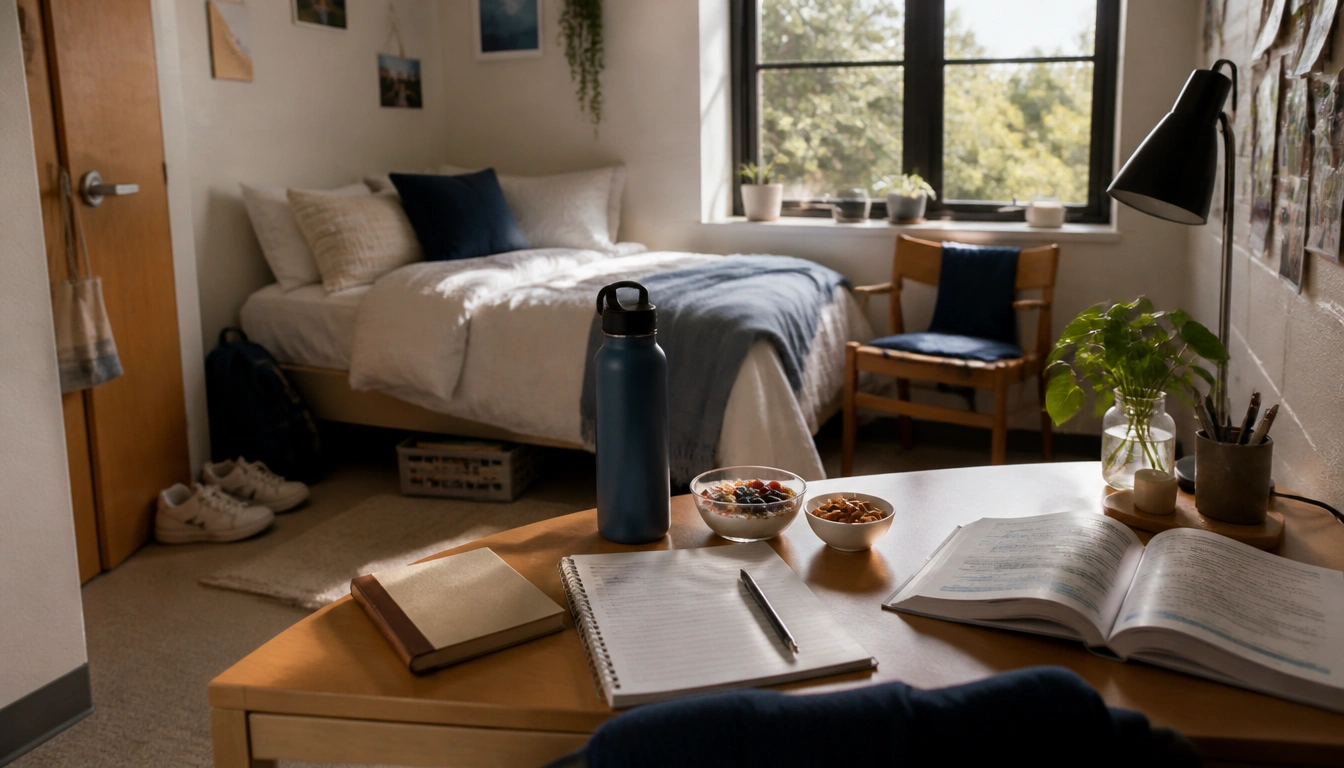
You can build a realistic wellness routine in college without using apps by keeping it simple: protect a steady sleep window, make movement easy to start, keep food choices visible and affordable, and tie habits to physical cues in your room or backpack. The most sustainable routine is the one you can repeat on busy days, not the one you can track perfectly.
Key Takeaways
- Start with the Big Three: sleep, movement, and food. Those habits affect energy, mood, and focus more than any app score.
- Use physical cues instead of notifications: lay out shoes, place water on your desk, and keep a notebook where you study.
- Dorm and commuter routines need different setups, so build around your actual space, travel time, and meal access.
- During midterms and finals, shrink the routine instead of dropping it: short walks, simpler meals, and a protected bedtime still help.
- If sleep problems, low mood, pain, or eating concerns keep going, campus health or counseling is a better next step than self-help alone.
Why a no-app wellness routine works better for many college students
A wellness routine without apps for college students often works better because college life already asks you to manage class changes, social plans, deadlines, and money. Adding another dashboard to check can turn self-care into one more task. A simpler routine reduces decision fatigue and makes it easier to act on busy days.
Public health guidance from the CDC emphasizes consistent sleep, regular movement, and nutritious eating as core habits for health. Those basics matter more than a phone-based score. For many students, the best routine is not the most detailed one. It is the one that fits a real dorm room, a packed schedule, or a long commute without needing constant attention.
That also makes the routine easier to adjust. If you miss a workout or sleep later than planned, you do not need to reopen an app and analyze the pattern. You just return to the next cue in your day. That lowers the friction between knowing what to do and actually doing it.
Build the routine around sleep, movement, and food
Think of your routine as three linked habits. Sleep helps memory, mood, and concentration. Movement helps energy and stress management. Food supports steady attention and recovery. The CDC recommends adults get enough sleep on a regular schedule, and young adults generally do best with a stable bedtime and wake time rather than a different rhythm every day.
For sleep, choose a realistic target window and protect it as much as your class schedule allows. For movement, use public health recommendations as a baseline rather than a score to chase. A brisk walk between classes, stairs instead of the elevator, or a short bodyweight session can all count. For food, build meals around a simple pattern: something filling, something with protein, and something colorful or high-fiber when possible.
This works because it gives you a few repeatable decisions instead of dozens of tiny ones. You do not need to be perfect. You need a structure that helps your body recover from long study days, late nights, and campus stress.
Create an analog daily anchor system
App-free routines usually work best when they are tied to environmental cues. That means you let the room do some of the remembering for you. Put a water bottle where you will see it first thing in the morning. Leave your notebook open on your desk if you want to journal at night. Place workout clothes on the chair you pass before leaving for class.
This is especially useful if you have ADHD or executive dysfunction. A reminder on your phone still asks you to decide what to do next. A physical cue reduces that step. Habit stacking helps too: after brushing your teeth, refill your water bottle; after your last class, walk for ten minutes before heading home; after dinner, pack tomorrow’s snack.
Keep the cues obvious, not hidden. If your healthy snack lives in an opaque drawer, it is easy to forget. If it sits on the counter or in the front of the fridge, it becomes the easier choice. The goal is not to force discipline all day. It is to make the right next action easy to notice.
Dorm and commuter versions of the same routine
Dorm residents need routines that work in shared spaces and around dining halls. That may mean keeping earbuds, slippers, and a water bottle in one basket so you can leave the room quickly. It may also mean deciding in advance what a late-night snack looks like, so social eating does not turn into random grazing. In the dining hall, use a visual plate guide: half vegetables or fruit, one quarter protein, and one quarter grains or starchy foods when available.
Commuter students need a routine that starts before campus and survives travel time. Pack a breakfast or snack the night before, keep a spare water bottle in your bag, and use the trip itself as movement when possible. Parking farther away, walking part of the route, or taking stairs between stops can build activity into the commute. If you are gone for long stretches, shelf-stable foods can help bridge gaps between meals.
Both versions need the same core idea: plan for the place where your day actually happens. A dorm routine is shaped by roommates and dining halls. A commuter routine is shaped by traffic, transit, and packed meals. Either way, the routine should feel like a support system, not a second major.
Scale it down during midterms and finals
Exam weeks are not the time to expect your ideal routine to stay intact. They are the time to protect the smallest version that still keeps you steady. If you usually work out for 45 minutes, a 10-minute walk can be enough. If you normally cook, a simple meal from the dining hall or a shelf-stable backup is better than skipping food. If you usually journal, write three lines instead of a full page.
During intense weeks, focus on a few minimum standards: a bedtime boundary, one short movement break, and regular meals or snacks. The CDC and other public health guidance emphasize that sleep supports attention and emotional regulation, which are exactly the skills exams demand. Pulling all-nighters may feel productive in the moment, but it usually makes focus worse the next day.
Use a “good enough” rule. You are not abandoning your routine; you are shrinking it to match the week. When the schedule eases, you can return to the fuller version without having to rebuild from zero.
Low-cost tools and setup that make habits easier
You do not need expensive gear. A few low-cost items can do a lot of work. An alarm clock can keep your phone farther from the bed. A reusable water bottle can sit on your desk as a cue to drink. A resistance band can give you a simple way to move without a gym. A small notebook can hold your class schedule, a to-do list, or a brief wind-down routine.
Visible food matters too. Keep affordable options where you will actually use them. Good shelf-stable choices can include peanut butter, canned beans, canned tuna or salmon, oats, whole-grain bread, nuts, and fruit that stores well, such as apples or bananas. These do not need a subscription or an app to manage. They just need to be easy to see and easy to grab.
If your campus dining hall is your main food source, use it as your default, not your backup. Look for vegetables, fruit, whole grains, and protein choices that fit your budget and schedule. The more your setup matches your real environment, the less willpower you need.
What to do when motivation disappears
Motivation often drops in college because energy, sleep, and stress all change at once. When that happens, do not wait to “feel like it.” Use a reset plan. Start with one short walk, one regular meal, and one screen-free wind-down step. You are trying to restart momentum, not prove discipline.
It helps to define the minimum version of your day ahead of time. For example: get out of bed at a set time, eat something before your first class, walk for ten minutes after lunch, and put your phone away before sleep. Those tiny anchors can keep a hard week from turning into a full routine collapse.
If you keep missing habits, shrink them again. Shorter is not failure. Shorter is how a sustainable routine survives exams, bad weather, roommate noise, or a rough mental health week.
When to get extra help from campus health or counseling services
A self-managed routine is for general wellness, not a substitute for care. If sleep problems last for weeks, if you feel persistently down or anxious, if you are missing classes because of exhaustion, or if pain keeps coming back, campus health or a clinician should be part of the plan. The same is true if eating becomes restrictive, chaotic, or tied to guilt and fear.
Get help sooner if you notice sudden weight change, frequent digestive trouble, dizziness, fainting, or thoughts of self-harm. Those are not problems to fix with more self-discipline or a better planner. They deserve medical or counseling support.
If you suspect ADHD, depression, anxiety, or another condition is making routines hard to start or keep, ask for an evaluation. A better support plan can make a no-app routine much more realistic.
Frequently Asked Questions
What should a no-app wellness routine include each day?
A basic routine should cover sleep, movement, and food. Try to keep a consistent wake time, build in some kind of walking or other movement, and eat regular meals or snacks that are easy to access. Add a short wind-down habit at night if it helps you sleep more consistently.
How do I stay consistent with sleep, exercise, and eating without tracking apps?
Use the same cues every day. Put your water bottle where you will see it, lay out workout clothes before bed, and keep a simple bedtime routine. Consistency comes more from repetition and environment than from counting every habit.
What are simple analog habits that work in a dorm or shared housing?
Use visible cues and low-friction setup: keep snacks on a shelf you can see, place shoes by the door for walks, and use a notebook for reminders instead of your phone. In shared housing, predictable spots help you act before distractions take over.
How do I adjust a wellness routine during midterms and finals?
Scale it down instead of dropping it. Replace a long workout with a short walk, choose simple meals, and keep a bedtime boundary so your sleep does not unravel. A smaller routine is still useful during high-stress weeks.
What can students with ADHD or executive dysfunction do to make routines stick?
Make the environment do more of the work. Use physical prompts, keep items where you will naturally notice them, and attach one habit to another, such as drinking water after brushing your teeth. These cues are often easier to follow than app reminders.
The Bottom Line
A realistic college wellness routine does not need an app, a wearable, or a perfect score. It needs a few repeatable habits that fit your living situation, budget, and energy level.
Focus on sleep, movement, and food first. Then make those habits easier with visible cues, simple backups, and a reset plan for busy weeks. If symptoms go beyond ordinary stress or exhaustion, campus health or counseling is the right next step.
Medical disclaimer
Medical disclaimer: This content is for educational and informational purposes only and is not a substitute for professional medical advice, diagnosis, or treatment. Dietary needs and supplement suitability vary by individual.
Sources
- Centers for Disease Control and Prevention (CDC) — cdc.gov. Accessed November 2026.
- National Health Service (NHS) — humber.nhs.uk. Accessed November 2026.
