
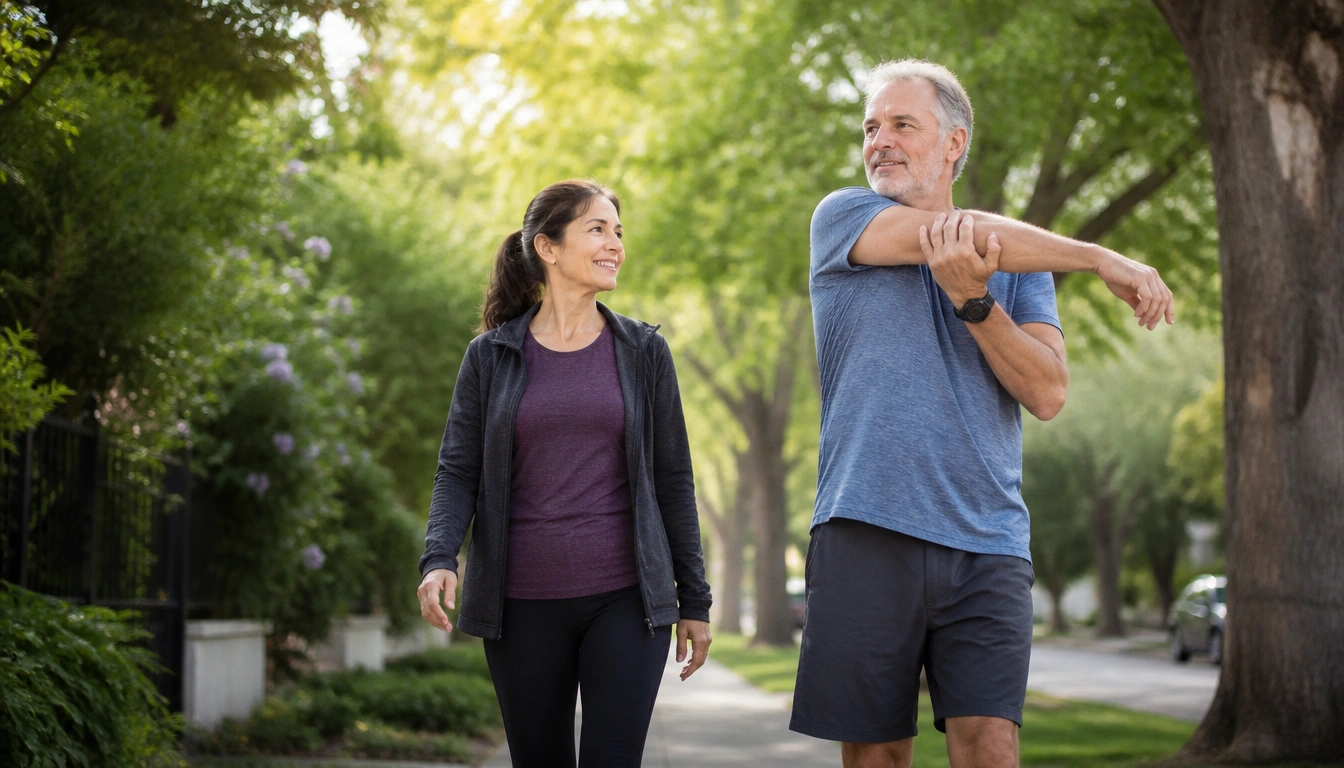
On a rest day, adults over 50 usually recover best with light movement that keeps blood flowing without creating new fatigue. Think easy walking, gentle cycling, pool work, mobility drills, or restorative yoga at a pace that feels refreshing rather than challenging. If movement increases sharp pain, swelling, limping, or unusual weakness, stop and get medical advice instead of pushing through.
Key Takeaways
- Active rest helps older adults stay looser and less stiff, especially when regular training is interrupted by long sitting or complete inactivity.
- Use the talk test: you should be able to speak in full sentences; if you are breathless or working hard, it is no longer a rest day effort.
- Walking, pool walking, easy cycling, mobility flows, and gentle yoga all count, but they load joints differently.
- For sore joints or arthritis, lower-impact options such as water walking or easy cycling are often more comfortable than impact-based exercise.
- Recovery is not just movement: hydration, protein spread across meals, and enough sleep support how well your body repairs.
- Sharp pain, swelling, limping, or pain that worsens instead of easing are signs to stop and consider medical evaluation.
Why rest days matter more after 50
For adults over 50, an effective rest day is usually not the same as a fully sedentary day. Recovery tends to take longer because muscle protein synthesis slows, connective tissues are less pliable, and joints can stiffen more quickly after long periods of sitting. That is one reason many people feel better with a little movement instead of staying still all day.
Complete inactivity can also make the first steps the next morning feel harder, especially after strength training or longer walks. The Centers for Disease Control and Prevention and the NHS both encourage older adults to break up long sitting time with movement during the day. That does not mean training hard. It means using low-key activity to support circulation, range of motion, and comfort while tissues recover.
After a workout, the body is repairing small amounts of exercise-related stress. A rest day gives that process time to catch up. Light movement can help with blood flow and stiffness, while heavy or jarring exercise can add more strain than your body is ready for.
How to think about active rest on a rest day
Active rest is meant to support recovery, not create a new training effect. The goal is to feel better after the session than you did before it. If you finish more relaxed, less stiff, and not depleted, you are probably in the right zone.
A practical intensity check is the talk test. Light activity feels easy enough that you can talk normally. Moderate activity may still allow conversation, but it should not feel effortful or leave you out of breath. On an active rest day, most people over 50 should stay at the lighter end of that range.
Another useful rule is whether the movement refreshes you. A short walk, a few mobility drills, or easy water movement can loosen you up. If the session leaves you sweating heavily, sore, or unusually tired, it has drifted away from recovery and into workout territory.
Best active rest day ideas ranked by joint load and effort
Not all recovery movement feels the same on knees, hips, feet, or the low back. The best choice depends on how much load you want, how sore you feel, and whether you need standing, seated, or supported options.
| Option | Joint load | Effort level | Best for |
|---|---|---|---|
| Pool walking or easy water movement | Very low | Very light | Sore joints, arthritis, extra body soreness, poor walking tolerance |
| Gentle cycling | Low | Light | Leg stiffness, cross-training days, people who want steady motion without impact |
| Easy walking | Low to moderate | Light | Most people, especially if weather and footing are good |
| Mobility flow | Very low | Very light | Tight hips, upper back stiffness, travel days, limited time |
| Restorative or yin yoga | Low to moderate | Light | Tight muscles, stress relief, flexibility work, calm recovery days |
Walking is the simplest option and often the easiest to keep truly light. A flat, conversational walk can increase circulation without pounding the joints. It is also easy to shorten if your energy changes mid-walk.
Pool walking or gentle water exercise is often the most joint-friendly choice. Buoyancy reduces body weight on the knees, hips, and spine, while the water still provides mild resistance. That makes it especially useful when soreness or arthritis makes land-based exercise feel irritating.
Easy cycling is helpful when you want continuous movement with little impact. Keep resistance low and cadence relaxed. If you start pushing a bigger gear or climbing hills, it stops being recovery.
Restorative or yin yoga can work well if you prefer stretching, breathing, and floor-based support. Choose poses that feel comfortable and never force range. If a pose creates strain in a joint, back off or skip it.
Mobility flows are best when you want a short, equipment-free reset. Controlled arm circles, ankle circles, hip hinges, seated spinal rotations, and gentle thoracic turns can keep joints moving without much fatigue. These are especially useful on days when weather, time, or transportation limits other options.
How to choose the right option for your body today
The best active rest day choice depends on what is driving your recovery need. If your muscles feel generally tired after lifting, a short walk or easy bike ride may be enough. If your joints feel cranky, water-based movement or mobility work is often the smarter choice.
For soreness that feels dull, symmetrical, and spread across the muscles you trained, light movement is usually reasonable. For arthritis, choose the lowest-impact option that still feels comfortable. Pool work is often the easiest on painful knees or hips, while cycling may suit people who want to keep moving without the repeated loading of walking.
Fitness history matters too. Someone who has trained consistently for years may tolerate a bit more movement on a rest day than someone restarting exercise after a long break. The same session can feel restorative to one person and too much to another, so your own response matters more than a fixed formula.
If energy is low, shorten the session rather than skipping movement entirely. Ten minutes of easy walking or a few minutes of mobility can be enough to break up stiffness. If you feel unusually drained, sleepy, or achy, choose the gentlest option available and keep the goal modest.
What to avoid on a rest day
Active recovery works only if it stays easy. The most common mistake is intensity creep: a short walk turns into a brisk workout, a cycle ride becomes hill repeats, or a yoga session turns into a strength challenge. That can delay recovery instead of helping it.
Impact work is another thing to avoid. Jogging, jump training, fast stairs, or explosive fitness classes may feel manageable in the moment, but they add more stress to tissues that are trying to repair. That is especially important if your knees, hips, feet, or back are already sensitive.
Long hard rides, heavy lifting, or “just one more tough session” are usually poor choices on a rest day after 50. The American College of Sports Medicine notes that hard resistance work for the same muscle groups generally needs time between sessions, often 48 to 72 hours. A rest day should help you return to training stronger, not leave you more beat up.
Also avoid stretching aggressively into pain. Gentle range work is useful; forcing a deep stretch when a muscle or joint is already irritated can make things worse. Recovery should feel easy to moderate, not like a test of endurance.
Simple active rest day templates
20-minute walk day: Start with five minutes at an easy pace, then continue with a flat, conversational walk for 10 to 15 minutes. Finish with a few gentle calf raises, shoulder rolls, or ankle circles. This works well after upper-body lifting or a busy week of sitting.
Pool day: Spend 10 to 20 minutes in the water walking forward and backward, then add a few side steps and gentle leg swings while holding the pool wall. Keep your breathing easy and stop before your legs feel heavy. This is a strong option for sore knees, hips, or feet.
Mobility-only day: Use five to 10 minutes of slow joint movements such as neck turns, shoulder circles, thoracic rotation, cat-cow, ankle mobility, and hip openers. If you want a little more, add a short easy walk later in the day. This template is useful when travel, weather, or fatigue limit exercise time.
Whatever template you choose, the day should feel like support work, not a hidden workout. If you want to talk yourself out of doing “too little,” remember that the purpose is recovery quality, not exercise volume.
Recovery habits that make the day work better
Movement is only one part of a good rest day. Hydration matters because even mild dehydration can make fatigue and cramping feel worse. Drinking water consistently through the day helps keep the body comfortable, especially if you are active outdoors or using a pool.
Protein also deserves attention. Spreading protein across meals supports muscle repair better than saving most of it for one meal at the end of the day. That matters more as we age, when the body’s response to protein can be less efficient than it was earlier in life.
Sleep timing is another recovery tool. The NHS and other health organizations emphasize regular sleep habits, and that matters on recovery days because the deeper repair processes happen overnight. A consistent bedtime, reduced late caffeine, and a calmer evening routine can help your body use the rest day well.
Think of these habits as part of the same strategy. Light movement improves circulation, food supplies repair materials, hydration supports function, and sleep finishes the job.
Red flags and when to stop
Normal delayed-onset muscle soreness usually feels dull, generalized, and related to muscles you worked. It often improves as you warm up. That is different from pain that is sharp, localized, or clearly centered in a joint, tendon, or bone.
Stop the activity and consider medical advice if you notice swelling, redness, limping, a change in your gait, or pain that gets worse as you move. Pain that wakes you from sleep, feels unstable, or does not improve over a few days deserves attention too. Those patterns are more concerning than ordinary post-workout soreness.
If you are returning to exercise after a long break, have arthritis that is flaring, or live with a chronic condition, it is sensible to use medical guidance when choosing how much activity is appropriate. Active rest is meant to support recovery, but it should never be used to push through a possible injury.
When in doubt, choose the gentlest version first. If a short walk or mobility flow feels good, you can keep it. If it feels wrong, stop. Recovery days are for backing off on purpose.
Frequently Asked Questions
How intense should an active rest day be for adults over 50?
It should stay at the light end of exercise, where you can talk comfortably and finish feeling better, not drained. If the session leaves you breathless, sweaty, or sore, it is too hard for a recovery day.
Is walking enough on a rest day after strength training?
Yes, for many adults over 50, an easy walk is enough. Keep it conversational, flat, and short to moderate in length. If walking makes your joints ache more, switch to a gentler option such as pool walking or mobility work.
What active rest day activities are best for sore joints or arthritis?
Pool walking, water exercise, easy cycling, and gentle mobility work are often the most joint-friendly. They reduce impact while still keeping you moving. Choose the option that feels smooth and does not increase joint pain during or after the session.
Can yoga, cycling, or swimming count as active recovery after 50?
Yes, if they stay easy. Restorative or yin yoga, low-resistance cycling, and gentle swimming or water walking can all count as active recovery. Avoid making any of them intense enough to feel like a workout.
How do I tell the difference between normal soreness and an injury on a rest day?
Normal soreness is usually dull, spread across worked muscles, and improves as you warm up. Injury-type pain is more likely to be sharp, one-sided, associated with swelling or limping, or worse as you keep moving. If that happens, stop and seek medical advice.
The Bottom Line
For adults over 50, the best rest day is usually an active one, but only at a light intensity. Walking, pool movement, easy cycling, mobility drills, and gentle yoga can all help recovery when they leave you looser and fresher instead of tired.
Choose the option that matches your joints, soreness, and energy level today. Pair movement with hydration, protein spread through meals, and enough sleep, and watch for pain signals that suggest you should stop rather than push through.
Medical disclaimer
Medical disclaimer: This content is for educational and informational purposes only and is not a substitute for professional medical advice, diagnosis, or treatment. Dietary needs and supplement suitability vary by individual.
Sources
- National Health Service (NHS) — www.nhs.uk. Accessed November 2026.
- Centers for Disease Control and Prevention (CDC) — cdc.gov. Accessed November 2026.
- American College of Sports Medicine (ACSM) — acsm.org. Accessed November 2026.
- Johns Hopkins Medicine — hopkinsmedicine.org. Accessed November 2026.
