
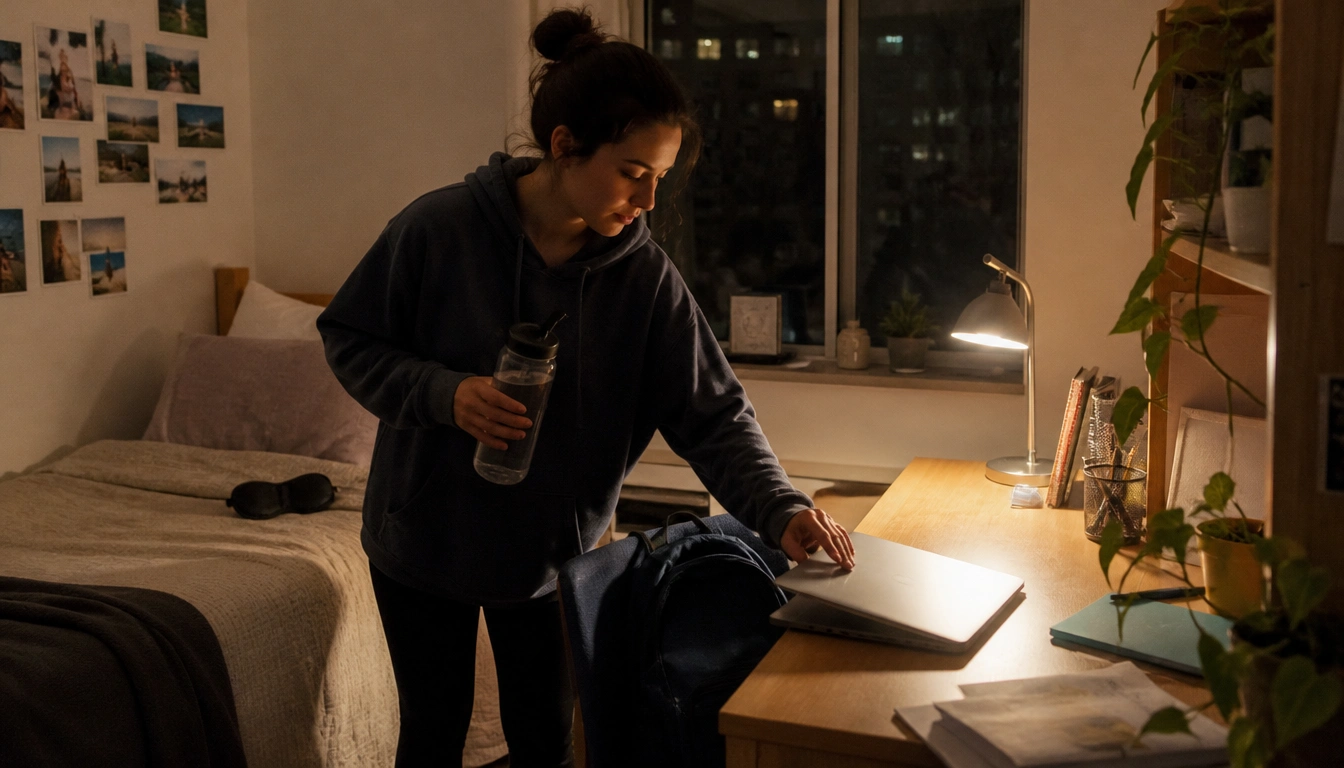
Start with a short transition period the moment work or class ends: decompress, eat or drink something light if needed, move gently, cut off stimulating screens, and set up your sleep space before you try to study or sleep. The order matters more than the clock. For students, this kind of recovery routine can lower mental overstimulation and make it easier to fall asleep later.
Key Takeaways
- Treat the space between class or work and sleep as a real recovery buffer, not leftover study time.
- Build the routine around sequence, so it still works after a 4 p.m. shift, a late lab, or an 11 p.m. library session.
- Use low-cost supports like an eye mask, blackout curtains, a water bottle, and a simple snack if you are hungry.
- Keep exercise light in the evening; save intense workouts for earlier in the day if possible.
- If fatigue keeps turning into cynicism, constant exhaustion, or poor functioning, recovery habits alone may not be enough.
Why college students need a real recovery buffer
Many students move straight from class, work, practice, or a study block into more screen time and more demands. That creates a mental bottleneck: your body may be home, but your nervous system is still acting like the day is not over. A recovery buffer gives you a clear signal that the high-demand part of the day has ended.
This matters because sleep works better when the brain is not still processing deadlines, social pressure, or customer-facing stress. According to the CDC and the American Academy of Sleep Medicine, young adults need 7 to 9 hours of sleep regularly. If the evening stays mentally “loud,” it becomes harder to reach that window consistently. A good routine is less about pampering and more about helping your system switch from output mode to restoration mode.
Sequence matters more than the clock
A student after-work recovery routine should be built around what happened last, not around a fixed bedtime on the wall. If you get off a shift at 4 p.m., your transition starts then. If your last class ends at 11 p.m., the same sequence still applies, just later. What changes is timing; what stays constant is the order.
Think of the routine as a chain: end the obligation, decompress, refuel if needed, reset your body, dim stimulation, and prepare the sleep space. That order helps the brain stop treating the rest of the evening like another task sprint. For students with irregular schedules, this is more realistic than trying to force one universal bedtime ritual.
If you only remember one principle, use this: the routine should begin immediately after your last major obligation and gradually lower your alertness, not spike it again.
Start with a commute boundary and simple fuel
The first step is mental decompression. If you walk, ride the bus, or drive home, let that time be a boundary instead of an extension of work or class. Avoid checking email, grades, group chats, or social feeds the entire way if you can. Give your mind room to process the day without adding new input.
After that, check two basic needs: hunger and hydration. If you have not eaten for several hours, a small snack or modest meal can help you feel steadier. Good options on a student budget include a banana, peanut butter toast, yogurt, oatmeal, crackers with hummus, or a handful of nuts. If you need a full dinner, keep it familiar and not overly heavy right before wind-down time.
Hydration should be simple too: drink water, especially after a sweaty shift or a long day of walking around campus. Avoid using energy drinks or late caffeine as a recovery tool. The NIH notes that caffeine can interfere with sleep because its effects can last for hours, so a cutoff well before bedtime is often helpful. For many students, that means avoiding caffeine late in the day rather than trying to “push through” until exhaustion takes over.
Use movement to reset, not rev up
Light movement can help you shift gears. A short walk, easy stretching, or gentle mobility work may reduce that stuck, wired feeling after a long day. The goal is not training stimulus; the goal is to release tension and move out of a stressed posture. Even a few minutes can help the day feel less compressed.
Timing and intensity matter. A hard workout late at night can leave your heart rate, body temperature, and mental energy too high for sleep onset. If you want exercise in the evening, keep it light enough that you could still relax afterward. Save intense lifting sessions, sprints, or competitive games for earlier in the day if possible.
Once movement is done, switch to lower-arousal choices. Good screen-free options include journaling for five minutes, reading paper notes, listening to calm audio, packing your bag for tomorrow, or making a very short to-do list so your brain does not keep rehearsing tomorrow’s tasks.
Set up a sleep environment that works in dorms
Your sleep space does not need to be perfect, but it should be predictable. In shared rooms, apartment bedrooms, or noisy dorms, the biggest challenge is usually light and sound. Blackout curtains, an eye mask, earplugs, or a white-noise app can make a real difference when you cannot control the building or your roommate’s schedule.
Keep the room as cool and uncluttered as you reasonably can. Put your charger, water, alarm, and next-day clothes in one place so you are not hunting for things after you start winding down. If your bed is also your study spot, try to create at least one signal that study time is over: close the laptop, stack the books, turn off the desk lamp, or move to a different chair for the last part of the evening.
Low-cost tools are enough. An eye mask, a cheap fan, a curtain clip, or a notebook by the bed can do more for consistency than expensive sleep gadgets. The point is to reduce friction between “I should sleep” and actually lying down calmly.
Adjust the routine for late shifts and night-owl schedules
Late classes, evening shifts, and night-owl chronotypes do not cancel out the value of a recovery routine. They just change when it starts. If you end work at 11 p.m., your transition sequence may be shorter and simpler, but it still helps to separate the final obligation from sleep.
For a night-owl student, the goal is not always to become an early sleeper overnight. A more realistic goal is to protect sleep quality by making the run-up to bed more structured and less chaotic. That means keeping the same sequence even when the clock is late: decompress, eat if needed, move lightly, lower stimulation, and prepare the room.
If your schedule changes across the week, try to keep the order stable and only adjust the duration. A 20-minute version may work after a late lab. A longer version may fit a lighter evening. The routine is successful if it reduces mental spillover and helps you sleep at the time your schedule allows.
Know the difference between tiredness and burnout
Normal fatigue usually follows a full day. You feel worn out, but rest, food, and sleep still make a noticeable difference. Burnout is different. It can look like emotional exhaustion, cynicism about school or work, feeling detached from people or assignments, and a sense that nothing you do helps much anymore. That pattern does not usually improve with one good night of sleep.
A routine is useful when the problem is mainly overload, timing, or poor recovery habits. It is not enough if you are consistently unable to sleep, dread most responsibilities, or feel persistently numb, hopeless, or overwhelmed. The same is true if fatigue comes with frequent headaches, stomach issues, panic symptoms, or major drops in functioning.
If that sounds familiar, campus health services or counseling can help assess whether you are dealing with insomnia, a circadian rhythm issue, anxiety, depression, or academic burnout. The routine can still be part of the fix, but it should not be the only support.
Examples of a 30-minute and 60-minute routine
30-minute routine: 5 minutes of quiet decompression after you get home, 5 to 10 minutes for water and a light snack if needed, 5 minutes of easy stretching or a short walk, 10 minutes with screens off while you set up your room, and 5 minutes to wash up, brush teeth, and get into bed.
60-minute routine: 10 minutes to disconnect from the day during your commute or walk back, 10 to 15 minutes for a meal or snack and hydration, 10 minutes of light movement, 15 to 20 minutes of screen-free wind-down, and the final 5 to 10 minutes for sleep setup and a short next-day reset.
Both versions work because they follow the same order. They are flexible enough for a student with a part-time job, a lab night, or a long commute. The best routine is the one you can repeat on ordinary weeknights, not the one that sounds ideal but collapses when your schedule gets messy.
Frequently Asked Questions
How long should an after-work recovery routine be for a college student?
Most students can benefit from a routine that lasts 20 to 60 minutes, depending on how intense the day was. The key is not the exact length; it is having enough time to decompress, eat or hydrate if needed, move a little, and lower stimulation before sleep.
What should I eat or drink after work if I still have homework to do?
Choose something that steadies you without feeling heavy: water plus a simple snack, or a light meal with carbohydrates and some protein. Good budget-friendly options include fruit, yogurt, toast, oatmeal, nuts, or crackers with hummus. Try not to rely on caffeine or energy drinks late in the day.
How late is too late for caffeine if I need to sleep later?
There is no single cutoff for everyone, but caffeine can still affect sleep for hours after you take it. If you notice trouble falling asleep, a practical move is to avoid caffeine in the late afternoon and evening and see whether your sleep gets easier.
What is the best wind-down routine for students living in a dorm?
The best dorm routine is simple, quiet, and repeatable: dim the lights, stop studying, use an eye mask or blackout curtains if needed, keep noise down, and replace scrolling with something low-stimulation like reading, journaling, or calm audio. Consistency matters more than luxury gear.
How do I know if I’m just tired versus actually burned out?
Tiredness usually improves with rest, food, and sleep. Burnout tends to be deeper and more persistent, with emotional exhaustion, cynicism, detachment, or a strong drop in motivation and performance. If those patterns keep going despite better sleep habits, it is worth getting professional support.
The Bottom Line
A good after-work recovery routine for college students is a transition sequence, not a checklist of random habits. Start by mentally leaving the day, then refuel, move lightly, lower stimulation, and prepare your sleep space in the same order each time.
The routine can be short and still work. What matters is that it fits your schedule, respects late classes or shifts, and gives your body a clear signal that the high-demand part of the day is over. If fatigue is becoming burnout, sleep changes alone may not be enough.
Keep the routine practical and repeatable: a quiet commute boundary, a simple snack, a few minutes of movement, a screen-free wind-down, and a sleep setup that works in real student housing. Those small steps can make tonight feel more recoverable and make sleep easier later.
Medical disclaimer
Medical disclaimer: This content is for educational and informational purposes only and is not a substitute for professional medical advice, diagnosis, or treatment. Dietary needs and supplement suitability vary by individual.
Sources
- Centers for Disease Control and Prevention (CDC) — cdc.gov. Accessed October 2026.
- National Institutes of Health (NIH) — nih.gov. Accessed October 2026.
- National Health Service (NHS) — cambspborochildrenshealth.nhs.uk. Accessed October 2026.
- Academic Research Institution — uga.edu. Accessed October 2026.
