
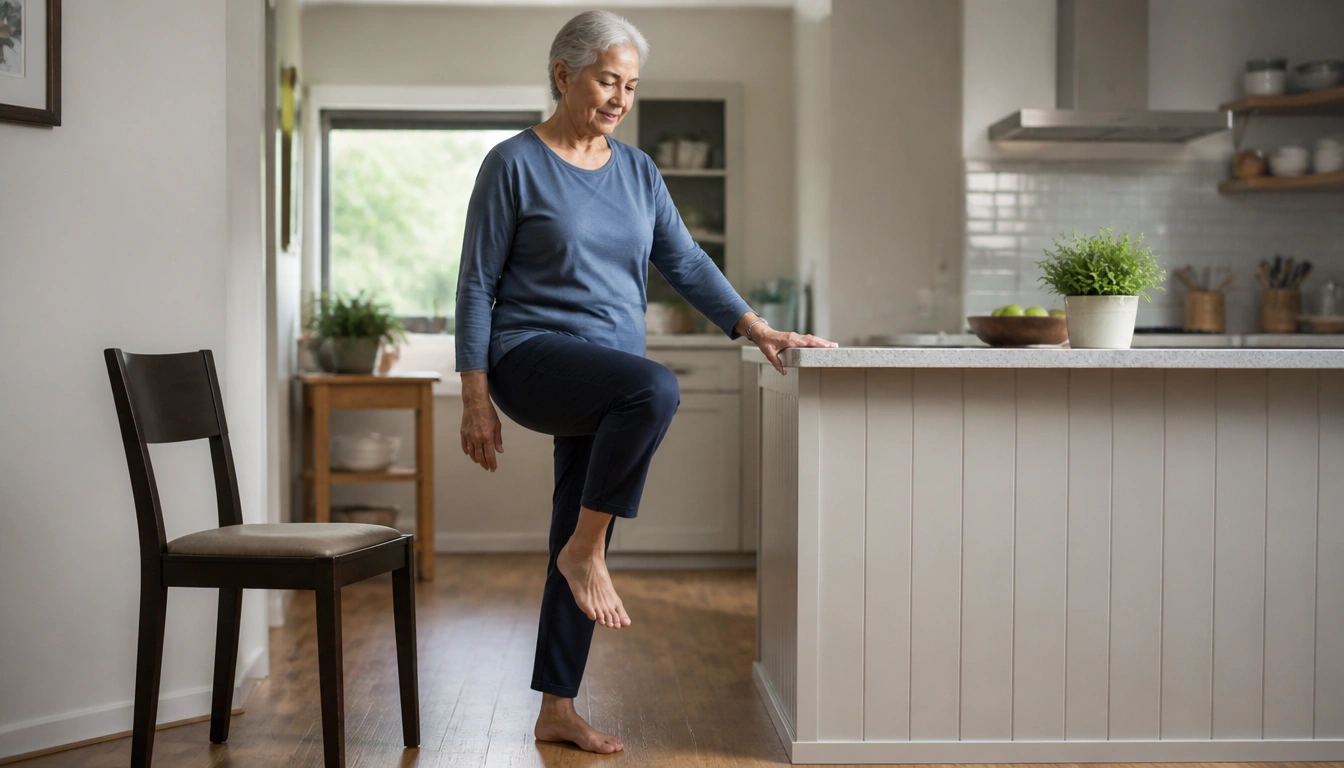
For most beginners over 50, the best balance exercises are sit-to-stands, weight shifts, single-leg stands with support, and heel-to-toe walks. Do balance work at least 2 days per week, and brief daily practice can also help if it is safe and realistic. Start near a sturdy counter or heavy chair, and stop right away if you feel dizzy, short of breath, chest discomfort, or sharp pain.
Key Takeaways
- Balance depends on three systems working together: vision, the inner ear’s vestibular system, and proprioception from muscles and joints.
- A beginner routine can be short and home-based; consistency matters more than long sessions.
- Start with support and a stable stance, then reduce hand support or narrow your base as you improve.
- Practicing balance while brushing your teeth or waiting for coffee can make the habit easier to keep.
- If you have frequent falls, unexplained dizziness, neuropathy, severe joint problems, or other medical concerns, get checked before pushing the routine.
Why balance training matters after 50
Balance is not one skill. It is the brain’s job of combining vision, the vestibular system in the inner ear, and proprioception, which is your body’s sense of position from muscles, tendons, and joints. When one part of that sensory triad is weaker, standing on one leg, turning quickly, or walking on uneven ground can feel less stable.
As adults get older, changes in muscle mass, joint sensitivity, and reaction speed can make the system less forgiving. That is why balance training is not just for people who already feel unsteady. It is a practical way to keep movement skills sharp enough for daily life. According to the CDC and the National Institute on Aging, multicomponent activity that includes balance work helps older adults maintain function and reduce fall risk.
Who this beginner routine is for matters more than age alone. A healthy 52-year-old who has not exercised in years may need the same cautious start as someone in their seventies. On the other hand, a very active older adult may progress quickly. The right starting point is your current function, not the number on your birthday card.
The safest way to start at home
Set up your space before you begin. Choose a flat, dry floor with enough room to step in all directions. Use a sturdy counter or the back of a heavy chair without wheels as your main support. A corner with two walls nearby can add confidence because you have more than one option for hand support if you need it.
Wear stable, closed-toe shoes with grippy soles if you feel more secure in footwear. Some people prefer to practice in socks, but slick socks on a smooth floor can be a problem. Avoid slippery rugs, clutter, loose cables, and low furniture edges that you might strike if you lose your balance.
Keep the first sessions simple. You should feel challenged but not shaky enough that you panic or grip hard for the entire exercise. Think of support as a safety net, not a crutch. If you feel unusually off that day because of poor sleep, illness, medication changes, or a flare in dizziness, choose the easiest version or skip the session.
A simple beginner balance routine
This routine uses movements that build lower-body control, steady weight transfer, and walking stability. Move slowly and breathe normally. If one exercise feels too hard, use the easier version for now.
Sit-to-stands
Start on the front half of a sturdy chair. Place your feet about hip-width apart. Lean forward slightly from the hips, press through your feet, and stand up using your legs. Sit back down with control. If needed, use your hands lightly on the chair or thighs at first. This builds the strength and coordination needed for safer standing and sitting in daily life.
Weight shifts
Stand tall near a counter. Shift your weight to one side until the opposite foot feels light or barely lifts. Hold briefly, then return to center and switch sides. This trains control over your center of mass without requiring a large movement.
Single-leg stand
Stand behind a chair with one hand or two fingertips nearby. Lift one foot a few inches off the floor and balance on the standing leg. Start with a short hold and gradually build time as you gain confidence. The goal is not perfect stillness; it is steady control with enough support to stay safe.
Tandem walk
Place one foot directly in front of the other, heel touching near the toes of the front foot, and take slow steps forward along a hallway or open wall space. This narrower walking pattern challenges lateral stability and body awareness. Turn around carefully and repeat if you feel steady.
A simple session might include one round of each exercise, with enough rest to feel ready for the next movement. For many beginners, a few focused minutes are enough to start. Deconditioned adults often improve faster than expected because there is a lot of “low-hanging fruit” in neuromuscular adaptation when the body has not been challenged this way recently.
How much to do each week
Public health guidance recommends balance training at least 2 days per week for older adults as part of a broader multicomponent activity plan. That said, brief practice on most days can be useful if it is safe and easy to fit into your routine. You do not need a long workout for balance to count.
A realistic starting target is two to four short sessions each week, with a few minutes added onto daily habits when that feels manageable. Many people do better with shorter, more frequent practice than with one bigger session they keep postponing. If you are also walking, doing strength work, or stretching, balance can be added before or after those activities.
Balance training should complement, not replace, aerobic exercise and strength work. Think of it as one part of a larger plan that supports mobility, stairs, turning, and safe recovery from small stumbles.
How to make the routine easier or harder
The safest way to progress is to change one variable at a time. Start with more support, a wider stance, and shorter holds. As the movement feels steadier, reduce support and narrow the base of support.
Make it easier: keep both hands on the counter, stand with feet wider apart, shorten the hold, or do the exercise next to a wall. You can also keep your gaze fixed on a point straight ahead, which helps orientation.
Make it harder: use lighter fingertip support, stand with feet closer together, lengthen the hold a little, or move from a two-foot stance to a staggered stance before trying less support. Later, you can reduce how much you rely on the chair during single-leg work or make your tandem walk more precise.
Daily life is also good practice. Try weight shifts while brushing your teeth. Do heel raises or toe raises while waiting for coffee or the kettle to boil. Walk slowly down a hallway and focus on smooth turns. These habit-stacking examples require no equipment and make the routine easier to keep.
Modifications for common barriers
Fear of falling: start with both hands near support and keep the range very small. Confidence often improves once your brain learns that the setup is predictable and safe.
Deconditioning: use shorter sessions and simpler positions. Sit-to-stands from a higher chair can be a better first step than long holds on one leg.
Neuropathy: reduced foot sensation can make standing tasks feel unstable. Use more visual focus, more hand support, and slower movements. Good lighting matters.
Vestibular problems: inner-ear issues can make head movement or quick turns feel worse. Keep changes small and avoid fast position changes if they trigger symptoms.
Visual limitations: make sure the area is well lit and free of obstacles. Clear visual cues can help the brain organize balance input more effectively.
Joint problems: if knees, hips, ankles, or feet are painful, reduce range and choose a position that feels controlled. Mild muscular effort is normal; sharp joint pain is not.
For people with more than one barrier, the safest approach is often the simplest one. A short, repeatable routine done well is more useful than a harder routine that makes you tense or avoid practice.
When to stop and get professional help
Stop the exercise immediately and sit down if you feel dizzy, lightheaded, short of breath, chest discomfort, or sharp pain. These are not cues to push through. They are signs to pause and recover, and sometimes to seek medical advice.
Talk with a doctor or physical therapist before starting if you have frequent unexplained falls, a recent injury, severe arthritis, osteoporosis with fracture concerns, uncontrolled heart or neurologic symptoms, or a vestibular problem that is not well managed. A physical therapist can check how you stand, walk, turn, and recover from a perturbation, then match the routine to your actual risk and ability.
If you are unsure whether your balance issue is normal aging or something that needs evaluation, an assessment is a good idea. Safety improves when the plan matches the person.
How to know you are progressing
Progress does not always look dramatic. Better balance often shows up as smaller, quieter changes: less gripping on the counter, fewer wobbles during a single-leg stand, smoother sit-to-stands, or more confidence when you turn quickly in the kitchen.
Other signs include being able to hold the position a little longer, needing less support, or recovering faster after a small sway. You may notice that everyday tasks such as getting dressed while standing, stepping into the shower, or walking through a crowded room feel less effortful.
When progress stalls, do not assume the routine has stopped working. It may mean you need one small change, such as more days per week, a slightly narrower stance, or a longer hold. The goal is steady challenge without crossing into unsafe territory.
Frequently Asked Questions
How many days per week should adults over 50 do balance exercises?
A good target is at least 2 days per week. Shorter practice on more days can also be helpful if it is safe and you can fit it into normal routines. Consistency matters more than doing one long session.
What is a safe beginner balance routine I can do at home without equipment?
A simple home routine can include sit-to-stands, weight shifts, a supported single-leg stand, and a tandem walk near a counter or wall. Keep the space clear, move slowly, and use hand support whenever needed.
How do I make balance exercises easier if I am unsteady or deconditioned?
Use both hands on a sturdy counter, stand with your feet wider apart, shorten the hold, and start with seated or supported versions. If needed, begin with very small weight shifts before trying one-leg work.
What safety precautions should I take before starting balance training?
Practice on a dry, flat surface, wear stable shoes, and use a heavy chair or counter that will not move. Avoid slick floors, loose rugs, and clutter. Stop right away for dizziness, chest discomfort, sharp pain, or shortness of breath.
When should I stop balance exercises and talk to a doctor or physical therapist?
Get checked if you have frequent falls, unexplained dizziness, a recent injury, severe joint pain, osteoporosis concerns, or neurologic or vestibular symptoms that are not controlled. A physical therapist can help tailor the routine to your needs.
The Bottom Line
A beginner balance routine for adults over 50 should be simple, repeatable, and safe enough to do consistently. Sit-to-stands, weight shifts, single-leg stands with support, and tandem walking are practical starting points.
Aim for balance work at least 2 days per week, and use brief daily practice when it fits your life safely. Start with support, progress slowly, and make the routine easier or harder by changing your stance, support level, or hold time.
If balance problems feel severe, are getting worse, or come with pain, dizziness, or frequent falls, get a professional assessment instead of guessing your way forward.
Medical disclaimer
Medical disclaimer: This content is for educational and informational purposes only and is not a substitute for professional medical advice, diagnosis, or treatment. Dietary needs and supplement suitability vary by individual.
Sources
- National Institutes of Health (NIH) — nih.gov. Accessed October 2026.
- Centers for Disease Control and Prevention (CDC) — cdc.gov. Accessed October 2026.
- Mayo Clinic — mayoclinic.org. Accessed October 2026.
