
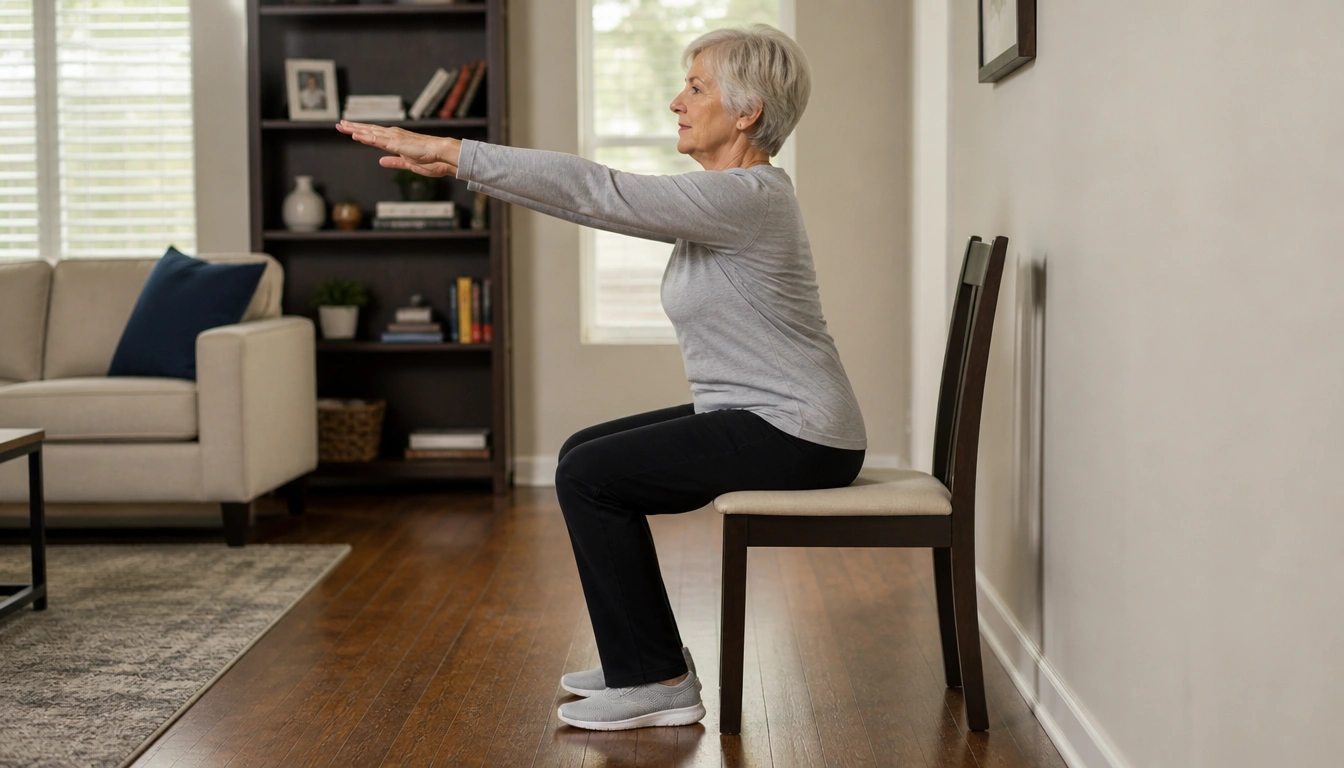
You can do bodyweight exercises safely after 50 by prioritizing balance, controlled range of motion, steady breathing, and joint-friendly setup over depth or speed. Most adults do best with simple, supported versions first, then gradual progress as strength improves. The goal is not perfect athletic form; it is safe, repeatable movement that helps you stand, reach, push, and walk with more confidence.
Key Takeaways
- Choose versions that keep you steady, pain-aware, and able to breathe normally throughout the rep.
- For adults over 50, major muscle groups should be trained at least 2 non-consecutive days per week, according to the CDC and ACSM.
- Chair squats, wall or incline push-ups, supported split squats, and standing bird-dogs can be scaled with a chair, wall, or countertop.
- A controlled tempo and a comfortable range of motion matter more than going deep, fast, or to failure.
- Stop for chest pain, dizziness, severe shortness of breath, or sharp joint pain, and seek medical advice when symptoms do not settle quickly.
Why bodyweight strength matters after 50
Bodyweight exercise form checklist for adults over 50 starts with a simple idea: keep strength work useful, safe, and repeatable. As muscle mass and power decline with age, regular resistance exercise helps preserve the ability to stand up from a chair, climb steps, steady yourself during a stumble, and carry out everyday tasks. The CDC and the American College of Sports Medicine both recommend muscle-strengthening activity for adults at least 2 days per week, and that guidance matters even more when balance or mobility is changing.
Good form matters because older joints and tissues may tolerate poorly controlled positions less well than they once did. That does not mean exercises must be tiny or timid. It means the best version is the one you can perform with control, without breath-holding, and without losing alignment. A chair squat done smoothly is more useful than a deep squat that irritates the knees. A wall push-up done with a straight trunk is more useful than a lower, shakier version that collapses the back.
Think of each rep as practice for daily life: rising from sitting, lowering into a chair, pushing away from a counter, or balancing while reaching. Those patterns are the real target.
The core form checklist
Before you worry about sets or exercise variety, use the same checklist for every movement. Start with a stable stance: feet planted, weight spread across the whole foot, and enough space to move without bumping into furniture. Keep the ribs stacked over the pelvis rather than flaring the chest or arching the lower back. This helps the core brace naturally without stiffening the whole body.
Move slowly enough that you can notice position changes. A controlled tempo makes it easier to keep knees tracking well, keep the trunk steady, and stop before form breaks down. Range of motion should match what your joints can tolerate today, not what they may have handled years ago. If a partial squat or a higher incline lets you move with better control, that version is the better exercise.
Breathing is part of form, not an afterthought. Exhale during the effort phase and inhale during the easier phase. Avoid holding your breath, especially during harder repetitions, because that can raise blood pressure and make balance less steady. Finally, judge effort by quality. Mild to moderate muscle challenge is enough for most home bodyweight work, as long as you can keep your technique clean.
Chair squats, wall push-ups, split squats, and standing bird-dogs
Chair squat: Stand with feet slightly wider than hips, toes turned slightly out, and a sturdy chair behind you. Hinge at the hips as if reaching back to sit down, then press through mid-foot and heels to stand tall. Keep knees tracking in line with the toes and the chest open. Red flags include knees caving inward, heels lifting, or dropping all your weight onto the chair and bouncing back up.
Wall or incline push-up: Place hands on a wall, countertop, or other secure surface at about shoulder height. Keep the body in a straight line from head to heels or from head to knees, depending on the version. Lower with control and press away without letting the head jut forward or the lower back sag. Elbows usually feel best at a modest angle away from the torso rather than flared wide.
Supported split squat: Hold a counter, wall, or sturdy chair for light support. Step one foot forward and one foot back, then lower straight down in a comfortable range. The front knee should stay over the foot, and the torso should remain tall enough to avoid folding forward. This move is especially useful for stair climbing, getting up from low seats, and building side-to-side balance.
Standing bird-dog: Face a counter and rest both hands on it. Brace the midsection, then extend one leg back slowly without arching the lower back. For more challenge, lift the opposite arm as well. The goal is quiet hips and steady breathing, not height or speed.
How to scale each movement without losing form
Scaling is often the difference between an exercise that helps and one that feels discouraging. For squats, the simplest scale is chair height. A higher chair reduces how far the hips must travel and is often more joint-friendly for sore knees or stiff hips. You can also reduce depth by hovering above the chair instead of fully sitting. If standing balance is limited, keep one hand near a wall or countertop for light support.
For push-ups, the higher the hand position, the easier the movement. A wall is the most accessible option, while a countertop or sturdy table creates a steeper challenge. Use the version that lets you keep the trunk straight and the shoulder blades controlled. If wrists bother you, a wall or counter is usually easier than the floor.
For split squats, shorten the stance and keep the rear heel lifted only as much as needed. You can also reduce depth and use fingertip support. For bird-dogs, keep both hands on the counter and lift only the leg first. If balance is good, add the opposite arm later. In every case, it is better to do fewer clean repetitions than more shaky ones.
How to set up a safe weekly routine
The CDC and ACSM both support muscle-strengthening exercise on at least 2 non-consecutive days each week. That spacing gives roughly 48 hours for recovery, which matters when you are learning new movement patterns or returning after a long break. Two sessions per week can be enough to start, especially if the workouts are consistent and the form is solid.
A practical beginner structure is to choose 4 to 6 bodyweight moves and perform 1 to 3 sets of each, stopping while technique is still reliable. A workout might include chair squats, wall push-ups, supported split squats, and standing bird-dogs, with additional moves for pulling or core work if you know how to do them safely. You do not need fancy equipment or extreme range of motion. You do need regular practice.
Pair exercise with daily habits so it actually happens. Do a set after brushing your teeth, before coffee, while waiting for the kettle, or after a short walk. Small, repeatable sessions often work better than long workouts that are hard to sustain. Over time, you can add a little volume, but consistency should come first.
Common mistakes to avoid
Rushing through reps is one of the fastest ways to lose form. Speed can hide knee collapse, trunk sway, and shoulder shrugging. Slow the movement enough that you can feel where the weight is going and whether the joints are tracking well. If the rep gets ugly halfway through, the set is probably too hard right now.
Breath-holding is another common issue, especially during standing moves or when trying to “brace hard.” A gentle brace is useful; a held breath is not. Keep exhaling through the effort. If you notice yourself straining to complete a rep, take a break and shorten the set next time.
Letting the knees cave inward during squats or split squats can irritate the knees and reduce hip control. Think about pressing the knees gently in line with the second or third toe. Also avoid going too deep too soon. More range is not automatically better if it creates pain, wobbling, or compensation. The best form is the one you can repeat well.
When to stop or get medical advice
Stop exercising right away if you develop chest pain or pressure, severe shortness of breath, dizziness, faintness, or a sudden sharp pain in a joint or muscle. These are not symptoms to push through. If the problem does not settle quickly, seek medical care.
It is also smart to get medical clearance before starting if you have a new exercise history and live with uncontrolled high blood pressure, active arthritis flare-ups, significant osteoporosis, cardiovascular disease, or other chronic conditions that affect exercise safety. The same applies if you have recent surgery, unexplained swelling, or balance problems that have worsened recently.
Joint discomfort is more nuanced. Mild muscle effort is expected, but sharp, catching, or worsening joint pain is a signal to modify the movement or stop. If a certain exercise reliably triggers pain even after you reduce range or use more support, it is worth discussing with a clinician or physical therapist.
How to progress without sacrificing safety
Progress should be gradual and specific. First make the movement stable, then make it harder. For squats, progress might mean lowering the chair a little, using less hand support, or adding a pause just above the seat. For push-ups, progress might mean moving from the wall to a counter, or from a high counter to a lower one. For split squats, progress can come from less support or slightly more depth. For bird-dogs, you might add the opposite arm only after the leg-only version feels steady.
Another useful progression is better control, not just more challenge. Cleaner posture, smoother breathing, and more even balance are all signs that your body is adapting. If a harder version makes you rush or lose alignment, step back to the easier option for a while. That is not failure; it is smart training.
A good rule is to change one thing at a time. Increase reps, reduce hand support, or lower the incline, but do not change everything at once. That makes it easier to know whether your joints and balance are tolerating the work. Over weeks and months, those small steps can add up to real gains in daily strength and confidence.
Frequently Asked Questions
How many days per week should adults over 50 do bodyweight strength exercises?
Most adults over 50 should aim for muscle-strengthening exercise on at least 2 non-consecutive days per week. That spacing supports recovery and helps you keep good form. You can do more if your body tolerates it, but consistent practice matters more than doing a hard workout once in a while.
How can I modify bodyweight exercises if I have knee pain or limited mobility?
Use more support and less range of motion. A higher chair, a wall instead of the floor, or a countertop instead of a low surface can make the exercise more joint-friendly. If pain is sharp, worsening, or persistent, stop and ask a clinician or physical therapist for guidance.
What are the most important form mistakes to avoid during chair squats and push-ups?
For chair squats, avoid knees collapsing inward, heels lifting, and dropping heavily into the chair. For push-ups, avoid sagging hips, a rounded lower back, and flared elbows. Both moves work best when they are slow, controlled, and steady enough that breathing stays normal.
When should an older adult stop exercising and get medical help?
Stop immediately for chest pain or pressure, dizziness, faintness, severe shortness of breath, or sudden sharp pain. Get medical help if symptoms are severe, do not settle, or keep coming back. If you have an ongoing medical condition, it is wise to get clearance before starting a new routine.
How should breathing work during bodyweight strength exercises?
Exhale during the effort phase and inhale during the easier phase. For example, breathe out as you stand up from a chair or push away from a wall, then breathe in as you lower down. Avoid holding your breath, since that can make effort feel harder and may raise blood pressure.
The Bottom Line
Good bodyweight form after 50 is mostly about control: steady feet, quiet joints, normal breathing, and a range of motion your body can manage without compensation. A chair, wall, or countertop is not a shortcut; it is often the safest way to build a reliable foundation.
If you keep sessions simple, repeat them on 2 non-consecutive days each week, and progress one step at a time, bodyweight exercise can support balance, strength, and everyday independence without needing a gym or fancy equipment.
Medical disclaimer
Medical disclaimer: This content is for educational and informational purposes only and is not a substitute for professional medical advice, diagnosis, or treatment. Dietary needs and supplement suitability vary by individual.
