
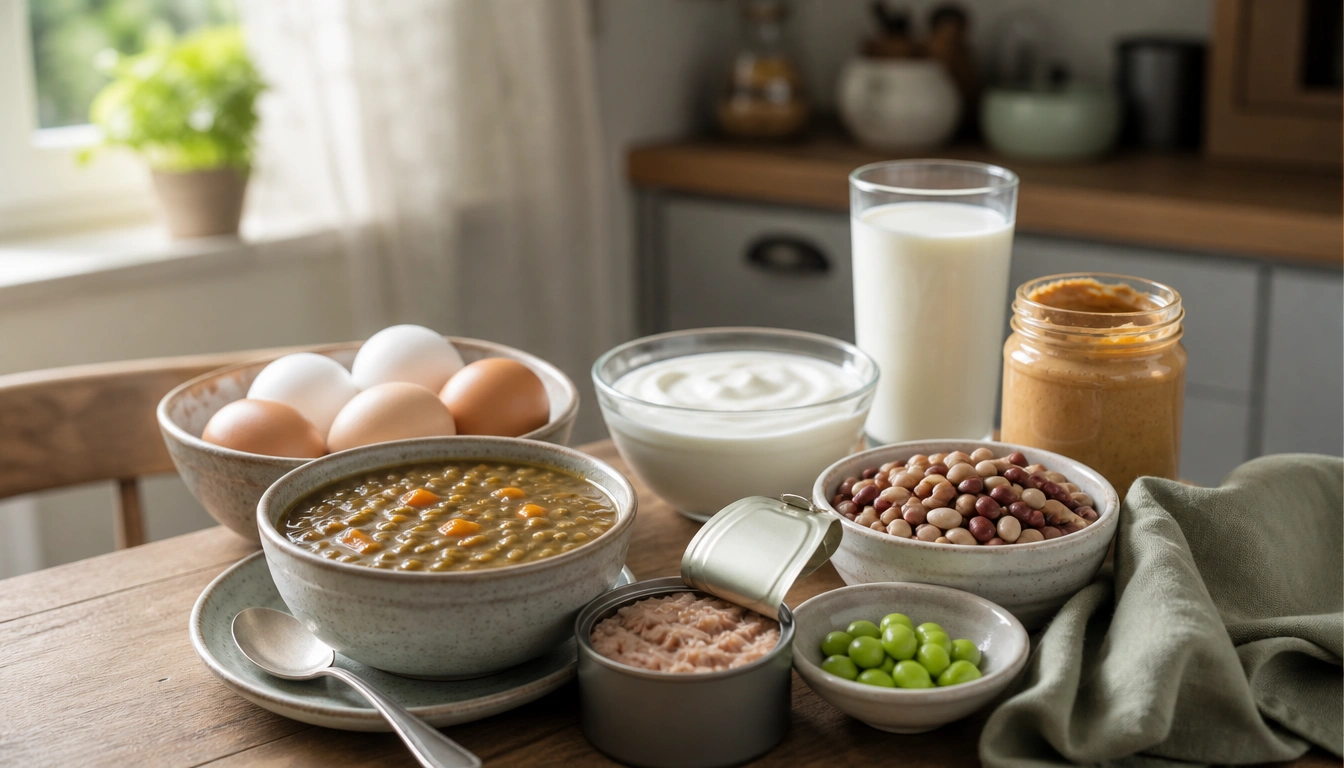
The cheapest protein foods for adults over 50 are usually eggs, beans, lentils, canned fish, Greek yogurt, milk or soy milk, peanut butter, edamame, and chickpeas. Used well, they can help many older adults reach about 1.0 to 1.2 grams of protein per kilogram of body weight per day, with protein spread across meals instead of saved for dinner. That pattern supports muscle, strength, and independence without relying on supplements.
Key Takeaways
- Older adults often do better with more protein than the old 0.8 g/kg baseline alone, especially when it is spread across breakfast, lunch, and dinner.
- Budget protein foods for adults over 50 include eggs, beans, lentils, canned fish, Greek yogurt, milk, soy milk, peanuts, edamame, and chickpeas.
- Soft, easy-to-chew options such as yogurt, scrambled eggs, lentil soup, canned salmon, and bean-based soups can help when appetite or dental comfort is a problem.
- Stretch protein farther by mixing beans into soups, swapping Greek yogurt for sour cream, and adding milk powder or eggs to oatmeal and soups.
- Kidney disease is a major exception: higher-protein advice may not apply, so older adults with CKD should get individualized guidance.
Why protein matters more after 50
Budget protein foods for adults over 50 are not just about saving money. They help protect the muscle that supports balance, walking speed, getting out of a chair, carrying groceries, and recovering from illness. As adults age, muscle loss becomes more common, and the process can speed up later in life. That matters because lower muscle mass can make daily tasks harder and raise the risk of falls and frailty.
The National Institute on Aging and other public health sources emphasize that older adults need enough protein alongside regular movement to preserve function. Aging muscle also becomes less responsive to the usual muscle-building signal from food. That is one reason many experts recommend a more intentional pattern: not just enough protein over the whole day, but enough at each meal to keep muscle protein synthesis working well.
This is where food choices and timing both matter. An inexpensive breakfast that includes protein can be more useful than saving most of your protein for dinner. A modest amount at each meal helps the body use what you eat more effectively, especially when appetite is smaller or meals are light.
Protein is not a magic fix, and it works best as part of a broader routine that includes safe strength or resistance activity. Even simple habits such as chair stands, wall push-ups, resistance bands, or brisk walking can help the body use protein to maintain muscle and independence.
How much protein adults over 50 should aim for
The old adult baseline of 0.8 grams of protein per kilogram of body weight per day is a general minimum reference, not necessarily the most useful target for healthy aging. For many adults over 50, guidance from clinical and nutrition groups points closer to 1.0 to 1.2 grams per kilogram per day, and sometimes more depending on health status, activity level, and recovery needs. The exact target should be individualized, but the trend is clear: older adults often benefit from more than the minimum.
For practical use, many experts suggest aiming for about 25 to 30 grams of protein per meal. That approach fits the way the body uses protein better than concentrating most of it at one sitting. If you eat three meals a day, each meal can contribute meaningfully. Snacks can help too, especially for people with small appetites.
A simple example: a 160-pound adult weighs about 73 kilograms. At roughly 1.1 grams per kilogram, that person would aim for about 80 grams of protein per day. Divided across three meals, that works out to around 25 to 30 grams per meal. You do not need to hit the number perfectly every day, but the pattern is useful.
If a full plate feels overwhelming, start by building meals around one solid protein anchor instead of trying to add protein to everything. A cup of Greek yogurt, a bowl of lentils, a can of fish, or eggs with beans can move a meal much closer to the target than a carb-heavy plate alone.
The best budget protein foods for older adults
The cheapest protein foods for adults over 50 are usually the ones that store well, cook quickly, and can be used in several meals. Eggs are often one of the most flexible choices. They are inexpensive, soft, easy to cook, and can be scrambled, boiled, poached, or stirred into soups and rice dishes.
Beans and lentils are among the best low-cost protein foods overall. They are affordable in dry form, convenient in cans, and easy to stretch into soups, stews, casseroles, and dips. They also provide fiber, which can help with fullness and digestive regularity. Chickpeas and black beans are especially useful because they can be mixed with vegetables, mashed into spreads, or added to salads and grain bowls.
Canned fish such as tuna, salmon, and sardines is another budget-friendly staple. It stores for a long time, requires little or no cooking, and delivers a concentrated amount of protein. For older adults who want convenience with minimal prep, this is one of the strongest options.
Greek yogurt, plain yogurt, milk, and fortified soy milk are also practical. Greek yogurt gives a lot of protein in a soft texture that works at breakfast, as a snack, or as a replacement for sour cream or mayonnaise. Milk and soy milk are useful because they can be poured into oatmeal, coffee, smoothies, or soups. Peanuts and peanut butter add protein too, though they are usually more of a support food than a main protein source. Edamame is another affordable option, especially frozen, because it cooks quickly and can be used as a side, snack, or salad topping.
| Food | Why it fits a budget | Texture or use |
|---|---|---|
| Eggs | Inexpensive, versatile, widely available | Soft, quick, easy to add to many meals |
| Beans and lentils | Low cost in dry or canned form | Soups, stews, mash, dips, salads |
| Canned fish | Long shelf life, little prep | Ready to eat, mix into meals |
| Greek yogurt | High protein from a single container | Soft, spoonable, easy on chewing |
| Milk and soy milk | Multiuse and easy to store | Drink, cook with, or add to hot foods |
What makes a protein food budget-friendly
A food is budget-friendly not only because it has a low sticker price, but because it delivers useful protein with little waste, little prep, and a long enough shelf life to fit real life. A cheap package of meat that spoils before you use it may cost more in practice than a tub of yogurt or a bag of lentils that serves several meals.
Cost per serving matters more than cost per package. Foods that can be portioned easily tend to work better for older adults on fixed incomes. Shelf life matters too, because pantry and freezer staples reduce food waste and make it easier to shop less often. Canned fish, dry beans, oats, milk powder, peanut butter, and frozen edamame are all useful here.
Versatility is another major factor. The best budget foods can move from breakfast to lunch to dinner without feeling repetitive. Greek yogurt can become a snack, a sauce, or a topping. Lentils can thicken soup, replace some meat in chili, or become a warm salad base. Eggs work across meals and require very little equipment.
Prep burden is just as important as price. If a food is cheap but too hard to chew, too time-consuming to cook, or too much trouble to clean up, it may not help you consistently. The most useful budget protein foods are the ones you can repeat week after week with little friction.
Soft, easy-to-chew protein options
Chewing comfort matters. Older adults who have dental problems, dry mouth, dentures, or low appetite often do better with soft proteins that do not require much effort. Scrambled eggs, omelets, cottage cheese, Greek yogurt, lentil soup, mashed beans, canned salmon, and tuna mixed with yogurt are all practical choices.
Soft texture does not mean low quality. A bowl of lentil soup with bread, a yogurt bowl with oats, or eggs stirred into hot grains can provide a meaningful protein dose without the toughness of some meats. For people who tire easily while eating, smaller meals and snacks can be easier than large plates.
If swallowing is difficult, texture changes should be discussed with a clinician or dietitian. The goal is to make protein easier to eat, not to force foods that feel unsafe or exhausting. Blending soups, softening vegetables, and using moist recipes can make a real difference.
How to build low-cost, high-protein meals
The easiest strategy is to build around pantry, freezer, and refrigerator staples you can repeat. Keep a few proteins on hand that do not depend on same-day cooking. A pantry with canned beans, canned fish, peanut butter, and broth; a freezer with edamame or frozen vegetables; and a refrigerator with eggs, yogurt, and milk gives you many low-cost combinations.
For breakfast, think protein first. Oatmeal made with milk and topped with peanut butter, yogurt with fruit and oats, or eggs with toast can be more filling than cereal alone. For lunch, a bean soup with added canned fish or a sandwich with egg salad can offer both convenience and protein. For dinner, use lentils in chili, beans in tacos, or canned salmon in a pasta dish or grain bowl.
Batch cooking helps, but it does not need to be complicated. A pot of lentils, a container of cooked beans, or a tray of hard-boiled eggs can support several meals without much effort. If cooking energy is limited, choose recipes that reuse one ingredient in different ways over the week instead of starting from scratch each day.
To reduce waste, buy foods that overlap in purpose. For example, Greek yogurt can work in breakfast, sauces, and snacks; canned beans can thicken soup and serve as a side; milk can be used in cereal, cooking, and hot drinks. That kind of overlap helps older adults eat better without buying more food than they can use.
Simple ways to increase protein without supplements
You do not need powders or specialty bars to raise protein intake. Small food swaps can have a big effect over time. Stir dry milk powder or a beaten egg into hot oatmeal or soup. Swap sour cream for Greek yogurt on baked potatoes or tacos. Add beans to chili, vegetable soup, or pasta sauce. Choose soy milk instead of a lower-protein drink when appropriate.
Another helpful tactic is to add one extra protein item to foods you already eat. Put peanut butter on toast or fruit. Add a hard-boiled egg to a salad. Mix chickpeas into a grain bowl. Use cottage cheese or yogurt as a snack instead of crackers alone. Those changes may not look dramatic, but they add up.
Protein and movement work together. If you are trying to protect muscle, combining a more protein-rich eating pattern with daily walking, light resistance bands, sit-to-stand अभ्यास, or other safe strength activity is more effective than either strategy alone. Food supports the muscle-building signal; movement helps direct that signal where it matters.
When to be cautious
Kidney disease is the major exception to broad higher-protein advice. Adults with chronic kidney disease, or those told to limit protein for another medical reason, should not automatically follow a higher-protein plan. Their needs may be different, and the safest approach is individualized care from a clinician or registered dietitian.
Rapid unintentional weight loss, persistent weakness, frequent falls, or a long-lasting loss of appetite deserve medical attention. Those symptoms can reflect more than low protein intake, and they may signal an illness that needs treatment. If eating has become difficult because of pain, fatigue, swallowing trouble, or low mood, it is worth bringing up early rather than waiting.
For most healthy older adults, the answer is not expensive supplements or perfect meals. It is a practical pattern: enough protein, spread through the day, using affordable foods you can tolerate and repeat.
Frequently Asked Questions
How much protein do adults over 50 need each day?
Many healthy adults over 50 do better with about 1.0 to 1.2 grams of protein per kilogram of body weight per day, rather than relying only on the old 0.8 g/kg baseline. A registered dietitian or clinician can help adjust that number for activity level, appetite, and medical conditions.
Which budget protein foods are easiest to chew and digest for older adults?
Soft options are often easiest: scrambled eggs, Greek yogurt, cottage cheese, lentils, mashed beans, canned salmon, tuna mixed with yogurt, and smooth soups made with beans or lentils. These foods are generally easier to manage when chewing is uncomfortable or appetite is smaller.
Are plant proteins enough for adults over 50, or do they need animal protein too?
Plant proteins can absolutely help older adults meet protein needs. Beans, lentils, chickpeas, edamame, peanut butter, and soy milk all count. Some people find it helpful to mix plant and animal sources, but you do not need meat at every meal to get enough protein.
How can someone on a fixed income add more protein without buying supplements?
Use low-cost upgrades: add beans to soups and chili, choose Greek yogurt instead of sour cream, stir milk powder or a beaten egg into oatmeal or soup, use peanut butter on toast, and keep canned fish or eggs on hand for fast meals. These changes are usually cheaper than supplements.
What should adults over 50 do if they have kidney disease and need to limit protein?
They should not follow general higher-protein advice without medical input. Chronic kidney disease often changes protein needs, so the safest step is to ask a clinician or renal dietitian for an individualized plan that fits kidney function, medications, and overall nutrition.
The Bottom Line
Older adults do not need expensive protein products to support strength and independence. Eggs, beans, lentils, canned fish, Greek yogurt, milk, soy milk, peanuts, and edamame are some of the most practical low-cost options, especially when they are spread across meals instead of saved for one big dinner.
The most useful strategy is to pair affordable protein foods with easy habits: add beans to soup, use yogurt in place of sour cream, mix milk powder or eggs into hot foods, and keep soft options on hand when chewing is difficult. If kidney disease, rapid weight loss, or persistent weakness is part of the picture, get personalized medical guidance rather than assuming a one-size-fits-all target.
Medical disclaimer
Medical disclaimer: This content is for educational and informational purposes only and is not a substitute for professional medical advice, diagnosis, or treatment. Dietary needs and supplement suitability vary by individual.
Sources
- U.S. Government / Health Authority — acl.gov. Accessed October 2026.
- National Institutes of Health (NIH) — nih.gov. Accessed October 2026.
- National Institutes of Health (NIH) — nih.gov. Accessed October 2026.
- Academic Research Institution — stanford.edu. Accessed October 2026.
