
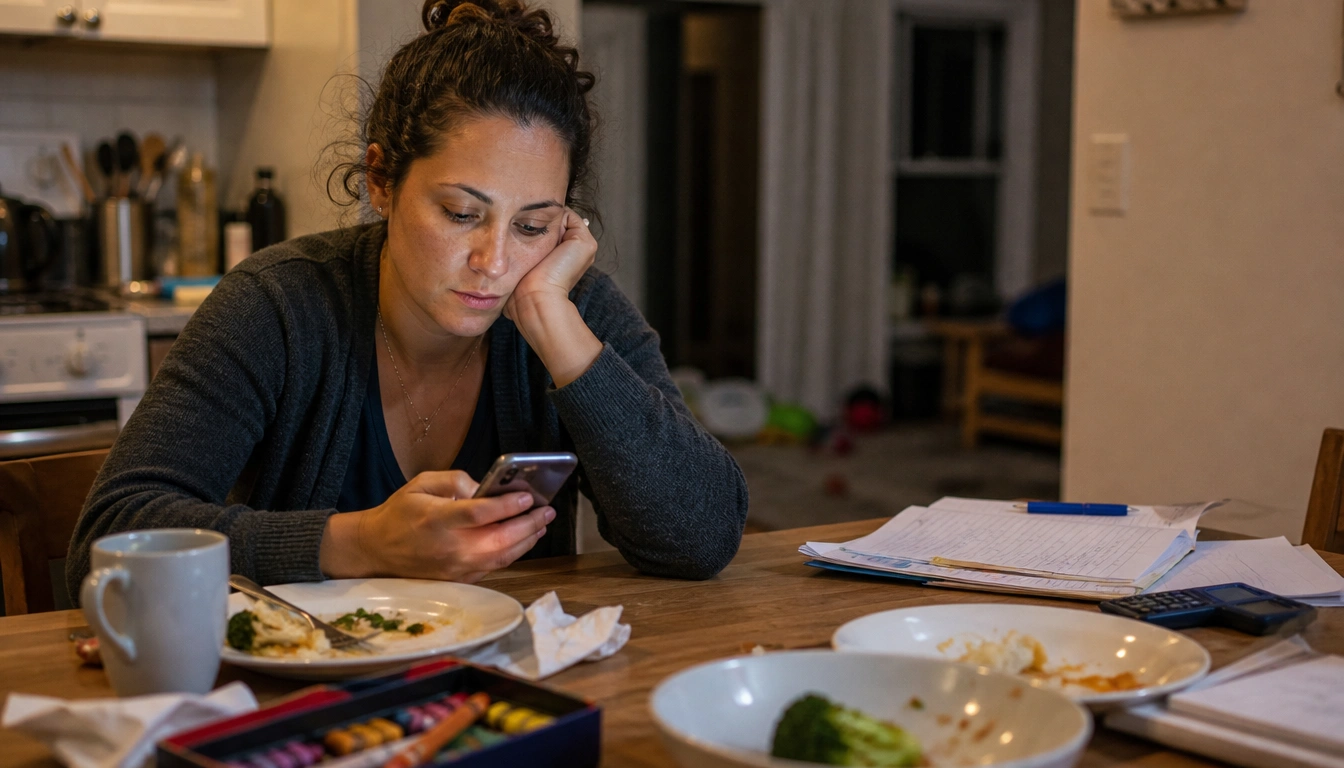
A realistic daily gratitude practice for busy parents is short, specific, and attached to something you already do, like dinner, toothbrushing, or bedtime. The goal is not forced positivity; it is to notice one or two genuine good things, even on hard days. Done consistently, this kind of practice can support stress buffering, family connection, and a steadier mood without turning into another chore.
Key Takeaways
- Keep it under a minute and attach it to an existing routine so it is easier to remember and less likely to feel like extra work.
- Specific gratitude works better than vague cheerfulness: name a person, moment, or small relief that was real today.
- If a day is rough, you can acknowledge the hard part and still notice one thing that helped you get through it.
- Family-based gratitude can support connection at the dinner table, at bedtime, or in a quick text to a partner.
- Benefits often build over a few weeks, not overnight, so the best measure is whether the habit feels more grounding over time.
Why busy parents benefit from gratitude specifically, not just as a generic wellness tip
Busy parenting often means living in a constant stream of tasks, interruptions, and unfinished conversations. That kind of load can make the brain scan for what is missing or going wrong, which is useful for safety but tiring when it never switches off. A daily gratitude practice gives attention a small reset. Instead of trying to feel calm all day, you pause long enough to notice something steady, helpful, or kind that already happened.
That matters for parents because the payoff is not only a better mood in the abstract. Research on family life suggests gratitude can help preserve relationship satisfaction and emotional resilience on stressful days. In other words, it may not erase the hard parts of parenting, but it can soften how much they take over the whole day. For many parents, that is a more realistic goal than chasing constant positivity.
Gratitude also fits the reality of parent life better than many wellness habits. You do not need special equipment, a block of quiet, or a long attention span. A tiny practice can still be meaningful if it is repeated often enough to become familiar.
The science in plain language: negativity bias, reward pathways, oxytocin, cortisol, and stress buffering
People naturally pay more attention to problems than to neutral or pleasant events. That negativity bias is not a flaw; it is part of how the brain stays alert to danger. The downside is that under stress, the brain can start treating every inconvenience like an emergency. Gratitude practices do not remove that wiring, but they can help balance it by training attention toward something positive that is also true.
When you deliberately notice appreciation, the brain’s reward systems are engaged, including pathways linked with dopamine. Feeling or expressing gratitude is also associated with oxytocin, a hormone involved in bonding and social connection. Over time, those shifts may support a calmer stress response. Some studies also suggest that structured gratitude interventions can be associated with lower cortisol and better subjective sleep quality, though the effect depends on the person, the practice, and the larger stress load in their life.
For parents, the most useful idea is the stress-buffering effect. Gratitude is not only about feeling pleasant in a quiet moment. It may help you recover a little faster after a hard interaction, a messy morning, or a day that felt too full. That buffering is one reason small practices can still matter even when life does not slow down.
What a realistic daily practice looks like for parents
A workable gratitude habit has three features: it is brief, predictable, and tied to something you already do. If it needs a separate appointment on your calendar, it will probably disappear on the first chaotic week. Aim for something that takes less than 60 seconds.
Choose one anchor point. Good options include the first sip of morning coffee, washing your hands before dinner, the moment you shut the laptop, or the few minutes before lights out. Then give yourself one prompt: What went okay today? Who helped me? What small comfort did I notice? You only need one answer, not a perfect list.
The habit should feel like a check-in, not a performance. If you notice yourself trying to manufacture gratitude, shorten it further. One genuine sentence is better than three polished ones that feel false. If the day is too packed, the practice can be as simple as naming one thing out loud while you are already moving through your routine.
Four low-friction gratitude formats that fit family life
Dinner-table round robin. Each person shares one specific thing they are grateful for from the day. Keep it concrete: a warm shower, help with homework, a funny comment from a child, or a ride that saved time. This works well because it uses a routine that already exists and can help children learn to notice small positives too.
Morning habit stacking. Pair gratitude with brushing your teeth, brewing coffee, making lunch, or packing bags. While your hands are busy, silently name one thing you appreciate. It can be as brief as “quiet kitchen,” “fresh fruit,” or “my child slept late.” The pairing matters more than the number of items.
60-second notes app journaling. Paper journals are helpful for some people, but many parents need something faster. Keep a note on your phone and add three short bullets at night. The bullets do not need to be profound. “Neighbor helped with pickup,” “kid laughed at dinner,” and “finished one load of laundry” all count if they were real moments of relief or connection.
Quick appreciation texts. Send a short message to your partner, co-parent, friend, or family member thanking them for something specific. Specificity matters: “Thanks for handling bedtime” is more meaningful than “thanks for everything.” This format supports connection and can be especially useful on days when speaking face-to-face feels rushed.
How to keep it authentic and how to make it stick when you are overwhelmed
The biggest risk for stressed parents is not failure; it is making gratitude feel fake. That usually happens when the practice is framed as “I should be grateful” or “I must ignore the hard parts.” A healthier version is more honest: “Today was rough, and I also noticed one thing that helped.” Both can be true at once.
This is where gratitude differs from toxic positivity. You are not denying anger, grief, financial stress, sleep loss, or the sheer difficulty of parenting. You are making room for evidence that your day contained more than the problem alone. That might be a kind text, a child’s laugh, a finished task, or five quiet minutes in the car.
To make the habit stick, use simple consistency rules. Pick one version of the practice and keep it the same for two weeks. Do it at the same trigger point every day. If you miss a day, restart without catching up. On chaotic days, use a fallback option: one sentence, one text, or one word. Consistency beats intensity.
It also helps to lower the bar on what counts. The practice is not a test of moral goodness. If you are too depleted to write, say the thought silently. If even that feels like too much, notice one physical comfort such as clean water, a charged phone, or a child finally asleep. That is still practice.
Parent-specific adaptations for high-stress households
Families under heavy stress may need the smallest possible version of gratitude. That includes parents of children with special needs, chronic illness, intense behavioral challenges, or unpredictable routines. In those homes, gratitude should never become another demand. It should function as a tiny stabilizer, not a mandate to stay cheerful.
If your evenings are chaotic, try a very narrow prompt: “What helped us get through today?” This framing can be less triggering than “What are you grateful for?” because it allows gratitude to coexist with hard reality. You might notice a medication that worked, a teacher who responded quickly, a sibling who was patient, or a moment when everyone paused before escalation.
If your child is involved, keep the language concrete and age-appropriate. Younger children may do better with “one good thing” than with abstract reflection. If your household is already overloaded, use only one format, not all four. The goal is a practice that fits the family system you actually have, not the one you wish you had.
For some parents, gratitude is also more effective when paired with practical support: respite, childcare help, counseling, medical care, or a parent support group. The practice can help with emotional buffering, but it does not replace structural help when the load is too heavy.
What results to expect and when
Parents often want to know whether gratitude is “working.” A realistic answer is that benefits usually show up gradually, not as a sudden mood lift. In research on structured gratitude interventions, people often notice changes within a few weeks. The shift may look subtle at first: a slightly easier bedtime, a less intense reaction to stress, or a more connected feeling with your partner or child.
Possible changes include better emotional recovery after stressful moments, a little less mental spiraling at night, or an easier time noticing supportive people and events. Some people also report improved sleep quality when gratitude is practiced regularly, especially if the habit helps them end the day with less rumination. But sleep is complicated, and gratitude is not a cure for insomnia.
To judge whether it is helping, watch for small signs rather than dramatic transformation. Are you returning to baseline a little faster? Does the practice feel less awkward after a week or two? Do family interactions feel a bit warmer? If the answer is yes, that is meaningful. If the practice feels exhausting or performative, simplify it further instead of abandoning it immediately.
When gratitude is not enough
Gratitude is a wellness tool, not a substitute for mental health care. If you are dealing with persistent hopelessness, severe anxiety, panic, trauma symptoms, intrusive thoughts, or major changes in sleep, appetite, or functioning, it is important to seek professional support. The same is true if you are postpartum and notice symptoms that feel deeper than ordinary exhaustion or stress.
Watch for signs that your distress is moving beyond what self-care can handle: feeling unable to function, feeling detached from your baby or family in a frightening way, crying often without relief, avoiding daily responsibilities, or feeling stuck in fear or numbness. In those situations, gratitude can still be present in small ways, but it should not be the only strategy.
Start with a primary care clinician, therapist, postpartum specialist, or other licensed mental health professional. If safety is an immediate concern, seek urgent help. Reaching out does not mean you failed at gratitude. It means the situation deserves more support than a habit can provide.
Frequently Asked Questions
How much gratitude practice is enough to notice benefits?
For many busy parents, a few seconds each day is enough to start. The most helpful approach is usually brief but consistent, such as one sentence at dinner or a short note before bed. Research on structured gratitude practices suggests benefits may become noticeable over a few weeks rather than immediately.
What are the easiest gratitude habits for parents who are exhausted?
The easiest habits are the ones attached to something you already do. Good examples are naming one good thing while brushing your teeth, sending one appreciation text, or adding one line to a phone note at night. If you are wiped out, one genuine thought is enough.
Can gratitude help with parental stress and sleep?
It can help some parents feel less mentally stuck at the end of the day, which may make it easier to wind down. Some studies link gratitude practices with better subjective sleep and stress buffering, but it is not a sleep treatment. If sleep problems are persistent, look for other causes too.
How do I practice gratitude without ignoring real problems or toxic positivity?
Acknowledge the hard part first, then notice something small that coexisted with it. For example: “Today was overwhelming, and I appreciated the neighbor who helped with pickup.” That keeps the practice honest. Gratitude should not deny burnout, grief, financial stress, or mental health symptoms.
Can I do a gratitude practice with my children or partner?
Yes. A quick dinner-table round robin or bedtime share can work well for families, and a specific thank-you text can be helpful for partners or co-parents. Keep it simple and concrete so it feels natural, not forced. One short round is enough.
The Bottom Line
A daily gratitude practice for busy parents works best when it is tiny, specific, and built into something you already do. You do not need a long journal or a perfect attitude; you need a repeatable moment of noticing something real that helped, comforted, or steadied you.
The most useful version is honest about hard days. Gratitude is not a way to deny stress or pretend everything is fine. It is a low-burden way to widen your attention so your entire day is not defined only by what went wrong.
If the practice feels fake, make it shorter. If it feels hard to sustain, anchor it to one routine and keep going for a few weeks before judging whether it helps. And if your stress, anxiety, mood, or trauma symptoms feel bigger than self-care can handle, reach out for professional support.
Medical disclaimer
Medical disclaimer: This content is for educational and informational purposes only and is not a substitute for professional medical advice, diagnosis, or treatment. Dietary needs and supplement suitability vary by individual.
Sources
- Academic Research Institution — berkeley.edu. Accessed October 2026.
- Academic Research Institution — mayo.edu. Accessed October 2026.
- Academic Research Institution — usu.edu. Accessed October 2026.
- mayoclinichealthsystem.org — mayoclinichealthsystem.org. Accessed October 2026.
