
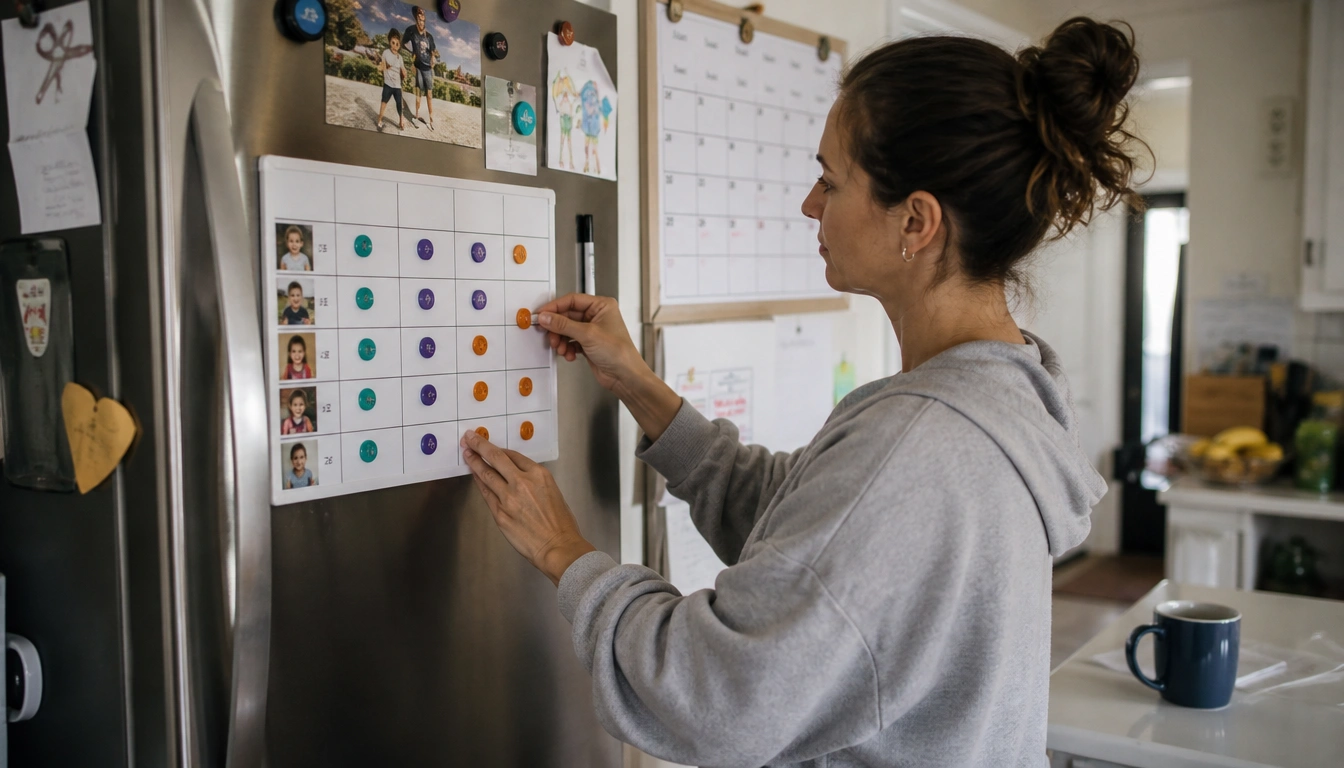
Yes—track only a few habits, keep the system visible, and attach each habit to something you already do. For busy parents, the easiest habit tracking system is usually a paper or whiteboard tracker with no more than three active habits, simple checkboxes, and a reset mindset when life gets chaotic. The goal is consistency, not perfection.
Key Takeaways
- Limit your active tracker to three habits or fewer so it stays manageable when parenting and work are already full.
- Pair each habit with an existing cue, such as coffee, bedtime cleanup, or school drop-off, so you rely less on willpower.
- Put the tracker where you will see it often, like the fridge, pantry, or family command center, and make updating it fast.
- Choose habits that fit your current parenting stage; what helps a newborn household is different from what helps a school-age routine.
- Treat missed days as information about what got in the way, not as a reason to quit or start over from scratch.
- If tracking starts to feel obsessive, stressful, or food- or weight-focused, scale it back and get support if needed.
Why busy parents need a different kind of habit tracker
A parent-friendly habit tracker has to work inside real family life: broken sleep, school forms, work deadlines, last-minute spills, and evenings that disappear faster than planned. The usual problem is not a lack of caring. It is that a complicated tracking system becomes one more task competing with everything else.
That is why the best habit tracking system for busy parents is deliberately small. It should reduce decision fatigue, not add to it. A long list of goals can make you feel behind before you even start. A short list of visible habits gives you a realistic place to begin and makes success easier to notice.
Think of habit tracking as a support tool, not a test. It helps you notice what is happening, spot patterns, and keep healthy routines from getting lost in the noise of daily life. The most useful version is the one you can keep using when the week goes sideways.
The science of self-monitoring and why it works better than relying on motivation
Behavioral research consistently shows that self-monitoring improves follow-through. When you track a behavior, you make it visible. That visibility creates immediate feedback, which helps you notice whether your actions match your intentions. Guidance from the American Psychological Association and public health organizations supports the idea that small, trackable goals are easier to sustain than vague intentions.
That matters because motivation changes from day to day. Parents do not get the luxury of perfect focus, and most habits are not built by feeling inspired. They are built by repeating a small action in a familiar context until it becomes easier to do. In other words, tracking helps you stay aware, while routine and environment do the heavier lifting.
Context matters more than people expect. If a habit always happens after coffee, after lunch cleanup, or before the kitchen lights go off, the cue becomes part of the system. You are no longer asking yourself all day whether to do it. The routine itself nudges you forward.
How to choose the right 1-3 habits to track first
Start with habits that are small, specific, and genuinely useful in your current season. If you are overwhelmed, choose the actions that support energy, stability, or family flow rather than trying to fix everything at once. One of the most common mistakes is mixing too many goals into one tracker and then feeling discouraged when none of them stick.
A good first habit is something you can do in a minute or two and measure simply. For example: drink water in the morning, take a short walk after dinner, set out clothes for tomorrow, or do a screen-free wind-down before bed. The CDC and child health guidance from the American Academy of Pediatrics both support simple, family-based routines that are easier to repeat than dramatic overhauls.
If you are not sure where to begin, ask three questions: What feels most doable? What would help the whole household? What would make tomorrow slightly easier? That keeps the tracker practical instead of aspirational. The goal is not to choose the “best” habits in theory. It is to choose the habits you can actually repeat this week.
Build a low-friction system: cue, place, and format
Every useful tracker has three parts: a cue, a place, and a format that is fast enough to keep up with real life. The cue is what reminds you to act. The place is where the tracker lives. The format is how you mark progress. If any of those require too much effort, the whole system starts to slip.
For busy parents, the easiest setup is usually visible and simple. Put the tracker on the fridge, pantry door, or a family command center whiteboard. These are places you already visit many times a day. A tracker hidden in a drawer or buried in an app can easily disappear from view, which makes it harder to use consistently.
Keep the marking method as basic as possible. A checkbox, dot, or slash is enough. The less time it takes to update, the more likely you are to do it on exhausted days. The most effective tracker is not the prettiest one; it is the one that takes almost no effort to maintain.
Paper, whiteboard, or app: which fits parent life best
Paper works well if you want something low-tech, portable, and easy to customize. It is especially good for parents who like to keep the system visible on the counter or inside a planner.
Whiteboards are ideal for shared households. They are easy to update, easy for partners or older kids to see, and easy to adjust when routines change.
Apps can help if you want reminders on your phone, but they can also become one more place to check. If you choose an app, keep notifications minimal and use it only if it truly reduces effort.
For many families, paper or whiteboard is the easiest place to start because it keeps the tracker in the same physical space as daily life.
How to use habit stacking with existing routines
Habit stacking means attaching a new habit to one you already do automatically. This is one of the most practical ways to make a healthy routine stick when your schedule is unpredictable. Instead of trying to remember a new action from scratch, you let an existing routine trigger it.
Examples are simple: after your morning coffee, drink a glass of water. After school drop-off, take five deep breaths before opening work email. After dinner cleanup, lay out tomorrow’s snacks or water bottle. Before the kitchen lights go off, check the tracker.
The best stack is specific and realistic. Do not pair the habit with a time of day that constantly changes unless the cue itself is stable. If mornings are chaotic, use a different anchor. If bedtime is unpredictable, choose an earlier routine such as lunch cleanup or the final load of laundry. Context beats motivation because the cue does the remembering for you.
How to adapt the tracker for infants, toddlers, school-age kids, and teens
The most useful habits change as children grow. A newborn household usually needs a different tracker than a house with a teenager. That is normal. A good system flexes with the season instead of demanding the same habits forever.
For infants and postpartum parents, the priorities may be hydration, meals, brief rest windows, and medication or appointment reminders if relevant. During this stage, tracking should support recovery and survival, not perfection. If sleep is fragmented, keep the goals very small.
For toddlers, use habits that support predictable family rhythm, such as outdoor time, brushing teeth, or a calm bedtime routine. For school-age kids, a screen-free wind-down, backpack prep, or family movement habit may matter more. For teens, the tracker may be more useful as a shared household rhythm than as a parent-controlled chart.
As kids get older, involve them in ways that feel age-appropriate. Younger children may like checking boxes with a marker or moving a magnet. Older kids may help choose the habit or track one family routine of their own. The point is to make the system fit the household, not force the household to fit the system.
How to keep tracking from becoming guilt, pressure, or obsession
A tracker should make life easier to notice, not harder to live. If it starts to feel punitive, obsessive, or tied to food, sleep, or weight anxiety, that is a sign to scale back. Healthy tracking should support well-being and flexibility, not turn into another source of stress.
One useful mindset shift is to treat missed days as data. If a habit keeps getting skipped, ask what the barrier was. Was the cue unclear? Was the habit too ambitious? Did the time of day fail every time because the family schedule changed? That approach turns a broken streak into useful information instead of a judgment.
It also helps to choose family-friendly habits that are supportive rather than restrictive. Good examples include a short walk after dinner, a regular water refill, a screen-free wind-down, a five-minute tidy, or a consistent bedtime prep routine. These are the kinds of habits that can improve daily flow without making the household feel monitored.
If tracking seems to increase anxiety, especially around eating, sleeping, or body image, pause the system and simplify it. In some cases, a small routine is enough without any visible tracker at all.
How to reset after missed days without starting over
You do not need to erase the tracker, restart a streak, or wait for a perfect Monday. Missed days are part of family life. Sick kids, travel, bad sleep, work emergencies, and emotional overload all happen. A sustainable tracker expects interruptions and makes it easy to resume.
The fastest reset is to return to the smallest version of the habit. If your habit was a 20-minute workout, restart with five minutes. If your habit was a full evening routine, restart with the first step only. If your tracker feels crowded, remove one habit before adding anything new.
A good reset also includes a brief review. Ask: What made this harder? What would make it easier next time? Do I need a different cue, a more visible place, or fewer habits? That kind of repair keeps the system practical. For busy parents, consistency usually comes from redesigning the routine, not trying harder.
The most durable systems are the ones that survive imperfect weeks. If your tracker helps you notice patterns, keep going after interruptions, and build one small family routine at a time, it is doing its job.
Simple tools work best when life is complicated. Keep the system visible, keep the list short, and let the tracker adapt as your family does. That is how healthy habits become repeatable instead of overwhelming.
Frequently Asked Questions
What habits should busy parents track first?
Start with one to three habits that are small, high-value, and realistic for your current season. Good first choices are hydration, a short movement break, a bedtime wind-down, or a simple family routine that would make the next day easier.
Is a paper habit tracker better than a habit tracking app for parents?
Often, yes. Paper or a whiteboard is usually easier to see, quicker to update, and simpler to share with a partner or older kids. Apps can help if you need reminders, but they can also add friction if they become another thing to check.
How many habits should I track at once to avoid burnout?
Keep the active list to no more than three habits. More than that usually increases mental load and makes it harder to stay consistent. If you want to add something new, wait until one habit feels stable or simplify the current list first.
How do I keep a habit tracker useful when my schedule keeps changing?
Anchor each habit to a routine that already happens, such as coffee, school drop-off, or kitchen cleanup. Also choose a visible tracker and a quick way to mark progress. When the schedule shifts, adjust the cue rather than abandoning the system.
What should I do when I miss days or break a streak?
Treat the missed days as information, not failure. Look for the barrier, shrink the habit if needed, and restart with the smallest possible version. You do not need to begin again from zero just because the week got messy.
The Bottom Line
An easy habit tracking system for busy parents should lower effort, not raise it. Keep the list short, make the tracker visible, and tie each habit to a routine you already do so the system depends less on motivation.
The best version is the one that fits your family stage and your current energy. If tracking starts to feel stressful or obsessive, simplify it immediately. A small, flexible system is more useful than a perfect one that you cannot maintain.
Medical disclaimer
Medical disclaimer: This content is for educational and informational purposes only and is not a substitute for professional medical advice, diagnosis, or treatment. Dietary needs and supplement suitability vary by individual.
Sources
- Centers for Disease Control and Prevention (CDC) — cdc.gov. Accessed October 2026.
- Academic / Medical Research Institution — apa.org. Accessed October 2026.
- healthychildren.org — healthychildren.org. Accessed October 2026.
