
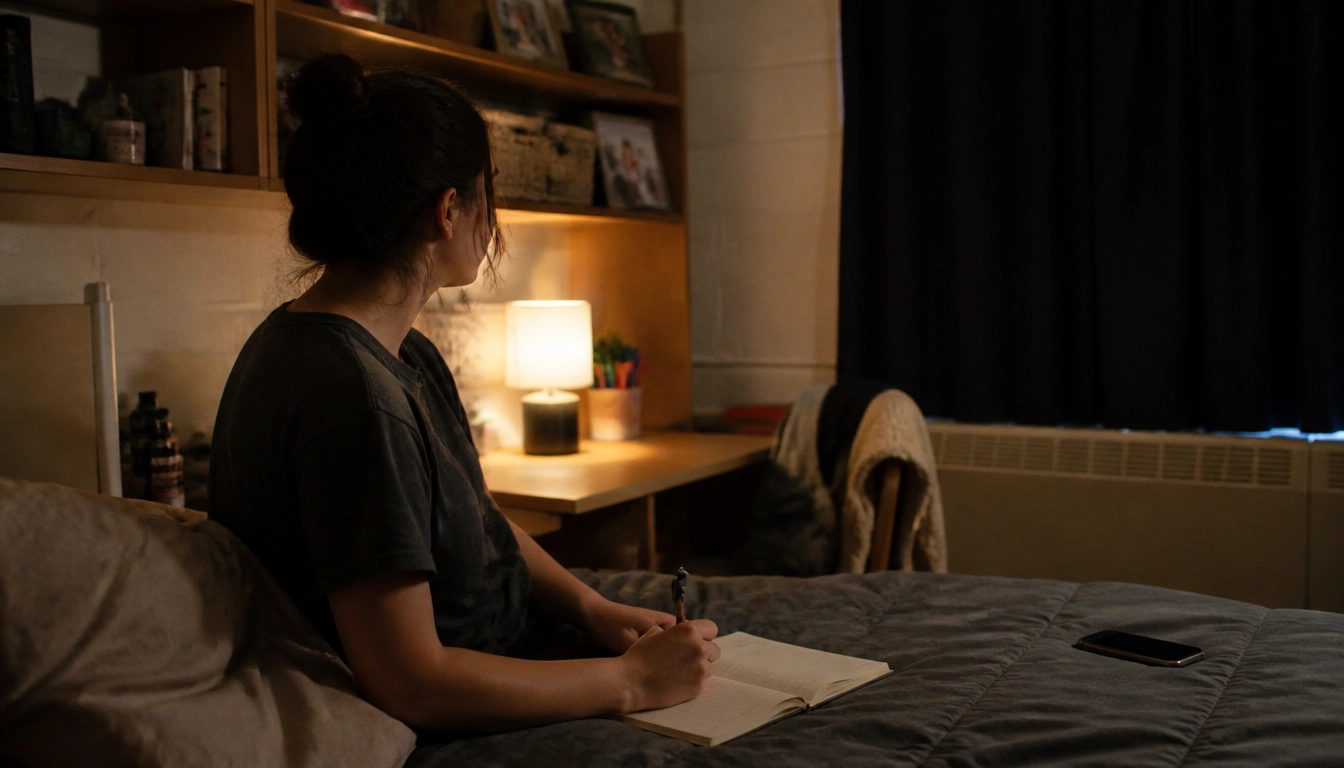
College students should aim for a predictable 30–60 minute evening preparation habit, not a perfect or early bedtime. The most useful version usually includes a digital cutoff, a quick brain dump, a sleep-friendly room setup, and a light finish to eating, drinking, and studying. That routine helps the body and brain shift from alert mode into sleep mode without forcing a dramatic schedule change.
Key Takeaways
- A wind-down routine works best as a buffer, not a strict early bedtime. It should fit your actual class, study, and social schedule.
- The goal is better sleep quality, not just feeling sleepy. Alcohol and heavy late-night meals can make you drowsy while still disrupting restorative sleep.
- Students who run later by nature do better with stable sleep timing than with a sudden, unrealistic bedtime shift.
- If you have ADHD, anxiety, or bedtime procrastination, shrink the routine into tiny steps you can repeat consistently.
- Dorm and apartment fixes matter: reduce light, noise, and temperature swings so your room feels more sleep-friendly.
- If sleep problems last for months or come with mood changes, campus health or mental health services can help.
Why an evening preparation habit matters for college sleep
College nights are different from the bedtime routines many adults imagine. You may be finishing a paper at 11 p.m., answering messages, studying with roommates nearby, or trying to relax after a stressful day. That mix keeps the brain alert long after your body is tired. According to the CDC and sleep experts, young adults need 7 to 9 hours of sleep, but irregular schedules and late stimulation make that hard to reach consistently.
An evening preparation habit helps because it creates a reliable bridge between daytime demands and sleep. Instead of trying to “go to bed early,” you are telling your nervous system that the active part of the day is ending. That matters for memory, mood, and next-day focus, especially when the week is packed with classes, work, and social obligations. The routine also gives you something repeatable even when your schedule changes.
For college students, the best routine is usually simple enough to do on ordinary nights, not just ideal ones. If it takes too much time or willpower, it will probably disappear during exams or busy weeks.
The 30–60 minute wind-down window
The most useful version of a wind-down routine is a 30–60 minute transition buffer before sleep. That does not mean you must be in bed for an hour before sleeping. It means you give yourself a stretch of time when the goal shifts from performance and problem-solving to lowering stimulation.
This buffer works because sleep is easier when your brain is not jumping between homework, messages, and mental replay. A stable routine can also support circadian timing by making bedtime cues more predictable. For many students, consistency matters more than picking an unrealistically early bedtime and abandoning it two nights later.
Think of the window as a series of “downshifts.” First, reduce stimulation. Then clear mental clutter. Then make the room comfortable. Then stop using food, caffeine, and alcohol in ways that interfere with rest. If you are short on time, keep the same order and shorten the steps rather than skipping the whole routine.
Build a digital sunset that actually sticks
Screen time matters because phones, tablets, and laptops keep your brain engaged and can expose your eyes to light that delays sleep timing. The point is not to ban screens forever. It is to stop using the most stimulating ones right before bed. According to NIH and university sleep resources, late-night exposure to bright light and emotionally activating content can make it harder to fall asleep.
A realistic “digital sunset” for a student might look like this:
- Put your phone on Do Not Disturb.
- Move it away from the pillow or bed if you can.
- Finish required messages, reminders, and calendar checks early in the wind-down window.
- Switch from scrolling to a low-stimulation option such as a paperback book, quiet music, or a paper planner.
If you must use a screen for classwork, lower the brightness, keep the task specific, and stop as soon as the work is done. The goal is to avoid “just one more scroll,” because that kind of open-ended use tends to pull bedtime later without adding real rest.
Use a brain dump to clear tomorrow out of your head
A lot of college sleep trouble is mental, not physical. Your body is tired, but your mind is still rehearsing tomorrow’s quiz, roommate issue, lab report, or social plan. A short brain dump helps interrupt that loop by moving thoughts from working memory onto paper.
Keep it fast. Write tomorrow’s top tasks, loose worries, and any follow-up you do not want to forget. You are not solving everything at night. You are giving your brain proof that the information is stored somewhere safe.
Students who feel anxious often benefit from this step because it reduces the “I’m forgetting something” feeling. If you have a long to-do list, do not try to organize your whole life at bedtime. Write enough to quiet the noise, then stop. A five-minute list is usually more helpful than a highly structured planning session that turns into another homework assignment.
Set up the room for sleep in a dorm or apartment
Environmental fixes can make a bigger difference than people expect, especially in shared housing. In a dorm or apartment, your room may be too bright, too warm, or too noisy for sleep to come easily. Small adjustments help signal that the space is meant for rest, not just studying.
Useful low-cost changes include blackout curtains or an eye mask, earplugs or white noise, and a cooler room if your space runs warm. A slightly lower temperature often feels better because the body naturally cools down before sleep. If you live with roommates, setting a quiet-hours expectation can help, but a backup plan is still useful for nights when you cannot control the noise.
Try to make your sleep space feel different from your study space. Even a simple cue, like turning off a desk lamp and using a bedside light only for the last part of the routine, can help your brain associate the room with sleep instead of work.
Food and drink matter too. A heavy or greasy late-night meal can leave you physically uncomfortable, and alcohol may make you feel sleepy without supporting restorative sleep. It can fragment sleep and increase middle-of-the-night waking. Caffeine too late in the evening can also keep you alert longer than you want. If you need something warm, choose a non-caffeinated drink and keep it light.
Adapt the routine for late classes, night owls, ADHD, or anxiety
Not every student should try to sleep at the same hour. Some people are naturally later sleepers, and college schedules often push sleep later anyway. The goal is not to force a dramatic bedtime shift. It is to stabilize sleep timing as much as your class load allows so your body is not constantly dealing with social jetlag.
If your schedule changes often, use a minimum viable routine. That could mean three steps only: dim the lights, write tomorrow’s first task, and put the phone away. If you have ADHD or bedtime procrastination, start even smaller. Pick one cue that means “the day is closing,” such as brushing your teeth immediately after your last assignment or setting a nightly alarm that says “wrap up now.”
For anxiety, the routine should feel calming, not perfect. Avoid turning bedtime into another performance metric. If you tend to overthink, pair the brain dump with a short, familiar activity such as stretching or reading a few pages. If social media makes you feel more activated or left out, replace it with something boring and predictable.
Students who work late or have evening classes may need to shift the routine later, not shorter in quality. A 30-minute routine done consistently at 1 a.m. is still a routine.
Common mistakes that backfire at night
One common mistake is trying to “fix” sleep with exhaustion. Pulling an all-nighter, crashing from stress, or relying on alcohol may produce sedation, but that is not the same as restorative sleep. The body may be unconscious, yet the sleep is lighter and more fragmented than it should be.
Another mistake is keeping bedtime tasks open-ended. Checking one email, then one message, then one assignment can quietly erase your wind-down window. Students also often overestimate how much they need to do before bed. A good routine is not a full productivity reset; it is a boundary around stimulation.
Weekend sleep can also backfire if you swing far away from your usual schedule. Sleeping in a little can help if you are genuinely short on sleep, but huge shifts can make Monday night harder. According to public health guidance, consistency is more helpful than repeated catch-up swings.
Finally, do not assume that feeling sleepy after alcohol or a big meal means you are getting better rest. The sensation of sedation is not the same as sleep quality.
When a sleep routine is not enough
Short-term sleep trouble is common during midterms, breakups, travel, or schedule changes. But if sleep onset problems or frequent night waking keep happening for weeks or months, the issue may be more than a habit problem. The National Institutes of Health and campus health experts recommend getting checked when insomnia becomes persistent, especially if it starts affecting school, safety, or daily functioning.
It is also worth reaching out if poor sleep comes with low mood, hopelessness, loss of interest, panic, or major academic decline. Those can be signs that stress, depression, anxiety, or another health issue is playing a role. Students who rely heavily on alcohol, cannabis, stimulants, or sleep aids to get through the night should talk with a healthcare professional as well, because substances can hide the real problem or make sleep worse over time.
If you are unsure, campus health services are a reasonable first step. You do not need to wait until the problem is severe to ask for help. A practical routine is useful, but it should support care, not replace it when there is a deeper issue.
Frequently Asked Questions
How long should a college student’s wind-down routine be before bed?
A good target is 30 to 60 minutes, but it does not need to be perfect. The point is to create a predictable buffer between active, stimulating tasks and sleep. If your schedule is tight, even 20 to 30 minutes done consistently can help more than a longer routine you rarely follow.
What should college students stop doing at night to fall asleep more easily?
Try to stop open-ended scrolling, intense studying right up to lights-out, heavy eating, and alcohol use as a sleep strategy. Also avoid caffeine too late in the day. These habits can keep your brain and body more alert than you realize, even if you feel tired.
Does blue light really affect sleep in young adults?
Yes, late-night light from phones, tablets, and laptops can make it harder for the body to shift toward sleep, and young adults are especially prone to delayed sleep timing. The effect is usually stronger when screen use is bright, stimulating, and close to bedtime.
Is alcohol or a heavy late-night meal a good way to help sleep?
No. Alcohol can make you feel sleepy at first, but it often fragments sleep and reduces restorative quality. A heavy late-night meal can also cause discomfort or reflux that interrupts rest. If you are hungry, a light snack is usually less disruptive than a large meal.
What can students with anxiety, ADHD, or bedtime procrastination do differently?
Use a shorter, simpler routine with fewer steps. Try a timer, a phone reminder, or a single nightly cue that signals it is time to start winding down. For anxiety, add a quick brain dump. For ADHD or procrastination, make the first step extremely easy so you can start without a lot of decision-making.
The Bottom Line
A college sleep routine works best when it is a realistic wind-down, not a fantasy of perfect discipline. Focus on a 30–60 minute buffer that lowers stimulation, clears mental clutter, and makes your room more sleep-friendly.
The most useful changes are often small: a digital cutoff, a quick brain dump, less noise and light, and smarter choices with food, caffeine, and alcohol. For students with late schedules or attention and anxiety challenges, consistency matters more than an early bedtime.
If sleep problems keep showing up or start affecting mood and daily functioning, campus health services can help you figure out whether this is just a habit issue or something that needs more support.
Medical disclaimer
Medical disclaimer: This content is for educational and informational purposes only and is not a substitute for professional medical advice, diagnosis, or treatment. Dietary needs and supplement suitability vary by individual.
Sources
- National Institutes of Health (NIH) — nih.gov. Accessed November 2026.
- Centers for Disease Control and Prevention (CDC) — cdc.gov. Accessed November 2026.
- Centers for Disease Control and Prevention (CDC) — cdc.gov. Accessed November 2026.
- Academic Research Institution — ncsu.edu. Accessed November 2026.
- Academic Research Institution — georgetown.edu. Accessed November 2026.
- Academic Research Institution — snhu.edu. Accessed November 2026.
- Academic Research Institution — usc.edu. Accessed November 2026.
- Academic Research Institution — colorado.edu. Accessed November 2026.
