
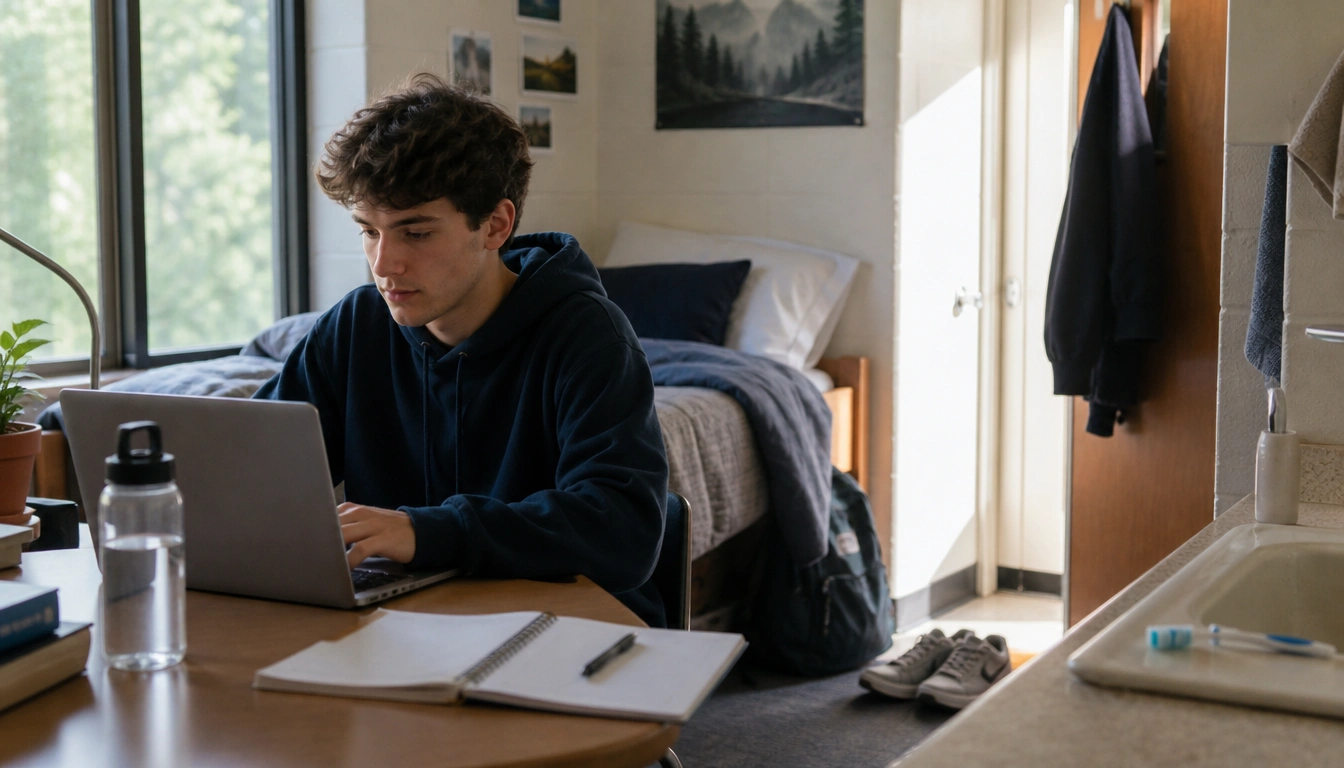
Yes—college students can use habit stacking to eat better, move more, sleep better, and manage stress by attaching one tiny health action to an existing daily habit, such as brushing teeth, making coffee, or charging a phone. The best stacks are small, repeatable, and tied to actions that happen even when class times change. Start with one stack, keep it simple, and build from there.
Key Takeaways
- Use stable daily anchors, not class times, because college schedules change from day to day.
- Make the new habit tiny enough to do in under a minute or alongside something you already do.
- One stack at a time works better than trying to change sleep, food, exercise, and stress all at once.
- Dorms, dining halls, and tight budgets require practical stacks, not ideal routines.
- Habit stacking can support healthy choices, but it does not replace care if sleep, mood, or eating problems persist.
What habit stacking means in a college context
Habit stacking for college students means attaching a new health action to something that already happens automatically. Instead of trying to remember a new routine from scratch, you use an existing behavior as the cue. That matters in college because class times, labs, work shifts, club meetings, and social plans can change almost daily. A routine based on “after my 8 a.m. class” falls apart when the schedule changes. A routine based on “after I brush my teeth” or “after I lock my dorm door” is more reliable.
This approach works because it reduces decision fatigue. You do not have to ask yourself when to begin or whether you feel motivated. The old habit becomes the trigger for the new one. In practice, that can mean: after I start my coffee, I drink water; after I put my laptop away, I stretch; after I plug in my phone, I lay out tomorrow’s clothes.
The goal is not to become rigid. The goal is to make healthy behavior easier to start on busy, unpredictable days.
Choosing an anchor that actually fits student life
The best anchor habit is daily, automatic, and unlikely to disappear when your class schedule shifts. Good anchors usually happen in the same context every day: brushing teeth, making coffee, getting into bed, opening your laptop, locking your room, or setting down your bag. These are stronger than time-based anchors because they follow your life, not the clock.
Choose an anchor that already feels stable, not one you hope will become stable later. For example, “after my last class” sounds simple, but the time may change, a class may get canceled, or you may head straight to work. “After I start my coffee maker” is more repeatable. “After I sit on my bed with my phone charger” is also repeatable, even on weekends.
If you are deciding between two anchors, pick the one that happens most days without much effort. A good anchor should feel almost boring. That is usually a sign it is reliable enough to carry a new habit.
A simple formula for building a stack
The basic formula is: After [anchor], I will [tiny health action]. The new action should be so small that it feels almost too easy. That is a feature, not a flaw. Tiny actions are more likely to fit into a dorm room, a dining hall line, or a packed study session.
Examples help make the formula concrete. After I brush my teeth, I will fill my water bottle. After I press start on my coffee, I will eat one piece of fruit. After I sit down to study, I will put my phone across the room. After I close my laptop at night, I will take three slow breaths. After I walk into my dorm, I will do one minute of stretching.
A useful test is whether the action still feels manageable on a bad day. If the plan requires a shower, a special app, a long workout, or a full meal-prep session, it is probably too large for a first stack. The best stack is specific, small, and tied to a cue you can actually expect to see.
Stack examples for sleep, hydration, nutrition, movement, and stress
For sleep, a stack might be: after I plug in my phone, I put my charger across the room and dim the lights. That adds a little friction to late-night scrolling and gives your brain a clearer cue that the day is ending. Another option is: after I brush my teeth, I lay out tomorrow’s essentials so the morning feels easier.
For hydration, try: after I start my coffee or tea, I drink one glass of water. This works well in a dorm because it does not require cooking or extra time. For nutrition, a dining hall stack might be: after I swipe in, I get one fruit or a vegetable serving before choosing the rest of my meal. That shifts the first decision toward a more nourishing option.
For movement, use a study-break stack: after my timer ends, I stand up and walk to refill my water or do 30 seconds of stretching. For stress, try: after I open my notebook, I write the three most important tasks before starting work. These are small enough to repeat during a full semester, even when motivation is low.
The best stacks do not try to fix your whole lifestyle at once. They target one useful change and make it easier to repeat.
How to keep a stack tiny enough to stick
One stack at a time is usually enough. When students try to change sleep, exercise, nutrition, and stress habits all in one week, the chain often breaks because the brain has too many new cues to learn. If you miss step one, step two never happens. If step two feels hard, the whole routine starts to feel like a chore.
Keep the first version almost frictionless. If the goal is better hydration, start with one glass of water, not a full hydration plan. If the goal is movement, start with one flight of stairs, not a 45-minute workout. If the goal is stress management, start with three breaths, not a long meditation. The point is to practice consistency before complexity.
Repeat the same stack for a while before adding another. In a high-stress semester, stable routines are more realistic than ambitious ones. Once one habit feels automatic, then you can layer in a second stack that fits naturally after the first.
Adapting stacks for dorms, dining halls, apartments, and budgets
College living spaces change what is easy. In a dorm, the best stack may use visible items as cues: a water bottle on the desk, shoes by the door, or a toothbrush next to the sink. In a dining hall, your anchor might be entering the line, sitting down with a tray, or finishing your first item on the plate. In an off-campus apartment, the anchor could be starting the kettle, opening the fridge, or setting your keys in a bowl by the door.
Budget matters too. Habit stacking does not need expensive gear or a perfect meal plan. You can stack healthy choices around low-cost options like water, fruit, eggs, oats, frozen vegetables, or a quick walk between buildings. A student with a tight budget may get more value from a repeatable routine than from a complicated wellness program.
| Setting | Possible anchor | Tiny stack example |
|---|---|---|
| Dorm | Locking the door | Take one deep breath before leaving |
| Dining hall | Picking up a tray | Choose fruit or vegetables first |
| Apartment | Starting the coffee maker | Drink a glass of water |
| Study space | Opening your laptop | Write the top three tasks |
The best stack is the one that fits the place you actually live, not the place you wish you lived in.
Habit stacking for ADHD or executive dysfunction
Students with ADHD or executive dysfunction often do better with cues that are physical and sensory, not only time-based reminders. A clock reminder can be easy to ignore or forget. A toothbrush on the sink, a sticky note on the laptop, or the feel of your phone charger can work better because the cue is part of the environment.
Reducing decision load helps too. Instead of asking, “What should I do for self-care right now?” decide in advance: after I sit at my desk, I put my headphones on and open my planner. After I finish dinner, I refill my water bottle. After I get in bed, I place my phone across the room. The fewer choices in the moment, the easier the habit is to repeat.
Visual reminders can also help. Keep the item you need in sight and in the same place every day. If your goal is to take a short walk, put your shoes by the door. If your goal is to drink more water, keep the bottle where you study. These are not treatment strategies for ADHD, but they can make healthy routines easier to start.
Common mistakes and when habit stacking is not enough
One common mistake is choosing an anchor that is too irregular, like “after my first class” or “after I finish homework.” Those events are not guaranteed to happen at the same time, and sometimes not at all. Another mistake is making the new habit too big. If the stack requires lots of energy, it may fail on the first stressful day. A third mistake is stacking too many behaviors together and expecting all of them to stick.
If a stack keeps breaking, shrink it rather than abandoning it. Change “I will do a workout” to “I will do one minute of movement.” Change “I will meal prep” to “I will add one vegetable.” Change “I will meditate for 10 minutes” to “I will take three slow breaths.” Small changes are easier to preserve during exams, late-night study sessions, and social weeks.
Habit stacking is helpful for behavior design, but it is not a substitute for care. If poor sleep, low mood, anxiety, or eating problems keep going despite your efforts, use campus health or counseling resources. According to the National Institutes of Health and other public health guidance, persistent problems that affect daily functioning deserve individualized support, not just a better routine. The same is true if you are losing a lot of sleep, skipping meals often, or feeling overwhelmed most days.
Frequently Asked Questions
What is habit stacking and how does it work for college students?
Habit stacking is a way of linking a new habit to one you already do automatically. For college students, that usually means using stable daily actions—like brushing teeth, starting coffee, or plugging in a phone—as the cue for a small health behavior.
What are the best anchor habits for a student schedule that changes day to day?
The best anchors are daily actions that do not depend on class time, such as waking up, brushing teeth, making coffee, locking your door, or getting into bed. These are more reliable than schedule-based anchors because they still happen when your day changes.
How do I create a habit stack for sleep, hydration, nutrition, movement, or stress?
Use the formula: After [anchor], I will [tiny health action]. For example, after I brush my teeth, I will fill my water bottle; after I start my coffee, I will eat fruit; after I close my laptop, I will take three slow breaths.
How many habits should I stack at once so I do not burn out?
Start with one stack. If you try to build several new habits at once, the chain is easier to break. Once one habit feels steady, you can add another small stack that fits naturally with the first.
Does habit stacking help students with ADHD or executive dysfunction?
Yes, it can help because it reduces reliance on memory and timing. Sensory cues, visual reminders, and physical prompts often work better than clock-based reminders. It still helps to keep the action tiny and the setup simple.
The Bottom Line
Habit stacking works best in college when you stop trying to build perfect routines and start linking tiny health actions to things you already do every day. The anchor should be stable, the new habit should be small, and the plan should fit real dorm, dining hall, or apartment life.
One stack is usually enough to start. If sleep, food, movement, or stress still feel unmanageable, or if mood and eating problems keep interfering with daily life, reach out to campus health or counseling services for individualized care.
Medical disclaimer
Medical disclaimer: This content is for educational and informational purposes only and is not a substitute for professional medical advice, diagnosis, or treatment. Dietary needs and supplement suitability vary by individual.
Sources
- National Institutes of Health (NIH) — nih.gov. Accessed November 2026.
- National Institutes of Health (NIH) — nih.gov. Accessed November 2026.
- National Institutes of Health (NIH) — nih.gov. Accessed November 2026.
- Academic Research Institution — umw.edu. Accessed November 2026.
- Academic Research Institution — uiowa.edu. Accessed November 2026.
- Academic Research Institution — bsu.edu. Accessed November 2026.
