
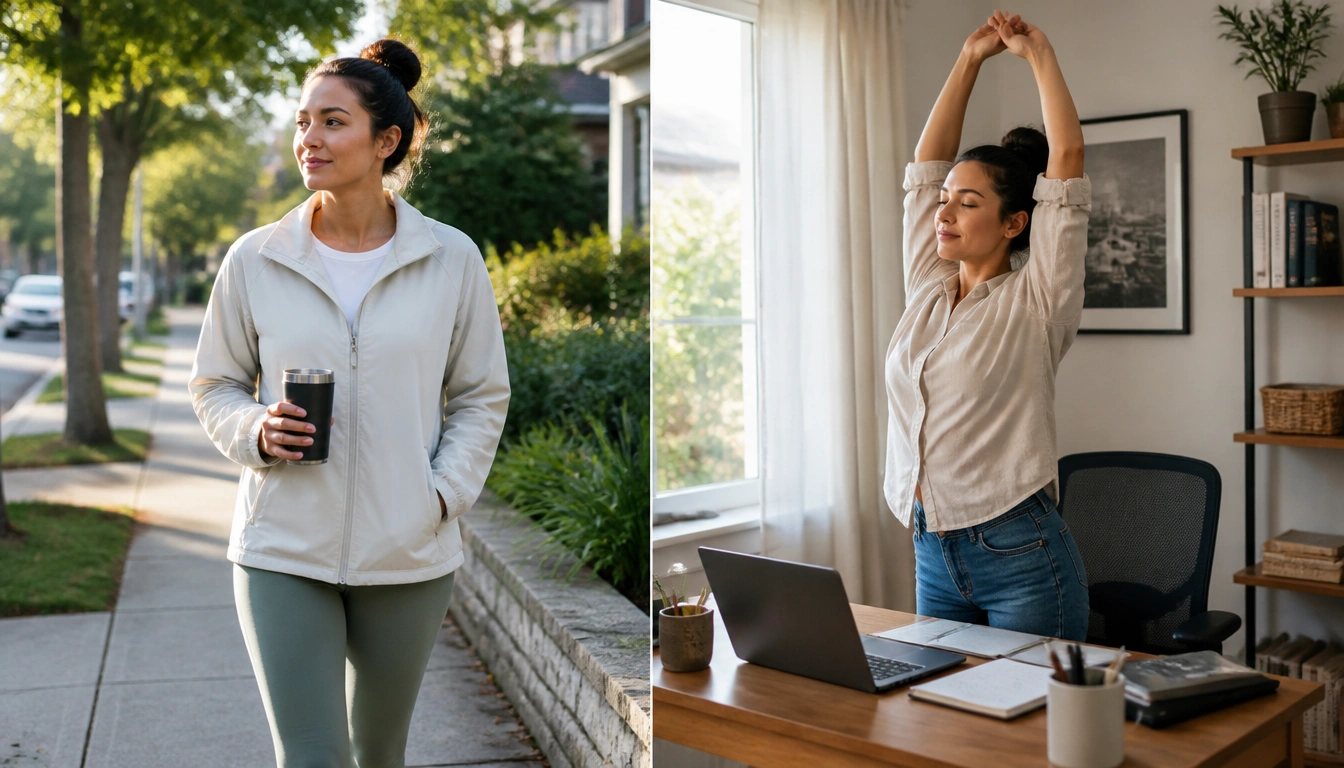
A realistic home commute routine is a short, repeatable transition before and after work that replaces some of the movement and mental boundaries a traditional commute used to provide. The goal is not to exercise hard. It is to reduce uninterrupted sitting, add light movement and daylight when possible, and create clear cues for starting and ending the workday.
Key Takeaways
- A virtual commute helps with both sedentary time and work-life boundaries, not just fitness.
- Morning and evening routines can serve different jobs: one helps you wake up and shift into work, the other helps you shut down.
- Outdoor walking is useful, but indoor pacing, stairs, stretching, and mobility breaks can also work.
- Even regular exercisers can still benefit from breaking up long sitting stretches during the day.
- If movement causes sharp pain or symptoms that linger, scale back and get medical advice rather than pushing through.
Why a commute matters more than the trip itself
For many remote workers, the biggest change is not the missing drive or train ride. It is the loss of a built-in transition that used to separate sleep, home life, and work. A commute creates small but meaningful bouts of movement before and after the workday: walking to the car or transit, climbing stairs, carrying a bag, standing in line, and moving through different spaces. Those micro-movements add up to more non-exercise activity thermogenesis, or NEAT, which is the energy you use outside formal workouts.
That matters because working from home can quietly increase sedentary time. Public health agencies such as the CDC and NIH emphasize that prolonged sitting is not fully offset by an occasional workout. Even people who exercise regularly can still spend many hours in unbroken sitting during the workday, which is why a commute routine can help beyond fitness. It gives the body a reason to move and the brain a cue that the day is changing.
The same routine also supports boundaries. Without a commute, work can start the moment you open a laptop and can bleed into the evening long after you stop answering messages. A virtual commute gives you a repeatable way to mark “I am available for work now” and “work is done for today.”
Designing a morning inbound routine
The morning version of a virtual commute should do two things: help your body wake up and help your mind step into work mode. For some people that means a short walk outside. For others it may be a brisk loop around the block, a few minutes on stairs, or a combination of daylight, hydration, and clothing changes that signals the shift.
If you can get outside, even briefly, morning daylight is useful for circadian timing and alertness. The point is not to chase perfect sunlight exposure or a long walk. It is to give your brain a clear day-start cue. Many remote workers also find that changing out of sleepwear, washing up, and drinking water before coffee makes the transition feel more intentional.
A simple inbound routine might look like this: wake up, hydrate, get dressed for the day, step outside for a few minutes, then sit down at your workspace only after that sequence is complete. If you have a longer window, use it for a comfortable walk at a conversational pace. If your schedule is tight, a shorter walk and a brief pause by a window or doorway is still better than going straight from bed to desk.
Building an evening outbound routine
The evening commute replacement has a different job. It is less about energizing you and more about helping you close the workday cleanly. A good outbound routine should end in three parts: stop work, move your body, and change context. That can be as simple as closing your laptop, leaving your work area, and taking a short walk or stretch circuit before shifting into dinner, family time, or rest.
This kind of shutdown ritual helps reduce work creep. If your desk is in the living room or bedroom, it is easy for work to remain mentally “open” even after your last task is finished. A short walk, a few shoulder rolls, or a gentle mobility sequence can act as a physical full stop. Some people like to listen to music or a podcast during this time; others prefer silence. Either is fine if it helps you detach.
Try to keep the outbound routine smaller than a workout and more structured than a vague promise to “relax later.” The routine should be easy enough to repeat on busy days, because consistency does more for boundaries than intensity does.
How long a virtual commute should be
There is no single perfect duration. The best length is the one you can repeat most days without resentment or logistical stress. A useful rule is to match the routine to the role it plays in your day, not to the number on a fitness tracker. A morning commute routine may only need a few minutes if your goal is to wake up, get daylight, and create a clean start. A longer version may feel better if you used to have a meaningful travel time before work.
For many people, a short routine is enough to be useful. The public health advice that matters most here is not about chasing a prescribed “virtual commute” length; it is about avoiding long, unbroken sitting and adding movement regularly through the day. If you can build a consistent morning and evening bookend, you may get more benefit from repetition than from stretching the routine too long.
If you want to progress, increase only one thing at a time: a few extra minutes of walking, a slightly longer mobility sequence, or a more deliberate shutdown ritual. That makes the habit easier to keep during hectic weeks.
Indoor and low-space alternatives that still count
Bad weather, poor air quality, caregiving duties, limited outdoor access, or an unsafe neighborhood can make outdoor walking unrealistic. In those cases, the goal is to preserve the function of the commute, not the exact form. A commute routine can happen indoors, in a hallway, at the top of the stairs, or even beside a couch if space is tight.
Useful substitutes include pacing while you listen to a briefing or voice note, walking laps around a room, stair climbing if it is comfortable and safe, gentle marching in place, or a short mobility block with arm circles, hip hinges, calf raises, and trunk rotations. For parents and caregivers, the routine may need to be broken into smaller pieces around school drop-off, nap time, or medication schedules. That still counts.
If weather or safety is the barrier, try making the routine more about movement and less about location. The main target is a reliable transition away from the desk. Even five minutes of purposeful movement can help create that reset when the day is crowded.
Adapting the routine for pain or limited mobility
If you already have back pain, neck tension, joint pain, wrist strain, or mobility limitations, the goal is comfort and consistency, not pushing through discomfort. A commute routine should leave you feeling looser and more settled, not flared up. Start with low-impact movement and use positions that feel stable.
Gentle walking is often the easiest option, but it is not the only one. Seated or standing mobility work can be a better fit on difficult days. You might try slow shoulder rolls, ankle circles, supported marching, or a few minutes of easy pacing. People with joint or back pain should pay attention to the difference between normal stiffness that improves with movement and pain that is sharp, radiating, or worsening.
Abruptly turning a commute routine into a power walk, run, or stair workout is not the goal. If you have been mostly sedentary, gradual progression is kinder to joints and soft tissues. When pain persists, keeps returning, or interferes with daily tasks, it is time to ask a healthcare professional for individualized advice.
Common mistakes that make virtual commutes less helpful
One common mistake is overcomplicating the routine. A virtual commute is not supposed to become another performance metric. If the routine starts feeling like a workout plan, a productivity challenge, or a chore you dread, it is probably too ambitious.
Another mistake is skipping the evening shutdown and expecting the morning routine alone to fix work-life boundaries. The two bookends work together. The morning routine helps you start; the evening routine helps you stop. If you only build one, work may still spill too easily into the rest of the day.
A third mistake is expecting perfection. Some days will be short, indoor, messy, or interrupted by caregiving. That does not mean the habit has failed. A two-minute reset is better than nothing, and a flexible routine is more sustainable than a flawless one that collapses under real life.
A simple starter plan you can repeat
On day one, keep it very small. In the morning, drink water, get dressed, and take a short walk or indoor movement break before opening work. In the evening, close your work tabs, step away from your desk, and do a brief walk or stretching circuit before settling into your after-work routine. If that feels manageable, repeat the same pattern for several days before changing anything.
Once the habit feels automatic, build it gently. Add a little daylight to the morning routine if possible. Add a few extra minutes to the evening wind-down if that helps you detach. If you have a week with heavier caregiving, poor weather, or a busy deadline, shrink the routine instead of dropping it completely.
The most useful version of a healthy commute routine is the one you can keep. The point is to make the workday feel bounded and the body feel less stuck, not to recreate a perfect old commute. Small, repeated transitions are usually enough to support both movement and mental separation over time.
Frequently Asked Questions
What should a remote worker do instead of a commute in the morning?
Use a short transition that includes movement and a clear mental cue. That might be a walk outside, pacing indoors, a few mobility drills, drinking water, getting dressed, and delaying work until after the routine is complete.
How long should a virtual commute be to be useful?
It can be as short as a few minutes if it is consistent and helps you shift into work or out of work. The most useful length is the one you can repeat most days without making the routine feel like another obligation.
Does walking have to be outside, or can a commute routine be indoors?
Indoor routines can work well. Hallway laps, stair walking, pacing, marching in place, or gentle mobility exercises can still break up sitting and create a workday boundary when outdoor walking is not practical.
What if I have caregiving duties, bad weather, or no safe walking route?
Shrink the routine and make it flexible. Try micro-walks, pacing during calls, stair use, or short movement blocks around your schedule. The goal is the transition, not a perfect outdoor walk.
What should I do if sitting all day is already causing back, neck, or wrist pain?
Scale back intensity and choose low-impact movement that feels comfortable, such as gentle walking or mobility work. If pain is sharp, persistent, or worsening, or if it keeps returning despite changes, get medical advice.
The Bottom Line
A healthy commute routine for remote workers does not need to be long or complicated. It just needs to give you a dependable way to move, reset, and separate work from home life.
Think of the morning version as a wake-up cue and the evening version as a shutdown cue. Together, they can reduce unbroken sitting, support NEAT, and make the workday feel more contained without turning your day into a workout.
Medical disclaimer
Medical disclaimer: This content is for educational and informational purposes only and is not a substitute for professional medical advice, diagnosis, or treatment. Dietary needs and supplement suitability vary by individual.
Sources
- National Institutes of Health (NIH) — nih.gov. Accessed October 2026.
- Centers for Disease Control and Prevention (CDC) — cdc.gov. Accessed October 2026.
- Centers for Disease Control and Prevention (CDC) — cdc.gov. Accessed October 2026.
- Centers for Disease Control and Prevention (CDC) — cdc.gov. Accessed October 2026.
- National Institutes of Health (NIH) — nih.gov. Accessed October 2026.
- National Institutes of Health (NIH) — nih.gov. Accessed October 2026.
