
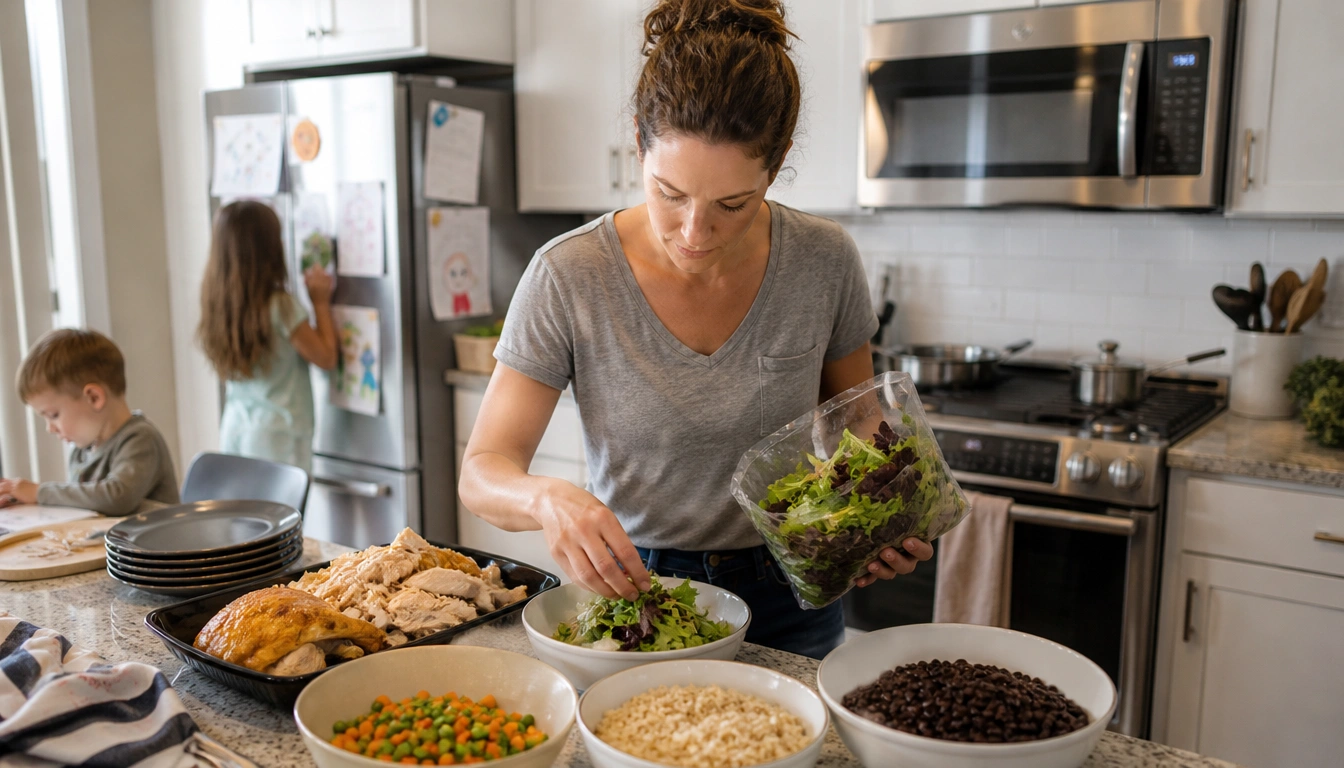
Yes—by using a healthy convenience food strategy, you can feed your family quickly and still choose foods that are nutritious and age-appropriate. The most practical approach is food-first and component-based: keep ready-to-eat or semi-prepared ingredients on hand, then build meals from a simple formula of base + protein + vegetable + flavor. Frozen and canned produce can be just as useful as fresh, and convenience foods only need extra label scrutiny when they are highly processed.
Key Takeaways
- Convenience foods do not have to mean poor nutrition; they can support a healthy pattern when you choose smart staples and build meals from components.
- Frozen and canned fruits and vegetables can be nutritious choices because they are often harvested and preserved at peak ripeness.
- A repeatable meal formula—base + protein + vegetable + flavor—makes dinner faster without relying on takeout or boxed meals.
- Deconstructed plates and snack-style dinners can work well for picky eaters, exhausted parents, and nights when everyone arrives at different times.
- Packaged shortcuts still deserve label checks for sodium, added sugars, and trans fats, especially in highly processed meals and snacks.
- Young children need age-appropriate serving sizes and cutting practices for foods that can pose choking risks, including grapes, cherry tomatoes, hot dogs, and chunks of cheese.
Why convenience does not have to mean poor nutrition
Busy families often end up choosing the fastest option available, not the healthiest one. That does not mean convenience foods are automatically a bad fit. Public health guidance from the Dietary Guidelines for Americans emphasizes building patterns around fruits, vegetables, whole grains, lean proteins, and low-fat or fat-free dairy while limiting added sugars, saturated fat, and sodium. The goal is not perfection; it is making the healthier option easier to use on nights when time and energy are limited.
A practical healthy convenience food strategy starts with a simple insight: friction shapes food choice. If a vegetable needs washing, peeling, and chopping after a long workday, it will lose to whatever is fastest. The solution is not to cook more elaborately. It is to remove the steps that slow you down. Pre-washed greens, frozen vegetables, canned beans, and rotisserie chicken are useful because they reduce effort without forcing you into a highly processed dinner.
This approach also fits real family life. School pickups run late. One child has practice. Another refuses the family meal. A well-stocked kitchen with a few smart shortcuts can still deliver a balanced dinner that feels doable instead of draining.
The food-first, component-based approach to family meals
The easiest way to think about healthy convenience cooking is as components, not recipes. Instead of planning a full meal from scratch, keep a few building blocks on hand and combine them at the last minute. This is the food-first version of convenience: you are still choosing real foods, just in forms that save time.
The simplest framework is base + protein + vegetable + flavor. A base can be a microwaveable whole grain, whole-grain tortilla, pita, or even potatoes. Protein might be rotisserie chicken, eggs, beans, tuna, salmon, or tofu. Vegetables can be frozen broccoli, bagged salad, baby carrots, pre-cut peppers, or canned tomatoes. Flavor can come from salsa, hummus, pesto, vinaigrette, low-sodium broth, or a simple seasoning blend.
This method works because it is flexible. You do not need a new recipe every night. You only need enough variety to rotate flavors so meals do not feel repetitive. If dinner feels manageable, you are more likely to repeat it, which matters more than finding a perfect menu once in a while.
Healthy convenience staples to keep stocked and how to assemble a balanced meal in minutes
A strong convenience pantry and freezer make weeknights easier before the clock even starts. For produce, keep pre-washed salad greens, baby carrots, snap peas, bagged slaw, frozen broccoli, frozen mixed vegetables, frozen berries, and canned fruit packed in water or 100% juice. For protein, stock rotisserie chicken, eggs, canned beans, lentils, tuna, salmon, and plain yogurt or cottage cheese if your family uses dairy. For grains, choose microwave brown rice, quinoa pouches, whole-grain pasta, tortillas, and whole-grain bread. For flavor, keep salsa, marinara, hummus, pesto, olive oil, vinegar, mustard, and lower-sodium broth.
Once these foods are available, a balanced meal can happen in minutes. Try a grain bowl with microwave brown rice, shredded chicken, steamed vegetables, and salsa. Or make wraps with beans, bagged greens, and a yogurt-based sauce. Another low-effort dinner is whole-grain toast with eggs, fruit, and a side of microwaved peas or broccoli. The details can change, but the pattern stays the same.
If you like structure, a plate can be built around one carbohydrate, one protein, one vegetable, and one flavor element. That keeps meals satisfying without requiring a long ingredient list or a fully cooked entrée.
Deconstructed dinners and snack-plate meals for picky eaters and exhausted parents
Family dinner resistance often has less to do with nutrition and more to do with format. Some children do better when food is separated instead of mixed together. Some parents do better when dinner can be assembled from things already cooked. Deconstructed meals solve both problems.
A deconstructed dinner might include sliced rotisserie chicken, cucumber rounds, whole-grain crackers, cheese cubes, fruit, and hummus. A snack-plate meal might use hard-boiled eggs, baby carrots, pita wedges, berries, and yogurt dip. These meals are not “less healthy” because they are casual. They can still cover multiple food groups, and they often reduce the stress that comes with a single dish everyone is expected to eat.
This style also helps when schedules are staggered. One child may need to eat before practice while another gets home later. A bento-style setup lets family members eat the same core foods without forcing everyone into one shared recipe at one exact time. For many households, that is the difference between a skipped dinner and a meal everyone actually eats.
Smart shopping and label-reading for packaged shortcuts
Packaged shortcuts are useful, but they are not all equal. The label still matters, especially when you are buying soups, frozen entrées, sauces, snack packs, and breaded proteins. Federal nutrition guidance recommends limiting added sugars, saturated fat, and sodium, so the first question is not whether a food is packaged. It is what is inside the package.
Start with the ingredient list. Shorter lists with recognizable foods are often easier to work with than products built around multiple starches, sweeteners, and additives. Then scan the Nutrition Facts panel. If a product is meant to be a major part of dinner, look for choices that are lower in sodium and added sugar and that do not rely heavily on trans fat-containing ingredients. In many cases, a “lightly processed” version is a better fit than an ultra-processed one.
It also helps to think in terms of use, not labels like “healthy” or “unhealthy.” A canned soup can be a quick lunch base if you add beans and frozen vegetables. A frozen entrée may be fine occasionally, but it should not crowd out simpler meals built from whole-food components. The more a product already combines starch, sauce, and protein, the more important label-reading becomes.
When frozen, canned, and pre-cut foods are helpful—and when to choose lower-sodium or no-added-sugar versions
Frozen and canned produce are often excellent tools for busy families. They are commonly harvested at peak ripeness and preserved soon after, which helps lock in nutrients and reduce waste. That means they can be nutritionally comparable to fresh produce, especially when “fresh” has spent days in transport or in the refrigerator before it is eaten. The best choice is often the one your family will actually use before it spoils.
Frozen vegetables are especially useful for quick dinners because they cook fast and require no chopping. Canned beans and canned tomatoes also make a meal come together quickly, but they deserve a closer look at sodium content. If you can, choose lower-sodium or no-salt-added versions of beans, broth, vegetables, and tomatoes. For canned fruit, look for fruit packed in water or 100% juice rather than heavy syrup or products with added sugar.
Some convenience foods are best treated as helpers rather than stand-alone meals. A jarred sauce can turn plain pasta into dinner if you add frozen spinach and beans. A can of tuna or salmon can become a wrap or sandwich filling. The more you pair these items with produce and whole grains, the more nutrition they bring to the table.
Child safety and age-appropriate serving tips for common convenience foods
Convenience foods also need to be age-appropriate. The same foods that make dinner fast can be choking hazards if served in unsafe shapes or sizes. Grapes, cherry tomatoes, hot dogs, and large chunks of cheese are common examples. For young children, these foods should be cut into smaller pieces that are easier to chew and manage, rather than served whole.
The safest serving style depends on the child’s age, chewing ability, and supervision level. Toddlers and preschoolers generally need foods that are soft, small, and easy to grasp. That may mean quartering grapes and cherry tomatoes, slicing hot dogs lengthwise before cutting them into small pieces, and using thin slices or small cubes of cheese instead of large chunks. Round, slippery, or firm foods deserve extra caution.
Other convenience foods may need texture adjustments too. Raw vegetables can be too hard for some young children, while sticky nut butters should be spread thinly rather than served in thick spoonfuls. If your child has feeding challenges, allergies, or special medical needs, a pediatrician or pediatric dietitian can help you adapt meals safely.
Simple weekly systems that reduce friction
The easiest healthy routine is one that removes decision-making on busy nights. A few small systems can make convenience food work in your favor. After grocery shopping, do a quick speed prep: wash fruit, transfer berries to visible containers, separate salad greens, and place ready-to-eat snacks at eye level. Even ten minutes of setup can save you much more effort later in the week.
It also helps to keep a backup plan in the freezer. A few bags of vegetables, tortillas, frozen fruit, and a couple of protein options can prevent last-minute takeout. If dinner is running late, you can turn those foods into a breakfast-for-dinner plate, a quick soup, or a wrap night. The point is not to create a rigid meal plan. It is to keep enough parts on hand that a meal can be built instead of invented.
Mix-and-match routines work best when they are boring in a good way. Pick two or three bases, two or three proteins, and a short list of vegetables and flavors you already know your family will eat. Repeating a simple system reduces food waste, keeps shopping under control, and makes the next dinner easier than the last one.
Frequently Asked Questions
What are the healthiest convenience foods to keep on hand for quick family meals?
The most useful options are foods that need little or no prep: frozen vegetables, pre-washed greens, canned beans, canned fish, rotisserie chicken, eggs, plain yogurt, whole-grain tortillas, microwaveable grains, and fruit packed in water or 100% juice. These make it easier to build a balanced meal fast.
How can I build a balanced meal from grocery-store shortcuts in 10 minutes or less?
Use the base + protein + vegetable + flavor formula. For example, microwave brown rice, shredded rotisserie chicken, steamed broccoli, and salsa. Or use whole-grain toast, eggs, bagged salad, and fruit. The trick is to combine ready-to-eat foods instead of cooking each part from scratch.
Are frozen and canned fruits and vegetables still nutritious enough to count?
Yes. Frozen and canned produce can be a practical way to meet fruit and vegetable goals, and they are often harvested and preserved at peak ripeness. Choose versions without much added salt or sugar when possible, and rinse canned vegetables or beans if you want to reduce sodium further.
What should parents look for on labels when buying packaged convenience foods?
Check the ingredient list and the Nutrition Facts panel. Look for shorter ingredient lists, and pay special attention to sodium, added sugars, and trans fat. Packaged foods are not automatically unhealthy, but heavily processed products can add a lot of salt, sugar, or less desirable fats very quickly.
How do I make convenience foods safer for young children to eat?
Cut round or firm foods into age-appropriate pieces and watch texture. Grapes and cherry tomatoes should not be served whole to young children, and hot dogs and cheese need smaller, safer cuts. Serve young kids foods they can chew easily and supervise meals when choking risk is a concern.
The Bottom Line
A healthy convenience food strategy is really a shortcut strategy, not a junk-food strategy. The goal is to keep real-food components on hand so busy nights still end with a balanced meal instead of a last-minute compromise.
Frozen vegetables, canned beans, rotisserie chicken, microwave grains, and pre-washed produce can all help you feed a family quickly. The most useful habit is to make the healthy choice the easiest one to assemble.
When you buy packaged shortcuts, use the label as a filter rather than a judgment. And for young children, convenience foods still need age-appropriate cutting and supervision so speed does not come at the expense of safety.
Medical disclaimer
Medical disclaimer: This content is for educational and informational purposes only and is not a substitute for professional medical advice, diagnosis, or treatment. Dietary needs and supplement suitability vary by individual.
Sources
- Centers for Disease Control and Prevention (CDC) — cdc.gov. Accessed November 2026.
- U.S. Government / Health Authority — health.gov. Accessed November 2026.
