
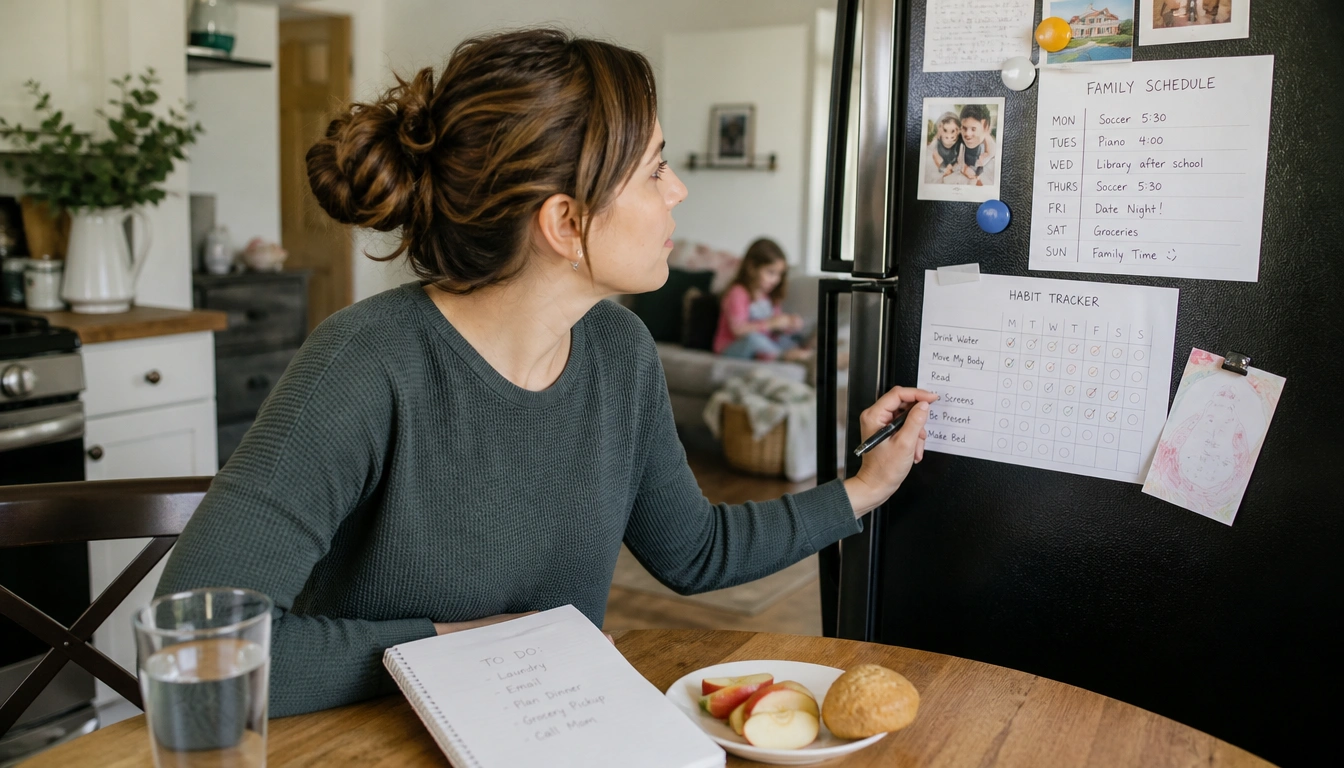
A healthy habit tracker for busy parents works best when it is simple, flexible, and tied to routines you already have. Instead of tracking everything, choose a few daily anchors such as hydration, short movement, sleep boundaries, and mental restoration. Use habit stacking, keep the tracker visible, and treat missed days as part of real family life rather than a reset to zero.
Key Takeaways
- Track only a few habits at first. A short list is easier to maintain when your schedule changes every day.
- Build habits onto existing routines, like water with breakfast or stretching while coffee brews.
- Missed days do not erase progress. Aim for steady frequency, not perfect streaks.
- Include mental restoration, not just physical metrics. Quiet time, gratitude, or connection count too.
- Choose budget-friendly habits that still matter, including frozen vegetables, quick home meals, and family walks.
Why a parent-friendly tracker needs a different design
A healthy habit tracker for busy parents should feel more like a support tool than a performance score. Generic trackers often assume steady schedules, predictable meals, and uninterrupted workout time. Parenting rarely works that way. A child wakes early, the night runs short, and a plan that depends on an hour of free time can collapse before lunch.
The better approach is to track the habits that help you function in real life. Public health guidance from the CDC and NHS emphasizes that children learn a great deal by watching adults, so your habits matter for your own health and for the household culture you create. That does not mean you need a perfect routine. It means a small, visible system can support both parent wellbeing and family habits.
Think of the tracker as a reminder to return to a few basics, not a test you pass or fail. If the tracker only works on calm days, it is too complicated for the people who need it most.
Use micro-habits, habit stacking, and flexible consistency
Micro-habits are tiny actions that fit into moments already in your day. Habit stacking means linking a new action to something you already do automatically. That combination lowers decision fatigue, which is one reason it helps so much for exhausted parents.
Examples are intentionally small. Drink water while breakfast is being made. Take three slow breaths while coffee brews. Do calf raises while brushing your teeth. Walk the hallway or the driveway while a child finishes a snack. Movement and self-care do not have to look like a formal workout to count.
The main goal is frequency over rigidity. If a habit happens most days, it can still become part of your life even when some days are missed. One missed day is not a failure and does not erase the pattern you have built over weeks. For busy parents, flexible consistency is more durable than an all-or-nothing streak.
The few daily pillars that matter most
A realistic tracker usually works best with three or four core pillars. More than that, and the system starts competing with family life instead of supporting it.
| Pillar | Simple example | Why it helps |
|---|---|---|
| Hydration | One glass of water at breakfast | Easy to remember and supports energy through the day |
| Movement | 10-minute walk, stretch, or family dance break | Keeps activity realistic even on busy days |
| Sleep boundary | Screens off before bed or a short wind-down routine | Protects rest for adults and children |
| Mental restoration | Quiet time, gratitude, journaling, or connection with a partner or friend | Supports stress recovery, not just physical health |
These are not the only healthy habits that matter, but they are often the most sustainable starting point. Mental restoration deserves a place on the tracker because recovery is part of health. A few minutes of quiet, writing down one grateful moment, or checking in with a partner can be as meaningful as steps or meals.
For children, the CDC notes that school-age kids and teens need regular daily physical activity, but parents do not need to mirror that target exactly in a home tracker. The point is to build a family environment where healthy choices are normal, visible, and repeatable.
How to tailor the tracker by life stage and make it family-friendly
Parents of infants or toddlers usually need a survival-focused tracker. Sleep is fragmented, feeding schedules shift, and the day may be built around naps, diapers, and soothing. In that stage, the best tracked habits are gentle: drinking water, a few minutes of stretching, one nourishing meal, short walks, and a calm reset moment after a hard stretch of caregiving.
Parents of school-age children can often add more structure. Morning water, after-school movement, a shared dinner vegetables goal, and a screen-off bedtime routine may be realistic. Parents of teens may focus more on modeling, meal rhythm, and sleep boundaries, while leaving more room for independence and conversation rather than direct supervision.
Make the tracker visible and easy to use. A fridge chart, notebook, phone app, or shared family whiteboard can all work. Choose the version you will actually see every day. If other adults in the home can participate, keep it collaborative. Shared tracking works best when it feels like teamwork, not surveillance.
Children can help with simple markers such as stickers, checkboxes, or color coding. That makes health habits more normal and less like correction. The goal is to model routines, not pressure children to perform them perfectly.
Healthy habits on a tight budget
A useful tracker should leave room for real budgets. Healthier habits are not limited to expensive groceries or paid fitness classes. Frozen vegetables, canned beans, plain yogurt, oats, eggs, peanut butter, brown rice, and quick home-cooked meals are all valid choices. They may be more practical than fresh produce that spoils before you can use it.
Budget-aware tracking can also include low-cost movement. Family walks, playground time, living room dance breaks, stairs, stretching, and active games all count. CDC physical activity guidance supports accumulated activity, so short bouts matter.
To reduce decision fatigue, pair the tracker with a short list of default options. For example: one easy breakfast, two go-to dinners, and one fallback snack. That way the tracker supports action instead of creating one more thing to decide when everyone is tired.
If your tracker includes meals, keep the standard simple. “Cooked at home” is a useful habit. “Added a vegetable” is a useful habit. “Chose water with dinner” is a useful habit. These are concrete, family-friendly, and far easier to repeat than strict food rules.
Postpartum caution, stress signals, and when to get help
Some habit trackers should be gentler after childbirth. Postpartum parents should get medical clearance before returning to high-impact exercise or strong core work, especially if there are pelvic floor symptoms, surgical recovery, or pain. In early recovery, gentle walking, breathing, and basic mobility may be more appropriate than ambitious workout goals.
Trackers can also become harmful if they trigger guilt, obsession, or a sense that every missed box is a personal failure. If the system makes you more anxious, it has stopped serving you. A helpful tracker should increase awareness and reduce friction, not turn daily life into constant self-criticism.
Get professional support if chronic fatigue, low mood, anxiety, postpartum depression symptoms, pain, or sleep problems are not improving. A tracker is a behavior tool, not a substitute for medical care, mental health care, or individualized advice. If a habit feels unsafe or confusing, ask a healthcare professional before pushing harder.
A simple weekly tracker example for a busy parent
Keep the layout small enough to complete in less than a minute. A sample weekly tracker could include four rows: water with breakfast, movement snack, sleep boundary, and mental restoration. Across the top, list Monday through Sunday. Add a checkbox or colored dot for each habit.
Example routine: on weekdays, drink water while packing lunch, walk for 10 minutes after dinner, start a screen wind-down before bed, and spend three quiet minutes journaling or sitting without interruption. On weekends, replace the walk with a family outing or active play, and replace journaling with a call to a friend or a few minutes of gratitude.
Do not make the sheet so strict that it breaks during normal life. If a day is chaotic, mark one habit that did happen, or use a simple “partial win” symbol. The purpose is to notice patterns, not to create a perfect attendance record.
How to start small and review progress without resetting to zero
Start with one week and only three or four habits. Put the tracker where you will see it, not where you will admire it later. Tie each habit to a cue you already have, such as breakfast, coffee, bedtime, or dinner cleanup.
At the end of the week, review what was easiest and what kept getting skipped. If a habit never fits, simplify it rather than abandoning the whole tracker. A five-minute walk may work better than a workout. Water at breakfast may work better than tracking total ounces. Quiet time may work better than a long journal entry.
Keep the review calm and practical. Ask what helped, what got in the way, and what one adjustment would make the next week easier. Then keep going. A healthy habit tracker for busy parents works when it supports momentum, not when it demands a restart every Monday.
Frequently Asked Questions
What 3–4 habits should a busy parent track first?
Start with hydration, a short movement habit, a sleep boundary, and one mental restoration habit. Those cover energy, recovery, and stress without creating an overwhelming checklist.
How can habit stacking make tracking easier when I have no free time?
Attach the habit to something you already do, such as drinking water with breakfast or stretching while coffee brews. That reduces decision fatigue because the new habit rides on an existing routine.
How do I track health without becoming obsessive or discouraged by missed days?
Keep the tracker small, avoid streak pressure, and treat missed days as normal. Focus on how often the habit happens across the week or month, not whether every box is filled.
What should parents of infants or toddlers track differently from parents of older kids?
Infant and toddler parents usually need gentler, survival-focused habits like hydration, basic movement, and short quiet moments. Parents of older kids can add more structure, like family meals, screen boundaries, and shared activity time.
Can a healthy habit tracker work on a tight budget?
Yes. Frozen or canned vegetables, quick home-cooked meals, water instead of sugary drinks, and free movement like walks or active play are all legitimate tracker items.
The Bottom Line
A healthy habit tracker for busy parents should be small, visible, and built around routines you already have. The best version is the one that supports your day instead of competing with it.
Focus on a few repeatable habits, especially hydration, movement, sleep boundaries, and mental restoration. Make room for budget-friendly food choices, family-friendly movement, and the reality that some weeks will be messy.
If the tracker starts creating guilt, panic, or pain, scale it back and ask for help when needed. Progress for busy parents is usually built through steady returns to the basics, not perfect streaks.
Medical disclaimer
Medical disclaimer: This content is for educational and informational purposes only and is not a substitute for professional medical advice, diagnosis, or treatment. Dietary needs and supplement suitability vary by individual.
Sources
- National Health Service (NHS) — kentcht.nhs.uk. Accessed October 2026.
- Centers for Disease Control and Prevention (CDC) — cdc.gov. Accessed October 2026.
- National Health Service (NHS) — icb.nhs.uk. Accessed October 2026.
