
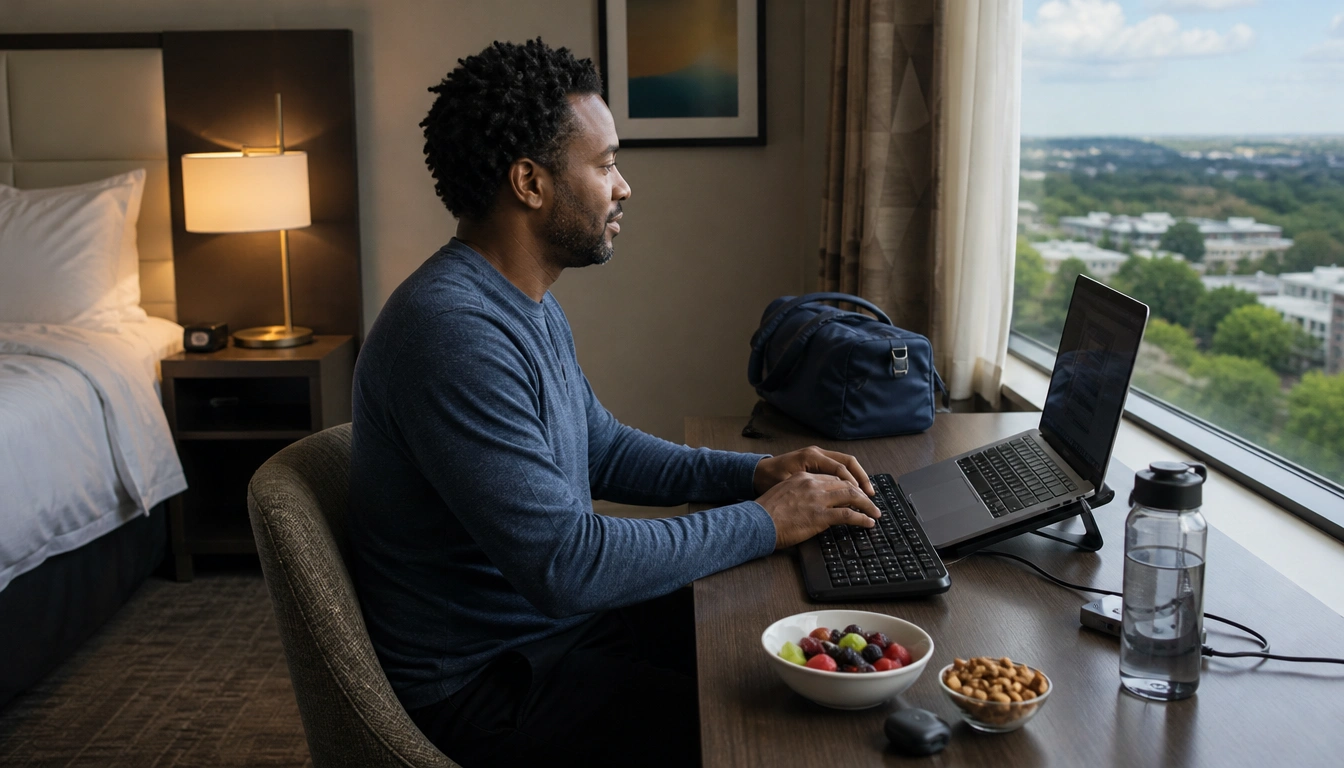
Yes—you can keep a healthy travel routine while working from home if you focus on the habits that matter most: plan health details before you leave, move regularly during transit, use light and sleep timing to protect your body clock, keep portable food on hand, and set firm work hours if the trip doubles as a workation. The goal is not to copy your home setup exactly, but to keep a few stable anchors wherever you go.
Key Takeaways
- Travel is harder for remote workers because it removes the home systems that support health: controlled ergonomics, kitchen access, and predictable activity breaks.
- A healthy travel routine starts 4 to 6 weeks before departure with vaccine review, destination research, and a medication check.
- On transit days, hydration and frequent movement matter more than perfection; walk when you can and do seated ankle pumps or calf stretches when you cannot.
- Use sunlight, sleep timing, and lighter screen use to help reset your body clock after time-zone changes.
- Pack stable snacks, keep prescriptions in original labeled packaging, and bring a buffer supply in case travel is delayed.
- If you are blending work and travel, define work hours and off-hours clearly so the trip does not become permanent low-grade burnout.
Plan ahead for health risks before you leave
A healthy travel routine starts well before departure. Public health guidance from the CDC and the NHS recommends reviewing destination-specific risks, entry rules, and vaccine needs about 4 to 6 weeks before you travel. That window gives you time to update routine vaccines, check whether extra vaccines or medicines are recommended for your destination, and sort out any prescriptions that may need a refill.
This step matters more for people who work from home than it may seem. At home, you may depend on a predictable schedule, a stocked kitchen, and easy access to your own supplies. Travel removes those anchors all at once. If you wait until the last minute, you are more likely to miss medication timing, forget a useful supply, or arrive without a realistic plan for sleep and meals.
Keep prescription medications in your carry-on, in their original labeled packaging, along with a copy of the prescription or a clinician letter if you need one. A small buffer supply is wise in case of delays. If you live with a chronic condition, or if your medicine schedule is time-sensitive, ask your healthcare professional whether your plan needs to change across time zones.
It also helps to think beyond “do I have my passport and charger?” and ask: What are the health risks where I am going? Are there food and water precautions? Will I be walking more, sitting longer, or sleeping less than usual? Those answers shape the rest of your routine.
Understand why home routines break down on the road
Many remote workers do not realize how much health support their home setup provides until they lose it. A desk chair, a familiar kitchen, a regular walking route, and a stable work block all act as quiet cues for sleep, eating, and focus. Travel interrupts those cues in the same day: you may sit for hours, skip meals, eat later than usual, and work from an awkward position in a hotel room or airport lounge.
That disruption can affect more than comfort. Irregular sleep timing can make you feel mentally foggy. Long periods of sitting can leave your legs stiff and may slow circulation. Limited food choices can push you toward convenience foods that do not keep you full for long. Even the change from being “off” at home to being “on” in a workation can make it harder to rest mentally.
The most useful response is not to chase a perfect routine. It is to identify the few habits that keep you steady: sleep timing, movement, hydration, and food you can actually rely on. Once those are protected, the rest of the trip becomes easier to manage.
Use transit time to protect circulation and energy
Long flights, train rides, and car trips usually mean more sitting and less natural movement. That is one reason travelers are encouraged to get up and move when they can. Frequent movement helps reduce stiffness and supports circulation in the legs. It is especially important if you already tend to sit for long periods while working.
Simple habits are often enough. Drink water steadily through the day, and do not rely on sugary drinks or alcohol to get through the trip. If you are on a plane or in another seat-bound setting, do seated ankle pumps, calf stretches, and short walks up the aisle or to a rest stop when possible. A standing break every 45 to 60 minutes is a useful target when the trip allows it.
If you are traveling after a long work week, the temptation is to “make up” for the stress with snacks, alcohol, and staying still. That usually backfires. A better approach is to keep transit simple: water, movement, and enough rest to arrive able to function. If you have leg pain, swelling, warmth, or shortness of breath, do not assume it is ordinary travel fatigue; seek medical care promptly.
Reset your body clock with light and sleep timing
Jet lag happens when your internal clock is out of sync with the local day-night cycle. Even without crossing many time zones, early departures, late arrivals, and poor sleep can throw off your rhythm. The CDC notes that light exposure is one of the strongest signals for the body clock, which is why daytime sunlight after arrival can be so helpful.
Use daylight strategically. If you arrive in the morning or early afternoon, spend time outside soon after arrival if it fits your schedule. If you arrive late and need to sleep, reduce bright screen exposure before bed and keep the room as dark and calm as you can. The goal is to give your brain a clear cue about when it is daytime and when it is time to wind down.
Do not try to force a perfect reset on day one. For some travelers, especially after long-haul flights, it is more realistic to shift gradually over a day or two. A consistent wake time, light exposure in the morning, and less screen use before sleep often help more than trying to “power through” the first night.
Build a portable food strategy
Travel often turns meals into a series of decisions made under pressure. If you work from home, you may be used to having easy access to regular meals and snacks. On the road, that predictability disappears. A portable food strategy helps bridge the gap between transit, meetings, and unfamiliar restaurants.
Choose stable foods that travel well and help you stay satisfied: unsalted nuts, seeds, whole fruit, shelf-stable protein options, whole-grain crackers, or similar simple snacks. The point is not to create an ideal diet in your bag. It is to avoid arriving so hungry that convenience food becomes the only option.
Food safety matters too, especially in places with different water or food handling standards. Follow local guidance, and adapt your choices if you are traveling somewhere with higher risk for foodborne illness. If clean water is uncertain, bottled or treated water may be the safer choice. If you develop severe diarrhea, high fever, or signs of dehydration, seek medical advice rather than trying to push through it.
Make temporary ergonomics good enough
A hotel desk, rental table, airport gate, or coworking bench is rarely as supportive as your home setup. That does not mean you have to accept hours of neck and back strain. A few temporary adjustments can reduce the toll of working on the road.
Raise your laptop so the screen is closer to eye level, even if that means using books or a portable stand. If possible, use an external keyboard and mouse so your shoulders are not hunched forward for hours. Sit with your feet grounded and your hips supported, and avoid working from a bed or couch for long stretches if you can help it.
Micro-breaks matter as much as the setup. Standing up every 45 to 60 minutes, rolling your shoulders, and walking a few steps can prevent stiffness from building. If you normally have a standing desk at home, think of travel ergonomics as a temporary substitute, not a full replacement. The best arrangement is the one that lets you work without spending the entire day folded over a screen.
| Travel setting | Useful adjustment | Why it helps |
|---|---|---|
| Hotel room | Elevate laptop; use a chair and table instead of the bed | Supports better posture and less neck strain |
| Airport or train station | Change position often; walk during delays | Reduces stiffness from long sitting |
| Coworking space | Use an external keyboard if available | Lets the screen sit higher without hunching |
Set boundaries for a workation so you can actually rest
A workation can be useful, but it also creates a common trap: feeling mentally “on” the whole time. If you answer messages all day, work late into the evening, and then spend your free time checking email, your nervous system never really gets a break. That can leave you more drained than a regular work week at home.
Set work hours and off-hours before the trip starts. Decide when you will check email, when you will stop, and what time belongs to rest or exploration. If you need a morning work block and a separate evening block, write that down. Clear boundaries reduce the mental friction of deciding in the moment.
It also helps to protect at least one recovery window each day with little or no screen time. That may be a walk, a meal without email, or a quiet hour before bed. Remote work already blurs the edges between personal and professional time. Travel can blur them further, so the structure has to be intentional.
Know when normal travel habits are not enough
Some situations need more than routine self-care. If you have diabetes, cardiovascular disease, asthma, or another chronic condition, your medication schedule and symptom plan may need adjustment for travel. Time-zone changes can affect when you take medicine, when you eat, and how you manage sleep, so it is worth asking a clinician before you go.
Watch for warning signs that should not be brushed off as ordinary travel discomfort. These include unilateral calf swelling, pain, or warmth; fever that does not settle; severe diarrhea that makes it hard to keep fluids down; and breathing problems or chest symptoms. Those signs can point to something that needs prompt medical attention.
Also be cautious if a trip involves unusually high altitude, extreme heat, or a region with local outbreaks. In those settings, the “usual” travel routine may not be enough. Adjust plans early, reduce exposure when needed, and be willing to shorten a day or skip an activity if your body is telling you it is too much.
Adapt to destination-specific risks instead of forcing your home routine
The healthiest travel routine is flexible. A trip to a city with easy food access is different from a trip to a remote area, and a business trip is different from a relaxed vacation. Local outbreaks, water quality, climate, and transportation all affect what “healthy” looks like for the day.
Check destination health advisories before departure and again if plans change. If the destination has water or food safety concerns, shift toward cooked foods, sealed beverages, and safer water sources. If you are traveling through a place where it is hard to eat at regular intervals, keep snacks in your bag so you are not forced into a long gap without food.
Think of your home routine as a template, not a rulebook. On some days, the best version of your routine may be a brisk walk, a bottle of water, a balanced snack, and lights out at a reasonable time. That is still a healthy routine.
Frequently Asked Questions
How do I avoid jet lag and circadian disruption when traveling as a remote worker?
Use daylight to anchor your schedule, especially after arrival, and reduce bright screen use before your target bedtime. Try to keep a consistent wake time, even if sleep was imperfect the first night. If the time-zone shift is large, adjust gradually rather than expecting one perfect reset.
What should I do to reduce stiffness and DVT risk on flights or long trips?
Move as often as the setting allows. Stand up during delays, walk the aisle when safe, and do seated ankle pumps and calf stretches if you have to stay seated. Drink water and avoid relying on alcohol or sugary drinks. Seek urgent care for one-sided leg swelling, pain, or warmth.
What travel health essentials should I pack in my medication and first-aid kit?
Keep prescription medicines in original labeled packaging, with a small buffer supply and a copy of the prescription if possible. A compact kit can include basic bandages, antiseptic wipes, pain relief you normally use, and any personal items you need for allergies or stomach upset. Carry medicines in your hand luggage.
How can I keep eating well on the road without relying on convenience food?
Pack stable snacks that travel well, such as nuts, seeds, whole fruit, or shelf-stable protein options. That helps you avoid long gaps that lead to whatever is closest. Once you arrive, choose simple meals with protein and fiber when available, and follow local food and water safety advice.
How do I set boundaries so a workation doesn’t turn into burnout?
Decide in advance when work starts and stops, and protect off-screen time just as deliberately as work time. Try to separate work blocks from exploration or rest blocks instead of checking email all day. A true break needs some time when you are not mentally available for work.
The Bottom Line
A healthy travel routine for a remote worker does not depend on recreating home perfectly. It depends on preserving a few stabilizers: movement, hydration, sleep timing, portable food, and realistic work boundaries.
Plan early, especially if you take prescription medicine or have a chronic condition. Then keep the routine flexible once you are on the road so you can adapt to the trip instead of fighting it.
If you develop fever, severe diarrhea, breathing problems, or signs of a blood clot, stop treating it like ordinary travel fatigue and get medical help promptly.
Medical disclaimer
Medical disclaimer: This content is for educational and informational purposes only and is not a substitute for professional medical advice, diagnosis, or treatment. Dietary needs and supplement suitability vary by individual.
Sources
- Centers for Disease Control and Prevention (CDC) — cdc.gov. Accessed October 2026.
- National Health Service (NHS) — stphilipsmedicalcentre.nhs.uk. Accessed October 2026.
- Centers for Disease Control and Prevention (CDC) — cdc.gov. Accessed October 2026.
