
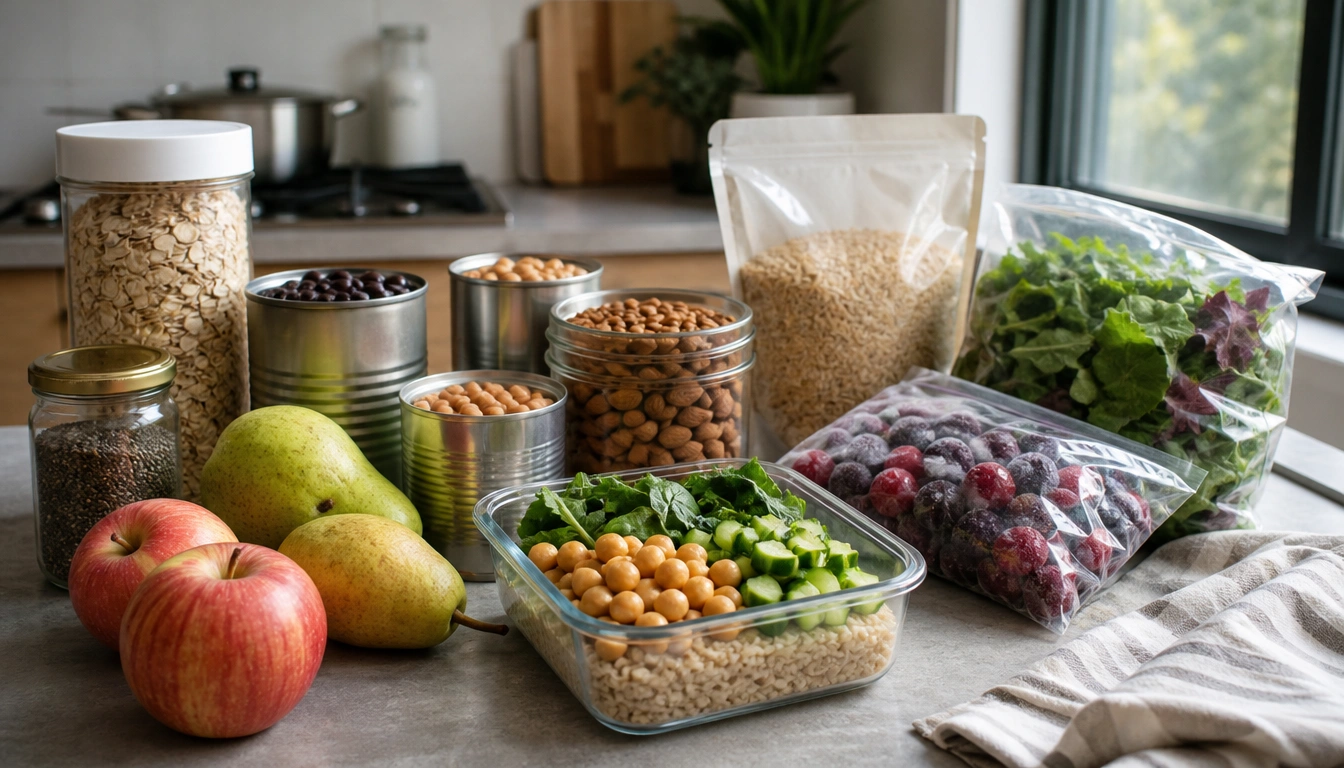
For a busy workweek, buy high-fiber foods that need little or no prep: canned beans and lentils, microwavable whole-grain pouches, oats, frozen berries and vegetables, pre-washed greens, apples, pears, avocados, chia, flax, and nuts. Build meals by upgrading staples rather than cooking from scratch. The best choices are the ones you will actually eat during a packed day.
Key Takeaways
- Aim for fiber by upgrading the foods you already buy, not by rebuilding every meal from scratch.
- Canned beans, lentils, frozen vegetables, and microwavable grains are practical high-fiber staples with very little prep.
- Pre-washed greens, bagged slaw, fruit, nuts, and seeds make office-friendly snacks and fast meals easier to pull off.
- Increase fiber gradually and drink more fluids so your digestion can adapt and constipation is less likely.
- If you have a GI condition that calls for a low-fiber diet, follow your clinician’s plan instead of using a general grocery list.
Why fiber matters for busy professionals
Fiber is the part of plant foods your small intestine does not fully digest. Soluble fiber dissolves in water and can help slow digestion, which supports steadier blood sugar and can help with cholesterol management. Insoluble fiber does not dissolve; it adds bulk and helps move food through the digestive tract. Most people benefit from getting both kinds, and the easiest way to do that is through ordinary groceries that fit a packed schedule.
The National Institutes of Health and the Dietary Guidelines for Americans point to a simple target: about 14 grams of fiber per 1,000 calories. In practical terms, many adult women aim for about 25 grams a day, and many adult men aim for about 38 grams a day, with slightly lower targets later in life. Public health guidance also notes that most adults fall short, which is why a realistic shopping strategy matters more than perfect meal planning.
If you are already busy, the most workable approach is not “eat more fiber someday.” It is to keep high-fiber foods in the cart on purpose so the workday makes those choices easier, not harder.
The best high-fiber grocery categories for low-prep eating
Start with foods that are shelf-stable, freezer-friendly, or ready to eat. Those options reduce food waste, survive long workweeks, and make it more likely that your healthy purchase actually gets eaten.
Canned and quick-prep legumes are one of the smartest buys. Black beans, pinto beans, cannellini beans, chickpeas, and lentils can go from can to bowl in minutes. Rinsing them can lower sodium, and they work in salads, soups, wraps, grain bowls, or even as a side with store-bought rotisserie chicken. If you want the biggest payoff for the least effort, legumes belong near the top of the list.
Frozen produce is equally practical. Frozen berries, broccoli, Brussels sprouts, mixed vegetables, and edamame are picked and frozen when ripe, so they keep well and usually need only a microwave or quick sauté. Frozen grain blends or riced vegetables can also help you build a meal without a full cooking session. For someone who shops once and eats all week, freezer items can be more realistic than fragile fresh produce.
These categories matter because they lower the two biggest barriers to fiber: prep time and spoilage. You are not just buying nutrients; you are buying convenience that keeps working after the initial shopping trip.
Pantry and shelf-stable whole grains
Whole grains are a reliable way to add fiber without changing your entire routine. Rolled oats, steel-cut oats, whole-grain crackers, whole-wheat wraps, and legume-based pasta are all useful staples. If mornings are hectic, oats are especially practical because overnight oats can be assembled the night before and eaten cold or reheated later.
Microwavable brown rice, quinoa, or multigrain pouches are another strong choice for workday meals. They can turn leftovers, canned beans, or frozen vegetables into a complete lunch in a few minutes. That makes them especially useful for people who are trying to avoid expensive takeout without relying on elaborate meal prep.
Legume pasta is worth a spot in the pantry too. Chickpea or lentil pasta usually cooks quickly and can bring much more fiber than refined pasta. It is not a miracle food, but it can make a familiar dinner more filling and more workday-friendly.
A practical shopping rule is to choose the grain you will actually use. A modest amount of a true whole grain eaten consistently is more useful than an ambitious pantry full of items that stay unopened.
Produce aisle shortcuts
Fresh produce does not have to mean extra work. Pre-washed spinach, kale, and spring mix are easy to toss into wraps, grain bowls, eggs, or takeout leftovers. Bagged slaw and broccoli slaw are also helpful because they add crunch and bulk with no chopping. These products make it easier to keep fiber in the house even when you are too tired to prep vegetables after work.
Portable fruit is another workday essential. Apples, pears, and bananas are easy to carry, store well, and require no refrigeration during part of the day. Apples and pears are especially useful because much of their fiber is in the skin, so eating them unpeeled improves the payoff. Avocados are another strong option, whether sliced on toast or added to a bowl, salad, or wrap.
For many busy adults, produce works best when it is “ready now.” The more cutting, peeling, and washing required, the less likely the food is to survive a stressful week.
Nuts, seeds, and topping boosters
Chia, ground flax, almonds, and pistachios are compact ways to add fiber without cooking. They are especially helpful because they can be sprinkled onto foods you already eat instead of requiring a separate recipe. A spoonful of chia or flax can go into yogurt, oatmeal, or a smoothie. Almonds or pistachios can sit in a desk drawer for an easy snack between meetings.
These foods are small but efficient. Seeds can make breakfast more filling, nuts can replace ultra-processed vending machine snacks, and both travel well. They also pair nicely with fruit, oats, and yogurt, so they help create a high-fiber pattern without much planning.
If you have limited time, toppings are one of the easiest ways to improve a meal. Adding fiber to a familiar food is often more sustainable than trying to force a completely new routine.
How to turn the grocery list into meals in under 5 minutes
The fastest approach is to build meals from a few repeating formulas. Think of lunch and dinner as assembly, not cooking. For example, combine a microwavable grain pouch, rinsed canned beans, pre-washed greens, and salsa. Add avocado if you have it. That creates a filling bowl with fiber from several food groups and almost no active time.
Another option is yogurt, frozen berries, chia, and oats for a quick breakfast. You can also make a wrap with hummus, bagged slaw, and a handful of greens, or keep apple slices, nuts, and string cheese for a snack that travels well. For the office, a desk drawer stocked with single-serve nuts, instant oats, or seed packets can keep you from defaulting to less filling choices.
The goal is not culinary perfection. The goal is to keep high-fiber foods visible, easy, and ready when work gets busy. That is how grocery strategy turns into an actual habit.
Gradual fiber increase and hydration
If your diet has been low in fiber, jumping straight to a very high-fiber pattern can lead to bloating, gas, or cramping. A more comfortable approach is to increase fiber gradually over several weeks. You might add one high-fiber food at breakfast first, then lunch, then snacks, instead of changing everything at once. That gives your digestive system time to adapt.
Fluids matter too. As fiber goes up, water intake should go up as well so digestion stays comfortable and stool does not become harder to pass. This matters for both soluble and insoluble fiber. If you increase fiber but ignore hydration, constipation can get worse instead of better.
Research and clinical guidance consistently support the idea that gradual change is easier to tolerate than a sudden overhaul. For busy professionals, that usually means small swaps: whole-grain bread instead of white bread, beans in a salad, berries at breakfast, or nuts in a snack bag. Those changes add up without overwhelming your routine.
When a high-fiber plan is not appropriate
A high-fiber shopping list is not right for everyone. Some digestive conditions call for a low-fiber or low-residue approach, including certain flares of inflammatory bowel disease, intestinal strictures, or recovery periods after specific gastrointestinal surgeries. In those situations, a general grocery guide should not override individual medical advice.
If a clinician has told you to limit fiber, follow that plan and ask for food-specific guidance that fits your condition. The same is true if fiber consistently causes pain, vomiting, severe constipation, or other concerning symptoms. A personalized medical plan is more important than any generic “healthy eating” checklist.
For everyone else, the best grocery list is one that matches your schedule, budget, and storage space. The right fiber plan is the one you can repeat on your busiest weeks.
Frequently Asked Questions
How much fiber should an adult aim for per day?
A widely used public health target is about 14 grams of fiber per 1,000 calories. In practical terms, many adult women aim for about 25 grams a day and many adult men aim for about 38 grams a day, with somewhat lower targets later in life.
Which high-fiber foods are the easiest to eat with minimal prep?
The easiest options are canned beans or lentils, microwavable whole grains, frozen vegetables, frozen berries, pre-washed greens, apples, pears, bananas, avocado, chia, flax, and nuts. These foods need little cutting, cooking, or cleanup.
How can I increase fiber without causing bloating or stomach discomfort?
Increase fiber gradually instead of all at once, and keep your fluid intake up. Start with one or two food swaps a day, then build from there. That gives your digestive system time to adapt and lowers the chance of gas, cramping, or constipation.
What are the best high-fiber options for the office, desk drawer, or commute?
Good office-friendly choices include almonds, pistachios, chia packets, instant oats, whole-grain crackers, fruit, and shelf-stable legume snacks. They travel well, are easy to store, and can keep you from relying on low-fiber vending machine food.
Can frozen, canned, and microwavable foods still count as high-fiber choices?
Yes. Frozen vegetables and berries, canned beans and lentils, and microwavable grain pouches can all be smart high-fiber choices. Convenience does not cancel out fiber, and these foods often make it easier to eat well on a packed schedule.
The Bottom Line
If you want more fiber during a busy workweek, buy the foods that require the least effort to become a meal: beans, lentils, oats, frozen produce, pre-washed greens, fruit, nuts, and seeds. Those items are practical because they survive real schedules, not ideal ones.
The most effective strategy is usually to upgrade staples and build quick meal assemblies instead of trying to cook from scratch every day. Add fiber gradually, drink enough fluids, and adjust the plan if you have a digestive condition that needs a different approach.
Medical disclaimer
Medical disclaimer: This content is for educational and informational purposes only and is not a substitute for professional medical advice, diagnosis, or treatment. Dietary needs and supplement suitability vary by individual.
Sources
- National Institutes of Health (NIH) — nih.gov. Accessed October 2026.
- Academic / Medical Research Institution — heart.org. Accessed October 2026.
- Mayo Clinic — mayoclinic.org. Accessed October 2026.
