
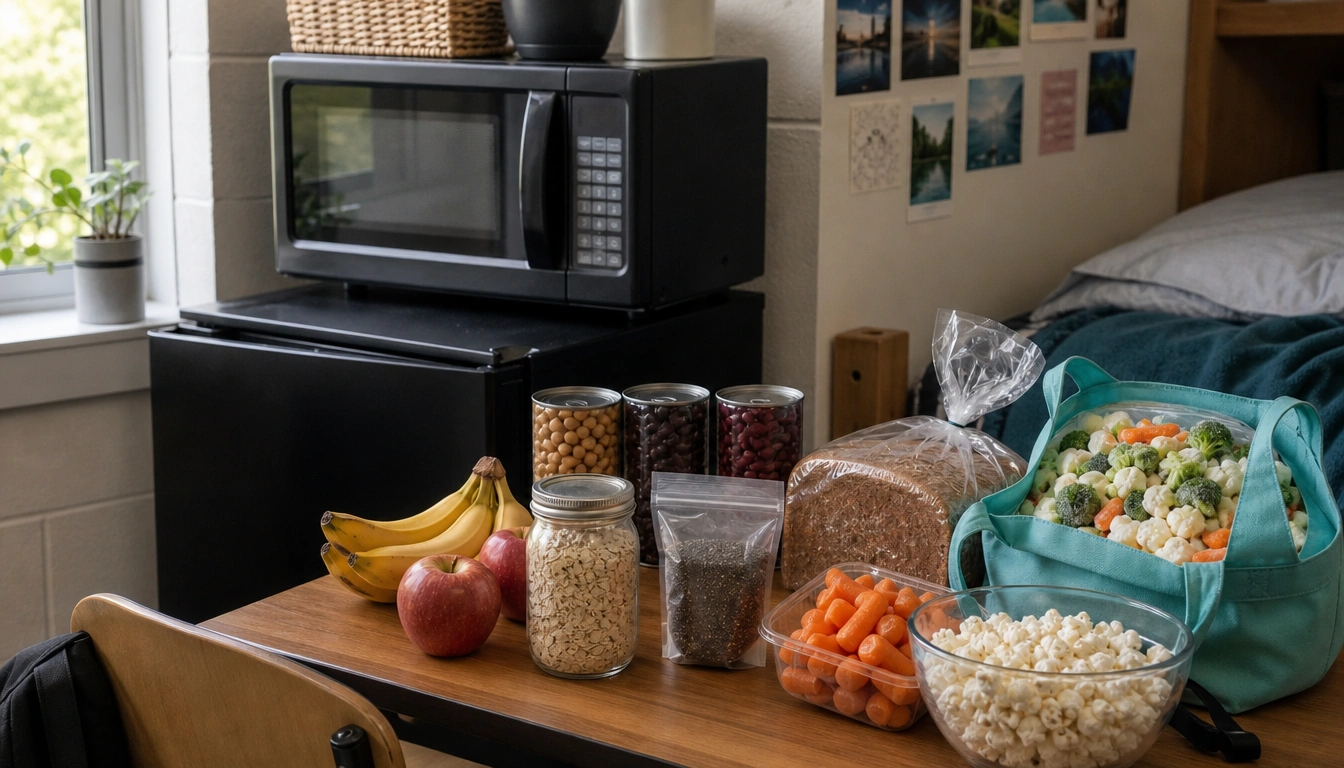
For most college students, the best high-fiber foods to buy are canned beans and lentils, oats, whole-grain bread, popcorn, frozen vegetables, portable fruit, and seeds like chia or flax. These foods are cheap, store well, and can be eaten with little or no cooking. Build up fiber slowly over a few weeks and drink enough water so the change does not cause bloating or constipation.
Key Takeaways
- Start with low-prep basics: beans, oats, frozen vegetables, fruit, popcorn, and seeds give the most fiber for the least work.
- Choose foods that fit dorm life: shelf-stable cans, freezer-friendly bread, microwaveable vegetables, and grab-and-go fruit.
- Increase fiber over 2 to 4 weeks and pair it with fluids to reduce gas, bloating, and constipation.
- Food-based fiber is usually better than supplements because whole foods also provide protein, vitamins, minerals, and phytochemicals.
- If digestive symptoms are severe, persistent, or unusual, don’t try to solve them with fiber alone—get medical advice.
Why college fiber advice often fails
Generic advice like “eat more fiber” misses the reality of student life. Many college students are working with a mini-fridge, a microwave, a meal plan, a tight budget, and a schedule that changes every day. That makes the best fiber foods the ones that are cheap, keep well, and can be eaten fast.
Most adults in the United States fall short of fiber goals, and college students are no exception. The NHS recommends 30 grams a day for adults, and U.S. guidance often uses a target of about 14 grams per 1,000 calories eaten. That means the right target depends on how much you eat overall, but the practical goal is the same: make fiber a routine part of meals and snacks instead of something you only think about once in a while.
Fiber matters for more than regularity. According to the NIH and major health organizations, it helps support bowel function, can slow digestion enough to steady blood sugar after meals, and helps support a healthier gut environment. For students who are skipping meals, relying on convenience foods, or eating late at night, that can make daily energy feel more stable too.
The best high-fiber grocery list for a student budget
Start with foods that give a lot of fiber per dollar and do not demand much kitchen equipment. The most useful categories are beans and lentils, whole grains, frozen produce, fruit, seeds, and a few easy snack foods.
Beans and lentils: canned black beans, pinto beans, navy beans, chickpeas, and lentils are the strongest budget buys. They are filling, portable, and versatile. Rinsing canned beans can also make them easier on digestion and lowers sodium.
Whole grains: rolled oats, whole-wheat bread, whole-grain tortillas, brown rice cups, and whole-wheat pasta are practical staples. Oats are especially useful because they can become breakfast, a snack, or a base for other foods.
Frozen produce: frozen broccoli, mixed vegetables, spinach, cauliflower, and edamame are valuable because they do not spoil quickly. Frozen berries are also helpful if you want fruit that lasts longer than fresh produce.
Fresh portable fruit: apples, bananas, oranges, pears, and single-serve bags of berries are easy to carry across campus. Fruit with edible skins gives you more fiber than peeled versions.
Seeds and snacks: chia seeds, ground flaxseed, plain popcorn, baby carrots, hummus, nuts, and nut butter all help close fiber gaps without much effort. The best snack foods are the ones you will actually keep around and eat during study sessions.
| Food | Why it works for students | Easy use |
|---|---|---|
| Canned beans or lentils | Cheap, shelf-stable, filling | Microwave into bowls, salads, wraps, or soups |
| Rolled oats | Low cost, no special cooking needed | Make oatmeal or overnight oats |
| Frozen vegetables | Lasts longer than fresh produce | Steam in the microwave and add to rice, noodles, or ramen |
| Apples, bananas, pears | Portable and easy between classes | Eat whole as a grab-and-go snack |
| Popcorn | Budget-friendly whole grain snack | Use plain microwave popcorn or air-popped |
| Chia or flax | Small amount adds a lot of fiber | Stir into yogurt, oats, or smoothies |
Easy ways to use them with a microwave or mini-fridge
The best grocery list only helps if the food is easy to eat. For dorm life, think in terms of microwave meals, no-cook snacks, and small meal add-ins that improve whatever you are already eating.
Microwave meals: add canned beans to instant rice, frozen vegetables to ramen, or edamame to a grain bowl. A bowl of oats with fruit and seeds can work for breakfast or a late-night meal.
No-cook snacks: apples with peanut butter, hummus with carrots, popcorn, trail mix, and yogurt with chia or berries are simple study foods. They travel well and do not require full kitchen access.
Meal add-ins: put beans in tacos, wraps, pasta, soup, or cafeteria bowls. Stir frozen spinach into pasta, mix lentils into canned soup, or add flaxseed to yogurt or oatmeal. Small changes can raise fiber without making meals feel completely different.
If your dorm has only one shelf in the fridge, prioritize the foods that are useful across several meals. A can of beans, a bag of frozen vegetables, a loaf of freezer bread, and a container of oats can support many different combinations.
How to shop so the food lasts and your money goes further
Build your cart around repeatable basics instead of one-time “healthy” purchases. A good system is to buy a few anchor foods each week: one or two canned legumes, one grain, one frozen vegetable, one fruit option, and one snack food.
Put shelf-stable foods first if storage is limited. Canned beans, oats, popcorn, whole-grain crackers, chia, flax, and nut butter can sit on a shelf and still help you eat better. Frozen foods come next because they hold longer than fresh produce and are less likely to go bad before you use them.
For a mini-fridge, choose produce that survives well: apples, oranges, carrots, and pears are usually easier to manage than delicate greens. If you have freezer space, stock whole-grain bread or tortillas there so they do not spoil before you finish the package.
Shopping the same core list each week also reduces decision fatigue. Once you know what you can eat between classes, it becomes easier to keep fiber intake steady without spending extra money on convenience food every time hunger shows up.
How to increase fiber without feeling worse
Going from a low-fiber diet to a high-fiber one too fast can cause bloating, gas, cramps, or constipation. A better approach is to add fiber gradually over 2 to 4 weeks. That gives your gut time to adjust and makes the change more comfortable.
Hydration matters just as much as the food itself. Fiber works best when there is enough fluid in the digestive tract. If you suddenly add more beans, oats, or whole grains but do not drink more water, you may feel backed up instead of better.
It also helps to spread fiber across the day rather than loading it all into one meal. Try having a higher-fiber breakfast, a fruit-and-seed snack, and a lunch or dinner with beans or vegetables. That approach is easier on digestion than piling everything into a single giant bowl.
If you have a sensitive stomach, start with smaller portions of beans, lentils, and seeds, then increase as tolerated. Rinsing canned beans and choosing cooked vegetables instead of huge raw salads can also be gentler while you adjust.
When whole foods beat supplements
Fiber supplements can be useful in some situations, but they should not be the first answer for most students. Whole foods usually provide a better package: fiber plus protein, vitamins, minerals, and plant compounds that supplements do not replace. The FDA, NIH, and major medical organizations all emphasize the value of getting nutrients from foods when possible.
That matters for student life because the goal is not just higher fiber on paper. A can of beans can become lunch, a banana can prevent an afternoon crash, and oats can replace a low-fiber breakfast. Those foods do more than one job at once.
Supplements may be worth discussing with a clinician if you truly cannot meet needs with food, but they are not a shortcut around a low-quality diet. If budget and storage are the main barriers, food-based options are usually the smarter first move.
Also be careful with “more is better” thinking. Extremely high supplement use can crowd out regular meals or make digestion less comfortable. The most practical approach is still simple: eat more plants, use convenient formats, and build the habit gradually.
Common college barriers and how to work around them
Meal plan reliance: If most meals come from the dining hall, look for the fiber add-ons first. Choose bean-based chili, vegetable sides, fruit, oatmeal, brown rice, whole-grain bread, or salad toppings like chickpeas and seeds when available.
Dining hall gaps: Some cafeterias have fiber at breakfast but not later in the day, or vice versa. Carry a backup snack such as popcorn, a banana, or a bag of nuts so you are not forced into chips or sweets every time you get hungry.
Late-night snacking: Studying often leads to grazing on refined snacks. Keep easy replacements visible: fruit, popcorn, yogurt with chia, or peanut butter on whole-grain toast. If the food is easy to reach, it is more likely to get eaten.
Low-prep cooking: Not every student has time to cook from scratch. That is fine. Frozen vegetables, canned legumes, microwave oats, and freezer bread are still real food choices. High fiber does not have to mean elaborate cooking.
A useful rule is to upgrade what you already eat. Add beans to instant noodles, use whole-grain bread instead of white bread, or pair campus meals with fruit. Small swaps are easier to repeat than full diet overhauls.
A simple campus grocery haul that covers the week
Here is a realistic starter haul for a high-fiber week on campus: a can or two of beans or lentils, a bag of oats, whole-grain bread or tortillas, one bag of frozen vegetables, several pieces of fruit, plain popcorn, and a small bag of chia or flaxseed.
With that basket, breakfast can be oats with fruit and seeds, lunch can be a bean wrap or grain bowl, and dinner can be a microwaved vegetable-and-bean bowl or a cafeteria meal improved with extra produce. Snacks can be popcorn, fruit, carrots, or yogurt with flax.
The goal is not perfection. The goal is to make the high-fiber choice the easiest one to grab when your day is busy. That is what makes the list sustainable.
Frequently Asked Questions
How can a college student add more fiber without spending much money?
Use inexpensive staples first: oats, beans, lentils, popcorn, whole-grain bread, bananas, apples, carrots, and frozen vegetables. These foods are usually cheaper per serving than packaged convenience snacks and can be used in several meals.
What high-fiber foods work best in a dorm with only a mini-fridge or microwave?
Canned beans, microwave oats, frozen vegetables, fruit, whole-grain bread kept in the freezer, popcorn, and seeds are all good dorm options. They need little prep and can be used in quick meals or snacks.
How should students increase fiber without getting bloated or constipated?
Add fiber gradually over 2 to 4 weeks, not all at once, and drink more water as you go. It also helps to spread higher-fiber foods through the day instead of eating a huge amount in one meal.
Which foods give the most fiber for the least preparation?
Beans, lentils, oats, frozen vegetables, berries, popcorn, chia, and flax are strong choices because they pack a lot of fiber into foods you can open, microwave, or mix with almost no cooking.
How much fiber should college students aim for each day?
A practical target is the adult guideline of about 30 grams a day, or the U.S. rule of about 14 grams per 1,000 calories eaten. Your exact target depends on age, sex, and total calorie intake, but most students can benefit from eating more than they currently do.
The Bottom Line
A high-fiber grocery list for college students does not need to be complicated. The best buys are usually beans, lentils, oats, whole-grain bread, frozen vegetables, fruit, popcorn, and seeds because they are cheap, flexible, and easy to store.
If you add these foods gradually, drink enough water, and spread fiber through the day, you can improve digestion and energy without making dorm life harder. Food-first choices usually give you the most value for your money and the most useful nutrients at the same time.
Medical disclaimer
Medical disclaimer: This content is for educational and informational purposes only and is not a substitute for professional medical advice, diagnosis, or treatment. Dietary needs and supplement suitability vary by individual.
Sources
- National Health Service (NHS) — www.nhs.uk. Accessed October 2026.
- National Health Service (NHS) — uhd.nhs.uk. Accessed October 2026.
- National Institutes of Health (NIH) — nih.gov. Accessed October 2026.
- Mayo Clinic — mayoclinic.org. Accessed October 2026.
- Academic Research Institution — stanford.edu. Accessed October 2026.
