
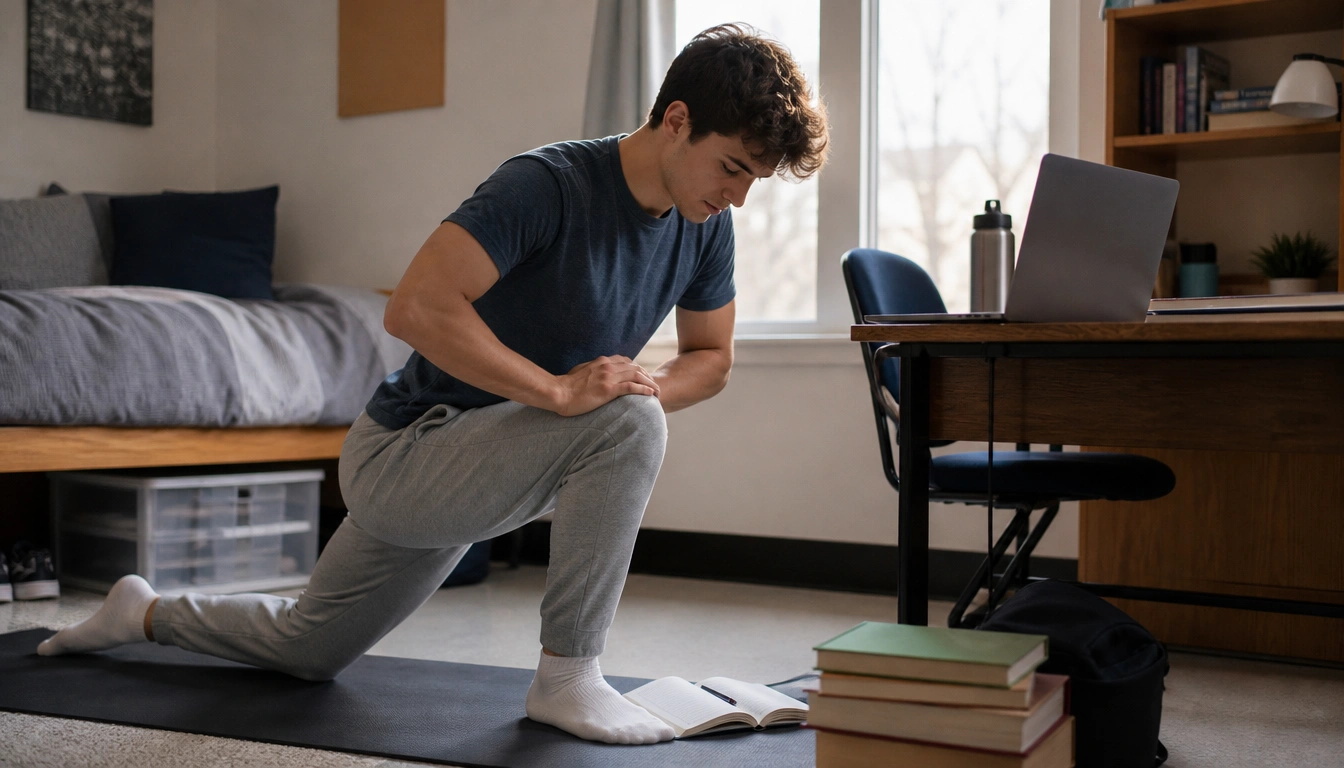
A college student can counteract sitting with a 10-minute hip mobility routine done most days of the week. Focus on active, controlled movements like hip circles, half-kneeling hip flexor work, 90/90 switches, glute bridges, and a supported squat. Use dynamic mobility during study breaks or before workouts, and save longer static stretching for after exercise or later in the day.
Key Takeaways
- A short daily routine is enough to help restore active hip motion after long sitting blocks.
- Mobility is not the same as flexibility: mobility adds control through range, not just stretch.
- Dynamic drills fit study breaks and warm-ups better than long static holds.
- If a deep position causes pinching in the front of the hip, do not force it; shorten the range and use support.
- Students with hip impingement, labral issues, or back pain may need modified drills and professional guidance.
Why college students get tight hips from sitting all day
College life often keeps the hips in the same bent position for hours at a time: lectures, laptop work, gaming, scrolling, and study sessions. That repeated sitting can make the front of the hips feel stiff and can leave the glutes less active when you stand up. Over time, the body starts to treat that bent position as the default.
According to the National Institutes of Health, regular movement helps maintain joint function and reduce the effects of prolonged inactivity. For students, the problem is rarely one dramatic workout; it is the accumulation of long sitting blocks with too little motion between them. The result can feel like a tight hip crease, reduced rotation, or a lower back that does extra work when the hips should be sharing the load.
That is why a hip mobility routine for college students should be simple, repeatable, and easy to do in a dorm room, apartment, or quiet corner of campus. The goal is not to make the hips “loose” in a vague sense. The goal is to restore useful movement after stillness.
Mobility vs. flexibility: what matters for hip function
Flexibility is about how far a muscle can be lengthened passively. Mobility is broader: it is the ability to move a joint through range with control. For the hips, that means not only getting into a position, but also being able to stabilize, shift, and exit that position smoothly.
This distinction matters because students often chase stretching alone. Stretching can help, but the hips also need active control. That is why a good routine combines gentle stretching with movement-based drills and simple strength work. The American Council on Exercise has long emphasized that healthy movement depends on usable range plus stability, especially when one joint must support the next one in the chain.
For the hips, limited mobility can push extra stress into the lower back or knees. If the hips do not rotate or extend well, the body borrows motion from somewhere else. A routine that improves both flexibility and active control is more likely to carry over to walking, lifting, running, and sitting with less discomfort.
How a short daily routine helps with active range and glute activation
A short routine works because consistency matters more than one long session. Even a few minutes of targeted work can remind the hips how to move through range and can wake up the glutes after hours of sitting. That combination helps with active range, posture, and control.
Think of the routine in three parts: first, move the hip joints through easy circles or switches; second, open the front of the hip with a controlled stretch; third, use a strength-based movement such as a bridge or squat to teach the hips to support the new range. This blend is more practical than stretching alone.
Research summaries on range-of-motion work suggest that small amounts of targeted movement, repeated across most days of the week, can improve joint motion. For a busy student, that makes a 10-minute daily routine a realistic target. It is short enough to stick with and long enough to matter when done regularly.
A useful habit rule is to spread the work out. A little hip work on five or more days per week is usually more sustainable than one large session that happens once and then gets skipped. The aim is regular exposure to motion, not perfection.
Best timing for hip mobility and a 10-minute student flow
Dynamic hip mobility works well during a study break or as part of a warm-up before lifting, running, or another workout. Static holds are usually better after training or later in the evening when the goal is to relax and recover. That timing matters because active drills prepare the nervous system for movement, while longer holds are better for downregulating and settling in.
Here is a simple 10-minute hip mobility flow for students:
1. Hip circles or controlled articular rotations — about 1 minute. Stand tall and draw slow, smooth circles with one hip, then the other. Keep the torso quiet and move only as far as you can control.
2. Half-kneeling hip flexor stretch — about 2 minutes total, 1 minute per side. Tuck the pelvis slightly, squeeze the back-side glute, and shift forward only until you feel a mild stretch in the front of the hip. Avoid arching the low back.
3. 90/90 hip switches — about 2 minutes. Sit on the floor with both knees bent and rotate the legs side to side. Move slowly and use your hands for support if needed.
4. Glute bridges — about 2 minutes. Lie on your back, feet flat, and lift the hips by pressing through the heels. Keep the ribs down and feel the glutes do the work.
5. Supported squat hold or assisted deep squat — about 3 minutes. Hold onto a stable surface such as a desk leg or sturdy frame. Sink only to a comfortable depth and breathe.
This sequence gives you motion, stretch, and activation in one short block. If you are in a rush, do the first three exercises. If you have more time or are preparing for a workout, complete the full flow.
How to adjust the routine if deep positions feel pinchy or uncomfortable
Deep hip positions should never be forced. If a squat, 90/90 position, or lunge creates sharp pinching in the front of the hip, back off immediately. That feeling is not the same as a normal muscle stretch. It can be a sign that the current range is too aggressive for your anatomy or current irritability level.
Students with femoroacetabular impingement, labral irritation, or lower-back problems often need smaller ranges, more support, and slower progressions. In practice, that may mean using a higher squat, staying upright instead of folding deeply, or working only through the range that feels smooth and non-painful.
If one side feels much tighter than the other, that does not mean you should force symmetry. Start where the motion feels clean, then gradually work toward more range over time. The best response to discomfort is usually to reduce depth, slow the movement, and keep the exercise active rather than passive.
Stop and get checked if you notice locking, catching, giving way, numbness, tingling, or pain that travels down the leg. Pain that lingers, worsens at night, or keeps returning despite easier movement also deserves a professional evaluation.
Simple desk-day habits that reduce stiffness without a full workout
The easiest way to improve hip comfort is to interrupt sitting before the hips stiffen too much. A simple habit for students is to set a gentle cue: every 50 minutes, stand up for 2 minutes and do a few bodyweight squats, standing hip circles, or a short walk down the hall.
That small break may not feel dramatic, but it reduces the amount of time the hips spend locked in one position. It also helps the glutes stay more involved across the day instead of going dormant for long stretches. If you live in a dorm or study in a library, even a brief lap around the floor counts.
Other low-effort habits help too. Use stairs when possible, stand while taking a phone call, and alternate sitting and standing during longer study blocks if you have access to a high table. The point is not to avoid sitting altogether. The point is to stop letting sitting happen in uninterrupted blocks.
Hydration, walking between classes, and regular movement breaks can support how your hips feel, but they do not replace focused mobility work. Think of them as the background habits that make the routine work better.
Common mistakes to avoid: forcing range, bouncing, and ignoring symptoms
One common mistake is trying to “win” at mobility by going deeper than your hips are ready for. Forcing range often leads to compensation, especially in the low back. Another mistake is bouncing into a stretch, which can make the movement feel harsher without improving control.
Students also tend to skip the active part. Stretching alone may feel good for a moment, but if you never use the new range, the body has little reason to keep it. That is why bridges, controlled squats, and slow switches matter: they teach the hips to own the movement.
Finally, do not ignore symptoms. A mobility drill should feel like effort, mild stretching, or muscular work. It should not feel like joint pinching, sharp groin pain, or nerve-like symptoms. If your body keeps telling you the range is wrong, respect that message and adjust the drill.
How to progress the routine over time with consistency and active control
Progress should come from control first, then depth, then load. Start by doing the routine regularly and moving smoothly through the same range. When that feels easy, slow the tempo, add a pause at the end of a controlled range, or increase how long you can hold a supported squat without pain.
You can also progress by combining mobility with light strength. For example, add a mini squat after a hip circle, or hold the top of a bridge for a few extra seconds. These small changes train active end-range control, which is more useful than chasing a bigger stretch alone.
For college students, the real win is not a heroic flexibility test. It is being able to sit for class, stand up without stiffness, move well in the gym, and repeat that pattern day after day. A routine that is short, safe, and easy to repeat is the one most likely to stick.
Frequently Asked Questions
How long should a hip mobility routine take for a busy student?
About 10 minutes is a practical target for most students. That is long enough to include a few useful drills but short enough to fit between classes, before a workout, or after studying.
Should hip mobility be done before workouts or after studying?
Both can work. Dynamic mobility is especially useful before workouts or during study breaks. Longer static holds are usually better after exercise or later in the day as a recovery tool.
What’s the difference between hip mobility and hip flexibility?
Flexibility is how far a muscle can be stretched passively. Mobility is the ability to move a joint through range with control. For hip function, both matter, but mobility is more useful for daily movement.
What exercises help hip stiffness from sitting at a desk?
Useful options include hip circles, half-kneeling hip flexor stretches, 90/90 switches, glute bridges, and supported squats. The best routine combines movement, gentle stretching, and active control.
When is hip pain during mobility a sign to stop and get checked?
Stop if you feel sharp pinching, locking, catching, giving way, numbness, tingling, or pain that radiates down the leg. Pain that persists, worsens, or disrupts sleep should be evaluated by a clinician.
The Bottom Line
A daily hip mobility routine does not need to be long to be useful. For most college students, 10 minutes of controlled movement most days is enough to counter long sitting blocks and keep the hips more usable.
The best results usually come from mixing dynamic mobility, gentle stretching, and active work such as bridges or supported squats. If deep positions pinch, shorten the range and do not force it. Modify early if you have hip or back issues.
If you make one habit stick, make it the movement break: every 50 minutes, stand for 2 minutes. That small reset, repeated across the week, can matter more than an occasional big session.
Medical disclaimer
Medical disclaimer: This content is for educational and informational purposes only and is not a substitute for professional medical advice, diagnosis, or treatment. Dietary needs and supplement suitability vary by individual.
Sources
- National Institutes of Health (NIH) — nih.gov. Accessed November 2026.
- acefitness.org — acefitness.org. Accessed November 2026.
