
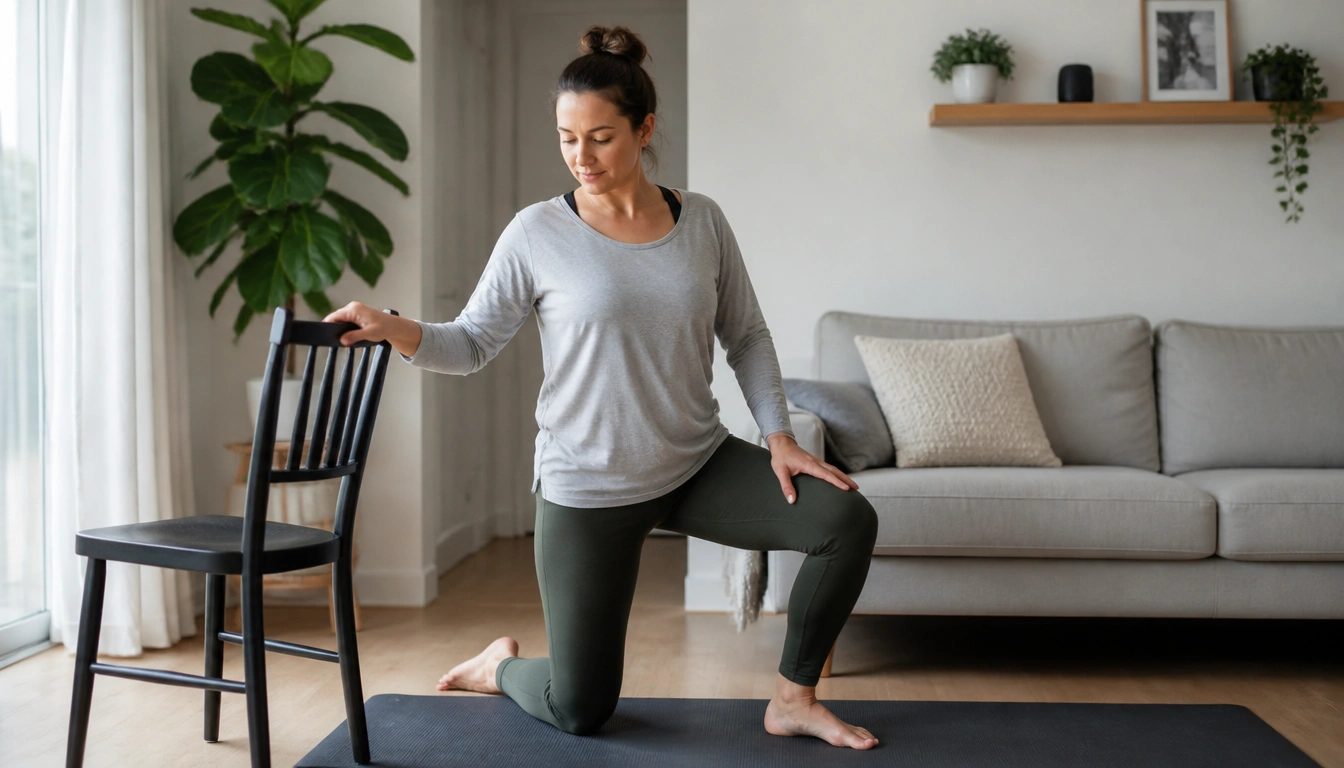
A good hip mobility routine for home exercisers combines dynamic movements, a little glute activation, and a short hip flexor stretch. A practical plan is to do it before workouts as a warm-up, and add static stretching after exercise or in a separate session. Most adults can aim for it 2 to 3 days per week, or daily if sitting a lot makes the hips feel stiff.
Key Takeaways
- Hip mobility is about active control through range; flexibility is more about passive length. Both matter, but control should come first.
- Prolonged sitting can reduce hip extension and make the hips feel stiff, which may push the lower back and knees to do extra work.
- Use dynamic moves before exercise, then save longer static stretches for after a workout or another time.
- A no-equipment 10-minute routine can fit into a small home space and still cover warming up, glute activation, and hip flexor opening.
- If you are older, sedentary, hypermobile, or recovering from hip surgery, choose supported and smaller-range versions rather than forcing depth.
- Stop and get evaluated for sharp pain, locking, giving way, numbness, or pain that lingers or worsens after the session.
Why hip mobility matters if you sit a lot
Hip mobility is useful for anyone who exercises at home, but it matters especially if your day involves long stretches of sitting. The hip flexors stay in a shortened position while you sit, and over time that can make hip extension feel limited or uncomfortable. In practical terms, that may show up as stiff hips when you stand up, a short stride when you walk, or difficulty getting into a comfortable lunge or squat.
Mobility also helps the rest of the body. The hips are a major part of the lower-body kinetic chain, so when hip motion is restricted, the lower back and knees often help out more than they should. That compensation can make a workout feel awkward and may increase strain during repetitive movements like stairs, squats, or getting up from the floor.
For home exercisers, the goal is not just to “loosen up.” The better goal is to move the hip through useful ranges under control so your body can use that range safely in daily life and exercise.
Hip mobility vs. flexibility: what to train
Flexibility and mobility are related, but they are not the same. Flexibility is the passive length a muscle or soft tissue can allow. Mobility is the active range you can move through with control. For a home routine, that difference matters because a stretch that feels long and easy is not always the same thing as a joint that can move well under load.
That is why a useful routine should include both. Dynamic movements help you control the joint through a range, while stretching can address tissues that feel tight after sitting or exercise. If you only chase passive stretch positions, you may gain range you cannot use well. If you only do activation and never work on tissue length, you may still feel stiff.
A practical hip mobility routine should therefore prioritize controlled movement first. Think “move well through the range” before “hold the deepest stretch.”
When to do hip mobility before or after exercise
Before a workout, dynamic mobility is the better choice. Dynamic work uses smooth, repeated movements that raise body temperature, prepare the joints, and rehearse the patterns you are about to train. This is why leg swings, marching, hip circles, and bodyweight movement drills often work well before a home session.
After exercise, or in a separate session, static stretching becomes more appropriate. Static stretching means you settle into a position and hold it. According to guidance used in exercise practice, adults often hold each stretch for about 10 to 30 seconds, while older adults may do better with longer holds around 30 to 60 seconds if they tolerate them comfortably. Repeating a stretch a few times is usually more useful than forcing one long hold.
The timing rule is simple: dynamic before activity, static after activity. If you only have one short window, use the dynamic portion before the workout and finish with the stretch later in the day.
A simple 10-minute no-equipment routine
This routine is designed for a small home space and no equipment. Use a wall, counter, or sturdy chair if you want extra support. Move slowly enough that you can stay balanced and feel what the hip is doing.
Warm the hips
Start with standing leg swings while holding a support. Swing one leg forward and back in a controlled way, then side to side if that feels comfortable. Keep the trunk tall and the movement smooth. After that, do gentle standing hip circles or marching knee lifts to wake up the joint and pelvis.
Wake up the glutes
Next, do glute bridges on the floor or on a firm bed if getting down is difficult. Lie on your back with knees bent, feet flat, and ribs relaxed. Press through the feet, squeeze the glutes, and lift the hips without arching the lower back. This helps the back side of the hips contribute more so the lower back does not have to do all the work.
Finish with a hip flexor stretch
End with a half-kneeling hip flexor stretch or a supported standing version if kneeling is uncomfortable. Keep the torso tall, lightly tuck the pelvis, and shift forward only until you feel a front-of-hip stretch, not pinching or strain. Hold, breathe, then switch sides. If you want a little more time on the floor, you can repeat the stretch once more on each side.
That flow gives you a complete home sequence: dynamic movement, activation, and targeted stretching. It is enough to use as a warm-up or as a short mobility reset after sitting.
How to modify it for older adults and beginners
If you are older, sedentary, or unsteady on your feet, the safest version is the one you can repeat without bracing or losing balance. Reduce the range of motion first, then build it slowly. A chair-based or wall-supported version is often the best place to start.
For standing work, keep one hand on a stable surface. Make the leg swings smaller and slower. If floor work is uncomfortable, do the glute bridge only if it feels easy to get down and up; otherwise, practice standing hip extensions or sit-to-stand movements as a bridge substitute. For the hip flexor stretch, use a standing split-stance stretch with a light pelvic tuck rather than kneeling.
Older adults may also benefit from holding static stretches a bit longer, as long as the sensation stays mild. The aim is steady practice, not forcing a deep position. If balance is a concern, avoid rushing between exercises and give yourself time to reset between sides.
How to adapt it for hypermobility or hip surgery
If you are hypermobile, your priority is usually stability, not chasing more range. People with loose joints may already have plenty of motion, but less active control at the end range. In that case, keep stretches shorter and more conservative, and spend extra time on controlled movement and glute activation. Do not hang out in deep end-range positions just because they feel easy.
If you have had hip surgery or a hip replacement, follow the specific precautions given by your clinician or surgical team. Some people must avoid deep hip flexion, crossing the legs, or twisting motions early on after surgery. Because precautions vary, this is one situation where your home routine should be individualized rather than copied from a general plan.
For work-from-home days, the easiest strategy is to attach the routine to an existing habit. Do a few standing hip moves after a bathroom break, after a video call, or before your first workout. Short movement snacks can help interrupt long sitting blocks without needing a full session every time.
Safety rules, pain thresholds, and red flags
A hip mobility exercise should feel like mild stretch, muscle work, or gentle effort. It should not feel sharp, stabbing, pinchy, or unstable. If an exercise causes pain that lingers, worsens later, or changes the way you walk or move, reduce the range or stop and reassess.
As a general rule, if discomfort persists for hours after the session or becomes more intense with repetition, that is a sign the dose is too much. Back off on range, hold time, or total volume. Sometimes the fix is as simple as using a smaller stance or a supported variation.
Stop and seek professional evaluation if you notice sudden severe hip or groin pain after a twist or fall, locking or catching in the joint, giving way, numbness or tingling down the leg, or inability to bear weight. Those are not routine mobility sensations and should not be pushed through.
How to make it a habit without overcomplicating it
The most effective home routine is usually the one that fits your life. Put the sequence where you will actually use it: after brushing your teeth, before your first workout, or during a planned break from sitting. You do not need special gear, a perfect floor setup, or a long session to make progress.
If consistency is hard, start with a smaller commitment. Even a few minutes of movement most days can help interrupt stiffness better than an occasional longer session. On work-from-home days, a brief standing reset every hour can keep the hips from stiffening up as much between workouts.
Progress should be gradual. Add time, range, or repetitions only when the current version feels controlled and calm. A good hip mobility routine should leave you feeling better prepared to move, not beaten up for the rest of the day.
Frequently Asked Questions
What’s the difference between hip mobility and hip flexibility?
Hip flexibility is how far the surrounding tissues can be passively lengthened. Hip mobility is how well you can actively move and control the joint through a range. For home exercise, both matter, but mobility is usually the more practical target because it carries over better to squats, lunges, walking, and bending.
Should I do hip mobility before or after my workout?
Use dynamic hip mobility before your workout so the joints and muscles are prepared for movement. Save static stretching for after exercise or for a separate session later in the day. That timing matches how the body warms up and recovers best.
How many days per week should I do a hip mobility routine?
Aiming for 2 to 3 days per week is a reasonable minimum, and daily practice can help more if sitting makes your hips feel stiff. The best frequency is the one you can repeat consistently without irritating the joint.
What are the safest hip mobility moves if I’m older, sedentary, or unsteady on my feet?
Choose supported standing moves, smaller ranges, and slower tempo. Chair or wall support can make leg swings, hip circles, and split-stance hip flexor stretches safer. If floor work is hard to get up from, stay upright and keep the movement gentle.
When should hip pain during mobility exercises be a warning sign to stop?
Stop if the pain is sharp, pinching, catching, locking, or makes the hip feel unstable. Also stop if you have numbness, tingling, pain shooting down the leg, or trouble bearing weight. Those symptoms deserve medical evaluation rather than more stretching.
The Bottom Line
A useful hip mobility routine for home exercise should do three things: move the hip dynamically, wake up the glutes, and open the front of the hip without forcing range. That approach is especially helpful if you sit for long periods and notice stiffness when you stand, squat, or walk.
For most adults, doing the routine 2 to 3 days per week is a solid start, with daily short practice helpful if your hips feel stiff from sitting. Use dynamic work before exercise, static stretching after, and choose supported versions if balance, age, or prior surgery changes what feels safe.
If an exercise causes sharp pain, joint catching, numbness, or lingering symptoms, stop and get checked. The best routine is the one you can repeat comfortably and safely over time.
Medical disclaimer
Medical disclaimer: This content is for educational and informational purposes only and is not a substitute for professional medical advice, diagnosis, or treatment. Dietary needs and supplement suitability vary by individual.
Sources
- National Health Service (NHS) — wwl.nhs.uk. Accessed November 2026.
- National Health Service (NHS) — uhd.nhs.uk. Accessed November 2026.
- National Health Service (NHS) — cuh.nhs.uk. Accessed November 2026.
- American College of Sports Medicine (ACSM) — acsm.org. Accessed November 2026.
