
Learning how to read supplement labels helps you compare doses, spot overlapping ingredients and separate evidence from marketing. Start with the Supplement Facts panel—not the promise on the front—and review the exact product with a clinician or pharmacist when medicines, pregnancy, surgery or a health condition are involved.
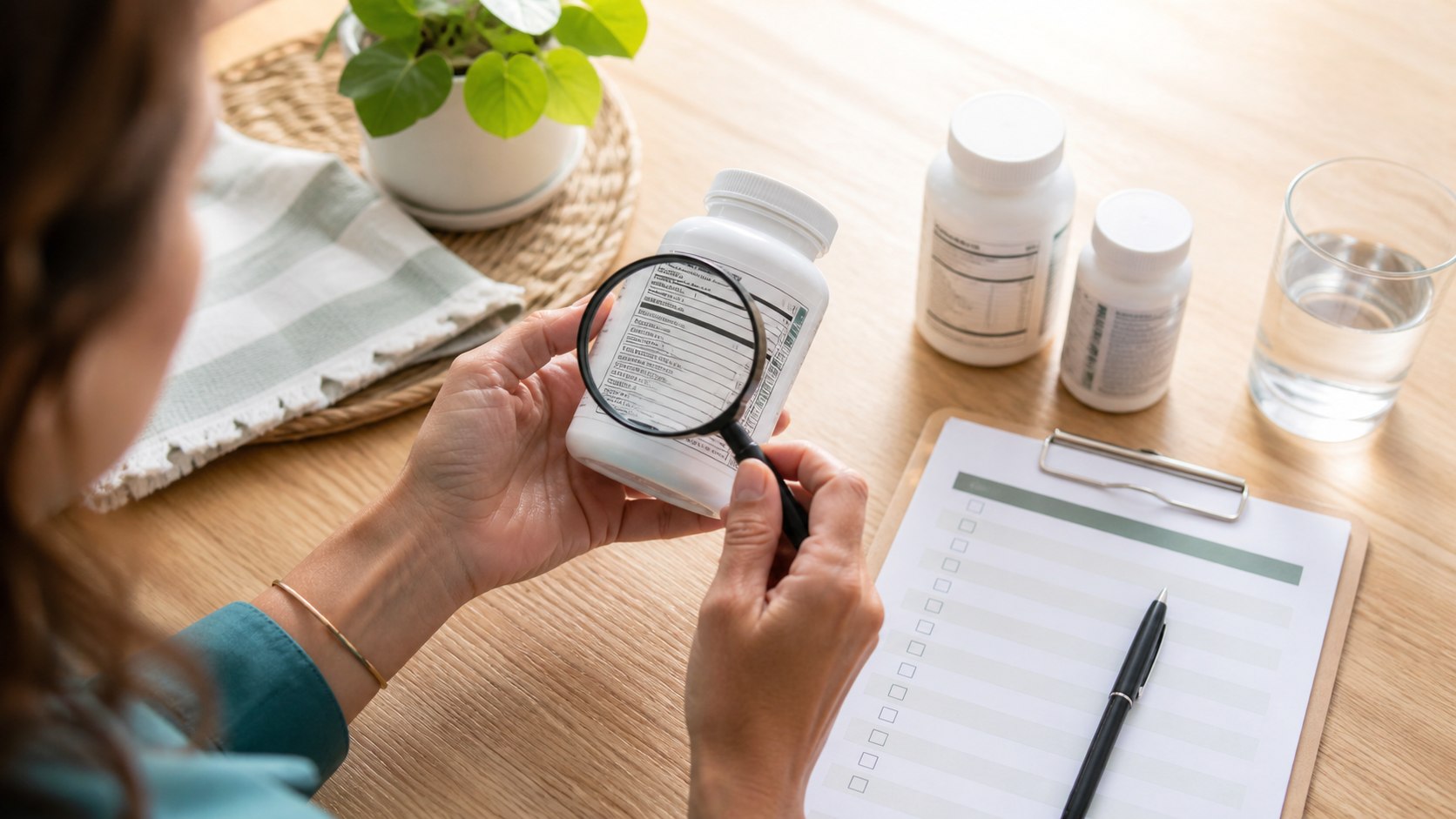
Turn the bottle around: serving size, ingredient amount and form usually matter more than front-label words such as “maximum” or “advanced.”
Read in this order: serving size, amount per serving, % Daily Value, ingredient form, proprietary blends, other ingredients, directions, warnings, lot or expiration information and company contact details. Then total the same ingredients across every product you use.
For the legal overview, see FDA dietary supplement label requirements. This guide focuses on using the label to compare products.
Supplement Facts and required label information
A dietary supplement label is required to identify the product as a supplement, state the net quantity, provide nutrition labeling, list ingredients and name the manufacturer, packer or distributor. The Supplement Facts panel includes the serving size, dietary ingredients and their amounts per serving. A percent Daily Value appears when the FDA has established one for that nutrient.
Botanical labels should identify the plant and the part used. Ingredients without an established Daily Value still need a quantitative amount, while the %DV column is marked to indicate that a Daily Value has not been established. “No Daily Value established” does not mean “no limit,” “proven effective” or “safe at any dose.”
The label is a map, not an approval certificate. FDA does not approve dietary supplements for safety and effectiveness before they are sold. A compliant-looking panel cannot tell you whether the product addresses your needs, interacts with a medicine or matches the exact formula tested in a study.
How to read supplement labels in eight steps
- Confirm the serving size. One serving may be two capsules, three gummies or multiple scoops. FDA guidance generally ties serving size to the maximum amount recommended per eating occasion. Never compare amounts until the serving sizes match.
- Read the amount per serving. This is the quantity supplied by the full serving, not necessarily one pill. Check whether the unit is grams (g), milligrams (mg), micrograms (mcg), International Units (IU) or colony-forming units (CFU).
- Use % Daily Value as a comparison tool. %DV shows how much one serving contributes to a standard Daily Value. It can help compare products, but it is not a personalized prescription.
- Identify the ingredient form. The form may affect absorption, tolerance, units and evidence. Look for wording in parentheses, such as the compound supplying a mineral or the species and strain of a probiotic.
- Unpack blends. A proprietary blend must show its total weight and list components in descending order by weight, but individual amounts may be hidden. That makes dose, evidence and interaction review difficult.
- Read “Other ingredients.” Fillers, binders, capsule materials, sweeteners, flavors and colors appear outside the Supplement Facts panel. Check for allergens and dietary restrictions.
- Review directions and warnings. Note timing, storage and the intended population. The absence of a warning does not prove that the product has no side effects or interactions.
- Find traceability details. Look for a lot number, expiration or best-by date and a reachable company. Photograph the label and keep the container if you experience a problem.
Start with serving size and amount per serving
A bottle may advertise “1,000 mg per serving” while a serving requires four capsules. Another may show 30 servings in a 60-capsule bottle. Compare the amount of the active ingredient per intended daily dose, the number of units required and the total cost per day—not the largest number on the front.
Powders add measurement uncertainty. A “scoop” can vary if it is packed, heaped or level. Use the included device exactly as directed and avoid household spoons for products that require precision. Gummies can make a large serving easy to overlook and may add sugar or omit bulky minerals.
Understand %DV, recommended intake, and upper limits
The Daily Value is one reference number used on U.S. food and supplement labels, generally for people age four and older. Recommended Dietary Allowances and Adequate Intakes vary by age, sex and life stage. Therefore, the DV may be similar to your recommended intake, but it is not always the same.
A tolerable upper intake level, or UL, answers a different question: it is the highest average daily intake unlikely to pose harm for most people. It is not a goal. A supplement with 500% DV does not promise five times the benefit, and stacking it with fortified foods and another multivitamin can push total intake higher.
Add the amount from your multivitamin, single-nutrient products, powders, drinks and fortified foods. Our supplement safety guide explains why high doses and overlapping formulas can cause harm.
Units and ingredient forms that change the meaning
| Label example | What to focus on | Common mistake |
|---|---|---|
| mg versus mcg | 1 mg equals 1,000 mcg | Treating similar-looking numbers as equal doses |
| Folate in mcg DFE | DFE accounts for differences in absorption; folic acid may also appear in parentheses | Comparing DFE and folic acid amounts as if they are identical units |
| Magnesium from citrate, oxide or another compound | The Supplement Facts amount is the magnesium supplied, while the form appears in parentheses | Comparing the full compound weight with the listed nutrient amount |
| Fish oil and omega-3s | Look for the actual EPA and DHA amounts, not only total oil weight | Assuming 1,000 mg fish oil means 1,000 mg EPA plus DHA |
| Vitamin A | Check whether it is preformed vitamin A, beta-carotene or a mixture | Ignoring form when evaluating pregnancy or high-dose risk |
| Probiotic CFU | Genus, species, strain, CFU and whether the count is guaranteed through expiration | Choosing only the highest CFU number |
Forms can affect absorption or tolerability, but “high absorption” is not automatically “best.” The useful form is the one supported for the intended purpose, at an appropriate dose, that the person can safely take.
What proprietary blends reveal—and leave out
Within a proprietary blend, ingredients are listed in order of predominance by weight and the total blend weight is declared. Individual ingredient doses may not be. A 600 mg blend containing six herbs does not tell you whether any herb reaches a studied dose or whether one ingredient dominates the formula.
This is especially problematic with stimulants, sedating herbs and products taken alongside medicines. If the exact dose is not disclosed, a pharmacist cannot fully screen exposure. Transparent single-ingredient or fully disclosed formulas are usually easier to compare and monitor.
Claims, asterisks and the FDA disclaimer
Front-label phrases such as “supports immune health,” “maintains energy” or “promotes restful sleep” are often structure/function claims. These claims describe an effect on normal structure or function; they are not the same as approval to diagnose, treat, cure or prevent a disease. When such a claim is used, the label carries the familiar disclaimer that FDA has not evaluated the statement and the product is not intended to diagnose, treat, cure or prevent disease.
The disclaimer does not mean the claim is proven. Manufacturers are responsible for having substantiation that a structure/function claim is truthful and not misleading, but FDA does not preapprove ordinary supplement structure/function claims. Be skeptical of rapid results, guaranteed cures, “FDA approved supplement,” secret formulas or one product said to treat many unrelated conditions.
Check quality seals and label databases
Independent programs from organizations such as NSF or USP test products using different methods. A legitimate quality seal may support manufacturing quality, identity and contaminant control. NIH emphasizes that these seals do not guarantee safety or effectiveness. Verify the certification in the organization’s own database because a printed logo alone can be copied.
Words such as “standardized,” “pharmaceutical grade,” “clinically studied” or “doctor recommended” need context. “Clinically studied” might refer to one ingredient rather than the exact finished formula. Ask whether this product, dose and population were actually tested and whether the outcome was meaningful.
The NIH Dietary Supplement Label Database catalogs label images, ingredient forms, amounts, claims and warnings for more than 200,000 products, including some that are no longer marketed. It is useful for comparison and documentation; inclusion is not an endorsement or proof of quality.
Compare two supplement labels side by side
Normalize the dose
Convert both products to the same number of capsules or the same daily dose. Match units before comparing.
Compare active amounts
Focus on the ingredient that serves your goal. Ignore decorative blends and front-label totals that do not equal the active amount.
Check duplication
Compare the label with every supplement and fortified product you already use, especially vitamin A, D, B6, iron and zinc.
Review cost and usability
Calculate cost per intended daily dose, required pill count, storage, allergens and whether you can follow the schedule.
A basic multivitamin comparison is a good place to practice. See our guide to multivitamins for adults 40+.
A label cannot clear medication interactions
Even a detailed label cannot account for your prescriptions, kidney or liver function, laboratory results or procedure plan. Calcium, iron, magnesium and zinc can reduce absorption of certain medicines; St. John’s wort can lower levels of many drugs; and high-dose biotin can distort some laboratory tests. Review our supplement medication interactions guide.
Speak with a clinician or pharmacist if you are pregnant, breastfeeding, giving a supplement to a child, planning surgery, receiving cancer treatment or living with kidney, liver, thyroid, bleeding, seizure or heart disease. Bring a photo of the full label—not just the product name.
Related supplement guides
- U.S. supplement regulations: FDA rules, claims, and reporting
- Third-party testing: what quality seals actually verify
Frequently asked questions
What is the most important number on a supplement label?
Start with serving size, then read the amount of the active ingredient per full serving. A large front-label number can be misleading if it refers to several capsules, total oil weight or an entire blend.
Is 100% Daily Value the right dose for everyone?
No. The DV is a general label reference, while individual needs vary by age, sex, pregnancy status, diet and health conditions. Some nutrients have different recommended amounts and upper limits.
What does “Daily Value not established” mean?
It means FDA has not established a Daily Value for that ingredient. It does not prove that the ingredient works, has no maximum safe dose or is appropriate for you.
Are proprietary blends unsafe?
Not automatically, but hidden individual doses make it harder to assess evidence, interactions and total exposure. Fully disclosed amounts allow a more useful comparison and professional review.
Does a USP or NSF seal mean the supplement works?
No. A legitimate independent seal may support identity, manufacturing quality and contaminant testing. It does not prove clinical effectiveness or guarantee that the product is safe for every person.
Sources
- U.S. Food and Drug Administration: Dietary Supplement Labeling Guide
- FDA: Dietary Supplement Labeling Guide — Nutrition Labeling
- FDA: Structure/Function Claims
- FDA 101: Dietary Supplements
- NIH Office of Dietary Supplements: Daily Values
- NIH Office of Dietary Supplements: Frequently Asked Questions
- NIH Office of Dietary Supplements: Dietary Supplement Label Database
- NIH Office of Dietary Supplements: Probiotics — Consumer Fact Sheet
Editorial note: This article provides general education and is not a product endorsement, diagnosis or individualized dosing plan. Labels and formulas can change; review the current container and ask a qualified professional when safety is uncertain.
