
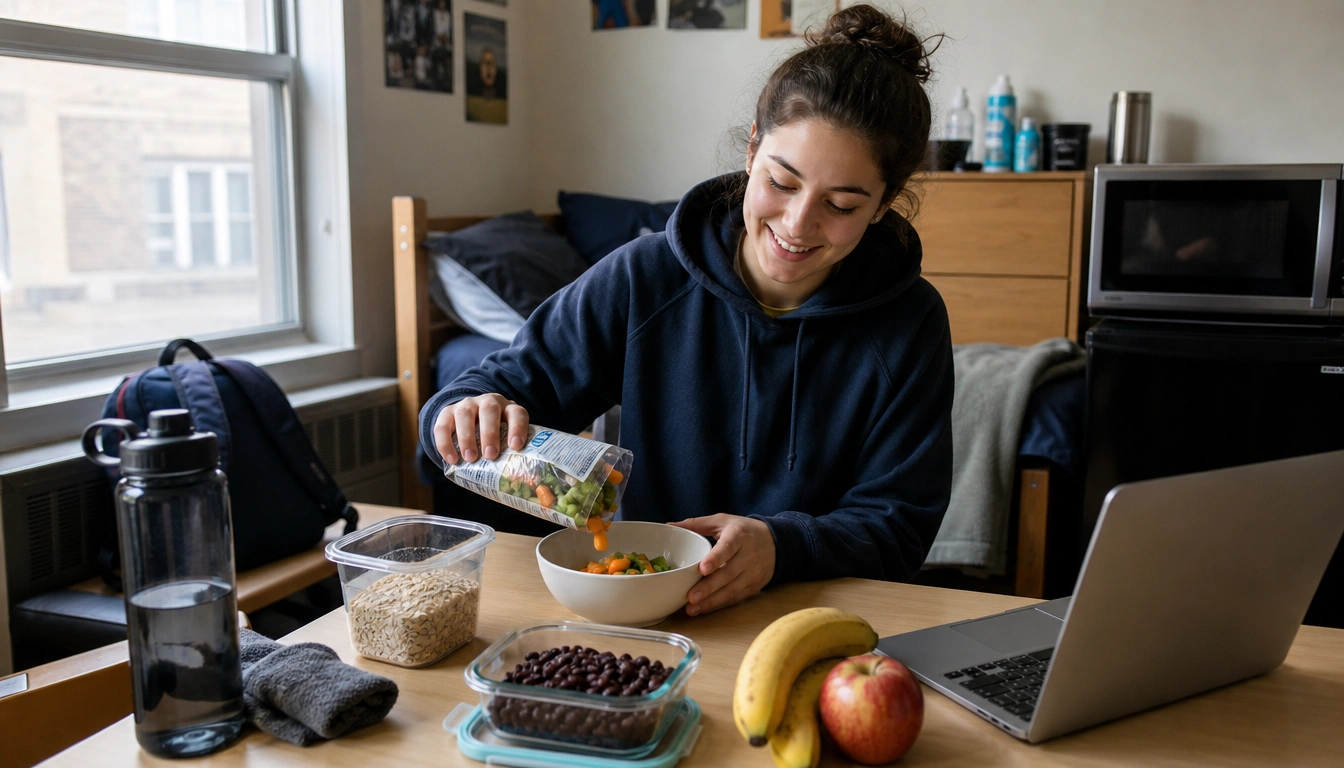
The cheapest healthy habits for college students are usually the simplest ones: build meals from low-cost staples, keep healthy foods visible and easy to grab, walk or bike more, use bodyweight exercise, protect sleep with a basic wind-down routine, and aim for minimum-viable habits during exams. You do not need a gym membership, specialty foods, or a perfect schedule to make meaningful progress.
Key Takeaways
- Start with low-cost staples such as beans, lentils, eggs, oats, rice, frozen vegetables, canned fruit, and peanut butter.
- Make the healthy choice the easy choice by keeping ready-to-eat foods at eye level and snacks in front of the fridge or desk.
- Free movement counts: walking to class, biking, campus stairs, tracks, and short bodyweight workouts all add up.
- During exams, shrink the goal instead of dropping it—keep one or two anchor habits rather than trying to do everything.
- Budgeting should never mean skipping meals, chronic restriction, or ignoring sleep and mental health problems.
College-specific reality check: why small changes matter
College life often pushes healthy routines off track. Classes run late, dining options may be limited, money is tight, and stress can make quick convenience food feel like the easiest option. Research on student health repeatedly shows that diet quality, activity, and sleep often slip during university years, especially when schedules become unpredictable.
The good news is that students do not need a full lifestyle overhaul to feel better. Small changes are useful because they are easier to repeat. A meal that costs less, a ten-minute walk between classes, or a consistent bedtime cue may seem minor, but these habits can reduce decision fatigue and make healthier choices more automatic. That matters in college, where every day can feel different.
The most sustainable approach is to look for habits that fit the real environment: dorm rooms, shared kitchens, meal plans, campus buses, late study sessions, and limited time. If a habit depends on having a perfect week, it will probably collapse. If it works during a messy week, it is worth keeping.
Budget nutrition basics for students
Healthy eating on a student budget usually starts with a short list of cheap staples that can be mixed in many ways. The Dietary Guidelines for Americans emphasize nutrient-dense foods such as vegetables, fruits, whole grains, beans, lentils, eggs, nuts, and dairy or fortified alternatives. For students, the easiest version is not a special plan. It is a repeatable set of affordable foods that can fill gaps between classes.
Frozen vegetables and fruit are especially useful because they last longer than fresh produce and reduce waste. Canned vegetables, beans, tuna, salmon, and fruit can also be practical, especially when low-sodium or no-sugar-added versions are available. Oats, brown rice, pasta, whole-grain bread, tortillas, peanut butter, hummus, and shelf-stable milk or milk alternatives can round out simple meals.
If you are trying to eat better without spending more, build meals around one protein, one fiber-rich carbohydrate, and one fruit or vegetable. For example:
- Oatmeal with peanut butter and banana
- Rice with beans and frozen vegetables
- Whole-grain toast with eggs and fruit
- Wraps with hummus, canned tuna, and greens
- Microwaved potatoes with beans and salsa
These combinations work because they are cheap, filling, and flexible. They also reduce the need for constant takeout decisions, which often cost more and leave students less satisfied.
Dorm-friendly meal planning and food prep
In a dorm or small apartment, food can spoil before it gets eaten. That is one reason students waste money without meaning to. A dorm-friendly plan should make use of the equipment you actually have, such as a mini-fridge, microwave, kettle, or shared kitchen. If you have very little equipment, choose foods that are safe to eat with no cooking at all.
One useful strategy is to keep a few “ready now” foods at the front of the fridge or on a visible shelf. When the healthiest foods are easiest to see, they are more likely to be eaten before fast food or chips. Behavioral economics research supports this idea: the environment shapes the choice. You do not need more willpower if the better option is the easiest option.
Practical dorm setups can be very simple:
- Keep washed fruit where you can see it first
- Put yogurt, string cheese, or hummus at eye level in the fridge
- Store snacks in single grab-and-go containers instead of a big bag
- Keep shelf-stable meals together so you can assemble them quickly
Good no-cook or low-cook meals include wrap sandwiches, tuna and crackers, yogurt with oats and fruit, peanut butter toast, bean salads, microwaved rice bowls, and instant oatmeal with nuts. If you can batch-cook once or twice a week, make a base such as rice, pasta, or lentils and reuse it in different combinations. That cuts both waste and spending.
For many students, the real goal is not meal prep perfection. It is having something better than the default option available when hunger hits. A few inexpensive foods in the right place can do more than an elaborate plan you never have time to follow.
Low-cost movement that fits campus life
Exercise does not have to mean a gym membership. Public health guidance supports regular movement, but any increase from your current baseline can help. For students, the easiest path is to use movement that already fits into the day instead of trying to create an entirely separate fitness schedule.
Walking is the most accessible option. You can walk to class, take the longer route to the dining hall, or use a walk between study sessions to reset mentally. Biking works well if campus is spread out and safe bike lanes are available. Many schools also include access to a recreation center, track, fitness classes, or intramural spaces in student fees, so it is worth checking what you already pay for.
Bodyweight exercise is another low-cost option. Push-ups, squats, lunges, planks, step-ups, and wall sits can be done in a dorm room, apartment, or empty common area. You do not need fancy equipment to keep muscles active. A short routine you can repeat is more useful than an ambitious plan you never finish.
A simple approach is to combine movement with another habit you already do. Walk after lunch, do a few sets before showering, or bike to the library instead of taking a ride. These choices are less likely to fail because they do not require extra motivation or travel time.
Sleep habits that improve recovery
Sleep is one of the first habits to break in college, especially when screens, deadlines, and social plans run late. Yet sleep supports memory, mood, immune function, and concentration, which makes it a major academic tool rather than a luxury. Most adults need about seven to nine hours of sleep, but the more important student habit is consistency.
A realistic sleep routine does not have to be complicated. Try a digital curfew, even if it is brief. That means putting your phone away or lowering stimulation before bed so your brain has a chance to slow down. A wind-down alarm can help cue the transition from study mode to sleep mode.
Helpful habits include:
- Keeping a consistent wake time as often as possible
- Turning down bright screens before bed
- Using the last 20 to 30 minutes for low-stimulation tasks
- Avoiding heavy caffeine late in the day if it affects your sleep
If you cannot control the whole night, control the beginning of the next day. A stable wake time can make sleep feel more regular over time, even when bedtime is imperfect. Students often underestimate how much a steady wake-up routine helps the body’s internal clock recover after late nights.
Stress-proofing your habits during exams
Midterms and finals are where many routines fall apart. That does not mean the routine failed. It means the situation changed. The smartest exam-week strategy is to define the minimum version of your habits before stress arrives. For example, instead of aiming for perfect workouts and home-cooked meals, aim for a basic version that is still doable under pressure.
A minimum viable routine might be: eat something with protein at breakfast, walk for ten minutes once or twice a day, and keep a consistent wake time as much as possible. If you can do more, great. If not, those anchor habits still protect your energy better than an all-or-nothing approach.
This flexibility matters because students often swing between rigid control and total drop-off. That pattern can make exams feel worse. It is more useful to plan for a lighter week in advance. Stock a few simple foods, reduce the number of decisions you need to make, and accept that “good enough” is a real strategy.
During stressful periods, the goal is not to optimize every health habit. It is to preserve enough structure that you do not feel worse by the end of the week. Even one stable routine can keep the slide from becoming a spiral.
Mental health and safety guardrails
Saving money should not mean harming yourself. If healthy eating turns into meal skipping, fear around food, obsessive calorie counting, or guilt that makes you avoid meals, that is a sign to get support. Budgeting is useful; chronic restriction is not. The same is true for exercise. More movement is not always better if it leads to exhaustion, injury, or anxiety when you miss a workout.
Watch for warning signs such as persistent fatigue, worsening sleep, frequent dizziness, unintentional weight changes, intense stress, or feeling unable to eat normally around food. Some students also use food control as a way to manage anxiety or pressure. If that feels familiar, campus health services, counseling, or a registered dietitian can help before the pattern becomes harder to reverse.
Seek help sooner rather than later if you notice:
- Repeated meal skipping or strong fear of eating
- Insomnia that continues despite basic sleep changes
- Low mood, hopelessness, or loss of interest in daily life
- Exercise compulsion, injuries, or inability to rest
- Stress that is affecting classes, relationships, or safety
Cost-conscious healthy living should leave you more stable, not more depleted. If the plan is making you feel unwell, the plan needs to change.
Frequently Asked Questions
How can college students eat healthier on a tight budget without wasting food?
Use foods that last longer and can be reused in several meals: frozen vegetables, canned beans, oats, rice, eggs, peanut butter, and fruit that stores well. Keep the most perishable foods visible and eat them first. Planning two or three repeatable meals usually wastes less than buying many ingredients for a complicated menu.
What are the best free or low-cost ways for students to exercise without a gym?
Walking, biking, campus stairs, running tracks, and short bodyweight routines are the easiest options. Many campuses also include recreation spaces in student fees. The best choice is usually the one that fits between classes and does not require extra travel, money, or equipment.
How can students improve sleep when classes, screens, and stress keep them up late?
Start with one or two sleep anchors: a steady wake time, a short wind-down routine, and less screen stimulation before bed. You do not need a perfect bedtime to make progress. Small changes that happen most nights usually help more than a strict plan that collapses after one late study session.
What healthy habits still work during midterms and finals when routines fall apart?
Keep the minimum version of your habits. That might mean one protein-containing meal, a short walk, and a consistent wake time. The goal is not perfection. It is keeping enough structure to protect your energy and focus while your schedule is chaotic.
What should students do if budget eating starts turning into meal skipping or disordered eating?
Take it seriously and ask for help. If money worries are leading to skipping meals, rigid food rules, guilt, or fear around eating, contact campus health or counseling services. A student health clinician or registered dietitian can help you find a safer, more sustainable plan.
The Bottom Line
The cheapest healthy habits are usually the least complicated ones: choose budget staples, make healthy foods easy to see and grab, walk more, and keep a basic sleep routine. Those changes are small, but they are realistic for student life and they add up.
A good college health plan should survive busy weeks. If it only works when you have extra time, money, and energy, it is probably too fragile. Build the smallest version you can repeat, then make it easier before you try to make it bigger.
If budget habits start turning into meal skipping, insomnia, overtraining, or persistent stress, get support from campus resources. Healthy routines should help you function better, not leave you more exhausted or anxious.
Medical disclaimer
Medical disclaimer: This content is for educational and informational purposes only and is not a substitute for professional medical advice, diagnosis, or treatment. Dietary needs and supplement suitability vary by individual.
Sources
- National Institutes of Health (NIH) — nih.gov. Accessed November 2026.
- National Institutes of Health (NIH) — nih.gov. Accessed November 2026.
- Centers for Disease Control and Prevention (CDC) — cdc.gov. Accessed November 2026.
- Centers for Disease Control and Prevention (CDC) — cdc.gov. Accessed November 2026.
- Centers for Disease Control and Prevention (CDC) — cdc.gov. Accessed November 2026.
- Centers for Disease Control and Prevention (CDC) — cdc.gov. Accessed November 2026.
- National Institutes of Health (NIH) — nih.gov. Accessed November 2026.
