
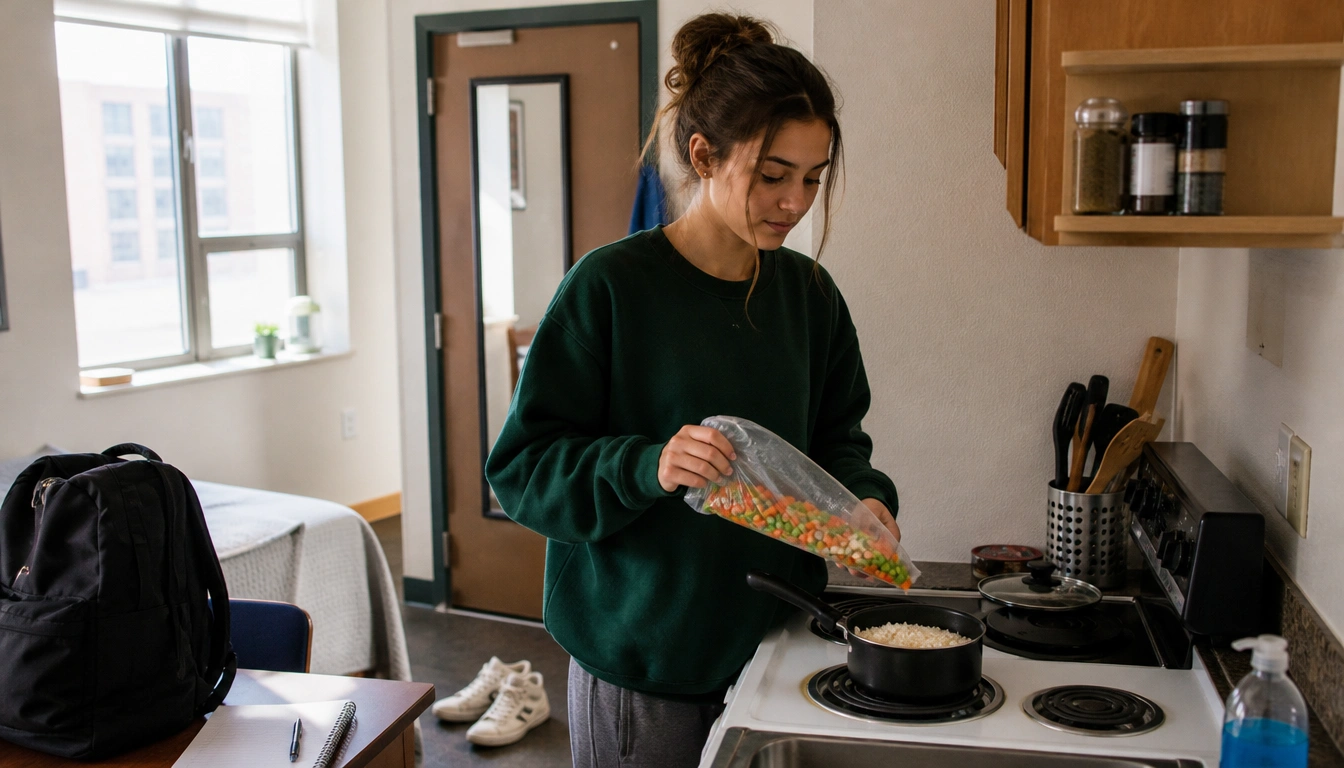
The cheapest, most effective wellness habits in college are the ones that support each other: steady meals built from budget staples, regular walking or other free movement, a consistent wake time, less late-night screen time, and early use of campus health or counseling services. You do not need a perfect routine or a gym membership to feel better, study more effectively, and reduce stress.
Key Takeaways
- Build around four basics first: food, movement, sleep, and support. These habits work together, not separately.
- Frozen and canned produce can be as useful as fresh for nutrition, and they often cost less and waste less in dorm life.
- Walking, biking, bodyweight exercises, and active study breaks can help students reach activity goals without paying for a gym.
- A consistent wake time and less screen time before bed are two of the highest-leverage sleep habits for irregular schedules.
- Use campus health, dining services, and counseling early so small problems do not turn into mid-semester crises.
- Caffeine can help in moderation, but it becomes counterproductive when it worsens anxiety, sleep, or palpitations.
Why college is the right time to build low-cost wellness habits
College is often the first time students have to manage food, sleep, movement, stress, and money at the same time. That can feel like a lot, but it is also why this period matters. According to the CDC and NIH, lifestyle habits in emerging adulthood are linked with both current health and academic performance. In plain terms, the way you eat, sleep, move, and ask for help can affect focus, energy, mood, and follow-through in class.
The good news is that wellness does not have to mean buying supplements, joining expensive fitness classes, or overhauling your life in one week. The habits that tend to matter most are basic and repeatable. They work because they reduce friction: fewer skipped meals, less sleep debt, a little more movement, and earlier support when stress starts to build. That combination is usually more powerful than a short burst of “perfect” behavior.
College is also a practical training ground. If you learn how to make a few affordable routines work now, those routines can carry into internships, jobs, grad school, and independent living. The aim is not optimization. The aim is a stable baseline you can keep even when classes, work shifts, and social life get messy.
The four foundations to prioritize first: food, movement, sleep, and support
It helps to think in systems instead of isolated habits. Food affects energy and concentration. Movement affects mood, sleep, and stress regulation. Sleep affects appetite, memory, and resilience. Support systems affect whether small problems get solved early or grow into larger ones. The strongest wellness plan usually starts with all four, but in the simplest possible form.
For students on tight budgets or irregular schedules, the first question is not “How do I do everything?” It is “Which habit will make the others easier?” For many students, that answer is a regular wake time, a reliable meal pattern, and daily movement that does not require planning, equipment, or money. The CDC’s physical activity guidance and public health nutrition guidance are useful here because they describe a baseline, not a perfect routine.
Support matters just as much as self-discipline. Campus health, counseling, dining staff, academic advisors, and disability or accessibility offices can all reduce the load. If you wait until a crisis, every task takes more effort. If you use these resources early, they can save time, money, and stress.
Budget-friendly nutrition basics for dorms, dining halls, and limited kitchens
Eating well in college is easier when you stop aiming for elaborate meals and start aiming for dependable ones. If you have only a mini-fridge, a microwave, or a shared kitchen, focus on foods that store well, require little prep, and can be mixed into several meals. That approach lowers cost and reduces the chance of going long stretches without eating.
Frozen and canned produce are especially useful. Nutritionally, they can be comparable to fresh options, especially when frozen items have no added sauces and canned options are packed in water or natural juice with low sodium and added sugar kept minimal. They last longer, waste less, and are often cheaper per serving. That matters in dorms, where produce can spoil before you finish it.
Dining halls can also be used strategically. Instead of trying to “eat perfectly,” scan for a few anchors: a protein source, a fruit or vegetable, and a filling carbohydrate like rice, potatoes, oats, pasta, or whole grains. A balanced meal does not need to be fancy to work.
If you have limited appetite or a chaotic schedule, keep one or two backup options that require almost no effort. The goal is not gourmet cooking. The goal is avoiding the all-day gap that leads to exhaustion, irritability, and impulse buying later.
Cheap staple foods that make balanced meals easier
A small set of low-cost staples can cover most of your meals. Common budget-friendly options include oats, rice, pasta, beans, lentils, eggs, peanut butter, plain yogurt, canned tuna or salmon, tofu, frozen vegetables, bananas, apples, and whole-grain bread. These foods are useful because they are filling, versatile, and easier to keep around than fresh ingredients that spoil quickly.
Protein is especially helpful for staying satisfied between classes, but it does not need to come from expensive packaged bars or restaurant meals. Beans, lentils, eggs, peanut butter, yogurt, and canned fish can all work depending on your preferences and kitchen setup. Pairing these with fruit, vegetables, and whole grains makes it easier to build meals that feel steady rather than random.
Think in combinations, not recipes. Oatmeal plus peanut butter and banana. Rice plus beans plus frozen vegetables. Pasta plus canned tuna and peas. Toast plus eggs and fruit. These are not “diet” meals; they are practical student meals. If you keep a few of them on hand, you are less likely to skip meals or rely entirely on vending machines and delivery apps.
How to build a simple plate without obsessing over perfection
Nutrition guidance often becomes overwhelming because people try to track too much at once. A simpler approach is to use a basic plate pattern. Public health guidance commonly recommends making roughly half the plate fruits and vegetables, a quarter protein, and a quarter whole grains or another filling starch. That is a guide, not a test.
If you are eating at a dining hall, this can look like a salad or cooked vegetables, chicken or beans, and rice or potatoes. If you are cooking in a dorm kitchen, it might be a bowl of microwave rice, frozen vegetables, and eggs. If you are grabbing something on the way to class, choose the closest version available instead of nothing at all.
Perfection is not the target. Consistency is. One balanced meal will not fix a week of stress, and one less-than-ideal meal will not ruin your health. The point is to build enough structure that your body has steady fuel for studying, walking, sleeping, and recovering.
Low-cost movement that actually fits a student schedule
You do not need a gym membership to get the benefits of movement. For many students, the most realistic exercise is the movement already built into campus life: walking to class, biking, taking the stairs, standing up between study blocks, or doing a short bodyweight routine in your room. The CDC’s adult activity framework can be translated into student life without expensive gear.
Brisk walking is one of the easiest options because it is free, flexible, and easy to repeat. If your campus is spread out, walking between buildings can add up quickly. If you commute, getting off the bus a stop early or parking farther away can turn a routine errand into activity. Biking is another good option if your area is safe and you already have access to a bike.
For strength, bodyweight movements are enough to start: squats, wall or regular push-ups, planks, lunges, and step-ups. You do not need a long workout to make progress. A few minutes before a shower, between classes, or while waiting for laundry can be enough to build the habit.
How to reach weekly activity goals without a gym membership
Public health guidance recommends at least 150 minutes of moderate-intensity aerobic activity each week, plus muscle-strengthening activity at least two days a week. That can sound intimidating until you break it into ordinary student routines. Thirty minutes of brisk walking on five days can cover the aerobic target. Short bodyweight sessions can cover the strength piece.
The easiest way to hit the weekly target is to stop treating exercise as a separate project. Use active study breaks: walk while listening to lecture audio, do a few squats between flashcard sets, take a short lap around the building after two hours at the library, or choose stairs when your body feels up for it. These small bouts matter because they lower the barrier to starting.
If you are very busy, consistency beats intensity. A 10-minute walk after lunch, a 10-minute walk after dinner, and a brief bodyweight routine on two days can be enough to build momentum. Students who are already active may need more, but many students are trying to move from “almost none” to “some.” That is a meaningful change.
Sleep habits that matter most when class, work, and screens compete
Sleep is one of the biggest wellness levers in college because it affects attention, learning, mood, and appetite. If your schedule is irregular, the highest-value habit is usually a consistent wake time. Waking up around the same time each day helps stabilize your body clock, even if bedtime shifts a little from night to night.
The second high-leverage habit is reducing screens before bed. Late-night scrolling, streaming, and constant notifications can keep the brain activated when it should be winding down. A full perfect “digital detox” is not necessary, but cutting screen intensity in the 30 to 60 minutes before sleep can help. Dimming lights, switching to audio-only content, or putting the phone across the room can also reduce the cue to keep going.
Sleep gets easier when you protect the basics: morning light, regular meals, movement during the day, and less caffeine late in the day. Students do not need flawless sleep hygiene to improve sleep. Even one or two anchored changes can reduce the feeling of being permanently tired.
How caffeine, late-night scrolling, and irregular weekends affect sleep and stress
Caffeine is not automatically bad. For many students, it can help with alertness. Problems tend to show up when caffeine is used to mask chronic sleep loss or when energy drinks are stacked on top of anxiety, skipped meals, and long study sessions. The NIH notes that heavy caffeine use can contribute to jitteriness, stomach upset, sleep disruption, and palpitations in some people.
A useful rule is to notice function, not just quantity. If caffeine makes you feel shaky, anxious, more irritable, or unable to fall asleep, it may be working against you. Energy drinks can be especially tricky because they often combine caffeine with sugar or other stimulants, which can create a short lift followed by a crash.
Late-night scrolling and irregular weekends can also undo weekday progress. Sleeping in far past your usual wake time can make it harder to fall asleep on Sunday night and harder to feel alert on Monday morning. A looser weekend is fine, but the more your schedule swings, the more your sleep and stress response can feel unstable.
Using campus health and counseling resources early
One of the most cost-effective wellness habits is learning how campus services work before you need them. Many colleges offer primary care, basic prescriptions, vaccinations, STI testing, and mental health support at low cost or included in student fees. The sooner you complete intake paperwork and learn the process, the easier it is to get help when a problem starts instead of after it has grown.
Cafeteria or dining staff can also be helpful when you have food restrictions, limited time, or trouble finding reliable options. Campus health staff may be able to guide you toward accessible care if you are dealing with recurring stomach problems, sleep issues, stress-related symptoms, or nutrition concerns. Counseling services can help with anxiety, low mood, homesickness, grief, burnout, or adjustment problems before they become overwhelming.
If you have a chronic condition, mental health diagnosis, eating concerns, or disability-related needs, it can help to establish care early in the semester rather than waiting for a crisis. That makes accommodations and follow-up easier to arrange.
A simple weekly wellness plan for broke, busy students
Keep the plan small enough that you can follow it during a bad week. For food, pick two or three grocery staples and one backup meal you can make in minutes. For movement, plan on walking as your default transport, plus two short strength sessions. For sleep, choose one consistent wake time and one screen cutoff that you can actually keep most nights. For support, save the campus health and counseling contacts in your phone and learn how to book an appointment.
If you are overwhelmed, build from what is already happening. Tie a walk to your commute. Tie breakfast to your first class. Tie your wind-down routine to brushing your teeth. The strongest habits are often attached to something you already do every day.
For students with ADHD, anxiety, depression, or an unpredictable class and work load, structure usually works better than motivation. Use reminders, visible food, easy clothing for movement, and a simple repeatable routine. The point is to lower the number of decisions you have to make when you are tired.
If money is the biggest barrier, focus on the habits that cost almost nothing: water, walking, sleep timing, frozen produce, beans, eggs, and early use of campus services. If time is the biggest barrier, shrink the habit instead of abandoning it. Ten minutes still counts as a start.
Common barriers and realistic workarounds for overwhelmed students
If you keep skipping meals: stock one emergency breakfast or snack you can eat without cooking, like oatmeal, yogurt, fruit, peanut butter toast, or a sandwich. Skipping meals often makes later eating more chaotic.
If you never have time to exercise: stop thinking in terms of a gym session. Walk between classes, take stairs, and do one short bodyweight set while waiting for food, laundry, or a call.
If your sleep is all over the place: protect the wake time first. It is usually more realistic than forcing bedtime to be perfect right away.
If screens keep you up: start with a smaller change, like charging your phone across the room or switching to a low-stimulation activity before bed.
If you feel stuck in stress, sadness, or panic: use campus counseling or student health sooner, not later. You do not need to wait until you are failing classes or barely functioning.
If caffeine is becoming a crutch: notice whether it is helping you focus or just keeping you wired. If it worsens anxiety or sleep, scale back and look at the habits underneath it.
The most effective student wellness plan is not the most ambitious one. It is the one that survives a crowded week and still keeps your body fueled, your sleep steadier, your movement regular, and your support within reach.
Frequently Asked Questions
How can I eat healthy in college without spending a lot or having a full kitchen?
Use budget staples that store well: oats, rice, beans, lentils, eggs, peanut butter, yogurt, frozen vegetables, fruit, and canned fish or beans. Frozen and canned produce can be nutritionally comparable to fresh and often cost less. Build meals from a protein, a plant food, and a filling starch whenever you can.
What are the easiest ways to get enough exercise on a campus budget?
Walk as much as possible, bike if you already have access, use stairs, and do short bodyweight sessions in your room. You do not need a gym membership to make progress. The easiest plan is to attach movement to things you already do, like commuting, study breaks, or laundry trips.
How can I sleep better in college when my schedule and screen time are irregular?
Start with one consistent wake time and one screen cutoff before bed. Those two habits often give the biggest return for students with changing schedules. Add morning light, less caffeine later in the day, and a short wind-down routine if you can, but do not wait for a perfect schedule to begin.
What free or low-cost mental health and medical resources are available to students?
Many colleges offer student health clinics, counseling services, vaccinations, basic medical care, and referrals at low cost or through student fees. Some schools also have dining support, disability services, and academic coaching. Check your campus portal early in the semester so you know how to access help before you need it.
How do I know when self-care is not enough and I need professional help?
Get professional support if stress, low mood, anxiety, insomnia, eating problems, or physical symptoms keep interfering with daily life. Ask for help sooner if you have panic symptoms, persistent palpitations, disordered eating patterns, or any thoughts of self-harm. Campus counseling or health services are appropriate starting points.
The Bottom Line
The cheapest wellness habits in college are the ones that reinforce each other: simple meals, regular movement, steadier sleep, and early use of campus support. You do not need expensive gear or a perfect routine to feel better and function more consistently.
If you only change a few things, start with a consistent wake time, fewer late-night screens, a few reliable budget foods, and daily walking. Those habits are low-cost, flexible, and strong enough to improve energy, stress, and follow-through.
When your schedule gets chaotic, shrink the plan instead of quitting it. Small habits are easier to keep, and in college, the habits you can repeat are the ones that matter most.
Medical disclaimer
Medical disclaimer: This content is for educational and informational purposes only and is not a substitute for professional medical advice, diagnosis, or treatment. Dietary needs and supplement suitability vary by individual.
Sources
- Centers for Disease Control and Prevention (CDC) — cdc.gov. Accessed November 2026.
- National Institutes of Health (NIH) — nih.gov. Accessed November 2026.
- National Institutes of Health (NIH) — nih.gov. Accessed November 2026.
- National Institutes of Health (NIH) — nih.gov. Accessed November 2026.
- National Institutes of Health (NIH) — nih.gov. Accessed November 2026.
- Academic Research Institution — purdueglobal.edu. Accessed November 2026.
