
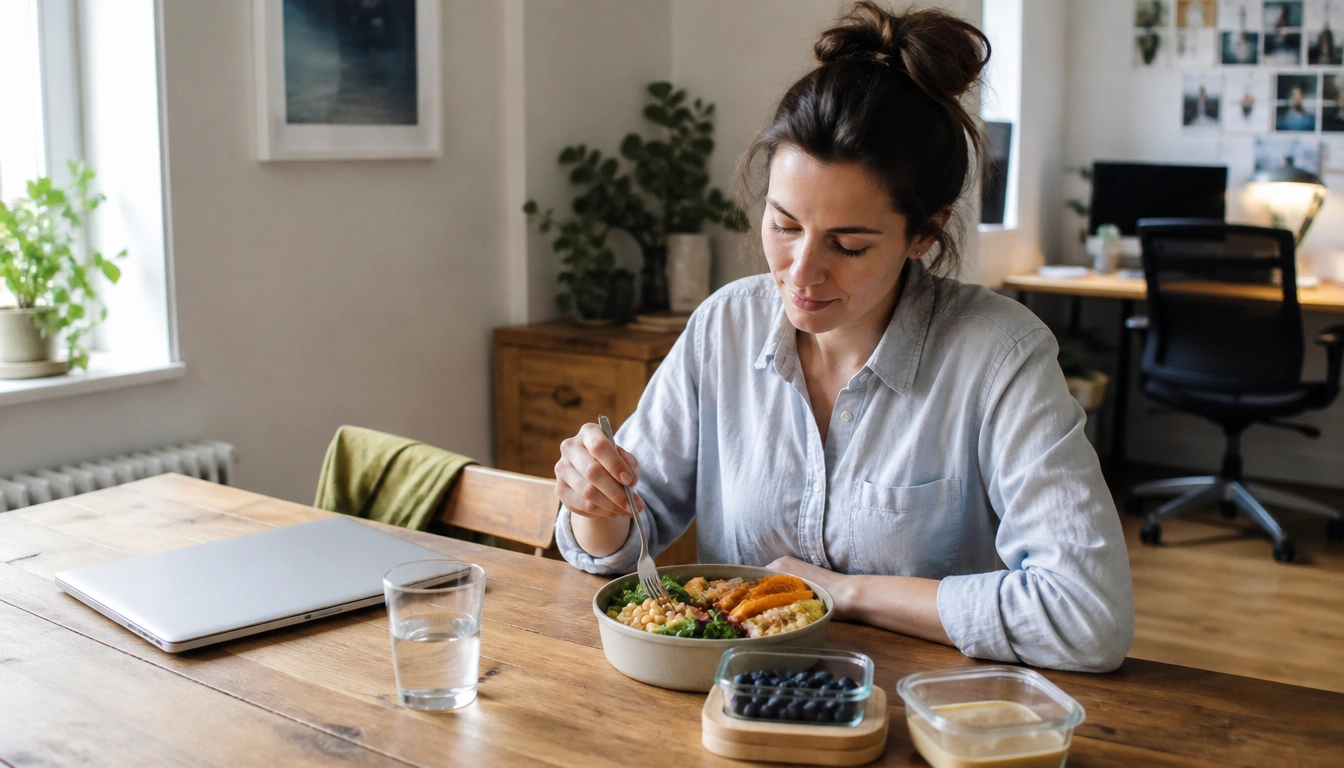
Remote workers do best with a meal plan that creates structure without becoming rigid: set a few reliable meal windows, protect lunch like a meeting, keep balanced meals within easy reach, and make snacks intentional instead of constant. That combination helps reduce mindless grazing, prevents skipped meals, and supports steadier energy during long screen-heavy days.
Key Takeaways
- Working near the kitchen can trigger eating from habit, stress, or boredom, so environment matters as much as willpower.
- Eating at your desk or while scrolling can weaken fullness awareness and make it easier to overeat without feeling satisfied.
- A simple workday rhythm with a protected lunch break helps meals happen before you are overly hungry and more likely to snack.
- Batch cooking and component prep are practical for remote workers because they cut decision fatigue on busy meeting days.
- Snacks work best when they are portioned on purpose, kept away from the computer, and used to bridge true gaps between meals.
- If eating patterns are causing blood sugar issues, GI symptoms, or possible disordered eating, individualized support from a clinician or dietitian can help.
Why remote work changes eating behavior
Meal planning for remote workers starts with a simple reality: your workday and your kitchen often share the same space. That proximity makes food easy to reach, so eating can shift from a planned meal to a reflex. A quick walk past the fridge, a stressful email, or a boring meeting can become a trigger to graze.
Clinical guidance from organizations such as Cleveland Clinic and Johns Hopkins Medicine describes this as a mix of environmental cues and habit loops. The more often you snack without a clear reason, the more your brain learns to expect food during work. The result is often skipped meals early in the day, then unplanned eating later when focus fades.
Remote work also blurs lunch boundaries. When no one else is taking a break with you, it feels easy to push a meal aside “for later.” But delaying food can leave you overly hungry, which makes quick snacks more appealing and planning less effective.
What helps: treat eating as part of the workday structure, not a reward for finishing tasks. That mindset makes meal planning feel less like restriction and more like support for focus.
Set your default meal rhythm
A realistic remote-work schedule usually works better than an elaborate meal plan. The goal is a default rhythm you can repeat most days, not a perfect timetable. Many people do well with breakfast, lunch, dinner, and one planned snack if needed, spaced far enough apart that meals actually feel like meals.
Meal timing matters because it reduces decision fatigue. If you wait until you feel shaky, distracted, or ravenous, you are more likely to grab whatever is easiest. A steadier rhythm gives your body a better chance to signal hunger before you are depleted.
Protect lunch as a non-negotiable appointment. If your calendar is packed, block it in advance and keep the slot visible. For meeting-heavy days, some people do better with a shorter, predictable lunch window and an earlier or later main meal, depending on their schedule. The exact timing matters less than consistency.
A simple framework: eat at roughly similar times on workdays, use one protected lunch break, and keep a backup plan for days when meetings run long. That backup might be a ready-to-eat meal or a planned snack so you do not end up skipping food entirely.
Build balanced remote-work meals for steadier energy
Remote-work meals are easiest to sustain when they are balanced enough to keep you satisfied. A practical plate usually includes protein, fiber-rich carbohydrates, and healthy fats. That mix helps meals digest more gradually, which can support steadier energy and fewer rebound cravings than a snack built mostly on refined carbs or sweets.
Think of lunch as fuel for the second half of your workday. A protein source can be eggs, chicken, tuna, tofu, beans, Greek yogurt, or cottage cheese. Fiber-rich carbohydrates might include brown rice, quinoa, whole-grain bread, beans, fruit, or starchy vegetables. Healthy fats can come from avocado, nuts, seeds, olive oil, or tahini.
You do not need a perfect formula at every meal. A sandwich with turkey and vegetables, yogurt with fruit and nuts, or leftovers with vegetables and grains can all work. What matters is that the meal is substantial enough to prevent you from hovering around the pantry an hour later.
If you often crash in the afternoon, look first at lunch quality and screen habits, not just caffeine. Balanced meals and fewer distracted bites are often more helpful than another quick snack.
Make meal planning frictionless
Remote work meal planning succeeds when it is easy enough to repeat during busy weeks. Batch cooking is one of the simplest tools: make extra soup, chili, roasted vegetables, grains, or protein at dinner so tomorrow’s lunch is already partly done.
Component prep can be even easier than full meal prep. Wash greens, chop vegetables, cook a grain, and prepare one or two protein options so you can assemble meals quickly between calls. This works well for people who do not want the same lunch every day or who only have a short window for food prep.
Repurposing leftovers is especially useful for tight budgets. A dinner of roasted chicken and vegetables can become a wrap, salad, or grain bowl the next day. Beans, rice, eggs, pasta, and frozen vegetables can also be turned into fast meals without much planning.
Low-friction idea: keep a few “meal building blocks” ready each week rather than trying to cook every lunch from scratch. That approach lowers the mental load and makes healthy eating more likely when your schedule changes.
Design a food environment that supports habits
Food placement influences behavior more than many people expect. If snacks are visible on your desk or in the first cabinet you open, you will think about them more often. A better system is to make the foods you want to eat more convenient and the foods you want less of slightly less obvious.
Keep ready-to-eat items such as fruit, yogurt, chopped vegetables, nuts, or hummus at eye level in the fridge or pantry. Store less useful impulse foods out of direct sight when possible. This is not about banning foods; it is about making the default choice easier when attention is low.
Use a “closed kitchen” cue during focus hours. That could be a note on the pantry, a reset of the kitchen counter, or a personal rule that the kitchen is only used at planned meal and snack times. The goal is to create a small pause between work and eating so the choice is more intentional.
For snacking, pre-portion food away from the computer. Eating from a bag or box makes it harder to notice how much you have had. A small bowl or plate is a simple boundary that helps separate a planned snack from unconscious grazing.
Lunch break etiquette for yourself
The healthiest lunch break is often the one that actually happens. Step away from your desk, even if the break is short. Changing location helps your brain switch out of work mode and makes eating feel more complete.
Try to minimize screens during lunch. Watching email, messages, or videos can keep your attention split, which makes it easier to eat quickly and miss fullness cues. Research on distracted eating shows that when attention is elsewhere, people are less likely to register satisfaction in real time.
This does not mean lunch has to be a formal ritual. A quiet kitchen, a short walk, or sitting somewhere other than your workstation can be enough. Even ten or fifteen screen-free minutes can help you return to work feeling clearer and less likely to hunt for snacks right away.
If you routinely eat at your desk, start by changing one part of the pattern. For example, eat lunch away from the screen three days a week, or leave your water bottle at the desk but take your food elsewhere. Small changes are easier to keep than all-or-nothing rules.
Snack strategy for long work blocks
Snacks are useful when they fill a real gap between meals. They are less useful when they become a default response to boredom, stress, or a nearby pantry. A good snack strategy starts with deciding when you actually need one, rather than asking yourself all day whether you want one.
For many remote workers, the best snack is the one planned ahead of time. Choose something with protein, fiber, or both so it feels satisfying. Examples include fruit with nut butter, yogurt, cheese with whole-grain crackers, hummus with vegetables, or a handful of nuts paired with fruit.
If your day is packed with back-to-back meetings, keep a backup snack ready so you do not skip meals and then overcorrect later. Store it away from your computer, and portion it before the workday gets busy. That makes the snack deliberate instead of automatic.
Budget and energy limitations matter too. On low-energy days, use simpler foods rather than abandoning the plan. Frozen vegetables, eggs, canned beans, whole-grain toast, oats, tuna, and plain yogurt can all support a workable meal rhythm without much prep. The best system is the one you can keep using on ordinary weeks, not just your most organized ones.
When to get help
Sometimes remote-work eating patterns are not just inconvenient; they may point to a health issue that needs individual support. If you have diabetes or another condition that depends on regular food timing, meal skipping and erratic snacking can interfere with blood sugar management. In that case, a clinician can help align meals, medication, and work schedules more safely.
You should also seek help if remote-work habits are linked to ongoing gastrointestinal symptoms, significant weight changes, frequent loss of control around food, or anxiety about eating that is getting worse. Those patterns may need the guidance of a registered dietitian or primary care clinician.
If food rules are becoming rigid, you feel driven to compensate for eating, or meals are regularly tied to guilt or distress, do not try to solve it only with stricter planning. More structure is not always the answer; sometimes the right next step is individualized care.
The most practical version of meal planning supports your work without taking over your day. If your current routine is making you skip meals, snack constantly, or feel out of control around food, it is worth getting tailored help rather than pushing through it alone.
Frequently Asked Questions
How can I stop grazing all day when my kitchen is always nearby?
Create distance and friction. Keep planned foods visible, move impulse snacks out of sight, and use a clear “closed kitchen” cue during work hours. It also helps to eat on a schedule so you are not making food decisions every time you pass the fridge.
What is a realistic meal schedule for someone working from home?
A realistic schedule is one you can repeat most weekdays. Many remote workers do well with breakfast, lunch, dinner, and one planned snack, spaced a few hours apart. Protect lunch as a scheduled break rather than waiting until you feel starved.
What should a remote-worker lunch look like for steady energy?
Aim for a mix of protein, fiber-rich carbs, and healthy fats. Examples include a grain bowl with chicken or tofu, a sandwich with vegetables and a side of fruit, or leftovers with beans and roasted vegetables. That balance tends to support steadier energy than a snacky lunch.
How can I meal prep when I have back-to-back meetings and little time?
Use batch cooking and component prep. Cook extra grains, proteins, or vegetables once, then assemble meals quickly during the week. Even 10 minutes of prep can make lunch much easier on meeting-heavy days.
What are the best snacks to keep at home for remote work days?
Choose snacks that are easy to portion and satisfying enough to last until the next meal. Good options include fruit with nut butter, yogurt, nuts, hummus with vegetables, cheese with whole-grain crackers, or eggs with toast. Keep them away from your desk so the snack is intentional.
The Bottom Line
Remote work can make eating feel scattered, but a few simple habits can bring more structure to the day. Set meal windows, protect lunch, and make snacks something you choose on purpose rather than something that happens automatically.
The most effective meal plan is usually the easiest one to repeat: balanced meals, low-friction prep, and a food environment that makes the healthy choice convenient. If you have diabetes, GI symptoms, or signs of disordered eating, get personalized support instead of trying to force a one-size-fits-all routine.
Medical disclaimer
Medical disclaimer: This content is for educational and informational purposes only and is not a substitute for professional medical advice, diagnosis, or treatment. Dietary needs and supplement suitability vary by individual.
Sources
- Centers for Disease Control and Prevention (CDC) — cdc.gov. Accessed October 2026.
- health.clevelandclinic.org — clevelandclinic.org. Accessed October 2026.
- hopkinsdiabetesinfo.org — hopkinsdiabetesinfo.org. Accessed October 2026.
