
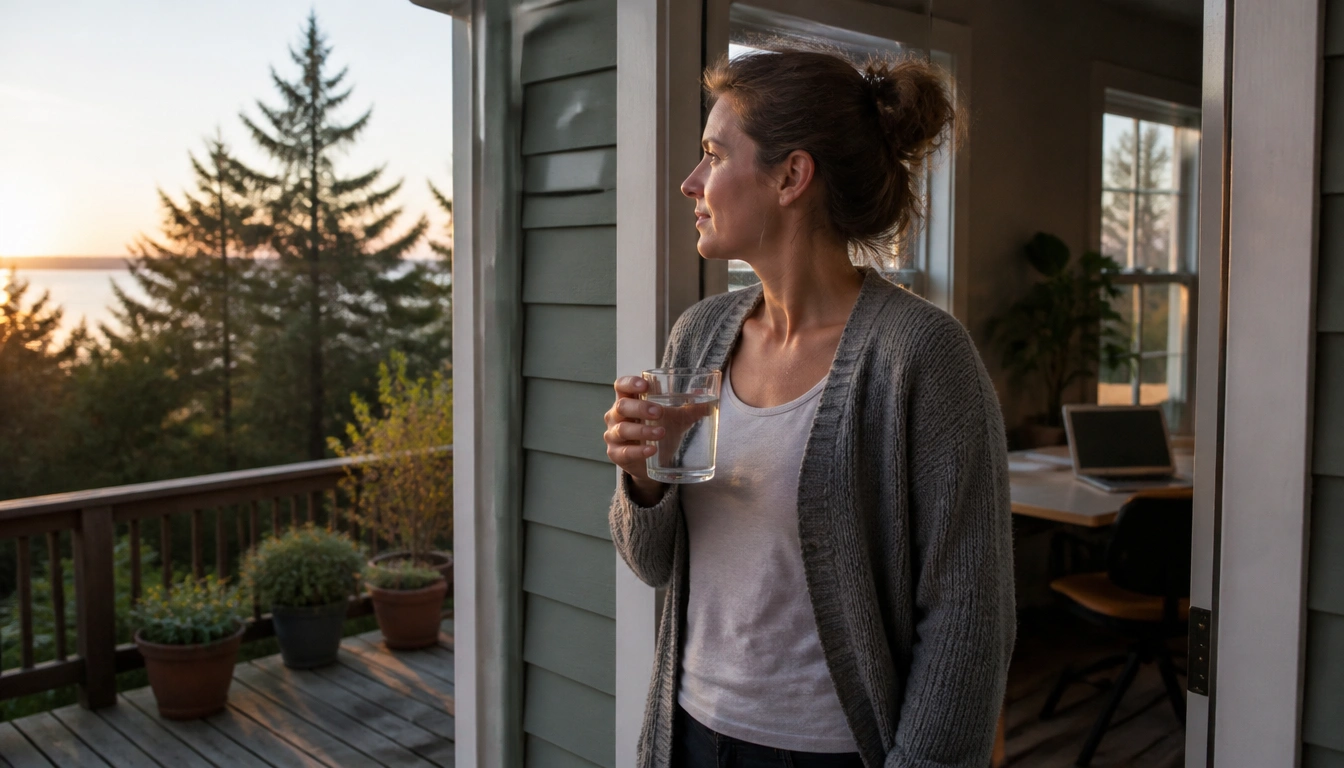
A safe, effective morning light routine for people working from home starts with outdoor light soon after waking, ideally within the first hour. Keep your wake time consistent, step outside before screens when you can, and pair the light with hydration and a little movement. Regular glasses or contacts are fine, but avoid sunglasses and never stare at the sun.
Key Takeaways
- Remote work can blur the line between night and day, so your brain may need a stronger morning cue than indoor lighting provides.
- Outdoor light is usually far brighter than typical indoor light, even on cloudy days, and that stronger signal helps set your body clock.
- The best routine is simple: wake, get outside, then hydrate and move before settling into work.
- Consistency matters as much as exposure time; a stable wake time helps your circadian rhythm stay anchored.
- If mornings are dark, cloudy, or wintery, longer outdoor exposure or supervised light therapy may be useful.
- People with eye disease, severe photosensitivity, or photosensitizing medications should get individualized medical advice before changing their light exposure routine.
Why remote work can push your body clock later
Morning light routine habits matter more when you work from home because the commute is gone. Without that built-in transition, it is easy to wake up, reach for a phone, and start work under indoor light that never feels fully like daytime to the brain. Over time, that pattern can encourage circadian drift, where your sleep schedule slides later and your mornings feel heavier.
Your circadian rhythm is coordinated by the brain’s central clock, which uses light as its strongest time cue. The Centers for Disease Control and Prevention notes that regular sleep timing helps support healthy sleep, and sleep medicine research consistently shows that light exposure is one of the main signals that keeps sleep and wakefulness aligned. For remote workers, the challenge is not just total light exposure; it is the timing and strength of the light signal.
How morning light sets sleep and alertness in motion
Morning light helps tell the body that the day has started. Light entering the eyes activates specialized retinal cells that respond especially well to bright daylight. That signal helps suppress melatonin, the hormone that supports sleep, and supports the normal rise in alertness that many people feel after waking.
This morning signal also helps advance your circadian phase, which means it nudges your internal clock earlier. That can make it easier to feel sleepy at the right time in the evening instead of staying alert too late. Consistent morning light does not work in isolation, though. It works best when the wake time itself is also steady, because your body is looking for repeated daily timing cues, not just a single bright moment.
Indoor lighting is often too dim to create the same effect. Typical home or office lighting may feel bright to your eyes, but it usually does not match the intensity of outdoor daylight. Even an overcast sky often provides a much stronger circadian signal than indoor light, which is why stepping outside can make such a noticeable difference.
The WFH morning light routine that actually fits remote life
The simplest remote-work routine is: Wake → Light → Move → Work. That sequence replaces the lost commute with a short, repeatable pattern your body can learn.
First, get out of bed and seek outdoor light as soon as practical. A balcony, porch, front step, backyard, or short walk around the block all work. The goal is not exercise performance or a perfect sunrise ritual. The goal is to give your eyes real daylight before you settle into screens and tasks.
Next, hydrate and add a little movement. Drinking water, stretching, walking slowly, or carrying out a small errand around the house all reinforce the message that the day has begun. The combination of light and movement often feels more effective than either one alone, especially on groggy mornings.
If you have a home office, try to position your desk near a window so daylight continues to support alertness after your morning routine. That is not a replacement for going outdoors, but it can help maintain a more daytime environment while you work.
How long to stay outside and why timing matters
For most people, spending 10 to 30 minutes outside shortly after waking is a practical target. The right amount depends on how bright the environment is, how cloudy it is, and how sensitive you are to light. A bright clear morning usually requires less time than a dull, overcast one.
Timing matters most in the first hour after waking. That is when morning light is most useful for anchoring the circadian clock. If your schedule forces an early start, try to make outdoor light one of the first things you do. If you wake later, the same principle still applies: the earlier in your waking period you can get daylight, the more helpful it tends to be.
Consistency is just as important as duration. A regular wake time gives your brain a stable expectation, which makes the morning light signal stronger over time. If your wake time changes wildly from day to day, the benefit of light is harder for your body to use as a dependable cue.
Cloudy mornings, winter darkness, and high-latitude living
Cloudy weather does not make outdoor light useless. Even on a gray morning, the outdoor environment is usually much brighter than typical indoor lighting. If the sky is dull, you may simply need a longer exposure to get a strong enough signal.
Winter and high-latitude locations create a different challenge because mornings may be dark for long stretches of the year. In those situations, people often need to be more deliberate: step outside anyway if there is any usable light, open blinds right away, and keep the wake time steady. For some people, especially in regions with very limited daylight, a light therapy box may be considered under professional guidance.
The point is not to chase perfection. If the sunrise is late or the sky is heavy with clouds, use the strongest natural light available and support it with routine consistency. A modest outdoor signal repeated daily is generally more useful than an occasional long session done unpredictably.
Window light, outdoor light, and light therapy boxes
Sitting by a bright window is better than staying in a dark room, but it is not the same as going outside. Glass reduces the intensity of light reaching your eyes, and the outdoor environment is usually far more powerful for circadian signaling. If you can step outdoors, even briefly, that is usually the stronger choice.
Light therapy boxes are different from ordinary lamps. They are designed to deliver a strong light level at a specific distance, and they are sometimes used when natural morning light is not available. They can be helpful for people who live in dark winter climates, work early shifts, or have schedules that make morning outdoor light hard to obtain. They are not a casual substitute for every situation, and they are best used with guidance if you have eye disease, bipolar disorder, or other relevant health concerns.
One practical rule: use natural daylight first when it is available and safe, reserve light therapy for situations where natural light is limited, and avoid assuming that a bright indoor room or screen light can fully replace outdoor morning exposure.
Who should be cautious with morning light
Morning light is generally safe for healthy adults, but some people should get medical advice before making major changes. That includes people with eye disease, a history of retinal problems, severe photosensitivity, or conditions that make bright light uncomfortable or risky. It also includes people taking medications that increase sensitivity to light.
Regular eyeglasses or contact lenses are usually fine. Sunglasses are different: they reduce the light signal and make the routine less effective, so they are usually not the best choice during your morning light window unless your clinician tells you otherwise for a specific medical reason.
Never stare directly at the sun. Morning light exposure means ambient daylight reaching your eyes, not sun gazing. Looking directly at the sun can damage the retina and is not a safe version of this routine. If bright light feels painful, causes visual symptoms, or worsens headaches or eye discomfort, stop and seek individualized advice.
How to combine morning light with a better evening wind-down
Morning light works best when the rest of the day supports sleep too. If you get strong morning light but then spend the evening under bright indoor lighting with a lot of screen time, you can still make it harder for melatonin to rise at night.
A useful complement is an evening dim-light routine. A couple of hours before bed, lower the brightness of your environment, reduce overhead glare when possible, and shift away from stimulating tasks if you can. You do not need to create a cave; you just want the light environment to signal that day is ending.
For remote workers, this morning-and-evening pairing is often the most sustainable approach. Bright outdoor light soon after waking helps the body clock start on time, and dimmer evenings help it stay there. That rhythm tends to support better sleep quality, easier wake-ups, and more stable daytime focus.
Frequently Asked Questions
How long should I stay outside in the morning for circadian benefit?
A practical target for many adults is 10 to 30 minutes soon after waking. Brighter conditions usually require less time, while cloudy or dim conditions may require longer exposure. Consistency matters, so a shorter routine done daily is often more useful than an occasional long session.
What if it’s cloudy, dark, or winter where I live?
Still try to get outside if it is safe to do so, because outdoor light is usually much stronger than indoor light even on cloudy days. In dark winter mornings or high-latitude locations, you may need longer exposure, stricter wake-time consistency, or supervised use of a light therapy box.
Is window light enough, or do I need to go outdoors?
Window light is helpful, but it is usually weaker than direct outdoor daylight because glass reduces the light signal. If you can safely step outside, even briefly, that generally gives your body clock a stronger cue than sitting by a window.
Can I use a light therapy box instead of sunlight?
Yes, in some situations a light therapy box can be used when natural morning light is limited. It is most useful in dark winter months, very cloudy climates, or schedules that make outdoor light difficult. If you have eye disease, bipolar disorder, or photosensitivity, get medical guidance first.
What should I do if I’m a night owl and wake up late?
Start where you are and make morning light the first daylight cue after waking, even if that is later than ideal. Keep your wake time as consistent as possible across the week, because regularity helps your body clock more than occasional perfect mornings.
The Bottom Line
If you work from home, morning light is one of the simplest ways to replace the missing commute and anchor your sleep-wake cycle. The most useful version is not complicated: wake up, go outside soon after, and keep that timing steady day after day.
Outdoor daylight is stronger than indoor light, even when the sky is cloudy, so small consistent habits can make a real difference. Pair the morning cue with a dimmer evening routine, and get individualized advice if you have eye disease, light sensitivity, or relevant medications.
Medical disclaimer
Medical disclaimer: This content is for educational and informational purposes only and is not a substitute for professional medical advice, diagnosis, or treatment. Dietary needs and supplement suitability vary by individual.
Sources
- National Institutes of Health (NIH) — nih.gov. Accessed October 2026.
- Centers for Disease Control and Prevention (CDC) — cdc.gov. Accessed October 2026.
- National Institutes of Health (NIH) — nih.gov. Accessed October 2026.
- Academic Research Institution — stanford.edu. Accessed October 2026.
