
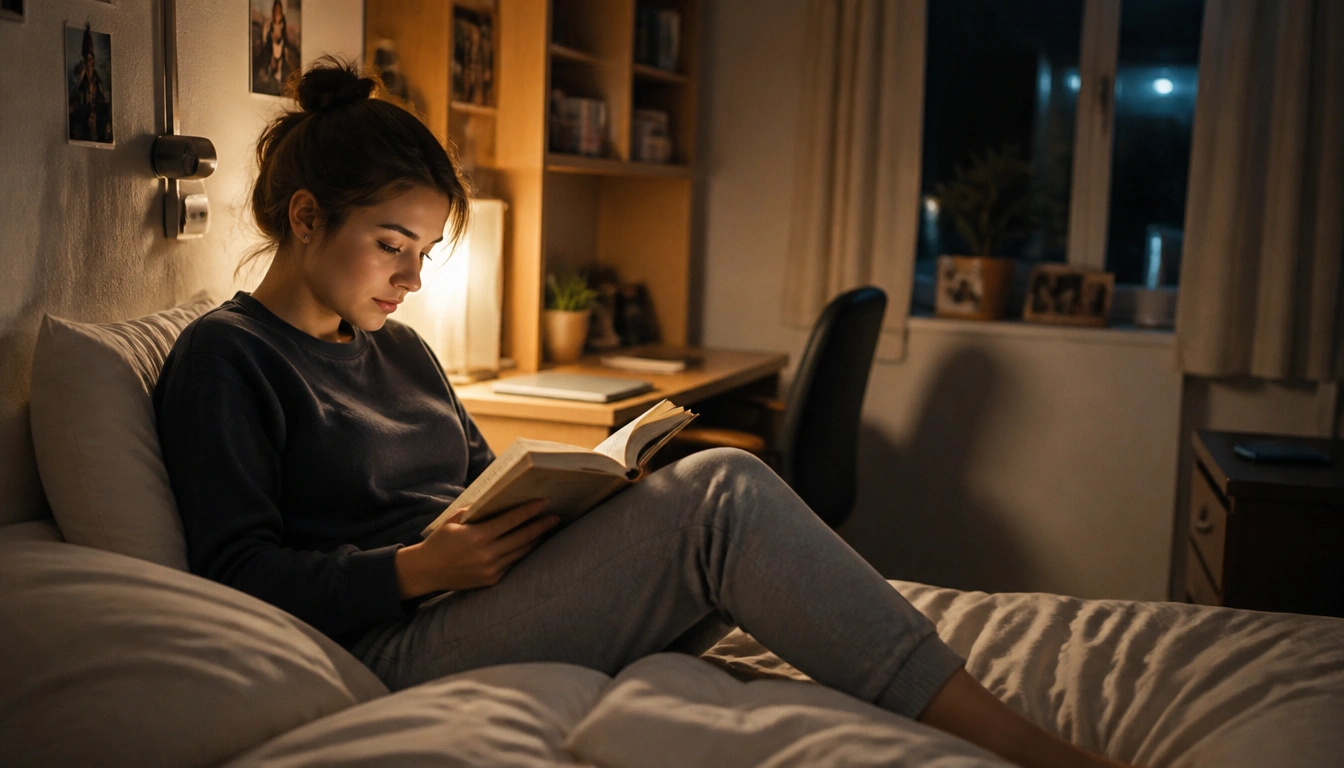
Yes—college students can use reading at night to unwind and fall asleep more easily, but it works best as a low-stimulation, screen-light-free transition rather than more studying. The most sleep-friendly version is usually a 30–60 minute digital sunset followed by 30–45 minutes of calm reading under warm, dim light. If reading makes you more alert, switch to a quieter activity or get out of bed after about 20 minutes instead of forcing it.
Key Takeaways
- Reading at night helps most when it replaces scrolling and other bright-screen habits that can keep the brain alert.
- Choose leisure reading, not dense academic material, for the final part of the night so your mind can leave problem-solving mode.
- A practical college routine is a 30–60 minute digital sunset, then 30–45 minutes of analog reading in bed or a relaxed chair.
- Physical books are often the simplest option, but e-readers with notifications off and minimal brightness can work better than phones or laptops.
- If reading increases rumination, anxiety, or hyperfocus, stop using it as a sleep cue and switch to a calmer, more monotonous activity.
- If sleep problems stay severe despite better habits, the issue may be insomnia or another sleep disorder that needs professional evaluation.
Why a bedtime reading routine can help you sleep
A bedtime reading routine works because it gives your brain a predictable signal that the day is ending. According to the CDC and NIH, bright evening light and interactive screen use can delay melatonin release and push sleep later. Reading under softer light lowers that stimulation and helps replace the mental pace of classes, messages, and deadlines with something slower and less demanding.
That transition matters for college students because the evening often starts with one type of mental work and ends with another. A student may spend hours reading slides, papers, or discussion posts, then try to “relax” with a phone in bed. That can keep the brain in an active, scanning state. A calmer reading routine creates a different cue: fewer notifications, less light, less decision-making, and more repetition.
The goal is not to make reading exciting. The goal is to make it boring enough to be soothing. When reading becomes a stable pre-sleep habit, your body can begin associating the book, the lamp, and the bed with sleep rather than with academic pressure or entertainment that pulls you in too far.
How to separate academic reading from sleep reading
For many students, the biggest mistake is assuming all reading has the same effect. It does not. Dense academic reading can keep you mentally engaged because it asks you to analyze, remember, compare, and solve problems. That kind of reading is useful earlier in the evening, but it is usually a poor choice right before sleep.
Leisure reading works differently. Fiction, memoir, light essays, magazines, and low-stakes nonfiction are more likely to support winding down because they do not demand the same level of active problem-solving. If you must read course material late, try to finish the hardest work first and save the final part of the night for something easier and less consequential.
A useful boundary is this: desk reading is for work; bedside reading is for downshifting. Keeping those roles separate helps your bed stay linked to sleep instead of deadlines. If you share a room, even a small physical change—moving the textbook to your desk and keeping a paperback near your pillow—can reinforce that distinction.
A practical wind-down routine that fits a college schedule
A realistic routine does not need to be complicated. The most useful structure for many students is a digital sunset of about 30 to 60 minutes before bed, followed by 30 to 45 minutes of calm reading. That buffer gives you time to stop active screen use, reduce stimulation, and shift into a slower rhythm without needing a perfect schedule.
Start by docking your phone across the room, in a drawer, or on the other side of the dorm. If you still need your laptop for school tasks, close it once your work is done instead of carrying it into bed. Then dim the room. Warm bedside lighting is better than bright overhead light because it is less likely to keep you alert. A small lamp, a warm bulb, or a reading light angled away from your eyes is usually enough.
Pick reading material before you are tired. If you wait until you are half-asleep, you may grab whatever is closest, including a stimulating textbook or a book you actually want to binge-read. Low-stakes material works best: something pleasant, familiar, and not emotionally intense. The point is to ease the transition into sleep, not to finish a chapter at all costs.
If your schedule is irregular, do not wait for the perfect bedtime. Use the same sequence even on late nights: screens down, lights low, easy reading, bed. Consistency helps more than an ideal clock time.
Best reading formats at night: physical books, e-readers, and audiobooks
Physical books are usually the easiest choice because they do not emit light and they do not carry the distraction of alerts, tabs, or social media. They also make it easier to stop after a few pages instead of drifting into one more notification, one more message, or one more chapter that turns into an hour.
E-readers can be a good backup if they use e-ink and have notifications turned off. They are not the same as phones or tablets. A simple e-reader with a low, warm setting can be a practical compromise for students who do not own many paper books or who travel between home, dorm, and library. The main caution is to avoid using a device that is still wired to the internet in ways that invite scrolling.
Audiobooks can also help, especially for students with ADHD, sensory overload, eye strain, or a packed dorm room. A sleep timer and a calm narrator can make it easier to settle down without visual stimulation. The tradeoff is that some people pay more attention to audio than they expect, so it helps to choose familiar, low-stakes material rather than a complex plot or a lecture-style recording.
If you notice that one format keeps pulling you into “just one more page,” that format may not be right for bedtime. Choose the option that makes your mind slow down most reliably, not the one that seems most efficient.
How to make the routine work in a dorm
Dorm life adds noise, light, and limited control over your environment, so the routine has to be flexible. Start with the simplest improvements. Put your phone somewhere that takes effort to reach. If you need it as an alarm, place it across the room and set Do Not Disturb. This reduces the reflex to check messages when you should be winding down.
Use the room layout to your advantage. A bedside lamp or clip light gives you enough visibility without brightening the whole room. If you have a roommate, talk about your plan so your lighting and their sleep do not clash. Shared-space routines work better when they are brief, predictable, and low-drama.
Choose reading that does not create pressure. A challenging book can be fun, but bedtime is not the time for material that demands analysis, emotional intensity, or note-taking. If your routine becomes another academic task, it stops serving its purpose. Keep a few “sleep-safe” books nearby so you do not default to whatever is closest on your desk.
If you only have ten or fifteen minutes, that can still be useful. A short, repeatable version of the routine is better than skipping it because you cannot make it perfect. College schedules are messy; the habit should be sturdy enough to survive that mess.
Common ways bedtime reading backfires
Reading can fail as a sleep tool when the content is too stimulating, the light is too bright, or the routine becomes a performance goal. Thrillers, stressful news, emotionally charged nonfiction, and course material can all keep your mind active. So can reading while half-checking your phone or lying under harsh overhead light.
Another common problem is turning reading into another task to complete. If you set a goal to finish a chapter, underline important ideas, or “be productive” before bed, you may recreate the same pressure you had during the day. That defeats the purpose. The sleep version of reading should feel unimportant in the best possible way.
If you are prone to anxiety, rumination, or hyperfocus, notice what happens when the book makes your thoughts faster instead of slower. A calming routine should reduce mental noise, not amplify it. If you repeatedly find yourself reading while more awake than before, it is a sign to change the content, the timing, or the activity itself.
That also applies to the bed. If you are in bed and still alert after about 20 minutes, get up and move to a dim chair. Do something quiet and monotonous, such as rereading a familiar passage or folding clothes, then return to bed when sleepiness comes back. That approach is more useful than staying in bed and forcing it.
Adjustments for ADHD, hyperfocus, anxiety, and delayed sleep timing
Students with ADHD or other neurodivergent patterns often need a routine that is more flexible, not more rigid. A perfect bedtime script can backfire if it creates pressure or becomes another thing to “do right.” For some students, a short audiobook with a sleep timer works better than silent reading. For others, an e-reader with notifications off is more realistic than a paper book that gets lost in the room.
If hyperfocus is the problem, set external limits before you start. Use a timer, choose a short chapter, or pick a format that is easy to pause. The goal is to keep the routine from turning into an all-night reading session. People who tend toward delayed sleep timing may also need the digital sunset to happen earlier than they expect, especially on nights when they feel mentally “on.”
Anxiety needs a different adjustment. If the reading content feeds worry, choose something repetitive, familiar, or mildly dull. Re-reading a favorite book can be more helpful than starting something new. The best reading choice is the one that lowers arousal instead of adding to it.
Students whose sleep timing is persistently late may need more than a reading habit alone. Sleep routines help, but they cannot always correct a deeply shifted body clock by themselves. If late nights remain the norm even with consistent habits, a campus health clinician or sleep specialist can help sort out whether there is a circadian rhythm issue, insomnia, or another problem.
When sleep hygiene is not enough anymore
Reading can support sleep, but it should not be used as a cover for an ongoing sleep disorder. If you regularly spend a long time trying to fall asleep despite a calm routine, wake up often during the night, feel unrefreshed most mornings, or struggle with daytime concentration and sleepiness, it is worth getting evaluated. The CDC and sleep medicine organizations emphasize that persistent sleep problems deserve medical attention, not just better habits.
Professional help matters even more if your sleep issue comes with loud snoring, gasping, restless legs, panic at night, depressed mood, or strong daytime impairment. A student who is skipping classes, dozing off in lectures, or unable to function on most days may need more than a bedtime reading plan. Campus health services, counseling centers, and primary care clinicians can help determine whether the problem is insomnia, anxiety, a circadian rhythm disorder, or another sleep condition.
Use reading as one tool, not the whole plan. When it works, it helps the night feel quieter and more predictable. When it does not, that is useful information—not a failure.
Frequently Asked Questions
What should college students read at night: fiction, nonfiction, or textbooks?
For bedtime, fiction or other low-stakes leisure reading usually works better than textbooks. Dense academic reading can keep you in analysis mode and make it harder to wind down. If nonfiction is relaxing rather than challenging, that can work too. The best choice is the one that feels calm, familiar, and not emotionally intense.
How long should a bedtime reading routine be before sleep?
A practical target is about 30 to 45 minutes of reading after a 30 to 60 minute screen-free wind-down. That does not have to be exact every night. The important part is creating a consistent buffer between active screen time and sleep so your brain has time to settle.
Is reading on an e-reader okay at night, or should it be a physical book?
A physical book is often the simplest option, but an e-reader can be fine if it uses e-ink, has notifications off, and stays dim. It is usually better than a phone or tablet because it is less likely to pull you into messages, apps, or scrolling. Avoid anything that feels like a mini-screen portal.
What should students do if reading makes them more alert instead of sleepy?
Stop using that book or format as your wind-down tool. Switch to a quieter, more monotonous activity and lower the stimulation in the room. If you are still awake after about 20 minutes in bed, get up and sit somewhere dim until you feel sleepy again. Do not force the routine if it is clearly backfiring.
How can students with ADHD or late-night hyperfocus adapt a reading routine?
Use a routine that is flexible and easy to stop. Audiobooks with a sleep timer, e-readers with notifications off, or short chapters can help. Choose material that is familiar or low-stakes, and set a timer before you begin so reading does not turn into another late-night hyperfocus session.
The Bottom Line
A nighttime reading routine can help college students fall asleep more easily when it replaces screens, lowers stimulation, and stays separate from academic reading. The most useful version is simple: end screen use early, dim the lights, and read something calm and low-pressure.
If reading makes you more alert, anxious, or stuck in your thoughts, change the content or the format—or stop using it as your sleep cue. And if sleep problems keep happening despite a solid routine, do not assume it is just a bad habit. Persistent insomnia, daytime sleepiness, or frequent awakenings deserve professional evaluation.
Medical disclaimer
Medical disclaimer: This content is for educational and informational purposes only and is not a substitute for professional medical advice, diagnosis, or treatment. Dietary needs and supplement suitability vary by individual.
Sources
- National Health Service (NHS) — oxfordhealth.nhs.uk. Accessed November 2026.
- National Institutes of Health (NIH) — nih.gov. Accessed November 2026.
- Centers for Disease Control and Prevention (CDC) — cdc.gov. Accessed November 2026.
- Academic Research Institution — snhu.edu. Accessed November 2026.
- Academic Research Institution — colostate.edu. Accessed November 2026.
