
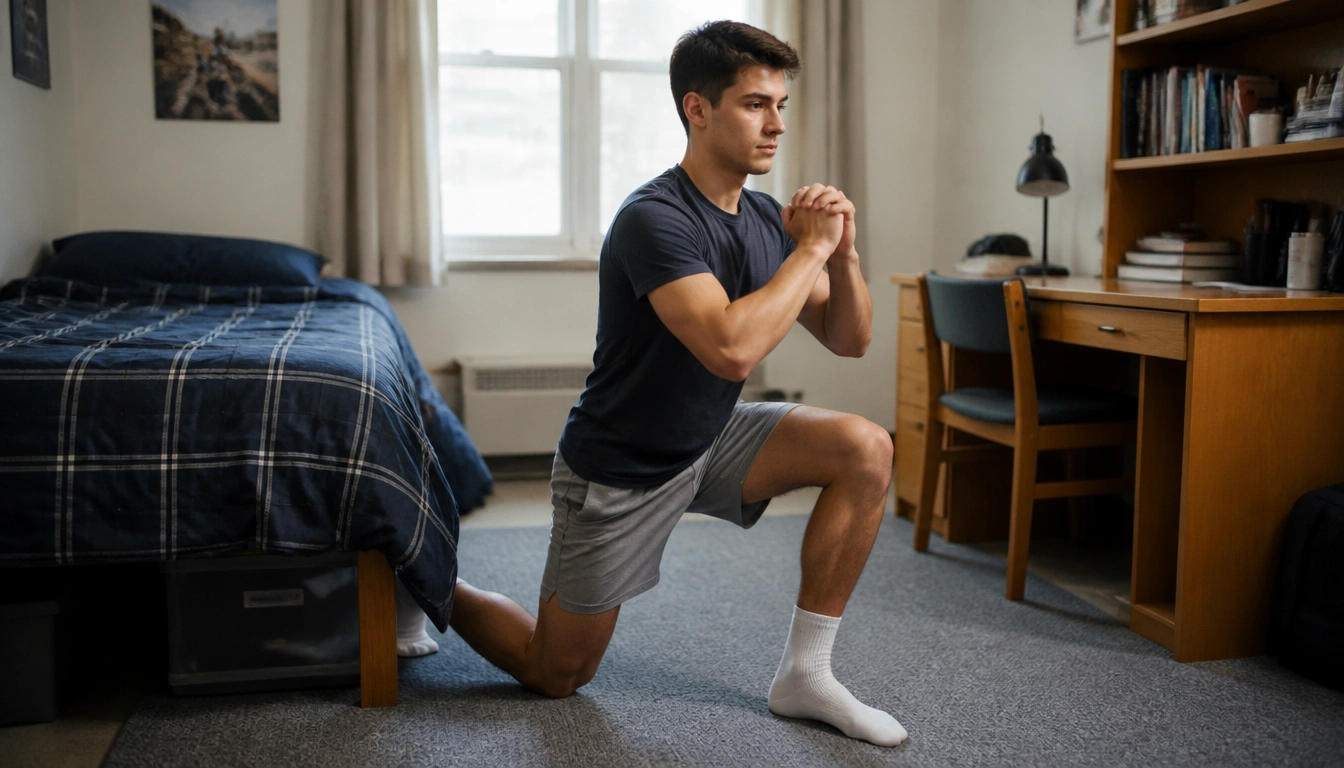
The best no-equipment leg workout for most college students is a simple twice-weekly circuit built around squats, reverse lunges, glute bridges, and calf raises. It works because it trains the major lower-body muscles with minimal space, no gear, and enough flexibility to fit an irregular schedule. Start with a brief warm-up, use good form, and progress by slowing the movement or adding reps before trying harder variations.
Key Takeaways
- Two lower-body strength sessions per week is enough for most healthy adults to build a sustainable habit and improve fitness.
- A dorm-room leg circuit should center on squats, reverse lunges, glute bridges, and calf raises.
- If you have been sitting for hours, a 2–3 minute dynamic warm-up can make the workout feel smoother and safer.
- You can make bodyweight leg work harder by using slower lowering phases, pauses, single-leg versions, and more reps.
- Sharp joint pain, swelling, or instability is not normal exercise fatigue and means you should stop and reassess.
Why a no-equipment leg workout fits college life
A no-equipment leg workout for college students makes sense because it matches real student constraints: limited space, limited money, crowded schedules, and noisy living situations. You do not need a gym to train the muscles that matter for everyday movement. The main goal is to build lower-body strength, muscular endurance, and basic mobility so stairs, walking across campus, carrying a backpack, and getting up after long study sessions feel easier.
The American College of Sports Medicine and the U.S. Department of Health and Human Services both support regular muscle-strengthening activity for major muscle groups at least two days per week. For most healthy students, that means you do not need to live in the gym or follow a complicated split. A short, repeatable routine is usually better than an idealized plan that is too hard to maintain.
This workout is also useful because it trains movement patterns, not just muscles. Squats and lunges challenge the hips, knees, and ankles together, while glute bridges and calf raises help round out the lower body. That combination supports balance, coordination, and everyday function in a way that translates well to student life.
A practical session usually takes about 15 to 25 minutes, depending on rest time and how many sets you do. A good starting point is 2 to 3 sets per exercise, with a pace that leaves you working hard but still in control of your form.
Start with a short warm-up after a long day of sitting
If you have been sitting through lectures, labs, or study sessions, your hips and ankles may feel stiff before the workout even begins. A brief dynamic warm-up helps your body switch from sitting to moving. The goal is not to exhaust yourself. The goal is to raise body temperature, loosen joints, and make the first few reps feel less abrupt.
Try this 2–3 minute sequence:
- March in place or walk briskly around your room for about 30 seconds.
- Do 6 to 8 leg swings on each side, holding a wall or desk for balance if needed.
- Perform 6 to 8 hip circles in each direction.
- Do 5 to 8 shallow bodyweight squats, moving only as far as feels smooth.
If your knees or ankles feel especially stiff, add a few gentle calf pumps and ankle circles. Keep the range comfortable. A warm-up should make the workout feel more available, not harder.
The core dorm-room leg circuit
This routine focuses on four movements that work well in a small room, create little noise, and do not require equipment. Rest 30 to 90 seconds between sets as needed, especially in the beginning.
Bodyweight squat: Stand with your feet about shoulder-width apart. Sit your hips back and down as if reaching for a chair, keep your chest open, and let your knees track in the same direction as your toes. Lower until your thighs are near parallel to the floor, or stop higher if that is what good form allows. Push through your whole foot to stand. A common starting dose is 2 to 3 sets of 8 to 15 reps.
Reverse lunge: Step one leg back, lower under control, then return to standing. The reverse step is often friendlier in a tight dorm room than a forward lunge because it gives you more balance and usually less forward momentum. Keep your front heel down and your front knee steady. Do 2 to 3 sets of 8 to 12 reps per leg.
Glute bridge: Lie on your back with knees bent and feet flat. Drive through your heels and lift your hips until your body forms a straight line from shoulders to knees. Pause briefly at the top, then lower slowly. This is a useful complement to squats and lunges because it emphasizes the glutes and hamstrings. Start with 2 to 3 sets of 12 to 15 reps.
Calf raise: Stand near a wall or desk for light balance support. Rise onto the balls of your feet, pause, and lower under control. Calf raises are simple, but they matter for ankle strength and lower-leg endurance. Use 2 to 3 sets of 15 to 20 reps.
If you want a simple structure, do the exercises in order, then repeat the circuit once or twice more. Keep the movement controlled enough that you can feel the muscles working without turning the session into a speed contest.
How to scale the workout down or make it more demanding
Not every student starts from the same place. If you are new to exercise, have been sedentary, or feel deconditioned after a stressful semester, make the workout easier first. If you already exercise regularly, you may need a tougher version within a few weeks.
Easier options: reduce the depth of the squat, hold onto a desk lightly during lunges or calf raises, use a shorter range of motion, or lower the total number of sets. You can also do split squats with a stationary stance instead of stepping back if balance feels shaky.
Harder options: use single-leg variations, slow the lowering phase, pause at the bottom of the squat or lunge, or increase the number of reps while keeping form clean. For glute bridges, try a single-leg bridge once the two-leg version feels easy and controlled.
The point is to match the version to your current ability. A workout is effective when it is challenging enough to create a training signal, not when it looks impressive.
Ways to progress without weights
Progressive overload is still possible without dumbbells or machines. You just change the demand in other ways. The easiest place to start is tempo. If you lower into a squat over three seconds instead of dropping down quickly, the muscles spend more time under tension. That extra control can make bodyweight work feel significantly harder.
Pauses are another useful tool. Hold the bottom of a squat for one to two seconds, or pause at the top of a glute bridge before lowering. Pauses reduce momentum and force your muscles to do more of the work.
You can also progress by increasing range of motion, as long as your joints tolerate it. Deeper squats or longer reverse lunges may challenge the glutes and thighs more, but only if you can keep good alignment. If form breaks down, shorten the range first.
Finally, increase reps gradually. For college students, a practical goal is to make small changes over time rather than chasing a perfect plan. If 10 clean reps become easy, move to 12 or 15, then make the movement harder in another way. That keeps the workout useful after the first few weeks.
Common form mistakes and simple fixes
Knees caving inward: This often happens when the hips and feet are not working together. Try pressing your knees gently in line with your toes and spreading the floor with your feet. Do not force an extreme stance.
Heels lifting during squats: Heel lift may mean your stance is too narrow, your ankles are tight, or you are trying to squat deeper than your mobility allows. Widen your stance slightly, reduce depth, or warm up the ankles more thoroughly.
Too much forward lean: A small lean is normal, but if you are folding excessively, focus on keeping the chest open and sitting the hips back. In reverse lunges, take a slightly longer step if needed so your torso stays more stable.
Shallow, rushed reps: Fast reps can be fine for power work, but most college students will get more from controlled repetitions. Aim for smooth lowering and a deliberate return to standing.
Wobbly balance on lunges: Put one hand near a wall, desk, or bedframe for light support. That does not make the exercise invalid. It makes the workout more accessible and safer while you build confidence.
If a movement keeps feeling awkward, reduce the challenge instead of forcing more intensity. Good technique is the foundation that lets you progress later.
Safety, soreness, and when to stop
It is normal to feel muscle fatigue, a sense of effort, and even delayed-onset muscle soreness after a new leg workout. That soreness often shows up later, not necessarily during the session itself. Normal training discomfort usually feels broad, muscular, and manageable.
What is not normal is sharp, shooting, or localized pain in a joint. Stop the exercise if you feel knee, ankle, or hip pain that is sudden, intense, or clearly different from muscular work. Swelling, instability, catching, or a feeling that the joint might give way are also reasons to stop and reassess.
If symptoms linger beyond expected soreness, or if a movement repeatedly hurts in the same spot, it is worth getting advice from a campus health clinician, physical therapist, or other qualified professional. That is especially important if you have a previous lower-body injury.
For most healthy students, the safest approach is to start easier than you think you need, then build gradually. That keeps the workout useful without turning every session into a test of tolerance.
How to fit it into a real college week
Two well-timed sessions per week are enough for most students to build a consistent lower-body routine. A simple schedule might be Tuesday and Friday, or Monday and Thursday, with at least one day between sessions. That spacing gives you recovery time and lowers the odds that soreness interferes with classes, walking, or sports.
If your week is unpredictable, anchor the workouts to existing habits. For example, you might do one session after your last class on Tuesday and another on the weekend before dinner. The exact days matter less than the pattern of repeatable effort.
A beginner-friendly week could look like this:
- Warm-up
- Squats for 2 sets
- Reverse lunges for 2 sets
- Glute bridges for 2 sets
- Calf raises for 2 sets
If you feel fresh after several weeks, add a third set or use a harder variation for one exercise. If you are overloaded with exams or sleep-deprived, keep the routine shorter rather than skipping it entirely. A smaller workout is still a workout, and maintaining the habit matters more than doing everything perfectly.
The most practical version is the one you can repeat in a dorm room, between classes, or after a long day of studying. Consistency is what turns a simple bodyweight routine into real progress.
Frequently Asked Questions
How often should college students do bodyweight leg workouts each week?
For most healthy adults, including college students, two lower-body strength sessions per week is a solid target. That frequency supports consistency and recovery without demanding a gym-style schedule. If you are just starting, keep the sessions simple and repeatable before adding more volume or harder variations.
What exercises should be included in a no-equipment leg day?
A practical no-equipment leg day should include a squat pattern, a lunge pattern, a hip-dominant exercise such as a glute bridge, and a calf exercise. Those four movements cover the major lower-body muscles and work well in a small space.
How many sets and reps are best for beginner bodyweight leg training?
A common starting point is 2 to 3 sets of about 8 to 15 reps per exercise, depending on the movement and your current fitness. Beginners should focus on clean technique and controlled motion first. If reps get sloppy, reduce the target or shorten the range of motion.
How can I make a bodyweight leg workout harder without weights?
You can make it harder by slowing the lowering phase, adding pauses, using single-leg versions, increasing range of motion, or adding reps over time. These changes increase challenge without requiring equipment, which is helpful in a dorm room or apartment.
What warm-up should I do before a dorm-room leg workout?
A short dynamic warm-up is enough: a minute of marching or brisk walking in place, a few leg swings, hip circles, and several shallow squats. If you have been sitting for hours, this helps reduce stiffness and makes the first set feel smoother.
The Bottom Line
A no-equipment leg workout for college students does not need to be complicated to be effective. Squats, reverse lunges, glute bridges, and calf raises can build lower-body strength, endurance, and mobility in a dorm room or apartment.
The most sustainable approach is two sessions per week, a brief warm-up, and gradual progression through tempo, pauses, range of motion, and reps. If you feel sharp joint pain, swelling, or instability, stop and get it checked rather than pushing through.
A simple routine you can repeat beats an ambitious plan you cannot keep up with. For most students, consistency is the real advantage.
Medical disclaimer
Medical disclaimer: This content is for educational and informational purposes only and is not a substitute for professional medical advice, diagnosis, or treatment. Dietary needs and supplement suitability vary by individual.
