
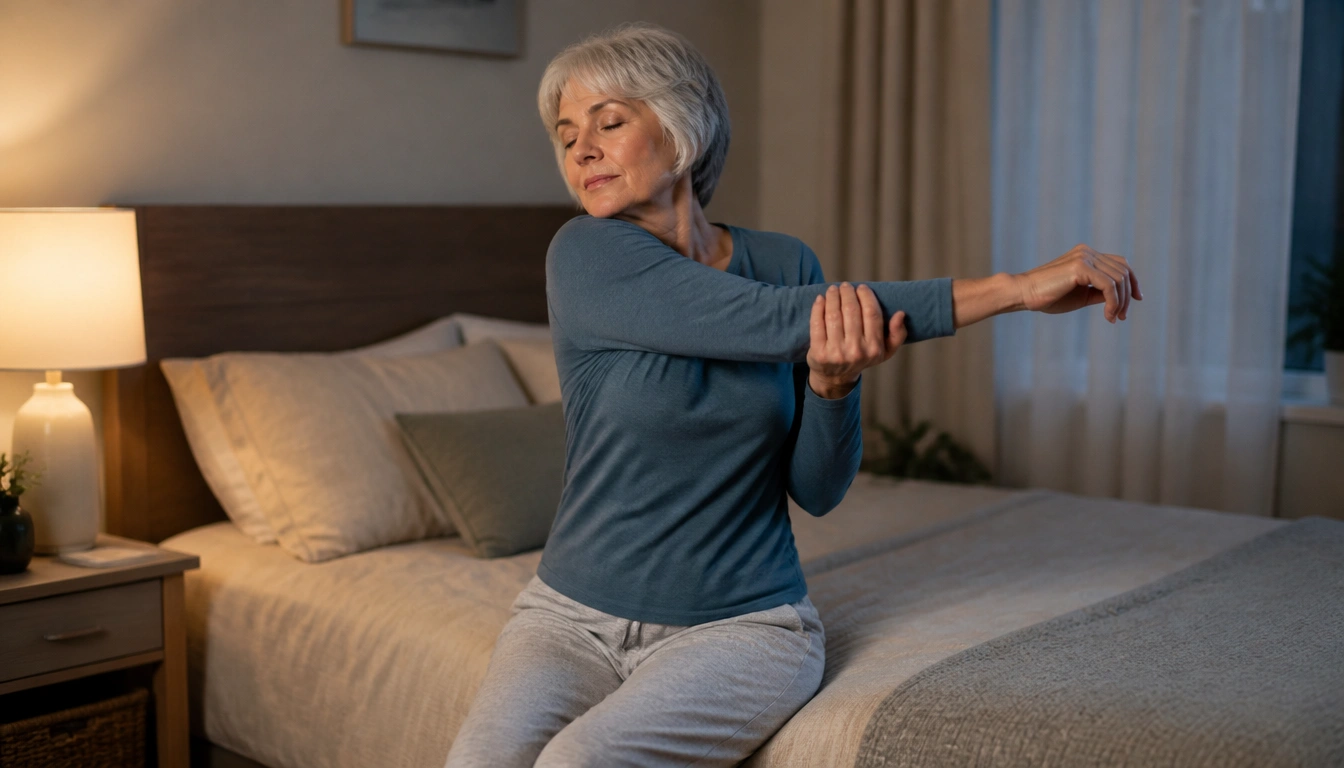
The safest and most effective 10-minute pre-bed stretch for many adults over 50 is a gentle routine done seated or lying down, with slow breathing and no bouncing or pain. Focus on neck, torso, hips, and hamstrings using mild tension only. This kind of routine can help the body relax before sleep, but it works best as part of a full bedtime wind-down that also includes a consistent schedule and a dark, cool bedroom.
Key Takeaways
- For many adults over 50, seated or supine stretching is safer than standing or floor-based work because it lowers fall risk and reduces balance strain.
- A bedtime stretch should feel like mild tension, not pain. Sharp pain, tingling, joint discomfort, or dizziness are reasons to stop.
- Slow stretching paired with controlled breathing may help shift the nervous system toward a calmer state and support better subjective sleep.
- A short routine can help with common trouble spots such as the neck, shoulders, back, hips, and hamstrings without taking much time.
- Stretching is a complement to sleep hygiene, not a replacement for a regular sleep schedule, screen reduction, and a comfortable sleep environment.
Why a pre-bed stretch can help adults over 50 wind down
A relaxing pre-bed stretch for adults over 50 works best when the goal is not flexibility training but a gentle transition into sleep. Slow movement, paired with steady breathing, can ease the day’s muscle tension and encourage a parasympathetic shift—the body’s calmer “rest and digest” state. That shift may lower arousal, make it easier to settle, and support sleep quality.
As people age, stiffness often builds in the neck, shoulders, back, hips, and legs. A short stretch routine can reduce that sense of physical tightness that sometimes keeps people alert in bed or wakes them up during the night. Some research on mind-body and flexibility practices suggests they may improve subjective sleep quality and sleep efficiency, especially for people with mild sleep disruption.
For many older adults, the safest version is done seated on a sturdy chair or lying on a stable mattress. Standing stretches can feel fine for some people, but they are not the best starting point if there is balance concern, nighttime unsteadiness, or a history of orthostatic hypotension. The point is to relax the body without creating a fall risk.
This routine is most useful for people who want a low-effort wind-down after a long day, especially if they sit a lot, wake with stiffness, or notice that gentle movement helps them feel more comfortable before bed. It should be used as part of a broader sleep routine, not as a substitute for it.
A safe 10-minute pre-bed stretching sequence for older adults
This routine is designed to be simple, quiet, and low risk. Use a firm bed, a sturdy chair, or both. Move slowly and keep your breathing smooth. The sequence below is enough for most people to feel looser without overstimulating the body.
- Settle into a seated position or lie on your back.
- Start with the neck and shoulders.
- Move to a gentle seated twist.
- Lie down for lower-back and hip work.
- Finish with a hamstring stretch on each leg.
Spend about 20 to 30 seconds on each side for the seated stretches and about 30 seconds per side for the lying stretches. If you feel rushed, keep the movement quality calm rather than trying to hold each stretch longer. For bedtime, consistency matters more than intensity.
If you are very stiff, begin with smaller ranges of motion than you think you need. Gentle stretching after age 50 is usually more effective when it feels easy enough to repeat nightly. Overdoing it can leave you sore and may make sleep worse instead of better.
Neck and torso moves that ease upper-body tension
Seated neck and upper trap release: Sit upright at the edge of the bed or in a chair with both feet supported. Let your shoulders relax away from your ears. Gently tip your right ear toward your right shoulder until you feel a mild stretch along the left side of the neck. Keep your chin level and avoid pulling on your head. Hold, breathe, and then switch sides.
This stretch is meant to reduce the tight, braced feeling many people carry in the neck and upper shoulders. It should never feel like a pull into the spine or a pinch into the shoulder joint. If one side feels significantly tighter, keep the tighter side gentle and do not force extra range.
Seated torso twist: Sit tall with feet flat. Place your left hand on your right thigh and your right hand lightly behind you on the bed or chair. Inhale to lengthen the spine, then exhale as you rotate gently to the right. Stay upright rather than collapsing forward. Hold briefly, breathe, then repeat on the other side.
This is a small, controlled twist, not a deep rotation. The goal is to loosen the mid-back and reduce the “stiff from sitting” feeling without compressing the neck or low back. If twisting increases pain, shorten the range or skip it.
Lower-back and hamstring stretches you can do on the bed
Supine single-knee-to-chest: Lie on your back with your head supported by a pillow if needed. Draw one knee toward your chest while the other leg rests straight or bent on the bed. Hold the shin or behind the thigh gently—never force the knee tightly into the body. Breathe slowly, then switch legs.
This move can ease the low back and open the hips in a way that feels restful rather than athletic. It is a good option for people who want to settle down after walking, gardening, or sitting for long periods. Keep the pelvis relaxed and avoid jerking the leg upward.
Supine hamstring stretch with a strap or towel: Lie on your back and loop a strap, belt, or towel around the ball of one foot. With the other leg relaxed, gently raise the leg until you feel a mild stretch along the back of the thigh. The knee can stay slightly bent if that feels better. Hold, breathe, and switch sides.
Keep your shoulders, face, and jaw soft. If the leg shakes, tingles, or pulls hard behind the knee, back off. A hamstring stretch before bed should feel steady and quiet, not aggressive. Slow exhalations can help the body release a little more tension while you hold the position.
How to fit the routine into a bedtime wind-down
Bedtime stretching works best as the final physical signal that the day is ending. Think of it as one step in a larger wind-down, not the whole strategy. The CDC notes that adults generally need 7 to 9 hours of sleep, and sleep quality depends on more than stretching alone.
A practical routine might look like this: finish evening tasks, dim lights, put away your phone or turn off screens, then spend 10 minutes stretching. After that, move into the rest of your sleep routine, such as washing up, reading, or preparing for bed. The consistency of the sequence matters because the brain learns those cues over time.
A calm room also matters. A dark, quiet, cool bedroom can support sleep more than stretching alone. If you stretch while watching television or scrolling on a phone, the body may feel relaxed, but the mind can still stay alert. For that reason, try to make stretching part of a screen-light transition rather than something added on top of stimulation.
Many people do best stretching about 30 minutes before lights out, but there is no single perfect clock time. The useful rule is that the routine should be close enough to sleep to feel connected to bed, yet not so late that you rush through it or forget it. The best timing is the one you can repeat most nights.
When to modify, skip, or stop stretching
Stretching should feel like mild tension or lengthening. It should not feel sharp, stabbing, electrical, or painful. Stop right away if you notice joint pain, nerve tingling, numbness, dizziness, or a sudden increase in discomfort. Those are not signs to push through.
Certain conditions call for extra caution. With osteoporosis, avoid forceful bending, deep spinal flexion, or any movement that feels risky to the spine. With spinal stenosis, some people do not tolerate certain bending positions well, especially if they worsen leg symptoms. With osteoarthritis, joints may prefer smaller ranges and slower entries into each stretch. After a recent hip or knee replacement, the surgeon’s movement precautions should take priority over any generic stretch routine.
Skip stretching and ask a clinician about it if you have severe balance problems, recent spinal injury, unexplained nighttime leg cramps that keep returning, or sleep symptoms that suggest a deeper issue such as loud snoring with gasping or marked daytime sleepiness. Stretching is a comfort strategy, not a way to override warning signs.
How to adapt the routine for limited mobility or balance concerns
If getting on and off the floor feels unsafe, do the entire routine in bed or in a sturdy chair. That is often the better option for older adults with nighttime balance concerns, dizziness, or fear of falling. Seated and supine positions reduce the need to transition quickly between standing and floor work, which can be a problem for people prone to orthostatic symptoms.
For limited mobility, shorten the range of motion first rather than skipping the stretch entirely. For example, a neck stretch can be very small, and a hamstring stretch can use a bent knee. A chair with armrests, a firm mattress, a pillow under the knees, or a towel under the head can make the positions more comfortable.
If arthritis makes gripping difficult, loop the strap around the thigh instead of the foot, or simply hold the back of the thigh with both hands. If your back does not like twisting, keep the torso twist very light or replace it with slow side-to-side breathing while seated. If you need support getting down to the bed, that is a sign to keep the routine seated rather than trying to prove you can do it a harder way.
When stretching is not enough and sleep symptoms need evaluation
Gentle stretching can help with relaxation, but it does not treat every sleep problem. If you have trouble falling asleep or staying asleep most nights for more than a month, it is worth discussing with a healthcare professional. Persistent insomnia may need a more complete look at pain, medications, stress, mood, sleep schedule, or an underlying sleep disorder.
Medical evaluation is also important if you snore loudly, stop breathing during sleep, gasp, or feel excessively sleepy during the day. Those can be signs of obstructive sleep apnea, which stretching will not fix. Likewise, recurring leg cramps, numbness, weakness, or pain that keeps worsening deserve attention.
For many adults over 50, the best outcome comes from combining a simple stretching routine with other sleep basics: a regular wake time, a predictable bedtime routine, limited evening screen exposure, and a sleep environment that supports rest. Stretching can be a useful part of that system, but it works best when the rest of the system is in place too.
Frequently Asked Questions
Which stretches are best for neck, shoulders, back, hips, and legs before sleep after 50?
The most practical options are a gentle seated neck stretch, a seated torso twist, a supine single-knee-to-chest stretch, and a supine hamstring stretch with a strap or towel. These target common stiffness areas without requiring standing balance or deep floor work.
How long should each stretch be held at bedtime?
A short hold is usually enough: about 20 to 30 seconds for seated stretches and about 30 seconds per side for lying stretches. The goal is calm, repeatable movement, not maximum flexibility. If you feel rushed or sore, shorten the hold rather than pushing harder.
Should pre-bed stretching be done standing, seated, or lying down for older adults?
For many adults over 50, seated or lying-down positions are safer because they reduce fall risk and balance strain. Standing stretches can be fine for some people, but they are usually not the best choice if you feel unsteady, dizzy, or very stiff at night.
Can stretching before bed actually improve sleep quality and sleep efficiency?
It may help some people, especially when it is gentle and paired with slow breathing. Research on mind-body and flexibility practices suggests benefits for subjective sleep quality and sleep efficiency, but stretching works best as part of a broader sleep routine rather than as a stand-alone fix.
What stretches should adults over 50 avoid if they have arthritis, osteoporosis, spinal stenosis, or joint replacements?
Avoid any stretch that causes pain, nerve tingling, or joint discomfort. People with osteoporosis should be cautious with forceful spinal bending, those with spinal stenosis may need to limit certain positions, and people with recent hip or knee replacements should follow their surgeon’s precautions. Arthritis often calls for smaller, slower movements.
The Bottom Line
A calm pre-bed stretch for adults over 50 works best when it is short, gentle, and easy to repeat. Seated or supine positions are often the safest choice because they reduce balance demands and make the routine easier to fit into a real bedtime schedule.
Use mild tension, slow breathing, and stop signs as your guide. If stretching is causing pain, tingling, dizziness, or worsened joint symptoms, modify the movement or get medical advice. And if sleep problems keep going despite good sleep habits, it is time to look beyond stretching alone.
Medical disclaimer
Medical disclaimer: This content is for educational and informational purposes only and is not a substitute for professional medical advice, diagnosis, or treatment. Dietary needs and supplement suitability vary by individual.
Sources
- National Institutes of Health (NIH) — nih.gov. Accessed October 2026.
- Centers for Disease Control and Prevention (CDC) — cdc.gov. Accessed October 2026.
- Centers for Disease Control and Prevention (CDC) — cdc.gov. Accessed October 2026.
- Hospital for Special Surgery (HSS) — hss.edu. Accessed October 2026.
