
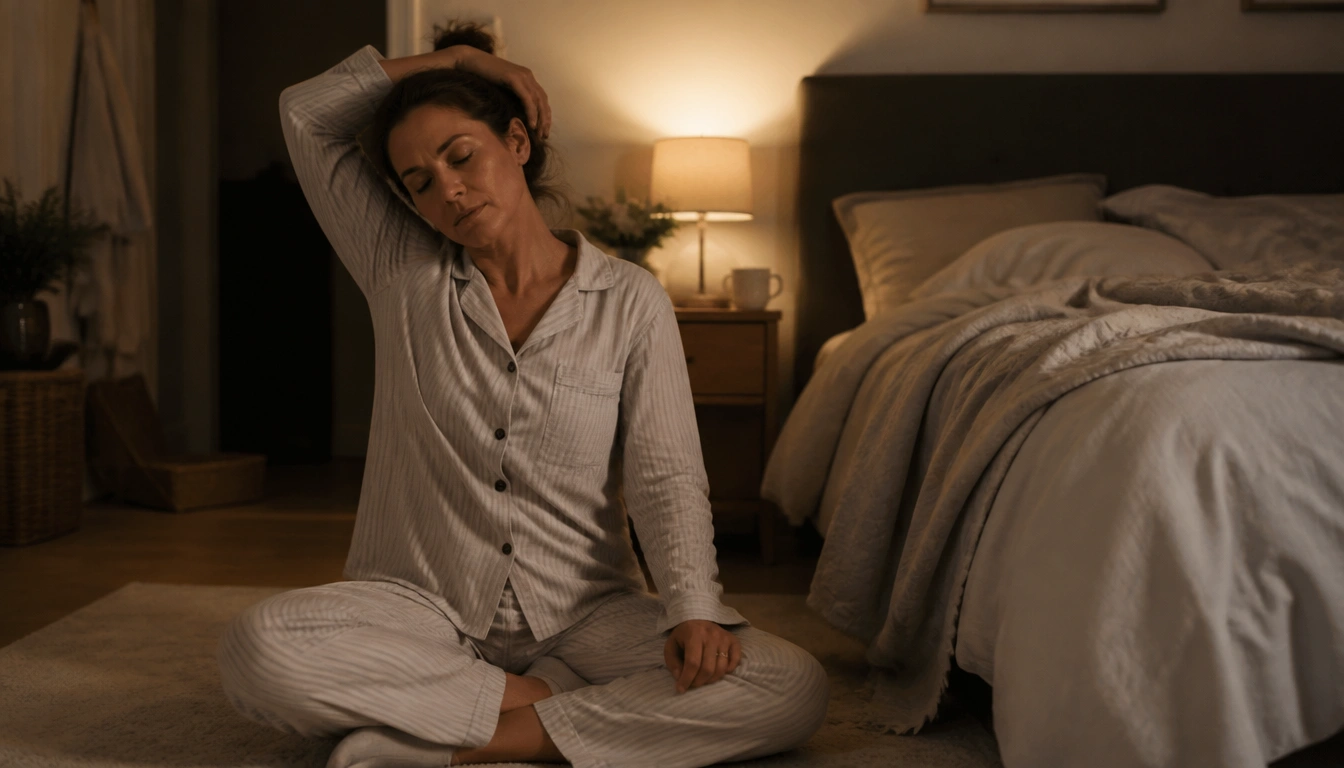
The best short pre-bed stretch routine is a 5-minute sequence of gentle, low-effort stretches that relax the neck, shoulders, hips, and lower back while you breathe slowly. It should feel calming, not athletic. For busy parents, the most useful version is one you can do in pajamas, on a small floor space, right before bed, and repeat often enough to become a reliable wind-down cue.
Key Takeaways
- A relaxing pre-bed stretch works best as a calm transition, not a workout, so keep the movements slow and easy.
- Focus on the areas that usually hold parent tension: neck, shoulders, hips, and lower back.
- A 5-minute routine is enough for many people if you do it consistently and pair it with slow breathing.
- Gentle stretching is different from vigorous exercise near bedtime; strenuous activity can be too stimulating, while restorative movement may help you settle.
- If a stretch causes sharp, shooting, or radiating pain, stop and choose a gentler option or get medical advice.
Why parents feel tired but wired at bedtime
Many parents reach bedtime physically drained but mentally alert. That combination is common after a day of childcare, work, lifting, carrying, bending, and constant decision-making. Stress can leave the nervous system in a heightened state, which makes it harder to shift into sleep mode even when your body is exhausted.
That stress often shows up as muscle tightness. The neck, shoulders, hips, and lower back are common holding patterns because they absorb a lot of repetitive daily strain: looking down at children, feeding or carrying them, sitting at a desk, and getting up and down from the floor. A short relaxing pre-bed stretch gives those areas a chance to soften.
Public health guidance on sleep hygiene emphasizes a consistent wind-down routine. The goal is not to force sleep, but to create a predictable bridge from daytime activation to rest. That is especially helpful for caregivers whose evenings are fragmented and unpredictable.
What makes pre-bed stretching different from exercise
Stretching before bed is not the same as doing a workout. Strenuous or high-intensity exercise close to bedtime can be stimulating because it raises heart rate, body temperature, and alertness. Sleep guidance from health agencies such as the CDC and NHS commonly recommends avoiding vigorous activity in the couple of hours before sleep.
Gentle stretching is different because it is slow, quiet, and low effort. When paired with steady breathing, it can support a parasympathetic shift, which is the body’s rest-and-digest mode. In practical terms, that means you are using movement to signal safety and downshift, not to train or tire yourself out.
A helpful way to judge the difference: if you feel more awake, sweaty, or energized afterward, the session was probably too intense for a bedtime routine. If you feel looser, slower, and calmer, you are likely in the right zone. The routine should feel restorative rather than athletic.
The 5-minute bedtime stretch routine for busy parents
This routine is designed to be low-friction and realistic. You can do it on a rug, bedroom floor, yoga mat, or even beside the bed. If you have only a little space, shorten the range of motion and keep the breathing slow.
Start with one minute of settling
Sit or lie down comfortably and take a few slow breaths through your nose if that feels easy. On each exhale, let your shoulders drop. Try not to force deep breathing; just make the exhale a little longer than the inhale if that feels natural. This helps shift attention away from the day and into the body.
Child’s pose or a supported resting fold
Spend about one minute in a gentle child’s pose if your knees and hips tolerate it. Kneel with your knees comfortably apart, sit your hips back toward your heels, and reach your arms forward or rest them by your sides. If kneeling is uncomfortable, sit on the edge of the bed and fold forward slightly with your forearms on your thighs or a pillow. This position can ease the low back and shoulders while giving you a quiet place to breathe.
Figure four for hips and glutes
Move to your back and cross one ankle over the opposite knee. If that is enough, stay there. If you want more sensation, draw the lower thigh toward you a little. Hold briefly, then switch sides. This is often useful for the hips and glutes, which can tighten from long periods of sitting, carrying, and standing with children.
Gentle knees-to-chest or a small twist
Bring both knees in toward your chest for a soft release, or let both knees drift to one side while your shoulders stay grounded. Keep the movement small. The purpose is to let the lower back and trunk release tension, not to deepen the stretch aggressively. If one position feels better than the other, use that one instead.
Finish with a quiet supported rest
End with one to two minutes lying comfortably on your back with your legs up on the wall or resting on the bed, if that feels good for you. If wall space is unavailable, simply lie flat with your knees bent. Keep your jaw loose, your tongue relaxed, and your breathing slow. This final pause matters because it turns stretching into a sleep bridge rather than a rushed checklist.
If five minutes feels like too much on a hard night, do the last two positions only. A shorter routine done regularly is usually more useful than an ideal routine that never happens.
How to adapt the routine if you’re postpartum, very tight, or short on floor space
Postpartum bodies often need extra caution. Ligaments and joints can remain more sensitive after pregnancy, so avoid forcing range or hanging out in deep stretches. Keep the effort mild, especially if you are recovering from delivery, healing abdominal or pelvic floor changes, or feeling unstable around the pelvis. If you were recently pregnant and have pain, leakage, heaviness, or a sense that something is not right, it is wise to ask a clinician or pelvic health physical therapist for individualized guidance.
If you are very tight, do less rather than more. A small, comfortable range of motion is enough. You do not need to “earn” relaxation by stretching hard. You may get a better result from holding each position a little longer, reducing the depth, and focusing on the exhale.
For tiny spaces, skip any move that feels awkward and use the bed as your base. You can do a supported forward fold sitting on the edge of the mattress, a gentle figure four on your back, and a small knee drop side to side. No special gear is required. Pajamas, a pillow, and a floor or bed surface are enough.
How to make the habit stick on chaotic nights
Busy parents rarely need a more complicated routine; they need one that is easy to remember. The best strategy is to attach the stretch to something you already do every night, such as brushing your teeth, dimming the lights, or putting the kids down. That kind of cue-based stacking makes the routine feel automatic rather than like one more task.
Make the setup almost effortless. Keep a pillow or folded blanket nearby if that helps, but do not rely on equipment that requires assembly. The fewer steps between “I’m in bed” and “I’m starting the routine,” the more likely it is to happen.
Give yourself a minimum version for difficult nights. For example, one minute of breathing, one gentle hip stretch, and one minute lying still is enough to keep the habit alive. The point is consistency and a repeatable signal to the body, not perfection. Over time, your brain can begin to associate the sequence with sleep.
Safety checks: when to stop and who should get medical clearance first
Stretching should feel mildly easing, not painful. Stop right away if you feel sharp pain, shooting pain, numbness, tingling, dizziness, or symptoms that radiate down an arm or leg. Those signs suggest the movement is too aggressive or that something else may be going on.
People with certain conditions should speak with a healthcare professional before starting a new stretching routine, especially if they have acute disc problems, severe osteoporosis, uncontrolled high blood pressure, or a recent injury or surgery. If you are postpartum and unsure what is safe, a clinician can help tailor the routine to your recovery stage.
Also pay attention to lingering pain that does not match ordinary muscle tightness. Stretching is not the right fix for every type of discomfort. If your pain is persistent, worsening, or interfering with daily function, a medical evaluation can help rule out a condition that needs more than a bedtime routine.
How to tell whether the routine is helping
Look for subtle changes first. You may notice that your shoulders drop more easily, your breathing slows, or your mind feels a little less busy by the end of the routine. Some nights the stretch will not make you sleepy immediately, but it can still lower tension and make the transition to bed smoother.
Track consistency before you judge results. A routine done most nights for a couple of weeks is more useful than a more dramatic routine used sporadically. Sleep hygiene works best when the signal is repeated often enough for your body to recognize it.
Realistic expectations matter. Stretching can support sleep, but it is not a cure for chronic insomnia, sleep apnea, or ongoing pain. If bedtime tension keeps building despite good habits, or if sleep problems persist for weeks, it may be time to ask a professional for help.
Frequently Asked Questions
How long should a pre-bed stretch routine be to actually help with sleep?
For many busy parents, 5 minutes is a practical and effective target because it is short enough to repeat consistently. Some people prefer 7 to 10 minutes, but the best routine is the one you can realistically do most nights without feeling burdened by it.
Which stretches are safest and most useful for parents who are sore in the neck, shoulders, hips, and lower back?
Gentle child’s pose, a supported forward fold, figure four, small knees-to-chest variations, and a light back-lying twist are common choices. Keep the range small and avoid pushing into pain. If one area feels irritable, choose the most comfortable version instead of forcing a deeper stretch.
Can I stretch right before bed, or should I avoid any movement too close to sleep?
Gentle stretching right before bed is usually fine and can even help some people wind down. The main thing to avoid is vigorous exercise, which can be too activating late at night. If stretching makes you feel energized rather than calm, make it gentler and slower.
What should I do if I’m postpartum, tight, or less flexible than average?
Use smaller movements, support your body with pillows or the bed, and avoid deep holds. Postpartum people should be especially cautious about joint laxity and any pelvic or abdominal symptoms. If you are unsure what is safe for your stage of recovery, ask a clinician or pelvic health specialist.
When is stretching not a good idea, and when should I get medical advice?
Do not keep stretching through sharp, shooting, numb, or radiating pain. Get medical advice if you have a recent injury, known spine or bone condition, unexplained symptoms, or pain that keeps returning. If sleep problems or pain are lasting for weeks, a professional evaluation is appropriate.
The Bottom Line
A short pre-bed stretch routine can be a realistic way for busy parents to shift out of tension and into sleep mode. The most useful version is gentle, repeatable, and easy enough to do on tired nights without special equipment.
Focus on the neck, shoulders, hips, and lower back, and keep the pace slow with relaxed breathing. If a movement feels sharp, intense, or energizing, scale it back. Consistency matters more than depth or complexity.
If you are postpartum, have a pain condition, or notice persistent sleep problems, get individualized advice. Stretching can support bedtime relaxation, but it should not replace medical care when symptoms suggest something more is going on.
Medical disclaimer
Medical disclaimer: This content is for educational and informational purposes only and is not a substitute for professional medical advice, diagnosis, or treatment. Dietary needs and supplement suitability vary by individual.
Sources
- Centers for Disease Control and Prevention (CDC) — cdc.gov. Accessed October 2026.
- National Health Service (NHS) — www.nhs.uk. Accessed October 2026.
- National Health Service (NHS) — scot.nhs.uk. Accessed October 2026.
- National Health Service (NHS) — kingstonandrichmond.nhs.uk. Accessed October 2026.
- U.S. Government / Health Authority — wi.gov. Accessed October 2026.
