
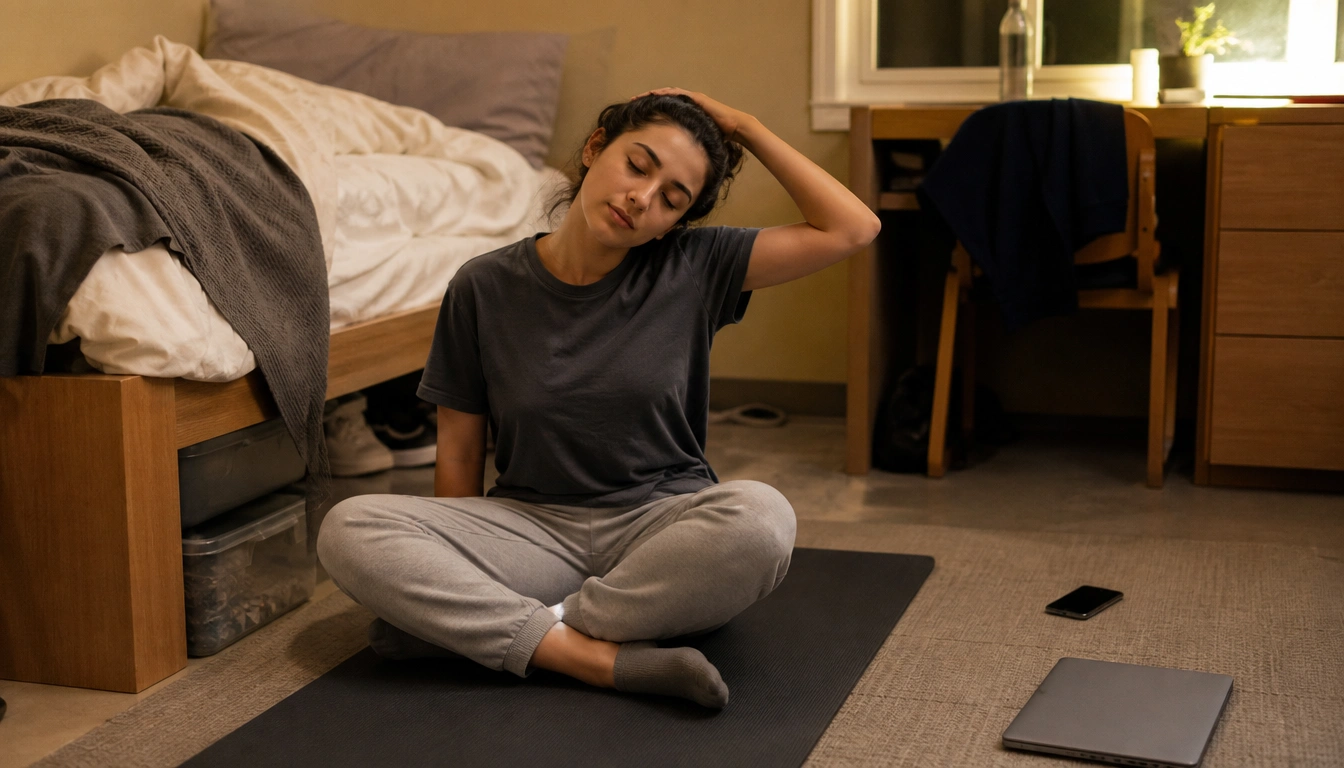
Yes—gentle, low-intensity stretching before bed can help college students relax and fall asleep more easily, especially when stress, screen time, and long hours of sitting leave the neck, shoulders, hips, and lower back tense. The most useful routines are short, quiet, and restorative, not sweaty or intense. A 10-minute sequence done consistently can work well as a wind-down cue.
Key Takeaways
- Use slow, gentle stretches that feel relaxing, not strenuous; bedtime is not the time for intense exercise or aggressive bouncing.
- Focus on the areas students commonly tighten up: neck, shoulders, hip flexors, hamstrings, and lower back.
- Pair stretching with a fixed habit cue, such as powering down devices or putting your phone across the room.
- Keep the routine brief and repeatable; consistency matters more than flexibility gains.
- Stop if you feel sharp pain, dizziness, numbness, or symptoms that worsen with stretching.
Why a pre-bed stretch can help you unwind
A relaxing pre-bed stretch works less like a workout and more like a behavioral dimmer switch. If your day has been full of deadlines, caffeine, bright screens, and a hunched study posture, your body can stay in a high-alert mode even after you get into bed. Gentle stretching helps interrupt that pattern by slowing your breathing, reducing muscle guarding, and nudging the nervous system toward a calmer state.
That shift matters because sleep is easier to reach when the body is not still preparing for action. Slow, comfortable holds can support the transition toward parasympathetic activity, the “rest and digest” side of the nervous system. They can also make you more aware of tension you may have been ignoring all day, which is useful if a tight neck or lower back is what keeps you tossing and turning.
The key is the intensity. Restorative stretching or light static stretching close to bedtime is different from a hard workout. Vigorous exercise, fast-paced movement, or ballistic bouncing can raise arousal and body temperature, which may work against sleep readiness. If the routine leaves you energized instead of settled, it is probably too intense for night.
A 10-minute dorm-friendly pre-bed stretch routine
You do not need equipment, a yoga background, or much floor space. A mat, a carpet, or even a folded blanket is enough. Move slowly and breathe out longer than you breathe in. The goal is not to “max out” range of motion; it is to tell your body that the day is over.
Neck and shoulder release
Sit comfortably and let one ear drift toward the same-side shoulder until you feel a mild stretch along the opposite side of the neck. Keep both shoulders relaxed. Hold, breathe, then switch sides. After that, make slow shoulder rolls to ease the tightness that builds from backpack straps, laptop use, and long study sessions.
Child’s pose for full-body downshifting
Kneel on the floor, sit back toward your heels, and reach your arms forward with your forehead resting down if that feels comfortable. This position can help lengthen the spine without effort and is often calming because it removes the need to “hold yourself up.” If kneeling bothers your knees, place a pillow or folded blanket under them.
Seated hamstring and lower-back stretch
Sit with one or both legs extended and hinge forward from the hips with a long spine. Keep the stretch mild, especially if your hamstrings are tight from sitting for hours. A slight bend in the knees is fine. This movement can ease the pull that sometimes shows up in the lower back when the back of the legs feels tight.
Supine knee-to-chest or gentle twist
Lie on your back and bring one knee toward your chest. If that feels comfortable, guide it slightly across your body for a gentle twist while keeping both shoulders as relaxed as possible on the floor. This can be useful after a day of sitting because it lets the hips and low back unwind without much effort.
Why students feel the most tension in the neck, shoulders, hips, and low back
College life creates a predictable set of tension points. Sitting through lectures, leaning over notes, and typing on a laptop can shorten the front of the hips, round the shoulders, and leave the neck working overtime. Carrying a heavy backpack adds another layer of strain, especially if you tend to shrug your shoulders up while walking across campus.
That is why a bedtime routine should not be random. If your body spends most of the day in flexed, forward positions, then a few minutes of counter-movement before bed makes sense. The routine does not need to be fancy. It just needs to target the places that feel most compressed and overworked by student life.
If you are sore from studying, gentle stretching can feel like a reset. If you are sore from training, the same rule still applies: keep it easy. Sleep is usually better supported by light mobility than by trying to make major flexibility gains late at night.
Legs-up-the-wall as a final wind-down pose
As a final position, legs-up-the-wall can be a useful closing cue. Lie on your back and place your legs against a wall so your body can rest with very little effort. If the full position feels awkward, you can keep your knees slightly bent or move farther from the wall. The point is comfort, not perfection.
This pose can feel especially good after a long day on your feet, a lot of walking between classes, or hours of sitting. Many students like it because it gives the body a clear “done for the night” signal. While you stay there, keep the breathing slow and let your jaw, hands, and shoulders soften.
How to time stretching with your screen-off routine
Stretching works best when it is tied to a real habit cue. If you wait until you “feel like it,” the routine is easy to skip. A better approach is to connect it to something concrete: power down your laptop, put your phone on the charger across the room, dim the lights, and then start stretching. According to the CDC and sleep experts, reducing late-evening screen stimulation is one of the most useful sleep habits you can build.
For many students, the routine is most effective when it becomes the last thing you do before bed. That makes it a boundary against one more scroll, one more email, or one more chapter of studying. If you need a simple structure, think: screens off, stretch, bathroom, bed. Repeating the same sequence helps your brain learn that sleep is next.
If you live in a dorm, the phone-across-the-room trick matters. It reduces the temptation to keep checking notifications after you start to feel sleepy. Stretching becomes part of a larger wind-down, not just an isolated exercise block.
How to modify the routine for tight muscles, soreness, or small spaces
If your hamstrings are tight, bend your knees during forward folds instead of forcing the stretch deeper. If your shoulders are sore, keep arm positions lower and more relaxed. If you are using a shared dorm room or a cramped apartment, you can still do most of the routine beside your bed with minimal space.
For sore muscles after the gym, keep the movements slow and comfortable. Gentle stretching can be fine, but it should not feel like a challenge or a test of flexibility. Avoid forcing any position if the muscle is already irritated. For students with hypermobility, especially those who can easily overreach into end range, smaller ranges are safer than deep holds.
If you have a history of back pain or a recent injury, choose positions that feel steady and supported. A pillow under the knees, a folded towel under the hips, or a shorter hold can make the routine more comfortable. The right stretch is one you can relax into, not one you need to brace against.
When stretching is not enough
Pre-bed stretching can help with routine tension and stress, but it is not a treatment for persistent sleep problems. If you have trouble falling asleep most nights, wake up often, feel exhausted during the day, or suspect something like sleep apnea, you should get evaluated by a campus health clinician, primary care provider, or sleep specialist.
Also seek help if stretching causes sharp pain, numbness, tingling, dizziness, or pain that lingers after you stop. Those are signs that the problem may be more than ordinary tightness. The same is true if back or neck discomfort is becoming a regular part of your night. Stretching may still be part of your routine, but it should not replace proper assessment when symptoms keep returning.
For most students, the best use of a bedtime stretch is simple: reduce physical tension, lower mental speed, and make sleep easier to start. It is a support for sleep, not a cure-all.
Frequently Asked Questions
How long should a pre-bed stretch routine be for sleep?
For most college students, 5 to 10 minutes is enough. A short routine is easier to repeat consistently, and consistency matters more than doing a long flexibility session. If the stretches help you feel calmer and less tense, that is usually a good sign the routine is the right length.
Which stretches are safest before bed for students with tight neck, shoulders, or hips?
Gentle neck side bends, slow shoulder rolls, child’s pose, a mild seated hamstring stretch, and a light knee-to-chest position are common options. Keep every stretch comfortable and avoid forcing depth. If a position causes pain or pinching, switch to a smaller range of motion.
Should I stretch before bed if I’m sore from the gym or from sitting all day?
Usually yes, if the stretching is light and does not aggravate the soreness. Gentle mobility can help you relax after sitting and may feel good after exercise. Avoid aggressive stretching when a muscle feels strained, sharp, or unusually irritated.
Can stretching at night actually help with stress and sleep, or is it just a placebo?
It can genuinely help some people. Gentle stretching can slow breathing, reduce muscle tension, and create a predictable wind-down ritual, which may support relaxation and sleep readiness. It should not be treated as a cure for insomnia, but it can be a useful part of a sleep routine.
What should I avoid doing in a bedtime stretching routine?
Avoid intense workouts, bouncing into stretches, pushing through pain, and anything that leaves you energized or overheated. It is also smart to avoid pairing the routine with more screen time. The goal is to calm the body, not to turn the routine into another source of stimulation.
The Bottom Line
A short pre-bed stretch can be a practical sleep cue for college students, especially when long study hours and screen time leave the body tense. The most helpful routines are gentle, repeatable, and focused on the areas that commonly tighten up during student life.
Keep the sequence simple: neck and shoulder release, child’s pose, a hamstring or lower-back stretch, a gentle twist, and a restful finish such as legs-up-the-wall. Pair it with a real habit cue like turning off devices or putting your phone across the room.
If stretching feels painful, if sleep problems keep going for weeks, or if you suspect a medical sleep issue, get evaluated. Stretching can support sleep, but it should not be the only answer when symptoms are persistent.
Medical disclaimer
Medical disclaimer: This content is for educational and informational purposes only and is not a substitute for professional medical advice, diagnosis, or treatment. Dietary needs and supplement suitability vary by individual.
Sources
- National Institutes of Health (NIH) — nih.gov. Accessed October 2026.
- Centers for Disease Control and Prevention (CDC) — cdc.gov. Accessed October 2026.
- Academic Research Institution — snhu.edu. Accessed October 2026.
- Academic Research Institution — colostate.edu. Accessed October 2026.
