
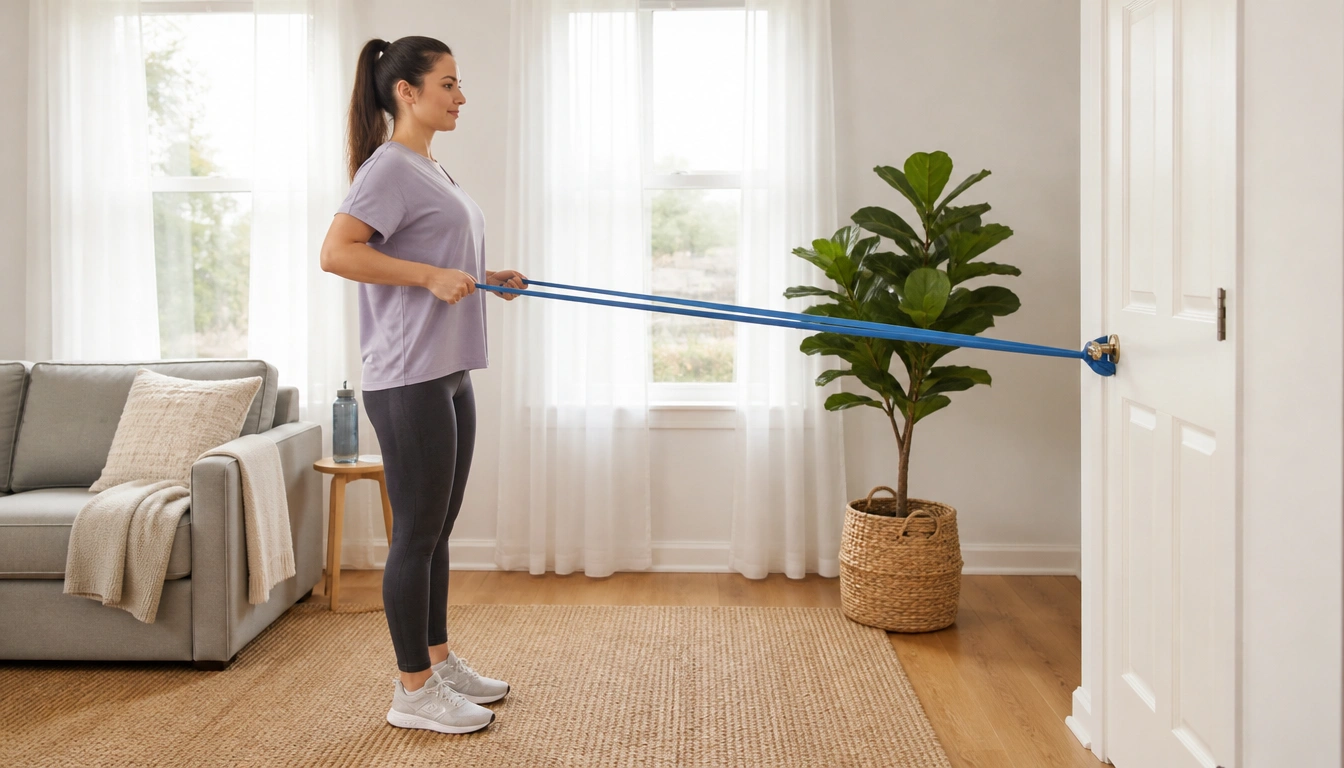
The simplest safe resistance-band routine for a true beginner is a small full-body plan done twice a week: row, squat, pull-apart, bicep curl, and Pallof press. Choose a band that lets you finish the target reps with clean form, not one that looks “light” by color alone. Start with 2 sets per move, rest at least one day between sessions, and keep every repetition controlled.
Key Takeaways
- Begin with two full-body sessions per week and leave at least one rest day between them.
- Early strength gains in the first 2 to 3 weeks are mostly nervous-system adaptation, not sudden muscle growth.
- Band colors are not standardized, so the right band is the one that lets you keep strict form for the target reps.
- Inspect bands before every workout, use secure anchors, and never let the band snap back.
- A five-move routine is enough to start: row, squat, pull-apart, bicep curl, and Pallof press.
Why resistance bands are a smart first strength tool for beginners
For someone who has never done strength training, resistance bands are often easier to start with than free weights or machines. They are inexpensive, easy to store, and friendly for home workouts. The resistance increases as the band stretches, so the load usually feels smooth rather than abrupt. That makes it easier to learn basic patterns without needing a gym.
Public health guidance from the CDC and the American College of Sports Medicine supports regular muscle-strengthening activity for all major muscle groups. Bands fit that goal well because they can train the upper body, lower body, and core with very little equipment. They also make it easier to scale the challenge by changing hand position, band length, or band thickness.
For a beginner, the most useful goal is not to “work out hard.” It is to practice the same simple movements often enough to learn them and recover from them. That is why a short routine repeated consistently is better than a complicated split program.
Simple weekly schedule: do your band routine two days per week, with at least one full day off between sessions. A Tuesday-and-Friday pattern works well for many people, but any two nonconsecutive days are fine. If you feel unusually sore or shaky, keep the next session lighter rather than adding more exercises.
How to choose a band: flat, tubing with handles, or closed-loop
Beginners usually do well with one of two styles. Flat bands or tubing with handles are useful for rows, presses, curls, and Pallof presses because they are easy to hold. Closed-loop bands are especially convenient for lower-body work and can be easier to position for squats or glute exercises. Neither style is universally better; the best choice is the one that fits the movements you can do safely and consistently.
Band color is a rough brand-specific label, not a universal standard. A “light” band from one company may feel stronger than a “medium” band from another. That is why color alone is not a reliable way to choose. Instead, test whether you can complete your target reps with solid posture, steady breathing, and control through the return phase of the movement.
If you are unsure, start easier than you think you need. The first goal is not maximum resistance. The first goal is a band that lets you move well without cheating, leaning back, shrugging, or holding your breath. If the last few repetitions feel challenging but still tidy, you are in the right zone.
How hard the workout should feel
For absolute beginners, a workout should feel like a manageable challenge, not a test of toughness. Your form should stay the same from the first repetition to the last. If your back arches, your shoulders creep up, or you start jerking the band, the resistance is probably too high or the set is too long.
One useful expectation: early strength gains often show up within the first 2 to 3 weeks, but they are usually driven by neuromuscular adaptation. In plain language, your nervous system is getting better at coordinating the movement. That means you may feel stronger before you see visible muscle change. That is normal and reassuring, not a sign that the workout is “too easy.”
The ACSM and other exercise guidance support starting with modest volume and building gradually. For this routine, 2 sets per exercise is enough to begin. If you finish a set feeling like you could have done many more perfect repetitions, the band may be too light. If you cannot keep good form, it is too hard. A good beginner set usually lands between those two extremes.
Safety checks before every session
Safety matters more with bands than many people expect because elastic material stores energy. Inspect the band before each session for nicks, thinning spots, cracks, fraying, or damaged handles. If anything looks worn, replace it rather than trying to “get one more workout” from it.
Anchor points should be stable and secure. Use a proper door anchor or another solid attachment point that will not move or slip. Do not loop a band around a sharp edge, an unstable chair, or furniture that could tip. Keep the path of the band clear so it cannot recoil toward your face, eyes, or nearby people if it slips.
During the exercise, control both directions. Do not let the band snap back. The lowering phase should be smooth and deliberate. If you feel sharp pain, catching, sudden instability, dizziness, or pain that seems localized to a joint rather than working muscle, stop. People with recent injuries, uncontrolled blood pressure, or other medical concerns should check with a clinician before starting a new exercise plan, as recommended by public health and exercise authorities.
The 5-move resistance band starter routine
This routine is intentionally small and repeatable. It targets the major muscle groups without requiring complicated setup. Perform the exercises in the order shown, then repeat the circuit if you have the energy and your form is still strong. The goal is to practice good movement twice a week, not to exhaust yourself.
1. Band row
Target: upper back and posture muscles. Sit with legs straight or stand with the band anchored securely in front of you. Pull your elbows back toward your ribs, then return slowly. Think “chest tall, shoulders down.”
2. Band squat
Target: thighs and glutes. Stand on the band and hold the ends at shoulder height or by your sides, depending on the style you have. Sit back and down as if reaching for a chair, then stand up by pushing through your whole foot. Keep the knees comfortable and tracking in line with the feet.
3. Band pull-apart
Target: rear shoulders and upper back. Hold the band at chest height with arms extended, then pull the hands apart until the band opens across your chest. Return under control. Use a lighter band than you think if your shoulders tend to shrug.
4. Bicep curl
Target: front of the arms. Stand on the band and keep your upper arms close to your sides. Curl the handles or ends toward your shoulders, then lower slowly. The elbows should not drift forward to help the band up.
5. Pallof press
Target: deep core and trunk stability. Stand sideways to a secure anchor point and hold the band at your chest. Press straight out without letting your torso twist, pause briefly, then bring your hands back in. Switch sides and repeat. This move trains bracing without forcing a lot of spine motion.
A practical starter dose is 2 sets of 12 to 15 repetitions for the row, squat, pull-apart, and curl, and 2 sets of 8 to 10 repetitions per side for the Pallof press. If that feels like too much in week one, use 1 set first and build up. The routine works because it is simple enough to repeat and easy to progress.
How to run the session
Start with a brief warm-up of 3 to 5 minutes. March in place, make small arm circles, and do a few gentle torso rotations. You are trying to raise your body temperature and reduce stiffness, not to tire yourself out before the first set.
Move through the exercises at a steady pace. For most beginners, a simple rhythm works best: lift or pull the band in a controlled way, pause for a moment if needed, and return slowly. Do not rush the lowering phase. If you can, count a similar tempo on both the effort and return portions of the rep.
Rest long enough to breathe normally between sets. Many beginners do well with 45 to 90 seconds, but the exact rest is less important than keeping the next set technically clean. If your breathing is still ragged or your grip is failing, rest a little longer.
Watch for a few basic form cues: ribs stacked over pelvis, shoulders relaxed, neck long, and no holding the breath. If one side feels weaker, that is common. Keep the movement symmetrical and controlled rather than trying to force extra reps on the weaker side.
How to progress without overcomplicating the plan
Progress should be gradual and simple. In the first few weeks, consistency matters more than complexity. The easiest way to progress is to keep the routine the same and make one small change at a time: add a few reps, slow the lowering phase, or use a slightly stronger band only when the current one feels clearly too easy.
You do not need a different workout for every day of the week. For most beginners, repeating the same full-body plan twice weekly is enough to learn the movements and build confidence. If you want more challenge later, first increase the quality of each rep. Then consider adding a third set only if recovery is good and your schedule supports it.
Another useful form of progression is better control. If a squat used to wobble and now looks smooth, that is progress. If your row used to involve a shrug and now your shoulder blades move more cleanly, that is progress too. Beginners often improve faster from better coordination than from heavier resistance alone.
Common beginner mistakes and how to fix them
One common mistake is choosing a band that is too heavy because the color seems right. Fix it by selecting the band that allows you to stay strict through the target rep range. Another mistake is trying to copy advanced routines with too many exercises, too many sets, or too little rest. A short routine done well is far better than a big routine done inconsistently.
Home setup errors are also common. People sometimes anchor the band to something flimsy or place it over a sharp edge. Fix that before training starts. If the setup feels questionable, it is not the right setup. A safe anchor point should feel boringly secure.
Rushing is another problem. Beginners often let the band pull them back too quickly, which reduces control and can make the movement feel unstable. Slow the return phase. If a movement causes sharp pain, stop and reassess the setup and your range of motion. Muscle effort is expected; joint pain, pinching, or sudden instability is not.
Finally, many beginners assume that if two sessions per week feel easy, they must not be enough. That is not necessarily true. The public-health minimum is meant to be doable and sustainable. Once the habit is established, you can add load or volume gradually. The first win is showing up on schedule and completing clean repetitions.
Frequently Asked Questions
How often should a beginner do resistance-band workouts each week?
A simple beginner target is two nonconsecutive days per week, with at least one full day of rest between sessions. That matches public-health guidance for muscle-strengthening activity and gives your body time to recover and learn the movements.
Which resistance band type is best for a beginner: loop bands or bands with handles?
Both can work well. Bands with handles are often easier for rows, curls, and presses, while closed-loop bands are convenient for squats and lower-body work. The best choice is the one that feels stable in your hands and matches the exercises you plan to do.
How do I choose the right band resistance if the color codes are different by brand?
Ignore color as a universal rule. Brand color codes are not standardized. Choose the band that lets you complete your target reps with strict form, controlled lowering, and a manageable challenge on the last few repetitions.
What exercises should be in a full-body resistance band starter routine?
A simple full-body starter routine can include a row, squat, pull-apart, bicep curl, and Pallof press. Those five moves cover the upper back, legs, shoulders, arms, and core without making the plan complicated.
How do I know if I’m using the band safely and not overdoing it?
Your form should stay steady, you should not feel sharp pain, and the band should be inspected before every session. If the setup feels unstable, the resistance is too hard, or the band snaps back quickly, stop and fix the problem before continuing.
The Bottom Line
A resistance-band starter routine can be simple, effective, and safe for a true beginner. The best plan is a short full-body session done twice a week with clean form, secure equipment, and a band that matches your current ability rather than your expectations.
Start with the same five movements each time, keep the reps manageable, and build gradually. If you stay consistent, the routine is enough to teach the basics, develop strength, and make your first few weeks feel successful instead of overwhelming.
Medical disclaimer
Medical disclaimer: This content is for educational and informational purposes only and is not a substitute for professional medical advice, diagnosis, or treatment. Dietary needs and supplement suitability vary by individual.
