
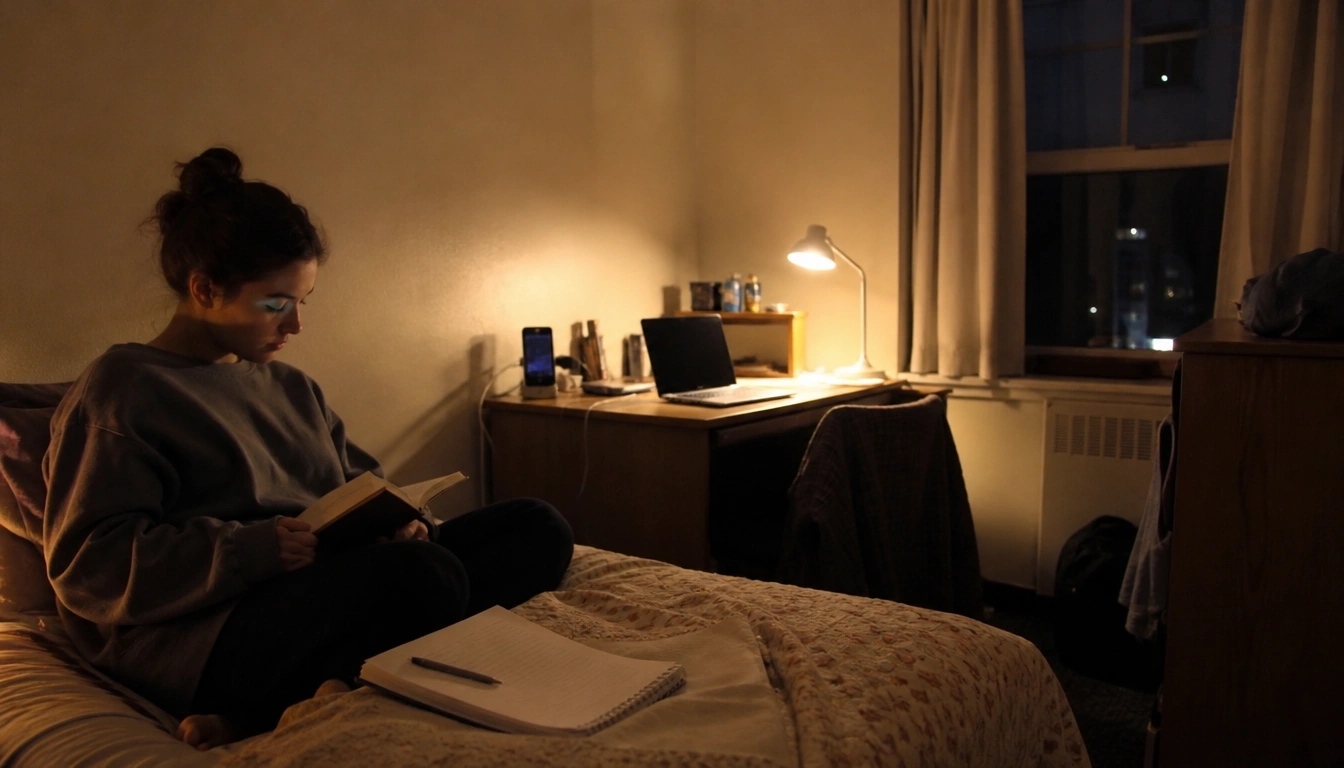
A screen-free evening routine for college students works best when it is realistic: stop the most stimulating screen use 30 to 60 minutes before bed if you can, switch to low-stimulation activities, and keep phones out of reach. If you must study late, reduce brightness and use blue-light filters as a backup, not a full substitute. The goal is to lower mental and visual stimulation so your body can settle into sleep.
Key Takeaways
- A short screen-free buffer before bed can make it easier to fall asleep by reducing light exposure and mental overstimulation.
- You do not need a perfect evening routine; a gradual step-down works better for many students than an abrupt digital cutoff.
- Dorm-friendly changes like a charging station, an analog alarm clock, and warmer lighting can make the habit easier to keep.
- If late-night studying is unavoidable, dimming the screen and using a blue-light filter may help a little, but they do not replace a true wind-down.
- If sleep problems keep going for 3 to 4 weeks, or daytime functioning is slipping, campus health or sleep support may be worth seeking.
Why screens make college sleep worse
A screen-free evening routine for college students matters because screens can push sleep later in two different ways. First, bright evening light can delay the body’s circadian timing and suppress melatonin, the hormone that helps signal sleepiness. Second, scrolling, messaging, gaming, or campus work can keep the brain alert when it should be downshifting.
That combination is especially relevant in college, where bedtime is often irregular and the last hour of the night can turn into a mix of class work, social media, and group chats. The result is not just “staying up late.” It is a pattern that can make it harder to feel sleepy, harder to fall asleep, and more likely to sleep less than the 8 to 10 hours recommended for young adults by the American Academy of Sleep Medicine and endorsed by the CDC.
Sleep loss in this setting can affect attention, mood, reaction time, and memory. According to NIH materials on sleep and circadian health, the body depends on a regular sleep-wake rhythm to support normal daytime function. For students, that means a late-night screen habit can spill into the next morning in a very practical way: groggier classes, slower studying, and more effort to feel mentally online.
What a screen-free evening routine is trying to accomplish
A screen-free evening routine is not about proving willpower or making night feel restrictive. It is about lowering stimulation long enough for the body and mind to shift from “do mode” into sleep mode. That shift usually happens more smoothly when the evening stops feeling like an extension of class, social life, or endless information intake.
For students, the routine should do three jobs. It should reduce bright light exposure, lower mental noise, and create a repeatable signal that the day is ending. This matters because the brain responds well to cues. If your last hour looks the same most nights, sleep becomes easier to recognize and easier to enter.
The best version is often simple: finish the most attention-demanding tasks, put the phone away, then do a few quiet activities that require little decision-making. A routine that feels too ambitious usually fails in college housing, especially when roommates, shared spaces, and unpredictable deadlines are part of everyday life.
The 30 to 60 minute buffer that students can actually keep
For most college students, the most workable goal is a 30 to 60 minute buffer before sleep with no active screen use. If you can stretch that longer, fine. But a realistic buffer is better than a perfect plan you abandon after two nights.
A gradual step-down usually works better than an abrupt shutdown. For example, if you know you are going to sleep around midnight, start moving away from your most stimulating screen use around 11:00 or 11:15. Finish messages, save your work, and stop opening apps that tend to spiral into “just one more minute.” Then shift into low-stimulation tasks that do not pull you back into alert mode.
This approach also acknowledges social connection and FOMO. Many students do not want to disappear from their group chat without warning. A softer transition can help: send a final message, let close friends know you are going offline, and keep your phone available for true emergencies but out of sight for routine checking.
If your schedule changes a lot, anchor the buffer to a cue instead of a clock. For example, the buffer can begin after you finish your last assignment or after you shower. The point is consistency, not perfection.
A dorm-friendly routine that does not take much space
Small rooms can still support a good routine if you design the environment to help you. One of the easiest changes is a charging parking station. Put your phone and laptop on charge across the room, not beside your pillow. If possible, charge them outside the sleep area entirely. Distance creates just enough friction to stop automatic checking.
An analog alarm clock can also help. If you do not need your phone on the nightstand to wake up, you remove one of the main reasons students keep it there. That one change often makes the rest of the routine easier.
Lighting matters too. Dim the overhead light earlier in the evening and switch to a small warm lamp if you need light for reading or journaling. In shared housing, even a single low-watt bulb or a clip-on lamp can make the room feel less like a work zone. Pair that with a few low-effort activities: a physical book, five minutes of journaling, light stretching, or writing down tomorrow’s priorities so they stop circling in your head.
Think of the routine as a sequence: park devices, lower lights, do one quiet activity, then get into bed. The fewer decisions left at the end of the night, the better.
What to do when late-night studying is unavoidable
Sometimes the answer is not “no screens,” because college deadlines are real. If you have to use a laptop at night, aim to reduce the damage rather than pretending the screen is harmless.
Start by using the lowest comfortable brightness and turning on night mode or a blue-light filter. These steps can reduce some visual strain and may soften the sleep impact, but they do not replace a true wind-down. A filtered screen is still a screen, and active studying still keeps the brain engaged. That means it is better to treat these tools as partial mitigation, not as permission to scroll or work right up to lights out.
If you must study late, try to protect the last part of the evening. Finish the screen-based work, save everything, and spend at least a few minutes away from the device before trying to sleep. Even a short reset with dim light, slow breathing, or a paper notebook can help your mind step out of assignment mode.
Also watch for the trap of turning “necessary study” into endless low-value screen time. Checking sources, rereading notes, and hopping between tabs can keep you up longer without improving the work. Set a stopping point before you begin.
How to handle social pressure and FOMO without checking your phone all night
FOMO is a real reason students keep looking at their phones. For many people, the fear is less about missing urgent news and more about not wanting to feel left out, lonely, or disconnected. A routine that ignores that reality usually fails.
One useful tactic is to make the cutoff social instead of secret. Tell your close friends or roommates that you are trying a new sleep routine and may reply later at night. You are not asking them to change their habits; you are just making your boundary visible. That small explanation can reduce the pressure to stay “on” in case someone texts.
Another tactic is to choose one planned check-in rather than repeated checking. For example, answer messages once during the evening, then stop. If you are worried about missing something, remind yourself that most notifications can wait until morning. True emergencies are the exception, not the rule.
If loneliness is driving the habit, replace the phone check with something that still feels connecting but less activating. A voice memo to a friend earlier in the evening, a short call before the wind-down, or an in-person chat in the common area can reduce the urge to keep scrolling in bed.
Best screen-free substitutes that actually help you wind down
The best substitutes are low-stimulation, easy to start, and unlikely to pull you into another round of productivity. Physical reading is one of the strongest options, especially if the material is enjoyable rather than academic. A few pages is enough. You are not trying to finish a chapter; you are trying to cue sleepiness.
Journaling works well for students who have racing thoughts. A quick “brain dump” can get assignments, worries, and reminders out of your head and onto paper. Some students find it useful to end with a very short plan for the next day so they do not keep rehearsing what they might forget.
Gentle stretching, quiet breathing, or a slow shower can also help the body transition. If you like audio, choose something you do not need to watch: a calm playlist, a podcast you have already heard, or an audiobook with the screen facedown and out of reach. The goal is not entertainment that grabs you; it is a low-friction activity that lets arousal drop.
It can help to test a few substitutes and keep the two or three that feel most natural. The best bedtime habit is the one you can repeat on busy weeks, not the one that looks ideal on paper.
When screen use and poor sleep need extra help
If you have tried a consistent routine and sleep still has not improved after 3 to 4 weeks, the problem may be bigger than screen habits alone. Persistent trouble falling asleep, staying asleep, or waking too early can point to delayed sleep timing, anxiety, depression, stress overload, or another sleep disorder that needs assessment.
Campus health services, counseling, or behavioral sleep support can be useful when poor sleep is starting to affect class attendance, concentration, mood, or safety. That includes feeling exhausted most days, falling asleep during classes, or seeing a clear drop in academic performance.
You should also seek help sooner if you are relying on alcohol, heavy caffeine use, or sleep aids to force sleep after late-night screen time, because those strategies can worsen the overall sleep pattern. Sleep problems are common in college, but they are not something you have to solve alone.
If you are unsure whether your routine is working, look at function rather than perfection. Are you falling asleep a little easier? Are mornings less miserable? Are you checking your phone less in bed? Small changes count. If the answer stays no for several weeks, it is reasonable to ask for support.
Frequently Asked Questions
How long before bed should I stop using screens?
A practical target is 30 to 60 minutes before sleep. If you can start earlier, that may help even more, but a short buffer is more realistic for many students than a full evening blackout.
What if I have to study on my laptop at night?
Study if you need to, but lower the screen brightness, use night mode or a blue-light filter, and stop as soon as the work is done. Those steps may reduce stimulation a little, but they do not fully cancel the sleep impact.
How can I avoid FOMO when I stop checking my phone in the evening?
Tell close friends you are doing a sleep routine, choose one planned message check-in, and keep the phone out of sight afterward. Framing it as a boundary, not a rejection, usually makes it easier to stick with.
What are the best screen-free activities to help me relax before sleep?
Low-stimulation activities work best: reading a physical book, journaling, light stretching, quiet breathing, or listening to calm audio without watching a screen. Pick something that feels easy, not something that becomes another task.
Should I use blue-light filters or night mode if I can’t fully avoid screens?
Yes, as a backup. They can help reduce some light exposure, but they are not a substitute for a true wind-down. If possible, finish screen work first and then spend a few minutes away from the device before bed.
The Bottom Line
A screen-free evening routine for college students does not have to be strict to be effective. The most useful version is usually a short, repeatable wind-down that lowers stimulation, keeps the phone out of reach, and fits dorm or apartment life.
If late-night studying is part of your schedule, use partial fixes like dimming the screen and turning on filters, but do not confuse those with a real bedtime buffer. If sleep remains poor after 3 to 4 weeks, or daytime functioning is slipping, campus health or sleep support is a sensible next step.
Medical disclaimer
Medical disclaimer: This content is for educational and informational purposes only and is not a substitute for professional medical advice, diagnosis, or treatment. Dietary needs and supplement suitability vary by individual.
