
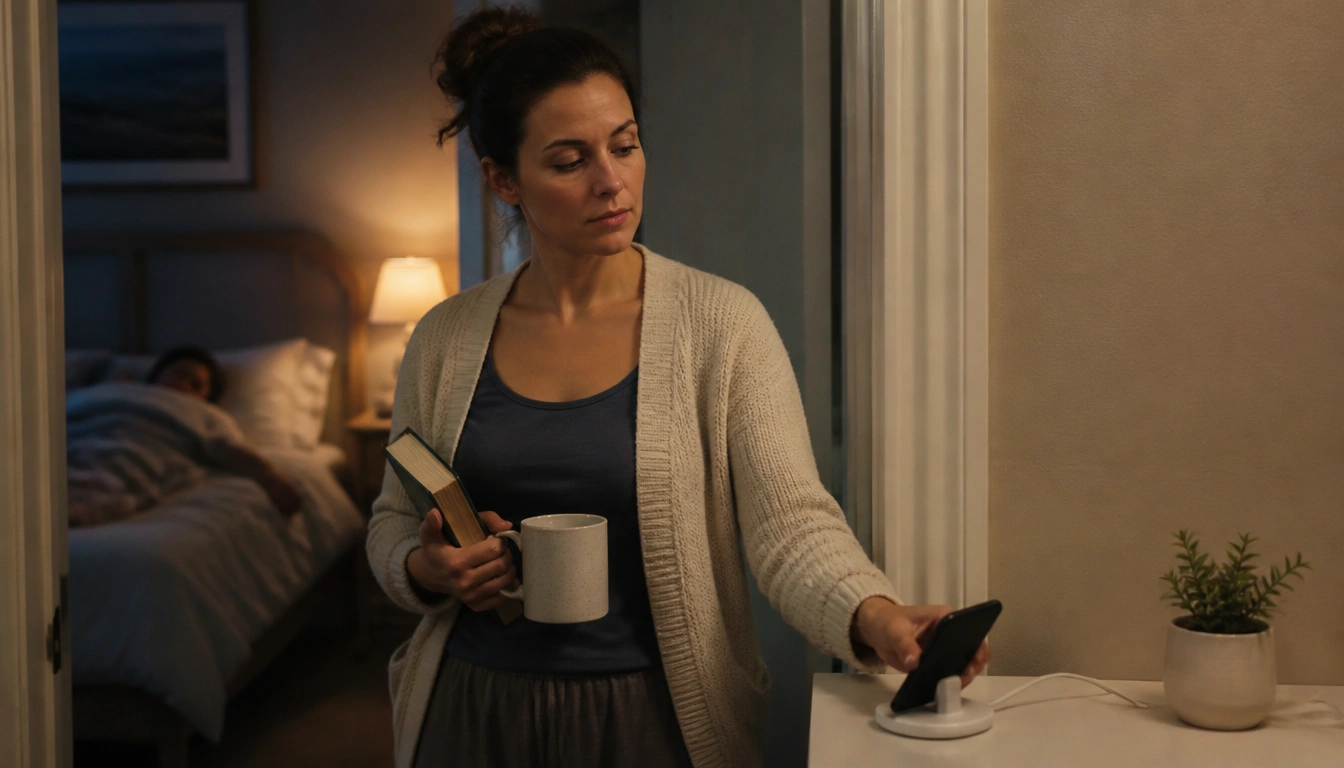
A busy parent can start by stopping phone use 30 to 60 minutes before bed and replacing scrolling with one low-effort, screen-free cue: a short read, a warm shower, breathing, journaling, or dim-light quiet time. If 30 to 60 minutes feels impossible, even a 10-minute minimum routine is better than falling asleep with a screen in hand. The goal is not perfection; it is giving your brain a short buffer before sleep.
Key Takeaways
- A screen-free wind-down routine for busy parents works best when it feels like a release, not a punishment for finally getting time alone.
- Most people do better when screens stop 30 to 60 minutes before bed; the minimum version can be much shorter on exhausted nights.
- Lower light, charge devices outside the bedroom, and use a simple analog backup so the routine still works when motivation is low.
- Late-night scrolling can keep you alert through both light exposure and mental stimulation, which makes sleep harder to start.
- Shift-working parents can use the same wind-down principles at any hour: reduce stimulation, dim light, and create a repeatable sleep cue.
- Persistent insomnia, loud snoring or gasping, or daytime impairment are signs to look beyond sleep hygiene and seek medical evaluation.
Why busy parents need a screen-free wind-down
For many parents, the problem is not that they do not care about sleep. It is that night finally becomes the only quiet time available. That is where revenge bedtime procrastination shows up: staying up late to reclaim a little personal time after a day spent meeting everyone else’s needs. A screen-free wind-down routine can make that time feel restorative instead of draining.
The sleep debt builds quickly when bedtime keeps sliding later. The CDC and other public health bodies consistently recommend at least 7 hours of sleep for adults, and parents who regularly miss that target often feel it the next day in mood, patience, concentration, and stress tolerance. The goal is not to remove all “me time.” It is to move that time into a form that helps sleep rather than delaying it.
For that reason, a good evening routine for parents should feel small, doable, and emotionally fair. If the routine feels like another rule, it will not last. If it feels like a brief handoff from parenting mode to rest mode, it has a much better chance of sticking.
How screens interfere with sleep
Phones and tablets can disrupt sleep in two main ways. First, the light they emit—especially short-wavelength blue light—can delay the body’s natural melatonin signal, which helps prepare the brain for sleep. Public health guidance from organizations such as the CDC and NHS-based services warns that evening screen exposure can make it harder to fall asleep.
Second, the content itself matters. Checking email, news, social media, or work messages keeps the brain engaged. That mental stimulation can raise alertness, increase emotional reactivity, and make it harder to shift into a calmer state. Even “just one more check” can leave you mentally activated when you want to be winding down.
That is why screen-free matters, not just screen-dimmed. Night mode and lower brightness may help somewhat, but they do not remove the habit loop of checking, reacting, and staying mentally on call. If you want sleep to come more easily, the main aim is to reduce both light and cognitive stimulation.
What a realistic 30 to 60 minute wind-down looks like
A practical buffer before bed does not need to be elaborate. For most busy parents, 30 to 60 minutes is a realistic target. That is long enough to mark a transition, but short enough to fit around childcare, cleanup, and the small tasks that always seem to appear at night.
If your evenings are especially full, think of the routine as a lane change rather than a ritual. You are not trying to create a spa night. You are trying to tell your nervous system that active problem-solving is over for the day. On some nights, that can mean 45 minutes of quiet time. On rough nights, the minimum version may be 10 minutes of low-stimulus off-screen time before lights out.
The important part is consistency of cue, not complexity. A repeated pattern—screens off, lights down, one calming activity, then bed—works better than trying a different solution every night. The body learns from repetition.
A simple step-by-step routine that is easy to repeat
Start with a digital sunset. Set an alarm or reminder that signals the end of screens for the night. Put the phone on charge outside the bedroom if possible, or at least out of reach and face down. This removes the easy reflex to check “one last thing.”
Next, switch to a low-stimulus, analog activity. Choose something that does not invite endless scrolling or decision-making. A few pages of a physical book, a short journal note, simple stretching, or quiet breathing can all work. The point is not productivity; it is downshifting.
Then dim the household lights. Overhead bright light keeps the evening feeling active, while lower light helps the room feel closer to bedtime. If you have children still moving around the house, this cue can help the whole environment settle, not just your own mind.
Finish with a brief body reset. A warm shower, a few minutes of slow breathing, or lying down with deliberate muscle relaxation can help signal that the day is ending. Parents often need something low-effort and repeatable, not a long routine that only works on the ideal night.
Best screen-free swaps when you are too tired to think
When exhaustion is high, the best swap is the one that asks very little of you. Reading is a classic option, but not everyone has the attention for a chapter after a demanding day. If that is true for you, use an easier fallback.
Good options include journaling a short list of tomorrow’s tasks so your mind stops rehearsing them, listening to offline audio with the screen put away, taking a warm shower, or doing a few minutes of slow breathing. These options work because they are predictable and low stimulation.
Parents often ask for the “best” screen-free activity, but the best one is usually the one you will actually repeat. If you are so tired that even reading feels like work, use the smallest possible version: sit somewhere quiet, keep the lights low, and spend a few minutes without a screen before bed. That is still a meaningful shift.
It also helps to match the activity to your energy. If your mind is racing, write things down. If your body feels tense, try breathing or stretching. If you feel wired but tired, a warm shower or a boring offline audio track may be easier than trying to force relaxation.
How to make the routine work in real life
Good intentions are not enough when the bedroom has chargers within reach and the phone is where your habit lives. Make the environment do some of the work for you. A charging station outside the bedroom is one of the simplest changes, because it adds friction between you and the scroll reflex.
Use household light cues as well. Dimming lights in the evening can serve as a visual signal that the day is slowing down. In a shared home, this can be especially useful because it works without a lecture or a new rule for everyone. The environment quietly says, “we are getting close to sleep.”
It also helps to set backup options for chaotic nights. If the full routine falls apart, keep a minimum plan: phones docked, lights low, one calming activity, and bed. A routine that survives busy nights is more useful than an elaborate one that only works when life is calm.
For many parents, the hardest part is the moment right after children fall asleep, when the temptation to “take back the evening” is strongest. Naming that moment can help. You are not failing if you want time to yourself. You are choosing a form of me time that does not borrow from tomorrow’s energy.
How shift-working parents can adapt the same principles
Shift-working parents do not need a traditional bedtime to benefit from a wind-down routine. The same principles still apply: reduce stimulation, lower light, and create a repeatable cue that tells the body sleep is coming, even if that sleep happens during the day.
That often means being stricter about the environment. Blackout shades, a quieter room, and a clear end to screen use before sleep can matter even more when the outside world is bright and active. If your sleep window is unusual, the routine becomes the cue that replaces natural evening signals.
What matters most is consistency around your own sleep period, not matching a clock-based schedule that does not fit your work. A shift worker may need the routine after a night shift, before daytime sleep, or before an early evening nap. The structure can flex. The principle stays the same: give the brain a clear transition from alert work mode to rest mode.
When a bedtime routine is not enough
A routine can help with habits, but it cannot fix every sleep problem. If you have trouble falling asleep or staying asleep most nights for weeks to months, especially if it starts affecting mood, concentration, or safety, it is time to look deeper. Chronic insomnia often needs more than better bedtime behavior.
Snoring that is loud, frequent, or paired with gasping or pauses in breathing is another reason to seek evaluation. Those symptoms can point to obstructive sleep apnea, which is not solved by a wind-down routine alone. Daytime sleepiness, morning headaches, and unrefreshing sleep also deserve attention.
Mental health matters too. Ongoing anxiety or depression can make sleep harder in both directions: you may feel too wired to fall asleep or too drained to wake rested. If the sleep problem feels larger than a habit issue, it is reasonable to ask a healthcare professional about CBT-I, sleep apnea assessment, or mental health support. The routine still helps, but it should not delay care when warning signs are present.
Frequently Asked Questions
How long should a wind-down routine be before bed?
For many busy parents, 30 to 60 minutes is a realistic target. If that is not possible every night, a shorter minimum version is still useful. The goal is to create a reliable buffer between stimulation and sleep, not to follow a perfect routine.
What are the best screen-free activities to replace bedtime scrolling?
The best option is the one you can repeat when you are tired. Reading a physical book, journaling, gentle stretching, slow breathing, a warm shower, or offline audio can all work. Choose activities that lower stimulation instead of creating more decisions.
Does blue light from phones really affect sleep?
Yes, evening light from screens can interfere with sleep, especially by delaying the body’s melatonin signal. The content also matters: work messages, news, and social media can keep the brain alert. Reducing both light and stimulation is more effective than dimming alone.
What should shift-working parents do if their bedtime is irregular?
Use the same wind-down principles at whatever time you sleep: reduce screens, dim lights, and repeat the same cue before rest. The routine should match your sleep period, not the clock. Blackout shades and a quieter sleep space can also help.
When is poor sleep more than a lifestyle issue and needs medical evaluation?
Seek evaluation if sleep problems are persistent, frequent, and affecting daytime functioning, or if you have loud snoring, gasping, or pauses in breathing. Ongoing anxiety, depression, or severe daytime sleepiness are also reasons to talk with a clinician.
The Bottom Line
A screen-free wind-down routine for busy parents does not need to be long or elaborate. Stopping screens 30 to 60 minutes before bed, lowering light, and swapping scrolling for one calm off-screen habit can make sleep easier to start.
The most sustainable approach is the one that fits real family life. A charging station outside the bedroom, a simple backup plan for chaotic nights, and a few analog cues can make the routine easier to repeat when you are tired.
If sleep problems keep happening despite better habits, or if you notice snoring, gasping, persistent insomnia, or daytime impairment, treat that as a health issue rather than a willpower problem.
Medical disclaimer
Medical disclaimer: This content is for educational and informational purposes only and is not a substitute for professional medical advice, diagnosis, or treatment. Dietary needs and supplement suitability vary by individual.
Sources
- National Health Service (NHS) — royalpapworth.nhs.uk. Accessed October 2026.
- National Health Service (NHS) — kingstonandrichmond.nhs.uk. Accessed October 2026.
- Centers for Disease Control and Prevention (CDC) — cdc.gov. Accessed October 2026.
- National Health Service (NHS) — uhs.nhs.uk. Accessed October 2026.
- Centers for Disease Control and Prevention (CDC) — cdc.gov. Accessed October 2026.
- National Health Service (NHS) — uhbristol.nhs.uk. Accessed October 2026.
- Centers for Disease Control and Prevention (CDC) — cdc.gov. Accessed October 2026.
- Academic Research Institution — harvard.edu. Accessed October 2026.
