
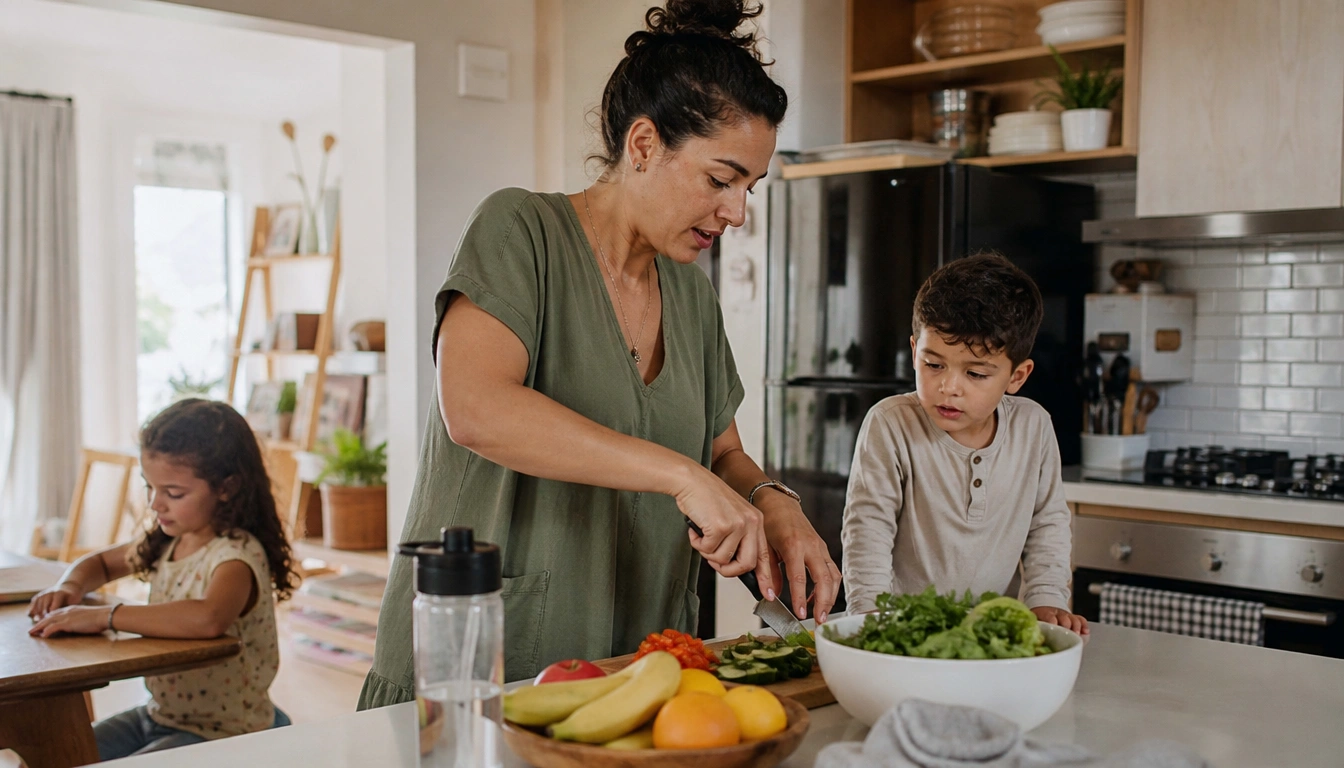
The easiest health goals for busy parents are the ones that take little time, little money, and little decision-making: drink more water, build meals from simple foods, walk in short bouts, protect sleep where you can, and make one part of the home support the habit automatically. These small changes are usually more sustainable than a full reset and can improve the whole family’s routines at the same time.
Key Takeaways
- Choose one low-friction habit first; the best goal is the one you can repeat on your busiest days.
- Small habits work because they lower mental load, so setbacks do not turn into giving up.
- Sleep, stress, food, and movement affect one another; improving any one of them can make the others easier.
- Parents model eating, activity, and sleep patterns, so family-friendly changes can benefit children too.
- Use habit stacking and environmental cues, like visible water or fruit at eye level, so progress depends less on willpower.
Start with the most realistic goal for your current season
If you are a busy parent, the best starting point is not the healthiest routine you can imagine. It is the smallest habit you can actually repeat while working, caregiving, and handling the unexpected. That might mean carrying a water bottle, adding a short walk after school drop-off, or making breakfast from two ingredients instead of skipping it. The CDC and NHS both emphasize foundational habits, but the right version has to fit your life right now.
Think in terms of one low-friction win. If sleep is chaotic, a rigid workout plan may fail quickly. If mealtimes are rushed, a daily smoothie might be easier than cooking from scratch. The goal is to remove friction, not to prove discipline. A habit that feels almost too easy is often the one that survives busy weeks.
For many parents, the first useful question is not “What is the ideal plan?” but “What can I do on a hard Tuesday?” That question keeps the goal grounded in real life.
Why small goals work better for busy parents
Small goals work because they lower cognitive load. Parents already make dozens of decisions before lunch. A health goal that demands extra planning, special food, long workouts, or a perfect schedule can become one more source of stress. Micro-habits reduce the number of choices you need to make and make follow-through more likely even when energy is low.
They also help you recover faster after setbacks. If you miss a workout or order takeout three nights in a row, a small goal is easier to restart than an ambitious program. That matters because inconsistency is normal in parenting. The habit that continues after a bad night of sleep is usually the habit that creates long-term change.
Research-informed behavioral advice consistently supports this approach: tiny, repeated actions are more sustainable than dramatic overhauls, especially under chronic stress. For busy parents, sustainability is not a bonus. It is the whole point.
Build around the four core health pillars: food, movement, sleep, and hydration
Public health guidance from the CDC and NHS keeps returning to the same basics because they do most of the work: eat reasonably well, move regularly, sleep enough, and stay hydrated. For parents, those pillars often interact more than they appear to at first glance. If one improves, the others often become a little easier.
Food: Focus on meals that include a protein, a fiber-rich carbohydrate, and produce when possible. The pattern matters more than perfection.
Movement: You do not need one long workout to count. Short bouts add up, especially when they are built into routines you already have.
Sleep: Adults generally need 7 to 9 hours of sleep, but parents of infants and toddlers may need survival-oriented rest strategies instead of strict sleep schedules.
Hydration: Water is a simple default. Replacing sugary drinks with water is one of the easiest low-cost changes available.
Sleep deserves special attention because it influences appetite, mood, and follow-through. When sleep is short or broken, cravings often rise, patience drops, and motivation gets weaker. A parent who slept poorly is not lazy; their brain and body are working with less reserve. Improving sleep, even slightly, can make eating choices steadier and movement feel less impossible.
During the infant and toddler stage, the realistic goal may be to protect rest in fragments: going to bed earlier, alternating night duties when possible, taking a brief daytime rest, or lowering nonessential evening tasks. The aim is not a perfect schedule. It is enough recovery to keep functioning safely.
Make meals easier, not perfect
Food goals are more sustainable when they are built around assembly, not performance. A family meal does not have to be elaborate to be useful. A simple plate might be canned beans, microwave rice, and a bag of salad. Another might be eggs, toast, and fruit. If dinner is already chaotic, one or two repeatable defaults can save time and reduce decision fatigue.
Try making the healthy choice the easy choice. Keep fruit visible on the counter, place cut vegetables at eye level in the fridge, and store less helpful snack foods out of sight if that makes sense for your household. The goal is not to ban treats. It is to make the most nourishing options easier to reach when everyone is tired.
For family food swaps, choose only one or two that fit your life. You might swap sugary drinks for water most days, add a vegetable side to takeout, or use whole-grain bread more often. Small changes are enough when they happen often. You do not need a full pantry overhaul to improve nutrition.
Move in short bouts throughout the day
Busy parents often assume exercise must happen in a single uninterrupted block. That idea makes movement feel optional, and optional habits disappear quickly under stress. A better approach is to accumulate activity in short bouts. A 10-minute walk, a few stretches during a child’s activity, or a brisk loop after school drop-off all count.
Walking is especially useful because it is low-cost, low-skill, and easy to combine with other tasks. You can walk while returning a call, listening to music, or supervising outdoor play. Family movement also works well: bike rides, playground time, dancing in the kitchen, or an evening neighborhood walk can turn exercise into shared time instead of another separate chore.
If you are returning to movement after a long break or after postpartum recovery, scale back the intensity and build gradually. The goal is consistency without injury. A short, manageable routine done most days is better than a punishing workout you cannot repeat.
Use habit stacking and your environment to make change easier
Willpower is unreliable when you are tired. Environment is more dependable. Habit stacking means attaching a new habit to something you already do. For example, drink water after brushing your teeth, take a short walk after school drop-off, or prep tomorrow’s fruit while making coffee. The existing routine becomes the cue.
Environmental design works the same way. Put a water bottle where you will see it. Keep walking shoes near the door. Put fruit at eye level. Set a walking reminder after a regular routine instead of trying to remember at random. These are small adjustments, but they reduce the amount of effort required to start.
That same approach helps children too. Kids notice what is normal in the home. If they see water bottles, fruit bowls, family walks, and a parent who treats rest as important, those patterns become part of the household culture. This is the modeling effect: children learn from what caregivers actually do, not from what they are told once.
Shared routines also protect parents from feeling isolated. A family walk or a shared snack is not just a wellness strategy; it is a simple way to weave health into family life instead of separating it from it.
Adjust goals for life stage and health status
Not every parent needs the same plan. A parent with an infant needs different support than a parent with school-age kids or teens. A parent with hypertension, type 2 diabetes, chronic pain, or postpartum recovery may also need a more tailored approach. Generic wellness advice can be a starting point, but it is not always enough.
Postpartum parents, for example, may need to prioritize healing, sleep protection, and gradual re-entry into movement rather than pushing hard on diet or exercise. Parents dealing with burnout may need fewer goals, not more. When the nervous system is overloaded, adding ambitious targets can backfire.
Persistent exhaustion, pain that limits daily functioning, unexplained weight changes, or mood symptoms that do not lift are reasons to talk with a clinician. The same is true if a health goal feels unsafe, especially after pregnancy, with a chronic condition, or after a long period of inactivity. Individualized medical care matters more than any one-size-fits-all trend.
Avoid the traps that make healthy habits harder
The most common trap for busy parents is all-or-nothing thinking. If the ideal plan cannot happen, nothing happens. That mindset is expensive. It turns a missed workout, a takeout night, or a short sleep into proof that change is impossible. A better standard is “good enough to repeat.”
Other traps include extreme fasting, punishing workouts, and guilt-based goals. These approaches may sound efficient, but they often drain energy and increase rebound eating or burnout. Families usually need steadiness, not intensity. If a plan makes you feel deprived, secretive, or constantly behind, it is probably too hard for this season.
It can help to frame health goals as self-care rather than another productivity task. Parents already carry a lot of responsibility. A realistic wellness goal should support your capacity, not become one more place to feel judged. The best plan is the one that fits alongside caregiving instead of competing with it.
If you need a reset, return to one basic habit: water, a short walk, a simpler meal, or an earlier bedtime. That is often enough to restart momentum.
Frequently Asked Questions
How can a busy parent improve health in 10 minutes a day?
Pick one habit that fits into a daily routine: a short walk after drop-off, a water break before coffee, a simple breakfast, or a 10-minute meal prep step. Consistency matters more than duration.
What health goal should come first: sleep, food, hydration, or exercise?
Sleep often has the biggest ripple effect because it influences mood, cravings, and energy. That said, the best first goal is the one you can actually maintain. For some parents, hydration or simpler meals is the easiest entry point.
How can parents model healthy habits for children without making family life harder?
Use shared routines instead of lectures. Keep visible water, offer fruit or simple snacks, take family walks, and show that rest and movement are normal parts of home life. Children learn from repeated examples.
What simple food swaps are realistic for families on a tight schedule?
Choose one or two swaps that reduce effort rather than add it, such as water instead of sugary drinks, fruit instead of a packaged snack, or a vegetable side with takeout. Assembly meals also work well.
How do stress and poor sleep affect cravings, energy, and follow-through?
Stress and sleep loss can increase cravings, reduce patience, and make it harder to start healthy actions. Improving sleep, even a little, often makes food choices and movement feel more manageable.
The Bottom Line
Busy parents do not need a perfect wellness plan. The most useful goals are small, repeatable, and easy to keep during stressful weeks.
Start with the basics that create the biggest ripple effect: a little more sleep when possible, simpler meals, short bouts of movement, and visible cues that make healthy choices easier.
If a goal adds more pressure than support, shrink it. When a plan fits the reality of parenting, it becomes much more likely to last—and more likely to help the whole household.
Medical disclaimer
Medical disclaimer: This content is for educational and informational purposes only and is not a substitute for professional medical advice, diagnosis, or treatment. Dietary needs and supplement suitability vary by individual.
Sources
- National Health Service (NHS) — www.nhs.uk. Accessed October 2026.
- National Institutes of Health (NIH) — nih.gov. Accessed October 2026.
- Centers for Disease Control and Prevention (CDC) — cdc.gov. Accessed October 2026.
